


A notice about a settled insurance claim usually brings relief, unless the damage and payment are both news to you.
Before you throw it away or call the person who sold you the policy, find out what the insurer recorded.
Overview
Real policies carried claims their owners had not made
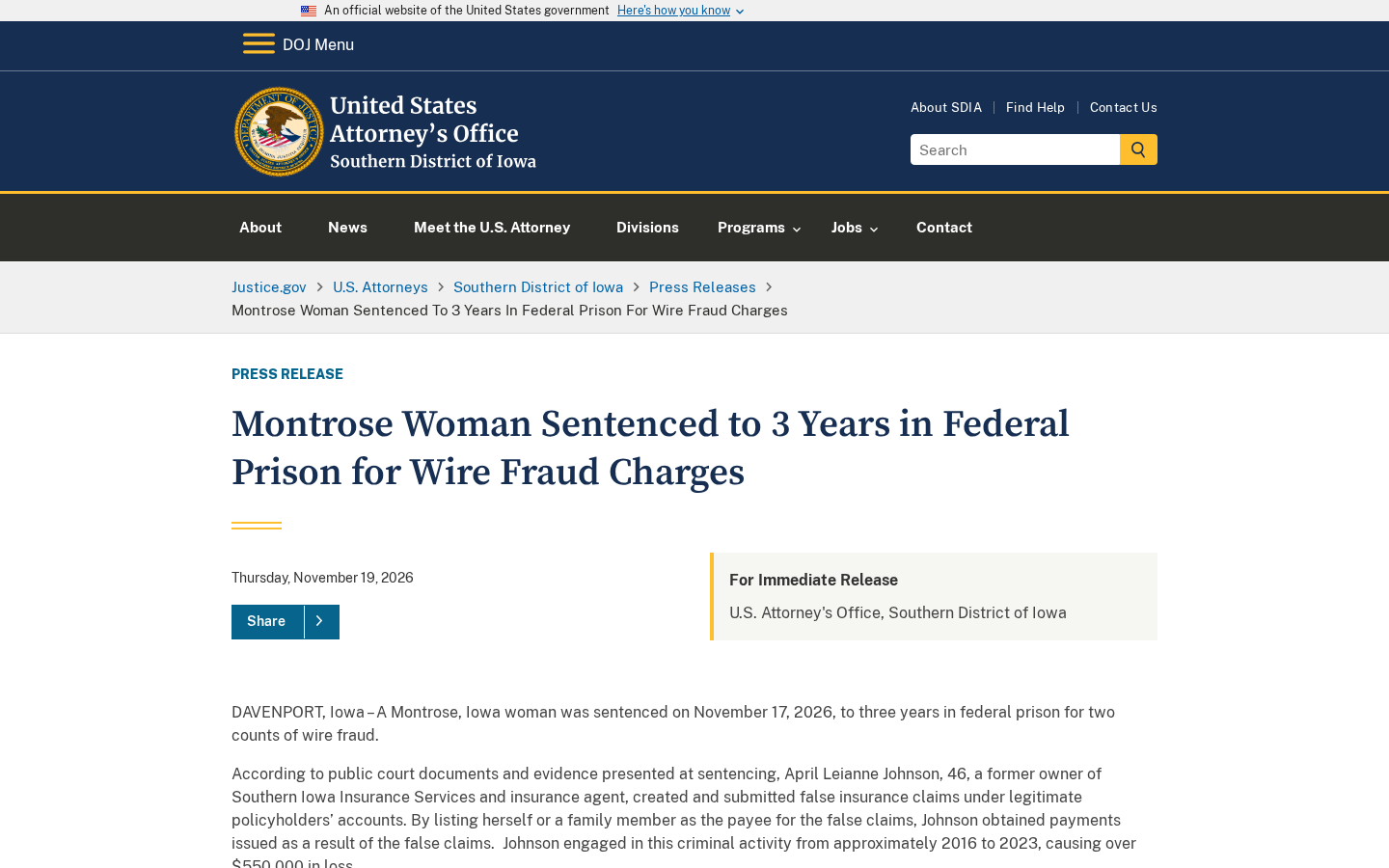
April Leianne Johnson, a former owner of Southern Iowa Insurance Services and insurance agent, submitted false claims under legitimate policyholders’ accounts.
The Justice Department’s sentencing release says she named herself or a family member as payee and obtained the money from the claims she filed.
The conduct ran from approximately 2016 to 2023 and caused more than $550,000 in losses, according to the public federal account.
Johnson received three years in federal prison on November 17, 2026, for two counts of wire fraud, followed by three years of supervision.
She was also ordered to pay $757,722.05 in restitution, a separate figure that does not tell individual customers what happened to their records.
This case was about false claims under existing policies, rather than forged applications for coverage or an unlicensed broker selling nonexistent insurance.
The claim can be wrong while the policy remains right
A real policy number on a letter may show that someone’s insurance record was used, but it cannot prove the claimed damage happened.
An insurer might list a claim as open, paid, withdrawn, denied or closed, and each result points toward a different next question.
An open claim needs review before further activity, while a paid claim also raises questions about who received the money and why.
Sometimes the answer is less alarming, such as a claim from another covered household member or a reference entered in error.
The insurer can help you sort those situations without asking the person who may have filed the claim to explain it first.
Ask for the claim and coverage status separately so an inquiry into the disputed entry does not disrupt insurance you still rely on.
Read the claim record in parts
Start with the claim reference and reported loss date, then compare the property and any description against what you know happened.
A mismatch in one field is worth querying, but several matching fields can still appear on a false claim using your policy.
| Entry you see | What to ask the insurer |
|---|---|
| Unfamiliar claim number | Claim type, status and reported loss date |
| Loss or damaged item | Address or covered property tied to the claim |
| Payment notice | Amount, date and recipient relationship, where disclosed |
| Closed or withdrawn claim | Reason for closure and whether the record remains |
| Higher renewal quote | Whether the disputed entry affected the insurer’s decision |
- Check with other insured household members before stating that nobody made a claim, but do not ignore a payment you cannot explain.
- Tell the carrier which detail you dispute so it can respond to the loss, payment or record accuracy separately.
- Keep both the first notice and later corrections, because those records may explain why another insurer still sees the entry.
When you contact the carrier, ask for a reference number instead of relying on an agent’s assurance that the notice means nothing.
How the False Insurance Claim Scheme Worked
Step 1: Existing policy records make the claim look familiar
Johnson worked as an agent and previously owned the named Iowa insurance agency, giving the case a setting familiar to her customers.
Unlike a person advertising a fake policy from outside the industry, she used accounts belonging to people with legitimate insurance coverage.
That meant a document could match the customer’s identity and coverage even when they had no reason to expect a claim.
As a policyholder, do not stop after checking the name and number, since the disputed entry may contain accurate information about you.
Compare the reported loss date and location with your own records before deciding whether to treat the letter as a simple mistake.
An old agent’s name on the file is useful for the insurer to investigate, not a reason to send sensitive records there first.
Step 2: A claim reaches the company for a loss the policyholder did not report
Federal prosecutors described false claims submitted under legitimate accounts, without listing the details of every claim or every policy in the records.
For the insurer, a claim attached to existing coverage is a request that has to be evaluated, not a separate insurance sale.
That difference matters to customers who never saw a new application, paid a new premium or heard from an unfamiliar seller.
You might learn about a problem only if a claim notice, a renewal question or an insurer’s later review brings it to your attention.
The public announcement does not identify how every policyholder discovered the problem, so these are ways an unfamiliar entry could come to light.
If the insurer confirms the claim is yours on paper, ask which facts it relied on rather than treating that as the final answer.
Step 3: The payee gets money without owning the policy
The Justice Department says Johnson listed herself or a family member as the payee on false claims and obtained the resulting payments.
The claimant, policyholder and payee can be different people, which is not automatically suspicious in an ordinary insurance settlement involving approved recipients.
For example, a repair business can receive a legitimate payment if the settlement arrangements call for that and the underlying loss is real.
What matters is the reason the recipient qualified for payment and how that decision ties back to the claim documentation.
Ask the carrier to confirm where the money went as far as it can disclose, and to investigate an unexplained change.
An insurer might withhold some private financial details while still confirming that you did not receive a payment in your name.
Step 4: The insurer and policyholder are left with different problems
An insurer may investigate a payment it should never have made, while the policyholder needs the incorrect claim marked and addressed.
A court sentence does not edit the claim entry or tell a future insurer whether the policyholder was involved in a loss.
That is why you should ask what records the carrier will correct, what it will retain and what it shared with others.
If a claim appeared on a renewal or quote, keep the old notice and ask the insurer to explain the effect in writing.
The Justice Department release identifies the Iowa Insurance Division Fraud Bureau as the investigator, but it does not report customer-by-customer corrections.
A specific claim inquiry can continue even if the financial recovery from the person who filed it is handled elsewhere.
If the False Claim Shows Up When You Shop for Coverage
A new insurer may ask about earlier losses, and an unfamiliar claim is easier to explain when you have a written dispute reference.
Do not guess which company entered the information if the quote does not explain where a loss entry was obtained.
Ask the company whether the entry came from its own files, your prior insurer or a consumer reporting company, then follow that route.
If a reporting company is named, get its contact details from the insurer and request the report associated with your quote or notice.
The Consumer Financial Protection Bureau’s guide explains how to request the home or auto claims reports that insurers may consult.
Use the report reference and loss date when filing a dispute, since a similar address may appear more than once.
Identify the item you dispute, provide only the supporting records needed and ask how you will receive the result of its review.
Keep the dispute with the report source separate from your correction request at the insurer that handled the original claim.
If you are about to renew, ask what happens while the review is open so you have time to avoid a break in coverage.
Once the dispute is resolved, check whether the agency or carrier that gave the first quote needs a copy of the written correction.
When the carrier says it sent a correction, ask which organizations received it and when you can check for the change.
Do not promise yourself a lower price after a correction, because insurers can use several factors that have nothing to do with that entry.
What to Do if You Have Fallen Victim to This Scam
-
Talk to the carrier’s claims department directly
Use the contact on a policy document you already trust or find the insurer’s official number without using the letter’s links.
Provide the policy and claim reference after the insurer verifies you, then ask it to read back the reported loss and status.
Say exactly which facts are wrong, including whether you never reported the loss or merely dispute the listed payee or payment.
-
Get the dispute noted while the claim is still active
If the insurer says payment is pending, tell its fraud team promptly and ask what it can do before the funds are issued.
When the claim has already been paid, ask for the available payment date, amount and explanation of why that recipient was approved.
Keep a case number, the name of the team and the date when you can reasonably expect a written update.
-
Separate proof of your policy from paperwork about the disputed claim
Save the policy declarations and any legitimate claims you know about separately, so an investigator can see which record you challenge.
Keep notices, portal records and communications that link the disputed loss to your policy, including fresh versions if the insurer updates them.
Write down relevant facts you can support without collecting unrelated personal information about other people named in the claim.
-
Report suspected fraud outside the agency when appropriate
In Iowa, visit the Insurance Division’s fraud reporting page and use its consumer route if you are submitting the report as a policyholder.
Identify the insurer, policy and disputed claim, then use the official form or its paper instructions instead of sending records to strangers.
If the concern arose elsewhere, check the relevant regulator’s current reporting process before sending an Iowa form to the wrong office.
-
Check who else needs the correction
Ask whether the claim may affect your renewal, quote or loss history, and request a written decision if a record is corrected.
If another insurer or reporting company still lists the claim after that decision, send a copy through its verified dispute process.
An agent’s apology is not a substitute for the carrier or reporting company confirming that its own record has been addressed.
-
Watch for further contact without changing good coverage unnecessarily
Continue monitoring policy notices and use the carrier’s own messages to tell legitimate updates apart from requests you did not expect.
Avoid stopping an authorized premium solely because a claim is disputed, unless you have checked how that decision affects active coverage.
Ask the insurer whether anything else under your policy was involved before dismissing the issue as a single bad claim.
Frequently Asked Questions
Was a policyholder required to buy a fake policy in this case?
No, the federal release describes false claims made under valid customer accounts, not buyers paying for coverage that was never issued.
The first question is which claim the insurance company has on file, rather than whether the policy was ever real.
Can a claim be wrong if it never paid me?
Yes, a disputed claim can sit on an account without paying the person whose name or policy number appears in the record.
Ask the carrier whether payment was made and what role it assigned you, especially if you never reported the loss in question.
Are all payments to repair companies evidence of fraud?
No, a legitimate claim can pay an authorized third party when the loss and the payment arrangement are properly documented.
The concern is a payment you cannot match to an actual loss or a recipient whose involvement the company cannot explain.
Does Johnson’s restitution order repair my insurance history?
A restitution order addresses financial obligations defined by the court, not each entry that a carrier or reporting company stores.
Contact your insurer about corrections without waiting for a refund or assuming that a payment elsewhere will fix the record automatically.
What if the unfamiliar claim is tied to someone else in my household?
Ask the insurer which people and property were covered for the loss date, then check whether a household member recognized the event.
If the answers still do not match, request a formal review while preserving the terms and payments for your valid coverage.
Can I tell from the renewal price whether a false claim was used?
A higher price alone cannot show which record affected it, because rates can change for several reasons at once.
Ask what information drove the decision and where the insurer got an unfamiliar loss entry before directing your dispute to one party.
The Bottom Line
Do not ignore a claim you never made, even if the policy number is correct and a familiar agent’s name appears.
Go straight to the insurer’s claims or fraud team, ask who received any payment and obtain a written record of your dispute.
Keep valid coverage in place while you find out whether the disputed entry needs correcting with the carrier or another record holder.

Join the discussion
0 commentsShare your experience or ask a question about this article.
Community experiences
Did this happen to you?
Your experience could help someone recognize the same scam. Submit a private report for our team to review.
I experienced this tooReports are reviewed before publication. Sharing publicly is always your choice.
Discussion
Start the conversation
Have a question or something useful to share? Add the first comment.