


The concerts are real, the artists are familiar, and the person offering the investment says your money will buy tickets and suites for resale.
With a written agreement and payment expected after the shows, the proposal can sound like financing an ordinary business opportunity.
Overview
Investors were promised returns from concert tickets and suites
Carlos Desean Goodspeed presented himself as a concert promoter operating under the assumed business name Straight Like That Entertainment and solicited money from investors.
He said their funds would purchase tickets and suites for concerts and events, with profits coming from reselling those purchases.
The DOJ sentencing announcement describes how that business story concealed personal spending and payments used to keep the fraud from being discovered.
Goodspeed received 75 months in federal prison in February 2026 and was ordered to pay nearly $1.2 million in restitution to seventeen victims.
Real performances did not mean the investment was genuine
One investor wired $180,000 under partner agreements covering a series of Tyler, the Creator shows, expecting a return after the performances took place.
The shows happened, but Goodspeed did not pay that investor as promised and admitted using the money for personal expenses and other investors.
The official account expressly states that the high-profile artists whose events he invoked were not involved in or aware of his fraud.
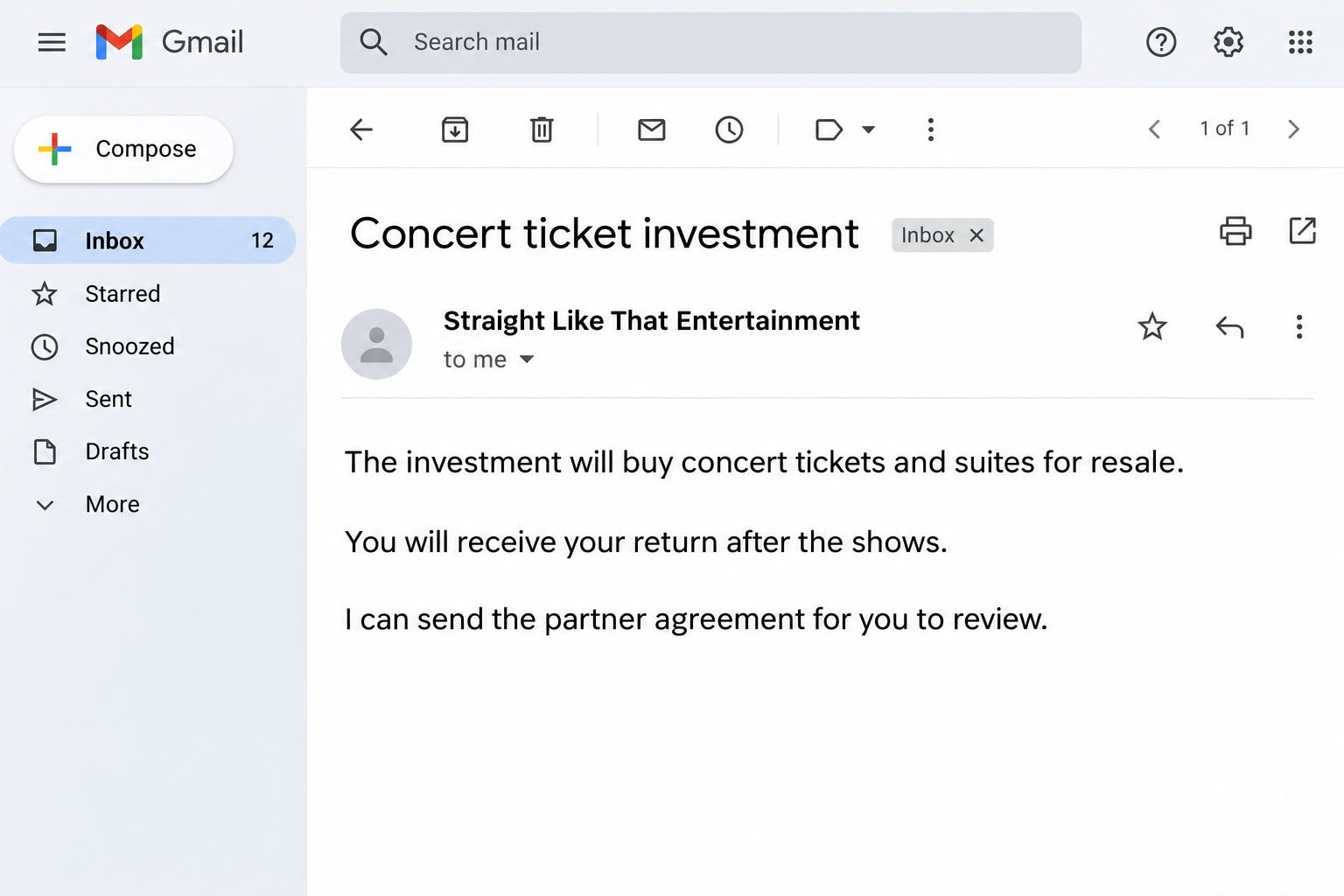
The email image reconstructs the type of investment pitch using fictional wording, rather than reproducing an actual Goodspeed agreement, email or verified ticket inventory.
The missing check was what the money actually purchased
An investment tied to a recognizable event still requires an explanation of the assets, sales proceeds and rights attached to your contribution.
- Confirm what specific tickets or suite rights the business claims it will acquire, rather than relying on the existence of a concert.
- Establish who will control the purchases and how investors can obtain records from a source independent of the person soliciting funds.
- Read how the agreement handles expenses, unsold inventory and losses, instead of treating a promised payment date as a guarantee.
- Keep actual payments and distributions separate from statements about expected profits, so a later dispute can follow the real money.
The Goodspeed case was confirmed investment fraud, rather than a conclusion based only on a disappointing resale price or one canceled event.
Why a Real Concert Can Make a False Investment Feel Safer
A recognizable tour provides details you can independently find, including an artist, a venue and a performance date that genuinely exist.
That can make the entire proposal feel verified before you have checked the separate claim that your contribution will purchase resale inventory.
The promoter may discuss ticket demand or describe access to suites, encouraging you to focus on whether the event will attract buyers.
The more basic questions concern what the money actually acquires, who controls that purchase and how you would see the resulting financial records.
In the example Goodspeed admitted, the performances took place while the investor’s money was used for purposes outside the promised deal.
Checking an event calendar would therefore have confirmed a real show without revealing the diversion that made the investment fraudulent.
A written agreement needs to be connected to actual conduct, since a document outlining a purchase doesn’t establish that the purchase occurred.
Ask for verifiable records before transferring funds rather than waiting until the performance date to learn whether the underlying investment existed.
How the Concert Ticket Investment Scam Works
Step 1: A promoter claims access to a profitable resale opportunity
Goodspeed held himself out as a promoter connected with concerts and events involving high-profile entertainers, using the business name Straight Like That Entertainment.
The recognizable events gave prospective investors a concrete reason to believe ticket demand could produce a return after the shows.
That demand story was separate from whether Goodspeed actually controlled the promised inventory or would use contributions for the stated purchases.
Before accepting a comparable proposal, identify the operator and the transaction instead of assuming an artist’s popularity answers the financial questions.
Step 2: A partner agreement gives the contribution a business purpose
The investor described in Goodspeed’s admissions sent money under agreements that outlined purchases for a series of concerts and the anticipated return.
Those documents made the transfers appear tied to a defined commercial activity, rather than an unexplained payment to an unfamiliar person.
Read who receives funds, which purchases are authorized and how performance will be documented, keeping a copy of the exact agreement before paying.
If important details are missing, a confident explanation about future sales does not supply the rights or records absent from the document.
Step 3: Money is diverted away from the promised purchases
Goodspeed admitted using the investor’s contributions for personal spending, including apartment rent, retail purchases, airline fees and hotels without the investor’s knowledge or consent.
That diversion was different from a resale business losing money because demand weakened or tickets remained unsold after a real purchase.
A genuine business setback should be explainable through records of purchases, sales and expenses, while personal spending requires its own explanation.
Keep the original stated purpose beside the transfer records when documenting a loss, rather than allowing later explanations to replace the original promise.
Step 4: Some investor money is used to pay other investors
Goodspeed also admitted using part of the contribution to pay other investors, helping conceal the scheme instead of generating the promised return.
A payment reaching someone else’s account can therefore look reassuring while coming from new contributions rather than successful ticket sales.
Ask where a claimed distribution came from, particularly when the explanation relies on another investor’s testimonial instead of records from the underlying business.
Do not treat the fact that someone was paid as proof that the operation’s advertised source of profit was genuine.
Step 5: The shows finish while the promised payment remains missing
The concerts connected to the $180,000 contribution took place, but the investor did not receive the payment that Goodspeed had promised.
At that point, the real event could no longer explain the missing funds, because its occurrence did not establish what happened to the contribution.
Preserve promises about payment timing along with actual bank credits, keeping unpaid expected profits distinct from the capital you personally transferred.
If an operator asks for another investment to release the first return, pause and seek independent help before increasing the amount exposed.
Straight Like That Entertainment and the Person Receiving Funds
The business name was an assumed name used by Goodspeed
The sentencing announcement connects Straight Like That Entertainment with Carlos Desean Goodspeed, identifying the person behind the business name used in the pitch.
Compare both names with your own agreement and payment records, without assuming a similar name elsewhere belongs to the same operation.
The artist names did not establish an investment partnership
Goodspeed invoked events involving well-known entertainers, but the official account states that those artists neither participated in nor knew about his scheme.
A real concert performance doesn’t authenticate an outside promoter’s investment offer or make the artist responsible for that person’s use of funds.
The receiving account needs to match the actual agreement
Identify who accepted the contribution and what role the agreement gave that recipient, keeping bank details alongside the business name shown in the pitch.
A payment receipt can prove that money reached an account while leaving unanswered whether the promised tickets, suites or investor rights were obtained.
Distributions need a source beyond another investor’s contribution
The admitted use of investor funds to pay other investors makes the origin of any supposed profit a central question in this case.
Look for the actual sales and settlement records behind a payment instead of relying on screenshots showing that somebody received money.
What Would Independently Confirm the Deal?
These comparisons help distinguish information about a real performance from information about the particular investment you are being asked to fund.
| What the pitch provides | What still needs checking |
|---|---|
| A real artist and concert date | Whether the operator has any verified right to sell the particular tickets or suites. |
| A signed partner agreement | What you acquire, who controls funds and which records will show the promised purchases. |
| A statement about expected resale profits | Actual purchase costs, authorized resale arrangements, expenses and the treatment of unsold inventory. |
| Another investor’s payment screenshot | Whether that payment came from genuine sales proceeds rather than a later investor’s money. |
| A promise to pay after the show | The agreed accounting, supporting sales records and the process if the promised payment never arrives. |
Ask any independent professional reviewing the proposal to examine the actual agreement and proposed flow of money, rather than only the promotional summary.
If the claim involves a venue or ticket provider, use that organization’s independently obtained contact to ask about the specific asserted right or arrangement.
Keep the scope of the answer clear, because confirming an event or seller relationship does not guarantee the profitability of a private investment.
Do not provide credentials to a personal ticketing account so someone can supposedly verify inventory that they claim to own themselves.
When a Missed Payment Needs More Than Another Explanation
A promoter may explain an overdue return through settlement delays, expenses or another event, but each explanation should connect to records you can examine.
Ask for an accounting showing purchases, sales and where the proceeds went, along with the amount still owed under your agreement.
Preserve the reply as evidence of what you were told, rather than accepting a newly promised payment date as proof that funds remain available.
If the operator changes the deal after payment, keep both versions so an adviser can compare the original promise with the new demand.
Avoid recruiting friends or relatives to supply more capital while your contribution remains unexplained, even if the promoter says that would resolve the delay.
The practical priority is understanding and protecting the money already involved, rather than helping the operator find another person willing to fund the business.
What to Do if You Have Fallen Victim to This Scam
-
Stop additional contributions to the documented investment offer and preserve the pitch, agreements, payment instructions and messages promising how your funds would be used.
Keep versions with dates intact so the original terms can be distinguished from later explanations, proposed extensions or requests for more money.
-
Prepare a transaction list showing the capital you transferred and any money actually returned, recording recipient names, dates, amounts and available bank references.
List unpaid promised profits separately instead of adding them as though you had deposited that amount, and mark any uncertainty in the records clearly.
If you introduced another investor, encourage that person to preserve their own documents without collecting or sharing their private financial information publicly.
-
Contact the bank or payment provider used for the contribution through its established contact route and explain the fraudulent purpose described to you.
Ask whether a pending transfer can be stopped or an available recovery process attempted, providing the actual recipient and relevant transaction reference.
Describe accurately whether you approved the payment after deception, and obtain the institution’s evidence requirements, reporting deadline and case reference for further contact.
-
Have an independent qualified adviser review the agreement, any requests for new signatures and the financial obligations created while funding the supposed investment.
Do not borrow again, waive rights or sign a replacement agreement solely because the promoter says it is necessary to receive the overdue return.
-
Report the online investment solicitation through FBI IC3, choosing the complaint option and reading the terms before accepting and supplying the requested incident information.
Include the business and operator names, payment records, promised purchases and communications about missing returns, retaining the submission confirmation with your other evidence.
-
If an unexpected person claims to represent the prosecution or a restitution process, verify their role through the actual agency before providing private records.
The restitution order doesn’t establish that your payment has been recovered, and an unsolicited agent should not demand a fee to release it.
-
Keep a record of later repayment offers and unsolicited recovery messages, especially those requiring another transfer, new investment or access to your accounts.
Update the existing bank or investigative case with relevant information instead of opening a new financial relationship with the person making the latest promise.
Separate a Business Loss From the Fraud Established Here
Ticket resale carries ordinary commercial risks, and an unsuccessful investment does not automatically prove that the operator deliberately stole the contribution.
Goodspeed’s case went further because he admitted personal diversion and payments to other investors that concealed what happened to the money.
That distinction helps you explain your experience accurately, focusing on promises, records and transactions rather than applying a criminal label to disappointment.
If records show purchases and genuine trading losses, preserve those facts too, giving advisers and investigators an accurate account of the situation.
Frequently Asked Questions
Were the concerts themselves fake?
The performances connected with the $180,000 example actually occurred, while Goodspeed failed to pay the investor and admitted diverting the contribution.
The fraud concerned the investment and use of money, so a real concert calendar would not have revealed the whole problem.
Was Straight Like That Entertainment connected to Goodspeed?
The DOJ announcement identifies that assumed business name as one Goodspeed used while presenting himself as a promoter and soliciting funds from investors.
Compare the exact operator and payment records rather than assuming that every similarly named entertainment business belongs to the criminal case.
Were the artists involved in the scheme?
The official account explicitly says the high-profile artists whose events Goodspeed invoked were not involved in or aware of his fraud.
Their performances supplied recognizable context for his pitch, without authenticating the private financial arrangement or making them responsible for his handling of contributions.
Did a written agreement protect the investor’s money?
The investor in the described example wired funds under partner agreements, but Goodspeed still used the contribution for personal expenses and other investors.
A contract should be examined alongside independent purchase and financial records, rather than treated as proof that the promised transaction occurred.
Does receiving one payment establish that the business made a profit?
Goodspeed admitted using some investor money to pay other investors, showing why a received payment can conceal the actual source of the funds.
Ask for the sales and settlement records behind a claimed return instead of relying only on another participant’s statement that they were paid.
Does restitution guarantee that every investor will be repaid?
The court ordered nearly $1.2 million in restitution to seventeen victims, but that doesn’t establish that every amount has been collected or distributed.
Follow verified case communications about any actual process and reject an unsolicited request for money to release a supposedly available repayment.
The Bottom Line
Do not invest through Goodspeed’s concert-promotion scheme or treat a real show, familiar artist or signed agreement as proof of the underlying purchases.
Before funding a comparable proposal, independently verify the operator, the assets and your rights to records explaining how the contribution will be used.
If you already paid, preserve the agreement and transaction history, contact your payment institution promptly and report the solicitation without financing another promised solution.

Reviews & discussion
0 commentsShare a firsthand experience, or ask a question.
Community reviews
Concert Ticket
Moderated reader experiences, not an editorial verdict.
Start the conversation
Have a question or something useful to share? Add the first comment.