


The person offering your flight says an airport contact can arrange a cheaper ticket, including changes that usually cost extra.
With a booking reference and a familiar airline name, the offer can seem easy to check before you hand over payment.
Overview
Real reservation access supported an unauthorized ticket business
Chaculvin Hayes sold discounted airline tickets under the name Neeve Andrews while participating in a scheme involving unauthorized reservation changes.
The FBI’s sentencing announcement describes fraudulent upgrades, altered bookings and travel coupons that caused three airlines more than $600,000 in losses.
Hayes pleaded guilty to conspiracy to commit wire fraud and received a 16-month prison sentence in November 2026.
The case concerns misuse of genuine airline systems, which makes it different from a seller simply inventing flights that never existed.
An employee’s access was different from permission to sell
Hayes and his co-conspirators worked for GAT Airline Ground Support, which provided ticketing and ground services at airports including Hollywood Burbank.
Their work gave them access to United and Delta reservation systems, along with the ability to book American flights through airline agreements.
They abused a legitimate accommodation process known as waivers and favors, making changes without collecting the fees the airlines required.
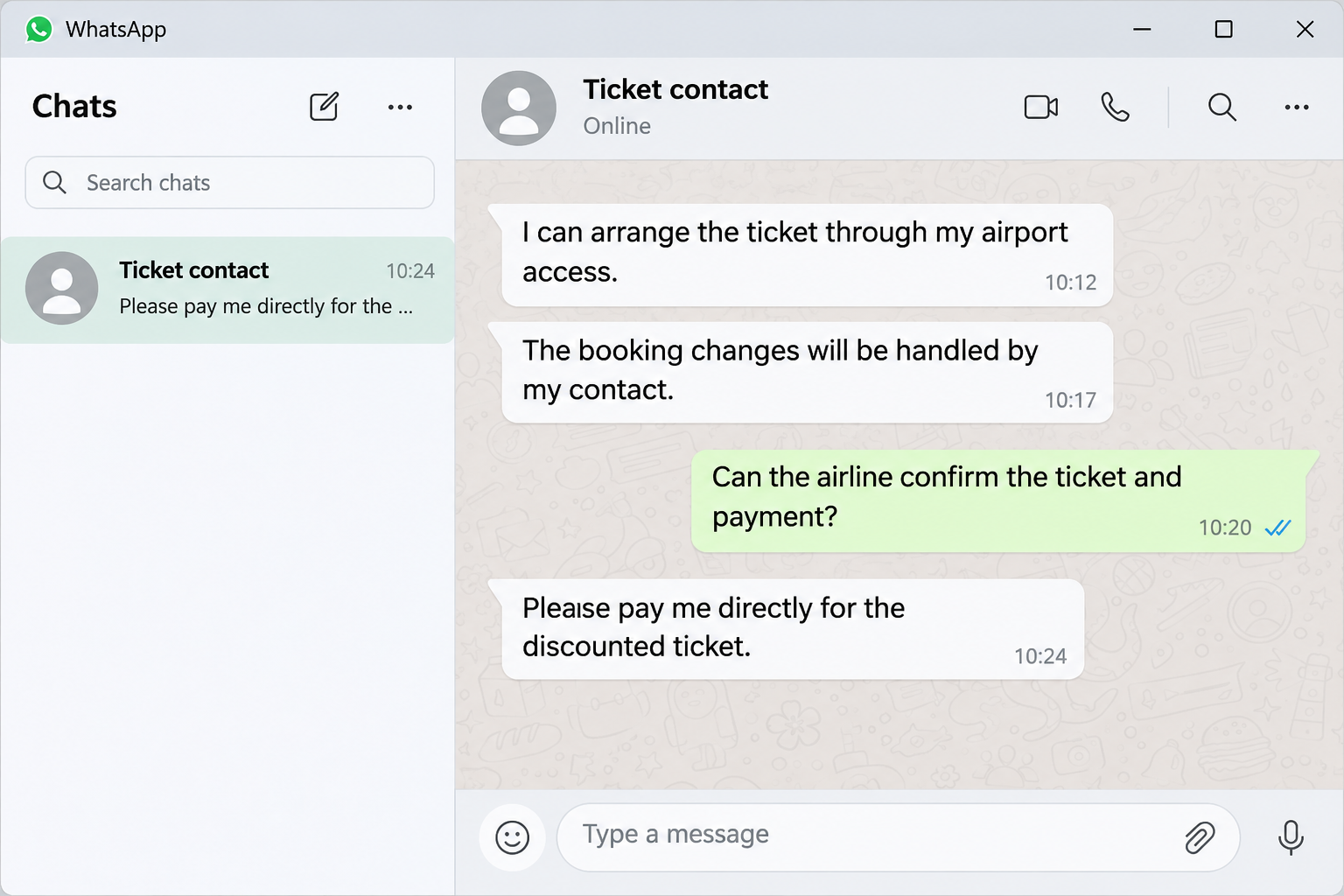
The fictional conversation shown illustrates an insider ticket pitch, rather than reproducing a message recovered from Hayes or identifying his actual sales platform.
A booking reference answers only part of the question
Before relying on a heavily discounted offer, separate these questions about the reservation from the seller’s explanation of their access:
- Does the airline recognize your reservation, passenger details and intended itinerary when you contact it through an independently obtained channel?
- Has a ticket actually been issued, and can the airline confirm its payment status rather than only locating a reservation?
- Are the promised cabin, travel dates and other changes recorded correctly, with any necessary additional payment handled through an authorized route?
- Can you identify the seller, keep a receipt and explain who received your money if the arrangement later needs investigation?
The FBI identifies the airlines as victims of Hayes’s fraud, without establishing that every passenger purchasing a discounted ticket knowingly participated.
Why an Insider Discount Can Sound Believable
Airline pricing can be difficult to understand, especially when the same route appears at different prices across several booking services.
A person claiming access through airport work offers an explanation for that difference, making a private discount sound less unusual.
They may also appear capable of resolving frustrating travel details, including an inconvenient date, an expensive upgrade or an unwanted change fee.
Those promises deserve a separate check because the ability to enter a reservation system does not authorize every change made there.
In Hayes’s case, the underlying access was real, while the upgrades, alterations and coupons were obtained through fraudulent use of that access.
That combination matters to passengers who assume a reference number settles every concern, particularly when a seller presents it before requesting payment.
A reservation record can show an itinerary without explaining the source of a coupon, the authorization behind an upgrade or the payment arrangement.
Ask the airline to examine those details directly, rather than asking the seller to send another picture of the same reservation.
How the Airline Insider Ticket Scam Works
Step 1: Legitimate airport work provides access to bookings
Between January 2017 and December 2019, Hayes and other ground-support workers had access to reservation systems through their airport jobs.
Their employer’s role supplied the opportunity to handle bookings, but the sentencing announcement attributes the fraudulent conduct to Hayes and his co-conspirators.
For a passenger, a claim about someone’s airport employment should lead to verification of the proposed booking rather than automatic confidence.
A genuine job can explain how someone obtained access while leaving unanswered whether the airline authorized the particular service being sold.
Step 2: Customer accommodations become unauthorized changes
The waivers and favors process was intended to let authorized customer-service staff make special booking changes when circumstances required them.
Hayes and his co-conspirators instead used that process to upgrade tickets and alter travel dates or itineraries without collecting proper fees.
The important distinction is authorization for the change, rather than whether the reservation screen could technically accept the employee’s entry.
Passengers cannot resolve that distinction by guessing how airline staff permissions work, but they can ask the airline to verify their own ticket.
Step 3: Unauthorized travel coupons create another source of value
The group also issued unauthorized Electronic Travel Coupons, which functioned like vouchers and helped produce the losses described in the case.
A voucher is therefore another item requiring verification, especially when a private seller claims it explains an unusually cheap fare.
Ask whether the credit can legitimately be applied to your journey, rather than assuming that a displayed balance can be sold or transferred.
Do not provide access to your airline account so that an outside contact can supposedly test a coupon or prove their staff connection.
Step 4: Discounted tickets are sold under an alias
Hayes admitted using the alias Neeve Andrews to sell heavily discounted airline tickets obtained through fraudulent reservation modifications and to accept customer payments.
The seller’s receiving payment was separate from the airline collecting the proper amount for the ticket and associated changes.
Keep both parts of the transaction visible when evaluating an offer, including the seller’s identity and the airline’s confirmation of ticket status.
An explanation about an unnamed airport contact does not replace a receipt identifying the business or person responsible for your payment.
Step 5: The records expose the difference between access and authority
The FBI described hundreds of modified Passenger Name Records and dozens of unauthorized vouchers, with combined losses of approximately $602,886.18.
Hayes was ordered to pay that amount in restitution, which is a court obligation rather than confirmation that every loss has been repaid.
The records establish a confirmed fraud scheme involving real bookings, without supporting a claim that all discounted airline tickets are fraudulent.
The practical response is to verify the specific arrangement before relying on it, particularly when the supposed discount depends on unexplained employee access.
Hayes, Neeve Andrews and the Businesses Named in the Case
The alias concealed the person accepting customer payments
The FBI identifies Neeve Andrews as the name Hayes used while selling discounted tickets, connecting the sales identity to his admitted conduct.
If your own records contain that name, preserve the full conversation and payment details instead of assuming a partial match proves involvement.
The ground-support employer was not the advertised authorization
GAT Airline Ground Support provided the work setting that gave the group access to reservation systems and airline booking arrangements.
The announcement does not say that GAT authorized the fraudulent ticket business, and its name should not be treated as an endorsement.
United, Delta and American were the affected airlines
The case describes access to United and Delta systems and the ability to book American flights through existing agreements between airlines.
Those airlines were harmed by the unauthorized changes, making their own reservation and ticket records the appropriate place to verify your journey.
The private seller and the airline had different responsibilities
A seller’s promise about a ticket does not tell you what the airline actually issued or which charges it received.
Keep the seller’s receipt alongside the airline’s booking information so that a dispute can distinguish the purchase promise from the recorded reservation.
What to Ask Before Trusting the Booking
Use the following checks to clarify what a reassuring piece of information actually establishes before making another payment or traveling.
| What you receive | What to check independently |
|---|---|
| Reservation reference | Correct passenger, route and dates, plus confirmation that a usable ticket was issued. |
| Promised upgrade | Cabin shown in the airline’s record and whether any required payment remains outstanding. |
| Voucher or travel credit | Whether the airline permits that credit to be used for your named passenger and trip. |
| Receipt from the seller | Actual recipient, agreed service and a contact route that remains usable if the ticket needs investigation. |
Do not ask a seller to explain away a discrepancy before the airline has checked it, especially if your departure is approaching.
If the airline cannot locate the booking, first compare the passenger spelling and reference against your records before concluding that a particular crime occurred.
If the reservation exists but its ticket or payment status remains unclear, ask the airline what must happen before you can travel.
Avoid buying another ticket solely because an unfamiliar caller announces a problem, since that caller may be offering a second fraudulent arrangement.
How to Check a Trip Through the Airline
For American Airlines, open its Find your trip page yourself and choose the trip lookup rather than a link supplied by the seller.
Enter your last name as booked, the requested date of birth and your confirmation code or ticket number in the appropriate fields.
Select Find your trip, compare the returned itinerary and passenger details, and contact American through its own support route if anything differs.
For Delta, use its Find Your Trip page, select confirmation number or ticket number, and enter the passenger’s first and last names.
After selecting Search, compare the booking with the offer and ask Delta directly to confirm any unresolved ticket, payment or cabin question.
For United or another carrier, start from its own website or installed app and use the reservation details in your genuine receipt.
If a lookup fails or the journey cannot be found, contact the carrier through its published support instead of an unofficial assistance site.
These checks concern your own trip, so do not post confirmation codes, ticket numbers or passenger information publicly when asking for help.
What to Do if You Have Fallen Victim to This Scam
-
Stop sending money to the private ticket contact while you verify the booking, preserving messages about discounts, employee access, vouchers and promised changes.
Keep the seller’s name, payment receipt and airline information together so that you can explain which part of the arrangement is disputed.
-
Contact the operating or ticketing airline through its official website, app or published support number and ask it to examine your reservation.
Provide your own passenger details, reference and ticket number privately, then ask whether the ticket is usable and whether payment or authorization issues remain.
Record the answer and any case reference before deciding how to handle an approaching departure, rather than relying on the seller’s reassurance.
-
Tell your bank or payment provider how you paid the seller and explain any discrepancy the airline has actually confirmed about the purchase.
Ask about a dispute, transfer recall or other available process for that payment method, including the evidence required and any applicable reporting deadline.
Describe an approved payment obtained through deception accurately, without calling it an unauthorized transaction if you personally approved the original transfer.
-
If you shared an airline password, secure that account through the airline’s genuine recovery or support route and explain exactly what you disclosed.
Ask support to review unauthorized account changes where appropriate, while keeping the booking dispute separate from any confirmed misuse of your login.
-
Report the online sales contact through FBI IC3, opening File A Complaint and reading the terms before accepting and completing the requested information.
Include the seller’s identifiers, payment destination and airline findings from your records, then retain the submission confirmation with your other evidence.
-
Reject anyone requesting another private payment to validate, repair or recover the ticket without independent confirmation from the airline or your payment institution.
Follow the actual institution’s instructions and keep any new contact tied to the existing case, rather than starting over with an unsolicited intermediary.
Frequently Asked Questions
Was this a confirmed fraud case?
Hayes pleaded guilty to conspiracy to commit wire fraud and received a federal prison sentence after admitting unauthorized reservation modifications and ticket sales.
The finding concerns that documented scheme, rather than a conclusion drawn from an unusually low fare or a passenger’s disappointing travel experience.
Were the flights themselves imaginary?
The FBI described genuine reservation systems being misused to change bookings, upgrade tickets and issue unauthorized coupons, rather than exclusively invented flights.
That distinction explains why finding an itinerary does not settle every question about the ticket’s payment status or the authority behind its changes.
Does every airport employee discount involve fraud?
An employee connection alone does not establish wrongdoing, but it also does not authenticate the specific ticket or private sales arrangement being offered.
Ask the airline to confirm the booking and any claimed authorization, keeping the accusation attached to the conduct established in Hayes’s case.
Was the airline responsible for the private ticket pitch?
The announcement identifies three airlines as victims of the scheme and describes Hayes accepting customer payments under the Neeve Andrews alias.
It does not establish that the airlines approved his sales pitch or that every passenger buying a ticket knew about the fraud.
Can a confirmation code prove that everything is paid?
A confirmation code helps locate a reservation, while the ticket’s issuance, payment status and authorized changes may require additional confirmation from the airline.
Check those questions directly before relying on the trip, particularly if a private seller says an insider connection explains the discounted price.
Does the restitution order guarantee a refund?
The $602,886.18 restitution order records Hayes’s court obligation, without establishing that a particular passenger has a refund approved or awaiting collection.
Raise your own payment dispute with the responsible institution and refuse unsolicited demands for another fee to release supposedly recovered money.
The Bottom Line
Do not rely on a private ticket offer merely because an airport contact can produce a booking reference or change an itinerary.
Verify the issued ticket and disputed changes directly with the airline, keeping the seller’s payment promise separate from the carrier’s records.
If you already paid, preserve the transaction, confirm the booking’s actual status and contact your payment provider promptly about any supported fraud claim.

Join the discussion
0 commentsShare your experience or ask a question about this article.
Community experiences
Did this happen to you?
Your experience could help someone recognize the same scam. Submit a private report for our team to review.
I experienced this tooReports are reviewed before publication. Sharing publicly is always your choice.
Discussion
Start the conversation
Have a question or something useful to share? Add the first comment.