


Seeing a mutual friend on Facebook can make an unexpected message feel less like a conversation with a complete stranger.
That small detail is easy to remember later, when you start looking for everything else the person said about themselves.
Overview
The message led to a fake crypto investment
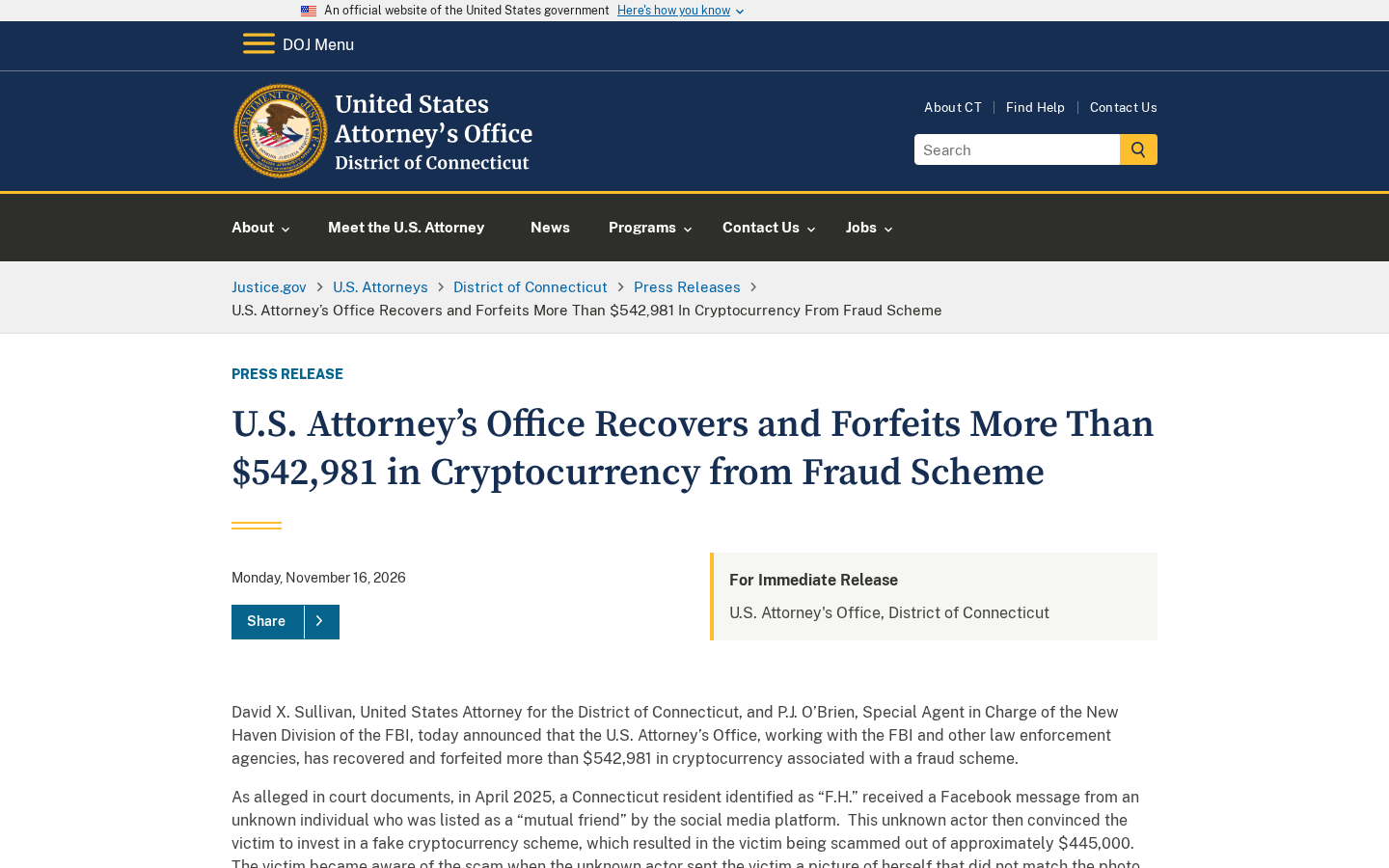
In April 2025, a Connecticut resident received a Facebook message from a stranger the platform listed as a mutual friend.
The stranger persuaded the resident to put money into a fake cryptocurrency investment, according to facts alleged in court documents.
The Justice Department’s November 2026 announcement puts the resident’s loss at about $445,000 and describes a mismatch between two photos as the clue.
Investigators from the FBI and Connecticut State Police traced transfers through several wallets and seized Tether worth $542,981, the announcement says.
On November 9, 2026, the federal court entered a forfeiture decree in civil case 3:25-cv-1770 covering the cryptocurrency at issue.
The case illustrates why accurate transaction records can matter even when the name, photographs and promises on the other end are false.
A shared connection is not a recommendation
A social network’s relationship label tells you about a connection shown by the platform, not whether someone has vouched for an investor.
You might know someone appearing in that person’s network, yet still have no reason to believe the two ever met.
A mismatch in pictures can help bring the story into question, but a matching photograph would not make the investment safe.
Someone can copy a real person’s image, and the person who owns it may have no connection with what was offered.
The better question is whether the adviser, investment and way of holding the funds can be verified outside the conversation.
Do not ask the stranger to supply the only contact who can verify the story or explain the investment account.
The records you need depend on what you actually sent
A balance on a web page is a claim about the investment, while a confirmed transfer is a record of money moving.
The point of a report is to explain both, without assuming that the figures displayed on the page were real currency holdings.
| Record to save | Why it matters |
|---|---|
| Original Facebook conversation | Shows who approached you and what they promised |
| Profile name and link | Identifies the displayed account without assuming its true owner |
| Exchange receipt | Shows the withdrawal or conversion you made |
| Transaction hash and network | Identifies the specific transaction investigators can examine |
| Destination wallet address | Shows where that transfer went, not who necessarily controlled it |
- If the investment page claims your deposit doubled, record that claim separately from the amounts confirmed by your exchange or wallet.
- When you have multiple transfers, put them in chronological order and keep the original receipt next to each entry.
- Never include your wallet’s recovery phrase or private key in a report, even when someone offers to verify the balance.
You can report without knowing the stranger’s legal name, particularly when the records show where and when you sent the funds.
How the Facebook Crypto Investment Scam Worked
Step 1: The first message feels like a social introduction
The opening contact came on Facebook and arrived from someone the recipient did not already know, according to the court account.
A familiar name in a network can lower suspicion without the stranger having to claim direct ties to your friends or family.
If you want to check a claimed connection, contact the mutual friend through a number or account you already used before.
Ask whether they actually know the person and whether they have firsthand knowledge of anything the person is asking you to buy.
Even an affirmative answer doesn’t replace independent checks, because your friend might simply have accepted an earlier request from the same profile.
The public account does not say how the mutual connection was established, and it does not accuse that third person of participating.
Step 2: The conversation changes into a request to invest
The stranger talked the resident into sending funds for what prosecutors describe as a fake cryptocurrency investment, resulting in the reported loss.
The announcement does not publish the platform name, the promises about returns or the full conversation that preceded the payments.
That leaves no basis to tell readers an identical site or balance screen was used in this particular case.
When someone you just met wants you to invest, put the proposal aside until you can identify the exact company and custody arrangement.
Find out which firm should hold the account and how it would confirm ownership without asking for more money or remote access.
If the proposal cannot survive those checks, end the conversation rather than making a small test transfer to see what happens.
Step 3: A new photo makes the person harder to believe
The resident noticed that a photo the stranger sent did not match the image presented on their Facebook account.
That discovery helped expose this case, but waiting for an obvious mistake gives an investment pitch more time to reach your money.
Save the mismatched images and the messages with them when you already have them, but do not bait the person for more evidence.
A copied photo might point to another victim of identity misuse rather than identifying the person who sent the messages.
Describe what differs when you report the account, and avoid naming the person pictured as the offender unless authorities independently establish that connection.
Your priorities after paying are to stop further transfers, get in touch with the sending service and preserve what you can still see.
Step 4: Investigators follow the funds using the transfer records
The FBI and Connecticut State Police report tracing the cryptocurrency through multiple wallets, then seizing the Tether identified in the case.
That was a law enforcement action involving records and legal authority, not a feature your wallet offers for reversing a transfer.
A transaction hash shows a recorded transfer on a particular network, while attribution usually takes evidence beyond what’s visible to the public.
The court entered a forfeiture decree after the seizure, which is different from the resident receiving a payment from the government.
The Department of Justice describes a general route for returning property in eligible cases but does not announce a distribution in this release.
Do not assume the value seized belongs to one person or is a refund amount that anyone can unlock for a fee.
The department’s victim compensation page describes a separate process for eligible people and says no participation fee is required.
Turn Your Transfer History Into a Clear Report
Open the exchange or wallet using your usual app, then find the withdrawal or activity history for the approximate date.
Choose the transaction you recognize and copy the network, asset, date, amount, exact receiving address and transaction ID from the details.
Some apps call that last field a transaction hash or TXID, and it identifies the event rather than the account it went to.
If your provider offers a statement or receipt, download it from your own account and keep it in the same folder.
When several withdrawals went to different addresses, give each transfer a row instead of copying the most recent address to every row.
Record the original asset amount and the currency value shown at the time, without recalculating everything using today’s market price.
If some details are missing, submit what you have and ask the sending service how to obtain the records for that transaction.
A text file with plain entries is easier to search than a folder full of screenshots with no dates or explanations.
Give your time zone when recording a transfer, because the exchange may display a different time from the chat app.
Note any amount returned to you so an investigator can distinguish the money you sent from the loss you are reporting.
Keep the crypto purchase separate if the exchange shows it alongside the later withdrawal you made to another person’s address.
The FBI’s reporting guide lists the transfer details it needs, and your messages can help show why you sent the funds.
What to Do if You Have Fallen Victim to This Scam
-
Stop the next payment before trying to recover the first
Cancel any pending order or unsent transfer you control, but do not follow instructions from the person who solicited your investment.
If they claim you need to pay more to withdraw, save that message and decline the demand instead of testing it.
Check whether you exposed an exchange password or authorized anyone else to act, and tell the provider if account access is at risk.
-
Call or message the service you actually used to send funds
Sign in through the service you already know and find its verified fraud or support route without using links from the stranger.
Give the provider a clear explanation of what happened, along with the relevant transaction identifiers and any remaining funds at risk.
Ask whether it can flag the destination or preserve records, without assuming it can cancel a transfer already confirmed on the network.
-
Save the conversations before blocking or reporting the account
Keep the profile link, names, timestamps and invitations to switch apps, alongside the exact investment requests and payment instructions you received.
If messages contain someone else’s identity documents or private photographs, keep them in your evidence folder rather than reposting them publicly.
Report the profile through Facebook after preserving what you can, since the profile may be removed or become unavailable later.
-
Send the facts to the FBI’s reporting service
Open IC3 yourself, follow its complaint link and enter the dates, contacts, transfer details and facts that show how you were approached.
List the case number only if you have evidence connecting your complaint to that case, rather than assuming every matching story is related.
Keep your complaint reference and the same evidence packet available in case a legitimate investigator contacts you about a later review.
-
Check any recovery message through official channels
If someone claims an investigator found your currency, look up the agency and call its published contact rather than theirs.
Do not send an advance fee, share a recovery phrase or connect a wallet to a service claiming it can release seized funds.
If you already paid a recovery service, include that separate payment and the new contact information in your report.
-
Deal separately with account or identity exposure
If you gave away a password, change it directly with the affected provider and follow its instructions for checking active sessions.
Ask your exchange about unauthorized activity if you see a transfer you did not initiate, and keep evidence of the alert.
Having a loss from one approved transfer does not prove all accounts were taken over, so describe precisely what you exposed.
Frequently Asked Questions
Does a Facebook mutual friend mean the investment came through a personal referral?
No, the label shows a connection on the network, but it does not show that anyone recommended the stranger or verified the investment.
Contact that person separately if needed, and make any investment checks without relying on links or introductions from the account you suspect.
Did the victim receive the full $542,981?
The Justice Department announced a seizure followed by forfeiture, not a confirmed payment of the entire amount to the Connecticut resident.
Treat the reported loss and the value of assets seized as separate figures, and confirm any further action with verified authorities.
Can the right transaction hash get a payment reversed?
The hash helps investigators and exchanges identify a transfer, but possessing it does not grant a right to reverse a completed transaction.
Give the sending service the hash and the other transfer details quickly, so it can explain what help is actually available.
Should I pay someone who already identified the receiving wallet?
No, someone can find an address or repeat transaction details without having control of the currency or authority to get it back.
A demand for upfront payment or access to your wallet is a reason to stop, preserve the message and report the contact.
What if the exchange shows a withdrawal reference instead of a hash?
Save the reference and ask the exchange for the transaction ID, network and destination recorded for that specific completed withdrawal.
Include the records you have even if you cannot get a hash immediately, because investigators can still use times and account details.
Does it help to report a message before anyone sends money?
Yes, an early report can preserve the profile and payment instructions without requiring you to risk a transfer to prove your concern.
Save the conversation first and use the platform’s reporting channel, then disengage rather than challenging the account to explain itself.
The Bottom Line
Do not invest because a stranger appears in your social circle, and do not send another payment to unlock money already lost.
If you paid, save the messages and transfer details, contact the sending service and report through IC3 instead of buying a recovery service.
The Connecticut forfeiture shows that authorities can sometimes trace funds, but it does not guarantee a payment or justify a recovery fee.

Join the discussion
0 commentsShare your experience or ask a question about this article.
Community experiences
Did this happen to you?
Your experience could help someone recognize the same scam. Submit a private report for our team to review.
I experienced this tooReports are reviewed before publication. Sharing publicly is always your choice.
Discussion
Start the conversation
Have a question or something useful to share? Add the first comment.