

You see Uvora Milk Thistle Detox 2.0 everywhere.
A clean white bottle. A big promise. And wording that makes it sound like your body has been “holding on” to something you can finally flush away.
It feels reassuring at first, almost simple. Take a capsule, feel lighter, fix the bloating, “repair” the damage, get your energy back.
But there’s a moment most people don’t notice until after they click “Add to Cart”.
It’s not in the ingredient list. It’s not in the before-and-after photos. It’s not even in the bold claims across the page.
It’s in the small patterns, the pressure tactics, and what happens once an order is placed.
If you’re thinking about buying Uvora Milk Thistle Detox 2.0, read this first.
Overview
What Uvora Milk Thistle Detox 2.0 claims to be
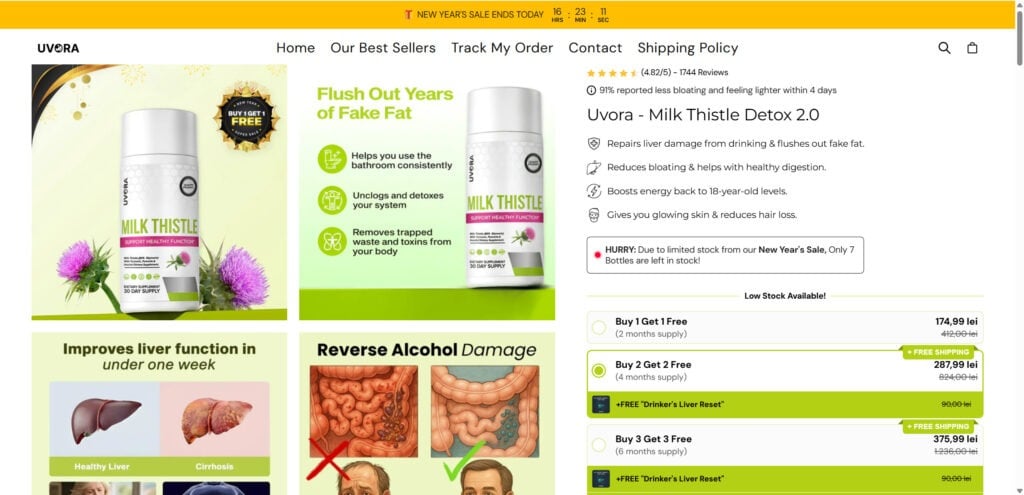
Uvora Milk Thistle Detox 2.0 is marketed like a modern “reset” supplement. The sales pitch usually targets a mix of pain points that many people worry about:
- Bloating and digestive discomfort
- “Detox” and liver health
- Weight gain and stubborn belly fat
- Low energy and brain fog
- Skin glow and even hair-related claims
The page commonly frames it as a simple daily habit: take 1 capsule a day and your body supposedly starts “unclogging,” flushing toxins, reducing bloat, improving digestion, and restoring energy.
That bundle of promises is a major red flag by itself, because it tries to cover nearly everything a person might want to fix, with one bottle.
The emotional hook: “fake fat” and “reverse alcohol damage”
A lot of these campaigns use dramatic phrasing like “flush out years of fake fat” or “reverse alcohol damage.”
Those phrases do two things:
- They make normal body changes feel like an urgent threat.
- They imply medical-grade results without the burden of medical-grade proof.
The liver is a real organ with real disease states. “Repairing liver damage” is not a casual promise. If a product strongly suggests it can reverse damage, that is not just marketing hype. It is a signal you should slow down and verify everything before buying.
The social proof problem: big ratings, big numbers, thin reality
These pages often display:
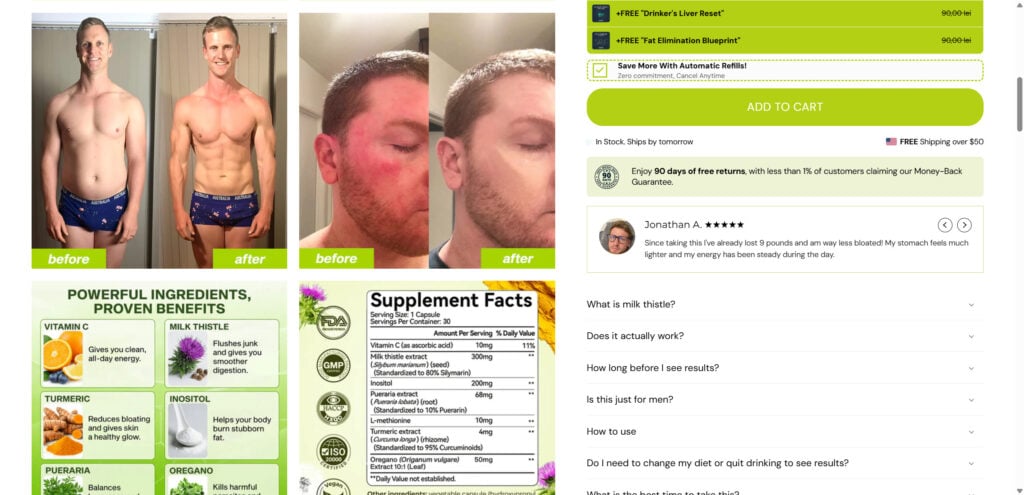
- A star rating like 4.8/5 or 4.82/5
- A large review count like 1,744 reviews
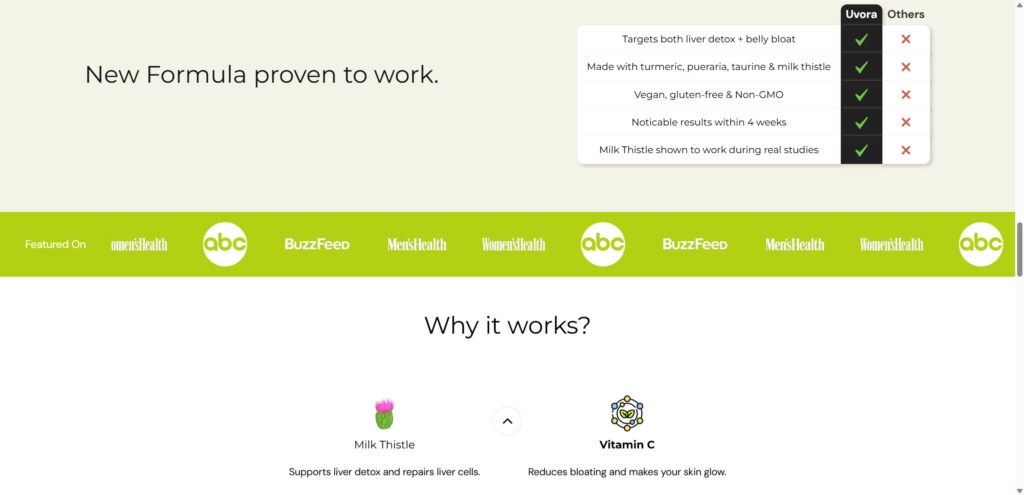
- “As seen on” or “featured on” style media logos
- Claims like “91% reported less bloating in 4 days”
- “Less than 1% use the money-back guarantee” style statements
The issue is not that a product cannot have reviews. The issue is the pattern.
When a page shows huge review totals and perfect sentiment, but gives you no reliable way to verify those reviews independently, you are not looking at proof. You are looking at conversion design.
Common signs the social proof is manufactured or curated:
- Reviews are uniformly positive and feel copy-pasted
- Reviews focus on vague outcomes instead of specific, measurable experiences
- Reviewer profiles do not exist outside the page
- There is no credible third-party trail you can confirm
- The same testimonials appear across multiple “brands” with different names
A real product with real demand usually leaves fingerprints across the internet: retailers, forums, mixed feedback, neutral reviews, and at least some critical comments that sound human.
The urgency stack: timers, “low stock,” and bundle pressure
Another common pattern is what I call the urgency stack. The page does not just offer a product. It pressures you in layers:
- Countdown timer that resets or feels endless
- “Only X bottles left” inventory warning
- “New Year’s Sale ends today” banners
- Heavy bundle incentives like buy 2 get 2 free, buy 3 get 3 free
- “Free gifts” that only appear if you buy more than 1 bottle
- Auto-refill “subscribe and save” boxes that are easy to miss
This is not how a careful health brand sells a supplement. It is how high-churn direct response funnels sell impulse purchases.
What is milk thistle, realistically?
Milk thistle (often tied to its key compound, silymarin) is a commonly marketed herbal ingredient for liver support. You will find it in many supplements.
That does not automatically make every milk thistle product a scam.
But it also does not magically justify claims like:
- repairing liver damage
- flushing out “years” of toxins
- rapid visible transformations in days
- dramatic body recomposition without lifestyle change
A supplement can be “real” as a physical product and still be promoted in a misleading way. That distinction matters.
The bigger concern: the business model, not the herb
TFhe pattern seen with similar pages, the primary risk here is not that the bottle is empty.
The risk is that you are dealing with a funnel-style dropshipping operation that:
- buys a low-cost supplement (often produced at scale)
- rebrands it with a premium story
- sells it at a steep markup
- uses aggressive claims to drive urgency
- makes refunds difficult through policy friction and logistics
- sometimes adds billing surprises (extra units, hidden subscriptions, or multiple shipments)
People report a familiar sequence: they order 1 unit, but see multiple charges, multiple units, or follow-up billing that they did not expect. Others report that shipping indicates the package originates from China, despite branding that suggests a local or premium operation.
That is the core “should you buy it” question.
Because when the operation is built around aggressive marketing and policy friction, you are not buying confidence. You are buying risk.
What the “before and after” imagery is trying to do
These pages often show dramatic before-and-after photos, “bloat transformation” side profiles, and lifestyle outcomes.
Before-and-after images are persuasive because they compress a story into one second: “this could be you.”
But in supplement marketing, before-and-after images are one of the most abused tools, because:
- you do not know the time gap
- you do not know the routine change
- you do not know if the person used other products
- lighting, posture, and camera angle can manufacture “results” instantly
- the person may not be a customer at all
If a brand leans heavily on transformations while staying vague on verifiable evidence, that is not transparency. It is performance.
The claims that should make you pause immediately
If you remember nothing else, remember this: the more a page promises in one bottle, the more you should demand proof.
High-risk claims include:
- “repairs liver damage”
- “reverse alcohol damage”
- “flush out years of waste”
- “boost energy back to 18-year-old levels”
- “glowing skin and reduces hair loss”
- “works in 4 days for 91% of people”
- “proven to work” without showing actual studies tied to the exact product
None of those claims are automatically true just because ingredients like milk thistle or turmeric are well-known.
Pricing and markup: why the numbers often feel weird
Many of these funnels price the first bottle to feel “reasonable” and then push you into bundles.
Example patterns:
- 1 bottle at a “discounted” price that anchors you
- 2 to 6 bottles priced to feel like the “smart” choice
- Free shipping locked behind a higher tier
- Free gifts only unlocked at 2+ bottles
When the real goal is to maximize average order value, the funnel is optimized for bundle conversion, not customer satisfaction.
That matters because refund friction becomes more profitable when the average order is higher.
Shipping origin and trust signals that do not match
A common complaint with these operations is that the shipping trail suggests the item comes from China, or moves through a logistics network that does not match the brand’s story.
That mismatch is important because the sales page often implies:
- premium quality control
- special formulation
- local trust
- easy returns
But the actual fulfillment system can be very different.
When returns require sending packages internationally, costs jump, delays increase, and many buyers simply give up. That is not an accident. It is a known lever in this business model.
So should you buy it?
If your goal is simple, low-risk support for digestion or general wellness, this sales funnel is a poor place to buy anything.
Not because every capsule is guaranteed to be fake, but because the sales process shows a strong pattern of deception and pressure, and because buyers commonly report issues that are expensive to fix later: billing surprises, slow shipping, and difficult refunds.
If you want milk thistle, you can buy it from a reputable retailer with transparent labeling, clear contact information, and straightforward refund terms.
When a funnel relies on hype, urgency, and hard-to-verify reviews, the safest answer is: do not buy it from this page.
How The Operation Works
Step 1: A high-emotion ad targets a specific frustration
The funnel starts with ads that hit a nerve:
- “Bloating is not food, it’s toxins”
- “Your liver is clogged”
- “Fake fat is trapped waste”
- “Detox in days”
- “Fix the root cause”
These ads often use short, punchy claims designed to bypass skepticism and trigger action.
They are not trying to educate you.
They are trying to move you to the checkout.
Step 2: The sales page overwhelms you with certainty
Once you land on the page, it is built like a guided tunnel.
Common elements include:
- bold claims presented as facts
- clean, medical-looking icons and diagrams
- a tight story about a “breakthrough” formula
- a comparison chart that makes “others” look useless
- “featured on” logos to borrow authority
- big ratings and review counts
- before-and-after images
This creates the feeling that you would be foolish not to try it.
Step 3: Urgency is engineered to kill hesitation
This is where timers and “low stock” warnings come in.
Even if you are skeptical, urgency creates a fear: “What if it sells out and I miss the deal?”
But in many funnels, scarcity is not real scarcity.
It is conversion pressure.
Step 4: Bundles are pushed hard because profit is in volume
Most of these operations do not want to sell you 1 bottle.
They want to sell you 4 to 6 bottles, because:
- shipping costs can be spread across more items
- ad costs are high, so they need a bigger order to stay profitable
- refund rates go down when the purchase feels “committed”
- the business can survive even with angry customers, as long as enough people do not fight the charge
That is why the “best value” option is usually pre-selected or heavily highlighted.
Step 5: The checkout introduces hidden risk points
The checkout stage is where complaints often start.
High-risk patterns include:
- pre-checked boxes for add-ons
- “priority processing” fees that quietly inflate the total
- confusing quantity selectors
- subscription or auto-ship language that is easy to miss
- payment pages that finalize quickly without a clean summary
This is also where some buyers report being charged for more units than expected.
Sometimes it is confusion. Sometimes it is deliberate dark-pattern design.
Either way, you are the one stuck cleaning it up.
Step 6: Fulfillment is outsourced and the story changes
After purchase, buyers often notice:
- tracking that takes days to appear
- tracking that shows international origin
- long transit times
- vague support emails with canned responses
This is typical when fulfillment is outsourced through third-party logistics networks.
A funnel brand can look polished and still operate like a temporary storefront with minimal customer support.
Step 7: Customer support delays until you give up
When customers ask for refunds, they may see patterns like:
- slow replies
- repeated requests for “more time”
- offers of partial refunds to avoid returns
- instructions that require international shipping
- policies that say “return within X days” but shipping takes so long that the window is effectively burned
Even when a “90 day guarantee” is advertised, the real-world experience can be very different once you try to use it.
Step 8: The return process becomes the deterrent
Returns are where the business model protects itself.
If returning requires shipping to China or another international destination, many buyers will not do it because:
- shipping is expensive
- customs paperwork can be confusing
- tracking a return internationally is stressful
- the outcome is uncertain
That friction is not just inconvenience.
It can be the business strategy.
Step 9: The brand can reappear under a new name
One reason this model persists is that storefronts can be rotated.
If complaints stack up, the operation can:
- change domain names
- change brand names
- update labels and creatives
- run the same formula again
That is why the same design language keeps showing up across unrelated products.
What To Do If You Bought This
If you already bought Uvora Milk Thistle Detox 2.0 and now feel concerned, here is a calm, practical plan. Do not panic. Focus on documenting everything and protecting your payment method.
1) Take 5 minutes to preserve proof
Save copies of:
- the order confirmation email
- the order number
- the product page (or at least key parts like guarantees, pricing, and claims)
- the checkout summary
- the merchant name shown on your bank statement
- any tracking pages showing origin and movement
If the seller changes the page later, your saved proof matters.
2) Check for multiple charges immediately
Look at your card or PayPal activity and verify:
- how many charges posted
- the exact amount of each charge
- whether any charge is pending
- whether the descriptor looks different than the brand name
If you see multiple charges and you did not authorize them, treat that as urgent.
3) Look for subscription or auto-ship wording
Search your confirmation email for terms like:
- subscription
- auto-ship
- membership
- recurring
- monthly
- refill
If you find anything that suggests recurring billing and you did not explicitly want that, move to the next step fast.
4) Email support once, clearly, and keep it short
Send a single message that includes:
- order number
- what you want (cancel order, refund, stop any recurring billing)
- a clear statement that you did not authorize extra units or recurring charges (if applicable)
Do not argue. Do not write an essay.
Short, firm, and documented is best.
5) If extra charges happened, contact your bank or card issuer
If you were charged for multiple units, charged again later, or enrolled in something you did not approve:
- call your card issuer
- explain the charge issue clearly
- ask about chargeback options
- ask to block the merchant from further charges if possible
If your issuer recommends replacing the card to prevent repeat billing, follow that guidance.
6) Do not rely on promises like “it will be fixed soon”
A common support tactic is to delay with reassurance.
If billing is wrong, treat it as a payment dispute first. You can always close it later if the merchant genuinely fixes it.
7) If a package arrives, photograph everything
If you receive the product:
- photograph the packaging
- photograph the label, batch info, and any manufacturer details
- photograph inserts and return instructions
- keep the shipping label
This helps if you need to dispute misleading origin claims or product representation later.
8) Be cautious with use, especially if you have health conditions
This is not medical advice, but it is a safety reality:
If you have liver disease, take medication, are pregnant, breastfeeding, or have chronic conditions, do not experiment because an ad promised a detox. Talk to a qualified healthcare professional before taking any supplement.
Also stop using it if you notice side effects.
9) Report the pattern if you believe it is deceptive
Depending on your country, you can report misleading ads and difficult refund practices to consumer protection agencies.
Even if you do not get personal money back from a report, reporting helps create a trail that protects others.
The Bottom Line
Uvora Milk Thistle Detox 2.0 is sold with the classic formula of a high-pressure funnel: bold health claims, heavy urgency, inflated social proof, and a checkout designed to maximize bundles.
Even if a physical bottle shows up, that does not make the marketing honest. When the pitch leans on “repair liver damage,” fast transformations, hard-to-verify ratings, and refund friction that can involve international returns, the risk is not worth it.
If you want milk thistle or basic digestive support, buy it from a transparent seller with clear labeling, verifiable reviews, and a straightforward return policy.
If you already bought, focus on documentation, checking for multiple charges, and protecting your payment method first.








