

They look majestic — rugged bearded men wrapped in thick cable-knit coats, standing against snowstorms like Norse warriors reborn. The ads promise “hand-crafted Viking knit sweaters” or “Nordic-inspired wool coats” that merge ancient craftsmanship with modern comfort. The price? Just $28 or $39.99. Too good to be true — and it is.
Behind these viral Facebook, TikTok, and Instagram ads lies a massive online fraud network selling fake “Viking” clothing using AI-generated images. Customers are lured by stunning visuals and emotional storytelling, only to receive cheap polyester knockoffs shipped from China. Refunds are nearly impossible, contact info is fake, and the sellers vanish as soon as their domains are flagged.
This is the story of the Viking Knit Sweater Scam — a new wave of AI-powered e-commerce deception targeting buyers worldwide.
Scam Overview
A new generation of fashion scams
Over the past year, social networks have been flooded with ads promoting “Viking-inspired knitwear”, “Nordic winter sweaters”, and “hand-crafted Norse coats.” The visuals are captivating: snow, rugged mountains, dramatic lighting, and models that look like they stepped out of a Viking saga.
The sellers claim to offer “hand-stitched wool sweaters with Celtic knot designs” or “Icelandic artisan craftsmanship.” In reality, none of these garments exist.
These ads are operated by Chinese scam rings running dozens of nearly identical websites — including Clothbeat.shop, Sirweara.com, Sunstara.com, Amberarte.com, Sylphij.top, and Nom02 / Tipstoguide.com. Each site uses the same AI-generated photos, plagiarized descriptions, and fake discounts to build trust and urgency.
How they appear online
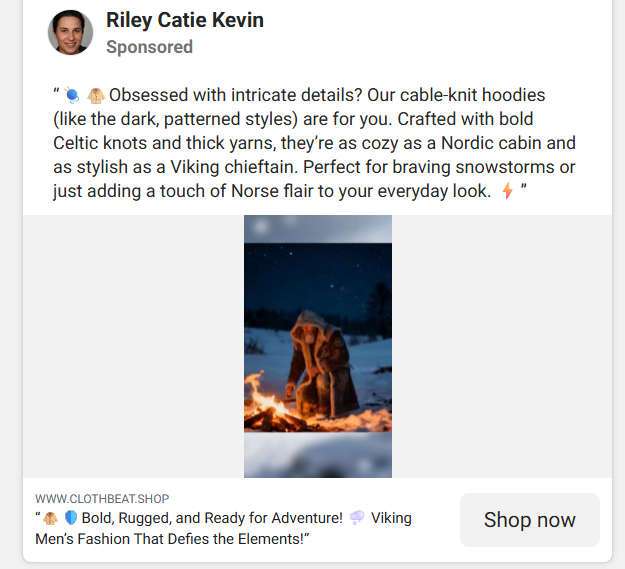
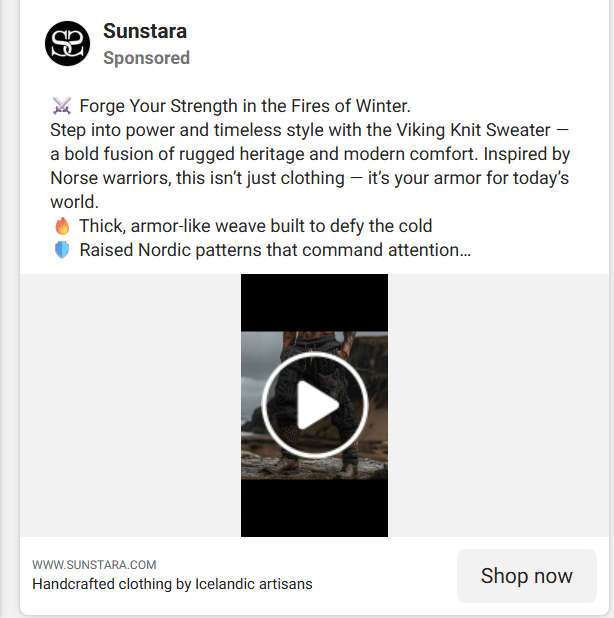
Victims usually encounter these scams on Facebook, Instagram, or TikTok, where sponsored posts feature long emotional captions such as:
“⚔️ Forge Your Strength in the Fires of Winter. Step into power and timeless style with the Viking Knit Sweater — your armor for today’s world.”
or
“🪶 Obsessed with intricate details? Our cable-knit hoodies are as cozy as a Nordic cabin and as stylish as a Viking chieftain.”
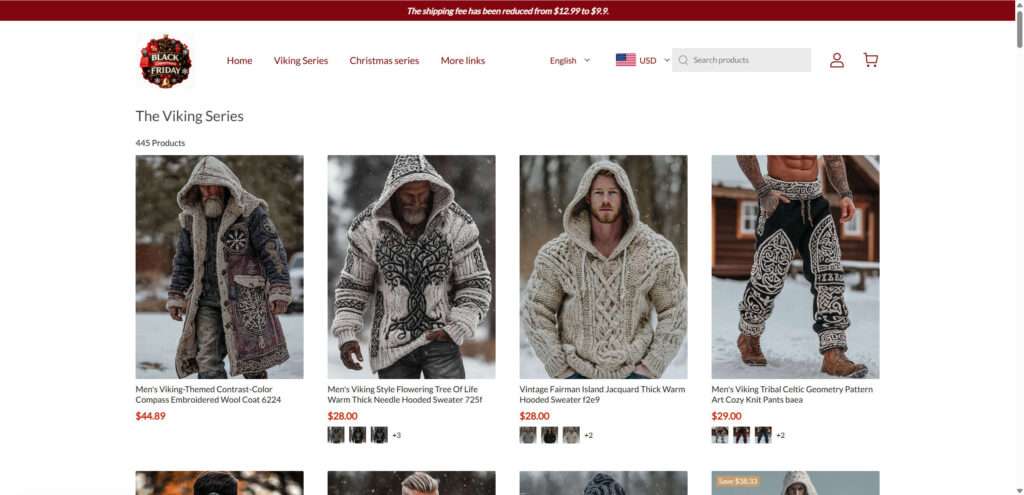
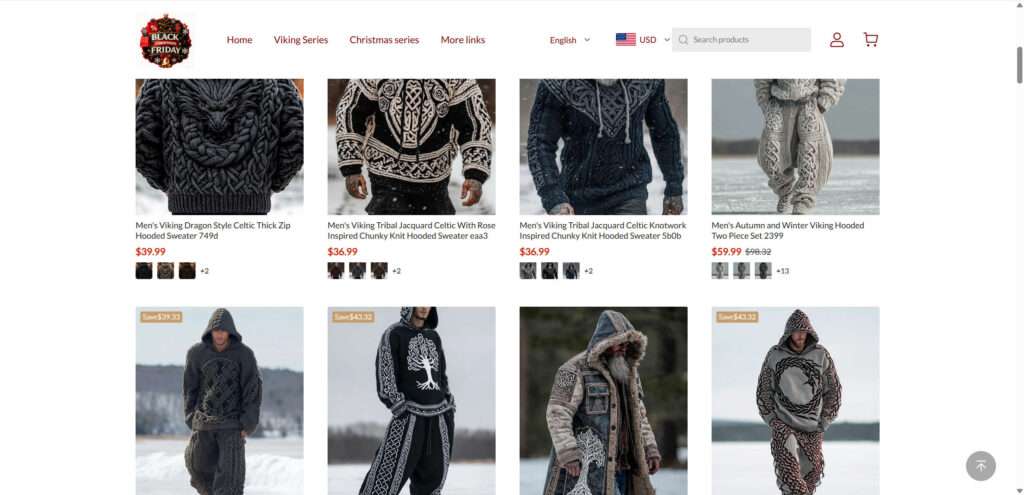
The call-to-action button says “Shop Now”, leading to a professional-looking website filled with hundreds of photos showing men and women in majestic winter settings.
But everything — the faces, the backgrounds, even the clothes — is AI-generated. The fake stores rely on tools such as Gemini, Sora, and Midjourney to create photo-realistic fashion images that can’t be found in any legitimate catalog.
Unrealistic deals
Once visitors enter the site, they’re met with “Black Friday”, “Outlet Closing”, or “Warehouse Clearance” banners claiming 50–70% discounts and limited stock.
Items that would cost hundreds of dollars if real are sold for under $30. Shipping is supposedly “worldwide,” but the fine print (if any exists) reveals vague policies, hidden fees, and no trace of a physical address.
Common slogans across scam sites include:
- “Store Closing Sale – Everything Must Go!”
- “Limited Time Offer – Up to 70% OFF Viking Series!”
- “Free Shipping on Orders Over $59.99!”
- “Going Out of Business – Final Clearance!”
All these are psychological triggers designed to push quick impulse purchases before suspicion sets in.
Signs of fakery
Experienced shoppers quickly notice red flags:
- Recently created domains – Most of these sites were registered only weeks before appearing in ads, using cheap domain registrars with privacy protection to hide ownership.
- No real contact information – Only a generic Gmail or Outlook address is listed; no phone number, no business registration, and no physical location.
- Identical templates – The same Shopify or WooCommerce layout, often with placeholder text like “More links” or untranslated code strings.
- AI-generated models – Faces with asymmetrical eyes, unnatural fabric folds, and lighting inconsistencies give away the use of image-generation software.
- No social media presence – Aside from the ads themselves, the stores have zero real followers or posts.
- Stolen or fictional reviews – Fake five-star reviews with names like “John K.” or “Emma L.” repeating similar phrases: “Fits perfectly, warm and stylish!”
The real products
When victims finally receive their packages — usually after 3–5 weeks — the truth hits.
The so-called Viking sweaters are thin, synthetic knockoffs made from acrylic or polyester, often with crooked seams, chemical odors, and completely different colors and patterns.
Instead of thick cable-knit wool, customers get something closer to a cheap printed sweatshirt.
Attempts to return or exchange the item result in endless email exchanges where the seller offers a “partial refund of 15–30%” and tells the buyer to “keep the product due to high international shipping costs.”
When pressed for a full refund, they demand that the item be shipped back to China, costing more than the sweater itself — making the process intentionally unviable.
How the Scam Works
The Viking Knit Sweater scam is a textbook example of how modern online fraud merges AI imagery, emotional storytelling, and dropshipping deception. Here’s how it unfolds.
Step 1: AI image generation
The fraud begins with fake imagery. Scammers use AI tools like Gemini, Midjourney, or Sora to create hyper-realistic photos of Viking-inspired fashion.
These images feature bearded men, snowy forests, and cinematic lighting — evoking authenticity and masculine strength. The details (braided textures, fur linings, Norse symbols) look handcrafted, but none exist in real life.
Some images even show imaginary textures that couldn’t physically exist — proof that they’re digital fantasies.
Step 2: Fake branding and story
Next, the scammers create a fake brand persona with a Nordic-sounding name — examples include Amberarte, Sunstara, Clothbeat, or Sirweara.
Each brand pretends to represent “Nordic artisans,” “Icelandic knitwear masters,” or “heritage craftsmanship.”
They copywriting follows a familiar template:
“Inspired by Norse legends and Celtic runes, our handcrafted sweaters merge ancient artistry with modern durability.”
The site might even include an “About Us” page mentioning “a small team of Icelandic designers,” though all text is plagiarized or AI-written.
Step 3: Paid ads on Facebook, Instagram, and TikTok
Once the fake imagery and text are ready, the scammers deploy meta ad campaigns across Facebook and Instagram using sponsored posts. They also appear in TikTok short videos showing “men walking through snowstorms in slow motion.”
Because the visuals are so striking, the ads perform extremely well — especially among users interested in Norse mythology, winter fashion, or outdoor gear.
Meta’s ad review system often fails to detect that the imagery is synthetic or the store fraudulent, allowing these ads to circulate for weeks before being reported.
Step 4: Conversion through emotional manipulation
The marketing plays on identity and fantasy.
It tells men they can embody Viking strength or Norse style — ruggedness, masculinity, courage. For women, the message centers on “warrior grace” or “empowering Nordic beauty.”
Combined with “limited time” banners and countdown timers, these ads pressure users to buy instantly.
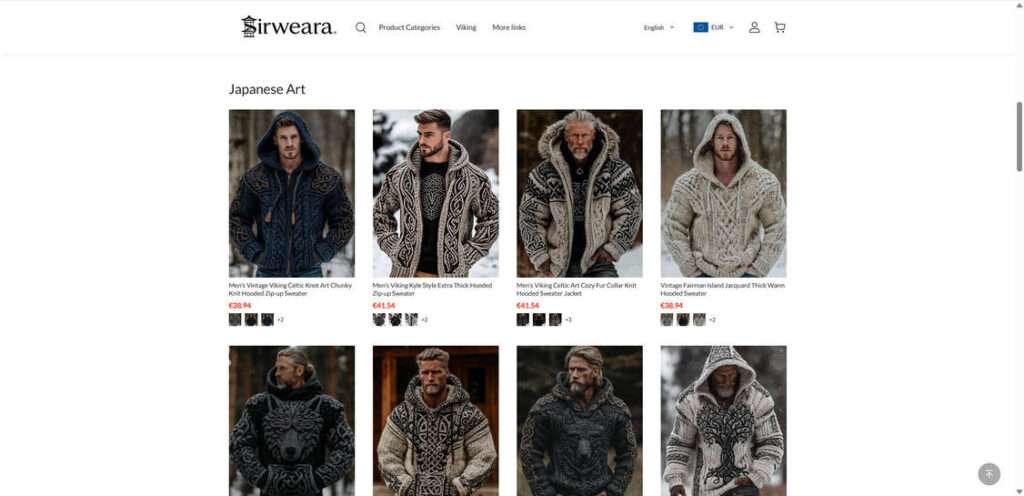
The low prices ($28–$39) make it seem like a harmless impulse purchase — exactly the psychological tactic scammers count on.
Step 5: Checkout and payment
Once customers click “Shop Now,” they’re redirected to a cloned e-commerce template (usually Shopify or Shoplazza-based). Payment is accepted via credit card, PayPal, or Stripe under vague merchant names.
Shipping is claimed to take “7–12 business days,” but real delivery times exceed a month.
Because the site operates from China, transactions are routed through offshore payment gateways — making chargebacks more difficult.
Step 6: Product fulfillment
Scammers forward the order details to low-cost Chinese factories or warehouses (often in Guangdong or Yiwu). Instead of custom wool garments, these suppliers send mass-produced polyester tops.
In some cases, victims receive completely unrelated items — plain hoodies, printed T-shirts, or imitation wool coats without any of the promised patterns.
Step 7: After-sales deception
When buyers complain, the scammers rely on a three-tiered deflection tactic:
- Partial refund offer: “We’re sorry to hear that. To avoid return shipping fees, we can offer a 15% refund and you can keep the item.”
- Fake return address: If the buyer insists, they provide a return address in China that leads to customs rejections or excessive costs.
- Silence or ghosting: After a few exchanges, the store stops responding altogether or disappears.
Step 8: Domain rotation and rebranding
Once negative reviews spread, the scammers abandon the domain and register a new one — often within days.
The same products and images then reappear on fresh domains such as:
- Clothbeat.shop
- Sirweara.com
- Sylphij.top
- Amberarte.com
- Sunstara.com
- Tipstoguide.com / Nom02
All use the same copy, pricing, and fake Viking imagery.
This constant domain rotation keeps the scam alive while staying ahead of takedowns and ad bans.
What to Do If You Have Fallen Victim to the Viking Knit Sweater Scam
If you purchased from one of these fake stores and received a poor-quality or incorrect product, you still have recovery options. Act quickly and document everything.
1. Gather evidence
Save all relevant materials:
- Order confirmations and transaction receipts
- Emails exchanged with the seller
- Photos of the received product and packaging
- Screenshots of the website and ads
Having detailed evidence strengthens your case for a refund or chargeback.
2. Contact your bank or credit card provider
Immediately contact your financial institution and report the purchase as fraudulent or deceptive.
Explain that you were misled by AI-generated images and false product descriptions. Request a chargeback under “merchandise not as described.”
Most credit card companies (Visa, Mastercard, American Express) allow chargebacks within 60–120 days.
3. If you paid via PayPal
File a dispute through PayPal’s Resolution Center:
- Go to the transaction, click “Report a problem.”
- Select “Item not as described.”
- Upload all supporting evidence (screenshots, photos, correspondence).
PayPal often sides with buyers in cases involving misleading advertisements or counterfeit goods.
4. Do not ship the item back to China
Scammers intentionally make returns difficult by giving foreign addresses that cost more to ship than the item’s value.
Unless your payment provider explicitly requires it, do not send the package back — it’s rarely necessary for chargebacks and often a trap to discourage complaints.
5. Warn others
Post about your experience on consumer forums, Reddit threads, or platforms like Trustpilot, ScamAdviser, and MalwareTips.
Sharing your story helps others recognize the warning signs and can lead to faster takedowns of the fraudulent sites.
6. Report the ads
Use the reporting tools within Facebook, Instagram, and TikTok to flag the advertisements as scams.
Meta’s systems rely on user reports to investigate and remove malicious campaigns, so every report counts.
7. Monitor your credit card statements
Scammers sometimes reuse stored payment data for unauthorized charges. Regularly check your account activity and consider canceling the card used for the purchase.
8. Stay informed
Because these scams mutate quickly, keep up with updates from reliable consumer protection sources. Sites like MalwareTips.com frequently publish investigative articles about emerging fraud networks, including fashion and AI-based scams.
How to Spot the Viking Knit Sweater Scam on Social Media
The Viking Knit Sweater scam dominates Facebook, Instagram, and TikTok feeds with dramatic AI-generated ads. Here’s how to recognize it instantly:
1. Unrealistic photos
If the sweater images look cinematic — glowing snow, perfect lighting, or fantasy-style models — they’re AI-generated. Look for odd hands, blurred fabrics, or identical models across multiple “brands.”
2. Emotional slogans
Ads use lines like “Armor for the Modern Viking” or “Forge Your Strength in Winter.” Real brands talk about fabric, fit, and materials — not mythology.
3. New or empty pages
The ad pages are usually just weeks old, with no posts, no followers, and no real interactions — only paid ads.
4. Huge discounts
Scammers push fake urgency: “70% OFF,” “Final Clearance,” “Warehouse Closing.” Real artisan brands rarely slash prices this drastically.
5. Mismatched or missing details
The ad name often doesn’t match the store name on the site, and there’s no physical address or verifiable company info. That’s your cue to leave immediately.
How to Spot a Fake Viking Knit Sweater Website
Even professional-looking sites hide clues that reveal they’re fake. Here’s what to check:
1. Domain age
Look up the site on Whois.com or ScamAdviser.com. If the domain is new (under a year old), it’s likely part of the scam network — e.g. Clothbeat.shop, Sirweara.com, Sylphij.top, Sunstara.com.
2. No real contact info
Only an email (often Gmail) is listed — no phone number, no address, no business registration. Real stores always provide traceable details.
3. Same template, same text
Hundreds of “Viking” sites use identical Shopify layouts and recycled product descriptions like “crafted with Norse spirit and warmth.” Copy-paste equals fake.
4. Unrealistic prices
A “handmade wool sweater” for $29 is impossible. These sites sell cheap polyester knockoffs while pretending to offer luxury Nordic craftsmanship.
5. Fake reviews
Look for repetitive five-star reviews with short phrases like “Very warm, great fit!” Genuine reviews mention details and show real photos.
6. Payment and refund tricks
At checkout, the company name often doesn’t match the website, and the refund policy is vague. If they ask to return items to China or offer 15% back “to keep the product,” it’s a scam.
Frequently Asked Questions (FAQ)
1. What is the Viking Knit Sweater scam?
The Viking Knit Sweater scam is a fraudulent online shopping scheme run by overseas sellers who advertise “hand-crafted Nordic sweaters” or “Viking-inspired coats” on Facebook, Instagram, and TikTok using AI-generated images.
Victims who order these items usually receive cheap polyester garments that look nothing like the ads. Refunds are obstructed, and the scam websites disappear soon after complaints arise.
2. Are the Viking sweaters shown in ads real?
No. The sweaters and coats featured in these viral ads do not exist.
The models, textures, and backgrounds are created with AI tools such as Gemini, Sora, and Midjourney to make the clothing appear luxurious and handcrafted. In reality, the images are digital fabrications used to trick buyers into believing they’re purchasing authentic Nordic fashion.
3. Which websites are linked to the Viking Knit Sweater scam?
As of now, multiple fake stores have been identified, including:
- Clothbeat.shop
- Sirweara.com
- Sunstara.com
- Amberarte.com
- Sylphij.top
- Nom02 / Tipstoguide.com
These domains share the same layout, identical AI-generated photos, plagiarized descriptions, and artificially inflated discounts. However, scammers frequently change domain names, so new versions appear every few weeks.
4. How can I tell if a Viking clothing website is fake?
Look for these warning signs:
- Recently registered domain (less than a year old).
- No business address or phone number, only a vague email.
- Too-good-to-be-true prices (e.g., $28 for a “hand-knitted wool coat”).
- Generic Shopify/WooCommerce templates with “Black Friday” or “Store Closing” banners.
- AI-generated faces and textures in photos.
- Fake five-star reviews repeating the same short phrases.
If a site checks several of these boxes, it’s likely part of the ongoing scam network.
5. Why are these ads appearing on Facebook, TikTok, and Instagram?
Because scammers buy paid ad placements using stolen imagery and temporary domains.
Meta and TikTok’s automated systems often fail to detect AI content or verify seller legitimacy, allowing fraudulent ads to circulate widely. The stunning visuals and emotional storytelling make them effective clickbait.
6. What do victims actually receive after ordering?
Instead of thick cable-knit wool or embroidered coats, victims typically receive:
- Thin, low-quality polyester or acrylic sweaters.
- Poor stitching, chemical odors, and incorrect sizes.
- Completely different colors and designs from the advertised product.
In some cases, the delivered item has no resemblance whatsoever to the original listing.
7. Can I get my money back after buying from one of these sites?
Yes, but it requires quick action:
- Contact your bank or credit card provider to initiate a chargeback under “item not as described.”
- If you paid via PayPal, open a dispute and upload all evidence.
- Do not return the item to China unless explicitly required by your payment provider; shipping costs are intentionally excessive.
Most victims who provide clear documentation successfully recover their funds through chargebacks.
8. Why do scammers offer partial refunds like 15–30%?
This is a manipulation tactic.
They try to avoid chargebacks by offering a small refund in exchange for the buyer keeping the defective product. Once you accept, you waive your right to a full refund. Always reject partial offers and go directly through your bank or PayPal.
9. Are these Viking sweater scams connected to each other?
Yes. Evidence shows a centralized operation likely run by Chinese dropshipping groups using the same image sets, ad text, and e-commerce templates. When one site receives negative reviews, they simply register new domains and relaunch under a new brand name with identical visuals.
10. Are there legitimate Viking or Nordic clothing brands?
Absolutely. Several reputable European artisans and Nordic heritage shops create real wool sweaters and coats — but these usually cost $150–$400, not $29.
Legitimate brands will always provide:
- Verified business information.
- Real photos (not AI-generated).
- Consistent online presence with verifiable reviews.
If the site hides its identity and offers massive discounts, it’s not authentic.
11. How can I report a Viking Knit Sweater scam ad?
- On Facebook or Instagram, click the three dots (…) on the ad → “Report ad” → “Misleading or scam.”
- On TikTok, hold down on the video → “Report” → “Fraud or scam.”
You can also submit the domain to scam databases like ScamAdviser.com, PhishTank, or Google Safe Browsing for faster takedowns.
12. What should I do if I gave scammers my personal details?
If you entered your full name, address, and phone number:
- Monitor your email for phishing attempts or suspicious messages.
- Block and mark scam emails as spam.
- If you used the same password elsewhere, change it immediately.
While these fashion scams usually aim for quick cash, stolen data can later be resold for identity-theft campaigns.
13. How can I stay safe from similar AI-generated fashion scams?
Follow these protective steps:
- Reverse-image search the photos before buying. AI or stolen images often lead to multiple identical listings.
- Check domain registration using WHOIS or ScamAdviser.
- Look for a real business address and social media pages with genuine engagement.
- Avoid “going out of business” or “limited-time” sales that appear every week.
- Read independent reviews before trusting an unknown store.
14. Will the Viking Knit Sweater scam return under new names?
Yes. These fraud groups continuously rotate domains and rebrand to evade detection.
When one site (like Clothbeat.shop) is exposed, a clone reappears within days under a new name such as Sirweara.com or Sylphij.top. The imagery, pricing, and copy remain identical.
15. Where can I find updates on new Viking Knit Sweater scam websites?
You can stay informed through reputable sources like MalwareTips.com, which regularly tracks new scam domains, emerging AI-based fraud tactics, and verified consumer warnings.
Our editors maintain ongoing lists of fake clothing stores and publish investigative articles to help buyers identify and avoid new scam variants.
The Bottom Line
The Viking Knit Sweater Scam is a chilling example of how scammers exploit AI technology, social media ads, and emotional storytelling to deceive consumers.
From Clothbeat.shop to Sirweara.com, Sunstara.com, and countless clones, these operations thrive on fake images, cheap textiles, and the illusion of Nordic authenticity.
Their goal isn’t to sell fashion — it’s to harvest quick profits before disappearing and resurfacing under new names.
Key takeaways
- The images used in these ads are AI-generated, not real photography.
- The products received are low-quality polyester imitations, not wool or handcrafted knitwear.
- Refunds are intentionally obstructed with partial refund tricks or cost-prohibitive return demands.
- The domains are recently registered, anonymous, and reused across multiple scams.
If a site promises Viking heritage clothing for $29 and looks identical to dozens of others, assume it’s fraudulent.
Consumers must now treat overly dramatic fashion ads — especially those featuring perfect snow-covered models and Norse myth references — with healthy skepticism.
Stay vigilant
The next time you see an ad for “Nordic warrior sweaters” or “Viking knit hoodies” promising 70% off and global shipping, remember: authenticity isn’t sold through AI images or $28 discounts.
Before buying, research the brand, look for real photos, and check the domain’s history on Whois or ScamAdviser.
MalwareTips continues to monitor newly emerging Viking Knit Sweater scam domains and related networks to help consumers stay protected from this growing wave of AI-driven e-commerce fraud.








