


To anyone on a budget, Vsapply.com looks like a lucky find. Do a few quick steps, it says, and you’ll get a big gift card from a famous store.
Instead of clear steps, you get vague ones and a bright button. Follow the button, and the deal on screen is replaced by a very different one.
Overview
What Vsapply.com says is waiting for you
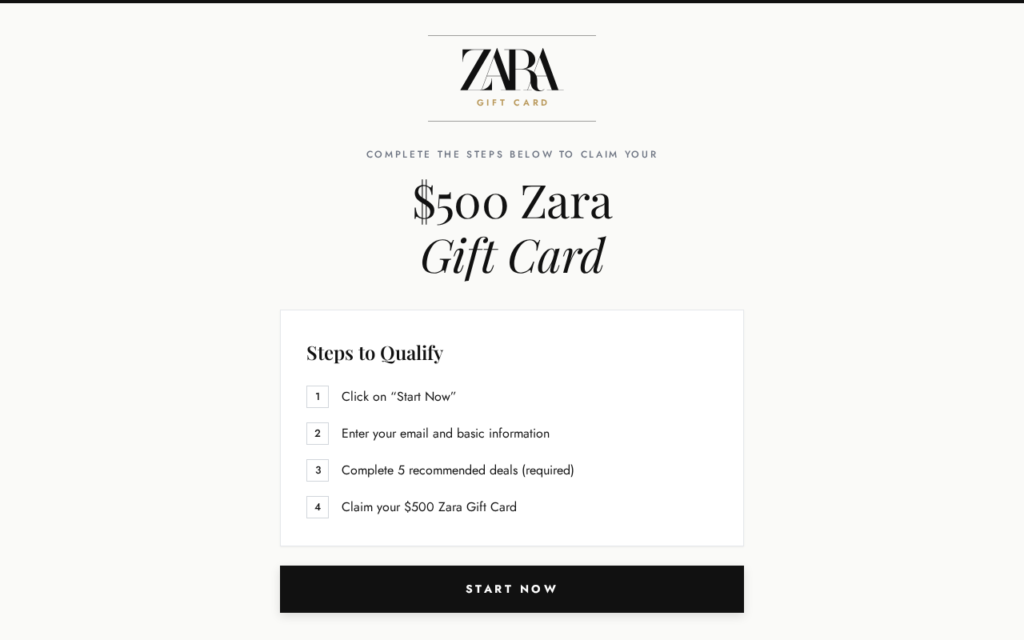
Vsapply.com hooks you with a big gift card headline and claim button, and similar pages usually add a famous retailer’s logo plus numbered steps toward “claim your card.”
On pages like this, the to-do list feels light: your email, a few quick questions, a few “recommended deals.” You only learn what those deals are once you’re inside.
A borrowed store name, not a store promotion
The retailer named here doesn’t run the offer. It doesn’t approve it either, and it doesn’t send out the card. Its name only lends the site trust it can’t earn.
The retailer doesn’t own this domain, and the claim button never sends you to the retailer. What it opens is a tracking link from an affiliate network.
Behind the “steps” to claim the card
A lead-generation funnel uses the gift card as bait. Here’s where buttons like this one typically take you:
- A tracking link that turns each visitor’s sign-up into a payment for the operator.
- Forms that capture your contact details (email, phone number and address) plus your date of birth.
- Sponsored offers like paid trials, subscriptions, app installs and credit applications.
- Ever-changing conditions, with the card always waiting behind one more deal.
- No named company on the hook for delivering the reward.
The page can promise anything it likes. Vsapply.com is still a gift card scam, so don’t share your details, don’t start its deals and don’t expect a card.
What We Found on Vsapply.com
A few details about Vsapply.com stand out:
- The page’s title reads "Claim Your $500 Zara Gift Card".
- Its claim button opens a tracking link on giftclick.org, an affiliate network domain, not the website of the store it names.
How the Vsapply.com Gift Card Scam Works
Every reward funnel like Vsapply.com runs the same script. The store name, the amount and the domain are the only things that change between pages.
Step 1: You’re singled out by a message
You’ve been “selected,” says the text message, email or social media ad that brings most visitors in. The prize is a reward from a famous store, or products to test.
The amount is the bait that halts your scrolling. The store’s name is the cover, lending an unknown website trust it had no way of building on its own.
Some messages know your first name or a recent purchase, so they feel personal. That knowledge can come from an earlier data leak, not from the store.
Step 2: The landing page makes it all seem simple and fast
A short run of numbered steps and a bright claim button is the usual design for pages like Vsapply.com. “Complete a few deals” sounds brief, with a clear stopping point.
Many of these pages add urgency through countdown timers, “only a few cards left” banners and counters showing people who “already claimed.” You have no way to check those numbers.
Step 3: The button connects to an affiliate network
Press “Claim” or “Start now” and the next stop is a tracking link, not the store. That link files away the operator’s affiliate ID and the offer you clicked.
Affiliate links are standard stuff. What they show in this case is simple. You aren’t a winner being rewarded; you’re a lead being sold, right from the first click.
Step 4: The product is your personal data
Expect a request for your email first, then your name, phone number, home address and date of birth. Often there’s also a “survey” asking about your income and shopping habits.
The more you answer, the more valuable you become as a lead for marketers. Walk away halfway and those details can still fuel emails, texts and calls for months.
Some boxes are ticked before you ever touch them. Hit “Continue” anyway, and dozens of “marketing partners” can receive your details.
Step 5: Sponsored offers with real costs attached
The site makes the card conditional on sponsored deals. You’re told to finish free trials, streaming plans, insurance quotes, credit applications, or mobile games played to a set level.
Many of the deals need a payment card, and a trial you don’t cancel in time can turn into a full-price subscription. Credit applications can leave hard inquiries.
Step 6: The card you were promised never shows
Expect the goalposts to move. Once a few deals are done, the page reports that you need more, that a deal “didn’t track,” or that your claim is “pending review.”
By the time you give up, every sign-up has already paid the operator. Nobody handles missing cards, because the card was never what this was selling.
Red Flags of Offers Like Vsapply.com
You’ll see these signs on almost every reward funnel. The first one alone is enough to settle it.
The card is locked behind “deals”
Stores don’t make you start paid trials or apply for credit to win their own gift cards. “Complete a few deals” is what an affiliate funnel says.
Too much reward for too little work
No store trades a card worth hundreds for a filled-out form, though genuine giveaways do happen. That prize size is one piece of the lure.
It’s not the store’s website
Read the address bar before anything else on the page. When a famous store’s name shows up inside an unfamiliar address, it’s an advertiser using the brand, not the retailer.
The button doesn’t stay on the site
On a computer, the claim button gives itself away when you hover over it. These pages point it at a tracking domain, not at the retailer.
An offer with no one behind it
Nobody you can contact will deliver the card or answer for it: no company, no address, no support. A tiny “not affiliated” note at the bottom doesn’t fix that.
Messages that arrive out of nowhere
Got a text or email from someone you don’t know saying you’ve “won” or been “selected”? That’s the funnel’s first step, not proof of any prize.
Running timers and dwindling card counts
The ticking clock is there so you’ll skip the checking. A real store promotion holds steady if you take a day to look into it.
Why the Store’s Name Isn’t Proof
Familiar store names are chosen because they do the persuading. Costco, Target, Walmart and Amazon gift cards are common, though scammers will borrow any trusted brand.
Major retailers regularly warn their customers about fake surveys and reward messages that misuse the store name, and they ask people not to enter details through unexpected links.
In 2013, the US Federal Trade Commission sued operators of “free gift card” text campaigns that pushed people toward paid offers. Today’s version runs on almost the same script.
Seeing a famous brand in the headline proves nothing on its own. Check the store’s website: if the offer isn’t mentioned there, it doesn’t belong to the store.
What a Real Store Promotion Looks Like
Stores do give away gift cards for real. Here’s what a genuine offer looks like, and once you compare it with a fake, the differences are easy to see.
- It’s announced where the store speaks for itself: its own website, app or verified social accounts.
- Its official rules name the company in charge, the prize and the date it ends.
- You don’t have to start trials, install apps or apply for credit to take part.
- You reach a receipt survey through the address printed on that receipt, and you collect loyalty rewards in your store account or app.
- Winners hear back through the account or channel they used to enter, not through a random text.
If any one of these doesn’t hold up, see the gift card for what it is: bait. A genuine promotion has nothing to hide behind a “claim” button.
What the “Deals” Can Cost You
The card doesn’t arrive. The costs of going after it are real, though, and these are the usual ones:
- Recurring charges. Discounted plans and free trials that roll over to full price when the cancellation window passes without you canceling.
- Hard credit inquiries. The loan and credit card applications on the offer list can leave a hard inquiry on your credit file.
- Unwanted calls and email. Once you hand over your email, phone number and address, they go to marketing partners you didn’t choose.
- The next scam. Lists of people who replied to a “you won” offer are valuable to other scammers. Expect phishing and fake delivery texts to follow.
- Unwanted apps. Tracking and ads can continue from the mobile games and apps you installed to “unlock” the reward, even after you stop playing.
- Lost time. All those hours of surveys, games and offers go toward a reward that was never on its way.
So the card is imaginary, but the damage isn’t. Every sign-up earns the operator money, and the visitor is the one left paying.
Same Funnel, New Domain
Vsapply.com is one of a whole family of near-identical reward pages: cheap to make, often built with website builders, and usually gone within days of a report.
One clue sits in the claim links. They often carry the same affiliate ID from domain to domain, which points to a single operator juggling many pages at once.
Look at them together and the pages share the same fingerprints:
- A gift card headline that pairs a well-known store with a large amount
- A tidy run of three or four numbered steps capped with “claim your card”
- A condition built around “complete a few deals”
- A “claim” button wired to an affiliate tracking link
- Timers or counters nobody can verify
A different store or a different amount doesn’t make it a different offer. If the pattern matches, it’s the same funnel under a new address.
How to Check a Gift Card Offer Before You Click
A real promotion holds up to a two-minute check. A reward funnel falls apart.
- Skip the link. Go to the store’s official website or app on your own and see if the promotion is listed there.
- Hold your cursor over the claim button on a computer, but don’t click. A tracking domain rather than the store’s address is the answer you need.
- A quick search of the site’s name with “scam” or “review” helps. New funnels often have no history at all, which is itself a warning.
- Hunt for “deals,” “offers” or “participation requirements” in the fine print. Finding any of them tells you the card has strings attached.
When even one check comes up short, walk away and close the page. It doesn’t deserve your email address, and it definitely doesn’t deserve your card details.
What to Do If You Have Fallen Victim to This Scam
The trial periods are your window. If you entered details or started deals through Vsapply.com, act now, and most of the damage can be limited before they end.
- Cancel every trial and subscription. Revisit each deal you started and cancel it before its trial ends. Keep every cancellation confirmation.
- Keep an eye on your statements. Small test charges and unfamiliar recurring payments are the ones to catch. Dispute them through your bank or card issuer.
- Replace any exposed card. Ask your bank for a new card number if you typed card details into any page in this funnel.
- Guard your credit. A loan or credit card application filled in on these pages means your credit report deserves a look. Watch for new inquiries or accounts you didn’t open.
- Stay wary of new texts and emails. Messages about “your reward” or “a problem with your claim” are scams, so don’t click any of their links.
- Lock down your device. Revoke the notification permissions these pages have. Installed something? Malwarebytes Free can scan for it. AdGuard blocks many ads that lead to them.
- Swap out reused passwords. If the account you created on the site shares a password with other accounts, give each of those accounts a new password.
- Handle the unwanted contact. Unsubscribe links are only for companies you recognize. Everything else gets marked as spam, and numbers that start calling or texting get blocked.
- Speak up. Tell the real retailer its name was used. Then report the ad or message and file at ReportFraud.ftc.gov in the US, or your national fraud service elsewhere.
Can’t get a charge or subscription canceled? Your bank or card issuer can usually dispute it for you. Don’t wait, since most issuers only allow a few months to file.
Frequently Asked Questions
Is the Vsapply.com gift card real?
No. Vsapply.com is a gift card scam. Your details are collected by an affiliate funnel that pushes paid deals, and no card ever follows.
Is Vsapply.com connected to the store it names?
No. What looks like an official deal is a borrowed store name, often with a borrowed logo on top. Real promotions appear on the retailer’s own website.
How does Vsapply.com make money?
Through affiliate commissions, paid by advertisers for every email address, survey answer and completed deal. A share of each one goes to the operator.
I completed some deals. Will I get the gift card?
The honest answer is no. Instead of starting another deal, cancel the trials and subscriptions already running, go through your statements and ignore every note about a “pending” reward.
Why do I keep seeing the same offer on new websites?
A new domain and a new store name cost the operators very little. Since each page gets reported fast, they keep relaunching the identical funnel somewhere else.
What should I do if I get one of these offers by text?
Leave the link untouched, forward the text to 7726 (SPAM) if you’re in the US or the UK, and delete it. That forward helps your carrier block similar messages.
The Bottom Line
A famous store’s name gets your trust, a big gift card gets your click, and Vsapply.com’s paid affiliate funnel takes over. The deals are the business; the card is bait.
Never enter your details or start the deals. Completing offers to claim a free gift card is the trap, so close the page as soon as you see that request.
Already participated? Cancel your trials one by one before they renew and check your statements. Don’t trust any message about your reward, because it’s the next scam.

Reviews & discussion
0 commentsShare a firsthand experience, or ask a question.
Community reviews
vsapply.com
Moderated reader experiences, not an editorial verdict.
Start the conversation
Have a question or something useful to share? Add the first comment.