

A text message claims you have an unresolved vehicle violation tied to your registration in Washington State. It warns of penalties, registration blocks, and fees unless you act immediately.
It looks official. It references real laws. It pushes you to click fast.
But this is not a legitimate message from the Washington Department of Licensing. It is a phishing scam designed to steal your money and personal information.
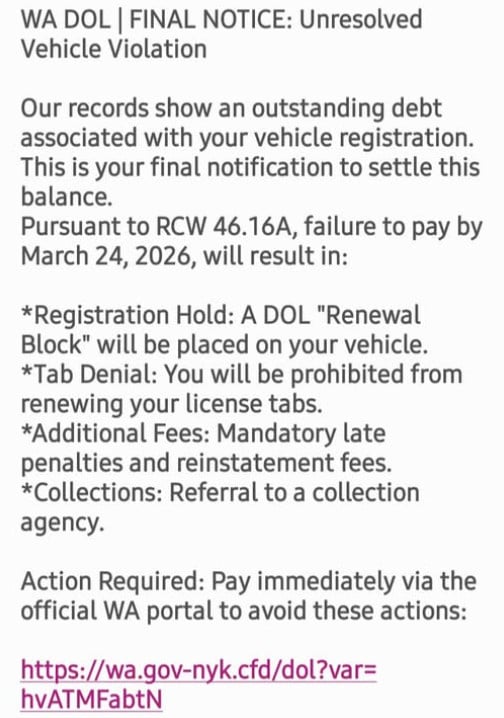
Scam Overview
The WA DOL Vehicle Violation scam text is part of a widespread smishing campaign targeting drivers by impersonating state motor vehicle agencies. In this version, scammers pose as the Washington Department of Licensing (DOL) and use realistic legal references such as RCW 46.16A to make the message appear credible.
The structure of these messages is carefully designed.
They often start with a bold header:
- “WA DOL | FINAL NOTICE: Unresolved Vehicle Violation”
Then they immediately create urgency:
- “Our records show an outstanding debt associated with your vehicle registration”
- “This is your final notification to settle this balance”
From there, the message escalates with consequences:
- Registration hold
- Tab renewal denial
- Additional fees
- Referral to collections
Finally, the message provides a link labeled as an “official portal” where you are told to resolve the issue immediately.
That link is the scam.
Why this scam works so well
This scam succeeds because it combines three powerful elements:
- Authority: It impersonates a real government agency
- Fear: It threatens consequences that drivers recognize as serious
- Urgency: It pressures you to act immediately
Most people are familiar with vehicle registration rules. They know that unpaid issues can lead to problems like renewal denial or penalties. That familiarity makes the message believable.
Scammers amplify that belief by including real legal references like RCW 46.16A, which governs vehicle registration in Washington State.
The law is real. The violation is not.
The role of legal references
Including a statute like RCW 46.16A is a calculated move.
It signals legitimacy. It makes the message feel official and grounded in real law.
But scammers often misuse or misapply these references. They rely on the assumption that recipients will not verify the details. Instead, people see the code and think, “This must be real.”
That is exactly what the scam depends on.
The link is the real objective
The message always ends with a call to action:
- “Pay immediately via the official WA portal”
The link may look somewhat legitimate, but closer inspection often reveals:
- unusual domains
- misspelled or altered URLs
- unfamiliar subdomains
- shortened links
Once clicked, the link takes you to a fake website that mimics a government payment portal.
This is where the real damage happens.
What the fake site looks like
The fraudulent page is designed to feel official and routine.
It may include:
- a case or reference number
- a violation description
- a small balance due
- a payment deadline
- buttons like “Continue” or “Pay Now”
The goal is to make you feel like you are already in the system.
At that point, many people stop questioning whether the notice is real.
Why the amount is usually small
One of the most deceptive aspects of this scam is the payment amount.
It is often low, such as:
- $6.99
- $9.99
- $14.95
This is intentional.
A small fee feels easier to pay than to investigate. Victims often think:
- “It is not worth the hassle”
- “I will just pay and move on”
But the payment is not the real goal.
The real objective is to collect:
- credit card details
- personal information
- billing data
Once that information is entered, scammers can use or sell it for further fraud.
Common red flags
These scam texts share consistent warning signs:
- Unexpected message about a violation
- Urgent tone demanding immediate action
- Threats of penalties or restrictions
- Suspicious links or domains
- No official letter or prior notice
- Pressure to pay quickly
Legitimate agencies do not operate this way.
How The Scam Works
Understanding how this scam unfolds step by step makes it much easier to recognize and avoid.
Step 1: Mass distribution of text messages
Scammers send these messages to thousands or millions of phone numbers.
They do not know whether you:
- have a vehicle
- have unpaid violations
- live in Washington
They rely on volume.
Even a small percentage of responses makes the scam profitable.
Step 2: Authority is established
The message uses:
- WA DOL branding
- legal language
- statute references
This creates an illusion of legitimacy.
Recipients assume the message is real because it looks official.
Step 3: Urgency is introduced
The message emphasizes:
- “Final notice”
- “Immediate action required”
- “Failure to pay will result in…”
This is designed to create pressure.
When people feel rushed, they are less likely to verify information.
Step 4: Threats increase compliance
The message lists consequences such as:
- registration holds
- renewal denial
- additional fees
- collections
These are believable threats.
That is why they work.
Step 5: The link provides a “solution”
After creating fear, the scam offers relief:
- “Pay via the official portal”
This transition is critical.
The victim moves from panic to action.
Step 6: Fake website captures data
The link leads to a fraudulent site that mimics a government system.
The site requests:
- personal details
- contact information
- credit card data
At this point, the victim is fully inside the scam.
Step 7: Financial theft occurs
Once the victim enters payment details:
- the card may be used immediately
- small test charges may appear
- larger charges may follow later
The damage can escalate quickly.
Step 8: Data is reused or sold
Beyond the payment, scammers may:
- sell the data
- use it for identity theft
- target the victim again
This is why the impact can continue long after the initial interaction.
What To Do If You Have Fallen Victim to This Scam
If you interacted with a WA DOL scam text, act quickly.
1) Contact your bank or card issuer
- Report the card as compromised
- Request a replacement
- Block unauthorized transactions
2) Monitor your account
Check for:
- unfamiliar charges
- recurring payments
- suspicious activity
Dispute anything you do not recognize.
3) Enable alerts
Turn on real-time alerts for all transactions.
This helps you catch fraud early.
4) Do not revisit the scam site
Avoid clicking the link again.
Do not attempt to “fix” the issue through the same message.
5) Report the scam
- Mark the message as spam
- Block the sender
- Forward it to 7726 (SPAM)
6) Verify through official channels
If you are concerned about a real issue:
- Visit the official WA DOL website directly
- Do not use the link in the message
- Contact support through verified sources
7) Stay alert for follow-up scams
Victims may receive additional messages after engaging.
Be cautious of:
- fake refunds
- fake support calls
- additional violation notices
The Bottom Line
The WA DOL Vehicle Violation scam text is a carefully designed phishing attack that uses real legal references, official language, and urgent threats to pressure victims into quick action.
It is not a legitimate notice.
It is a trap.
If you receive a message like this:
- Do not click
- Do not pay
- Do not panic
Always verify through official channels that you access yourself.
That simple step can protect you from this scam and many others like it.
FAQ
What is the WA DOL Vehicle Violation text scam?
It is a phishing scam where criminals send text messages pretending to be from the Washington Department of Licensing. The message claims you have an unresolved vehicle violation and pressures you to click a link or pay immediately.
Is the WA DOL text message real?
No. These scam texts are designed to look official, often using legal references and urgent language, but they are not legitimate notices from the Washington Department of Licensing.
Why does the message mention RCW 46.16A?
Scammers use real legal references like RCW 46.16A to make the message seem more believable. The law is real, but the violation claim in the text is not.
Why does the scam threaten registration holds and tab denial?
Because those threats sound realistic to drivers. Scammers use believable penalties to create fear and push people into quick action without verifying the claim.
What happens if I click the link?
You are usually taken to a fake payment website that looks like an official portal. It may ask for your personal information and credit card details.
Why is the payment amount usually small?
Small amounts like $6.99 or $9.99 make people less suspicious. The fee is bait. The real goal is to steal your card information and personal data.
What information are scammers trying to steal?
Usually:
- Full name
- Address and ZIP code
- Phone number and email
- Credit card number
- Expiration date and CVV
- Sometimes vehicle-related details
I clicked the link but did not enter anything. Am I still at risk?
Your risk is much lower if you did not submit any information. Close the site, do not return, and be alert for follow-up scam messages or calls.
I entered my card details. What should I do right away?
- Call your card issuer immediately
- Report that your card details were entered on a fraudulent site
- Freeze or replace the card
- Review recent transactions and dispute anything unfamiliar
- Turn on real-time alerts for new charges
Should I replace my card even if I do not see fraud yet?
Yes. Stolen card details are often used later or sold. Replacing the card quickly is the safest move after a phishing scam.
Can a scam text like this really block my registration or tabs?
Not through a random text message or fake payment link. Those threats are used to pressure you into paying. Real enforcement actions come through legitimate channels and can be independently verified.
How do I verify whether I actually owe anything?
Do not use the link or phone number from the text. Go directly to the official WA DOL website by typing it yourself, then verify through official support or portals.
How do I report the scam?
- Mark the message as spam or junk in your messaging app
- Block the sender
- Forward it to 7726 (SPAM) if your carrier supports it
- Report it through official fraud reporting channels and keep screenshots as evidence








