

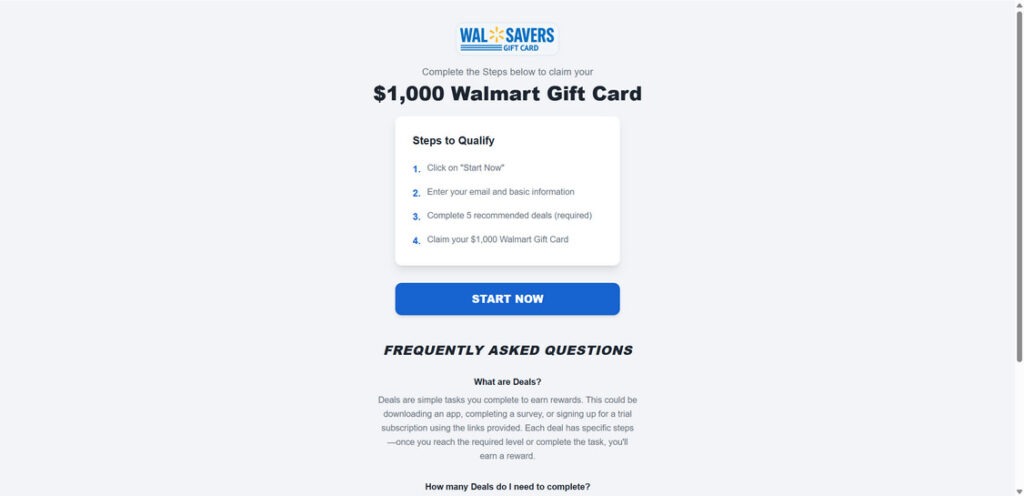
WalSaved.com presents itself like a simple reward page. It advertises a $1,000 Walmart gift card, gives you a short list of steps, and makes the process look fast, easy, and structured. At first glance, it can resemble a normal online promotion.
That first impression is what makes pages like this effective.
This guide explains what WalSaved.com appears to be doing, why the setup raises serious red flags, how these gift card funnels typically work, and what to do if you already interacted with it.
Scam Overview
What WalSaved.com is promising
Based on the live site listing and the page structure shown here, WalSaved.com promotes a $1,000 Walmart Gift Card and tells users to follow four steps:
- Click “Start Now”
- Enter your email and basic information
- Complete 5 recommended deals (required)
- Claim your $1,000 Walmart gift card.
That “5 recommended deals (required)” line is the most important part of the entire page.
It tells you this is not a straightforward Walmart promotion where you enter once and wait for a drawing. It is an offer funnel built around third-party tasks. That matters because the business model is no longer “give a customer a reward.” It becomes “get the user to complete monetized actions first.”
Why this does not match how legitimate Walmart promotions are usually structured
Walmart does run legitimate sweepstakes and customer satisfaction promotions, but the official rules for its current customer satisfaction sweepstakes look very different from what WalSaved.com is advertising.
Walmart’s official rules are published on corporate.walmart.com, not on a random third-party domain. They describe specific entry methods such as a receipt survey invitation, an email survey invitation, or a mail-in entry. The rules also say winners are chosen in a random drawing, and they spell out prize counts, notification procedures, and delivery timelines. That is a major contrast.
WalSaved.com does not look like an official sweepstakes rules page. It looks like a “claim your reward now” page tied to required third-party deals. That mismatch is a strong reason to treat it as suspicious.
The biggest red flag is not the gift card amount
A lot of people focus on the $1,000 number first.
The larger issue is the mechanism. WalSaved.com tells users they must complete five deals. In the FAQ visible on the page, “deals” are described as tasks such as downloading an app, completing a survey, or signing up for a trial subscription. That is not how a normal gift card claim works. It is how affiliate reward funnels work.
The reason this matters is simple.
When a page makes money from the “deals,” the reward becomes secondary. The incentive is to keep you moving through offers, not to hand you a gift card as efficiently as possible.
What these “deals” usually mean in practice
The page’s own description suggests the deals may involve:
- App downloads
- Surveys
- Trial subscriptions.
That means the risks go beyond wasting a few minutes.
A trial subscription can turn into recurring billing. A survey funnel can feed your information into marketing lists. An app install can lead to future upsells, subscriptions, or data collection. What looks like a simple “qualifying step” can have a real financial or privacy cost attached to it. Official retailer fraud guidance warns that fake survey and “free gift” scams commonly spread through online ads, websites, and social posts, and often lead people into giving up personal or payment information.
Why pages like this work so well
They work because they remove friction.
WalSaved.com uses a clean layout, a Walmart-themed name, a big gift card amount, and a short checklist. That makes the page feel more like a guided process than a sales funnel.
This is a common scam design pattern. The FTC says gift card scams and prize-related scams often begin through email, text, social media, or online messages, and they frequently rely on urgency and quick action. Walmart’s fraud page also notes that scammers use the internet and other channels to target people and that suspicious activity should be reported.
Why the domain itself is a problem
A genuine Walmart promotion should be easy to verify through Walmart’s official properties.
The official Walmart sweepstakes rules are hosted on corporate.walmart.com, and Walmart’s fraud resources are also on Walmart-controlled pages. WalSaved.com is not that. It is a separate domain presenting a Walmart-branded reward flow. That alone does not prove every technical detail of the operation, but it is a major authenticity failure.
When the website is not clearly controlled by the brand, and the reward depends on outside “deals,” skepticism is the correct response.
Why victims often never receive the promised reward
The most common pattern with offer-wall gift card pages is not immediate theft. It is delayed disappointment.
Users complete steps, finish offers, and then get stuck in one of these loops:
- One offer did not count
- Verification is pending
- More steps are required
- The wrong deal type was chosen
- The completion did not track.
Because affiliate systems rely on tracking, the site can always say a completion did not properly register. That makes the finish line flexible. A flexible finish line is extremely profitable for the operator and extremely frustrating for the user.
The risks are bigger than “no gift card”
If you interact with WalSaved.com or a similar page, there are three main types of risk.
Financial risk
If any of the required deals involve a trial or subscription, you may see charges later, including recurring monthly billing.
Privacy risk
If you entered an email, phone number, or other personal information, that data may be used for marketing, resold, or used to target you with additional scams.
Follow-up scam risk
Once you have clicked one reward page, you may get more “gift card,” “verification,” or “pending reward” messages afterward. The FTC specifically warns that prize and gift card scams often begin with messages pushed through digital channels and then escalate from there.
How The Scam Works
Step 1: You are pulled in by the reward promise
The process usually starts with a message or link promising a Walmart gift card.
The exact channel can vary. It may come through an ad, pop-up, redirect, social post, email, or text. The FTC says gift card scams commonly start through calls, texts, emails, or social media messages, and that scammers use those channels to create urgency and get people to act fast.
Once you click, the page gives you a simple story: complete a few steps and get a valuable gift card.
Step 2: The page creates a false sense of legitimacy
WalSaved.com does not present itself as a gamble.
It presents itself as a process. “Start Now,” enter some information, complete some deals, claim your reward. That framing is important because it turns skepticism into compliance. You are no longer judging the page. You are following instructions.
This is exactly why the checklist exists.
A checklist feels official. It also makes each individual step look small and harmless.
Step 3: Your email and basic details are collected early
The site asks for your email and basic information before the high-friction steps begin. That is not an accident.
Email capture is valuable all by itself. It gives the operator a lead, a retargeting point, and a way to connect your later offer completions to an affiliate account. Even if you stop before finishing anything else, your data may already have value to the people behind the page.
Step 4: You are introduced to the offer wall
This is where the funnel turns from “gift card page” into “monetized traffic.”
The site’s own FAQ says the required deals can include downloading an app, completing a survey, or signing up for a trial subscription. That means the page is not simply collecting entries. It is routing you into advertiser actions that can generate commission.
This is the point where the operator starts making money from your behavior.
Step 5: Low-friction actions build momentum
Offer-wall funnels usually do not start with the hardest step first.
They often begin with something that feels easy:
- Fill out a short form
- Install an app
- Answer a survey
- Sign up for a “free” trial.
These early steps matter because they create psychological commitment. Once you have already done one or two things, it becomes harder to walk away. You feel invested. That investment is what keeps users going.
Step 6: Higher-risk offers often appear later
The more valuable the conversion is for the operator, the more likely it is to involve payment details or a subscription.
That is why trial subscriptions are especially concerning. A “free trial” that requires a card can become a paid subscription later. Retailer scam guidance warns that fake gift and survey scams often end with users being asked for payment details or being exposed to fraudulent charges tied to the offer flow.
This is where “I was just trying to claim a gift card” turns into “Why was I charged two weeks later?”
Step 7: The reward stays vague on purpose
Legitimate Walmart sweepstakes rules are specific. They explain how winners are selected, how many prizes there are, how winners are contacted, and when prizes are shipped. WalSaved.com does not resemble that structure. Instead, it presents a direct claim flow tied to five deals and leaves the actual reward delivery process vague.
That vagueness serves the funnel.
If the reward is never clearly defined, it is easier to delay it, deny it, or blame the user for not meeting some invisible requirement.
Step 8: “Tracking” becomes the all-purpose excuse
Many users who interact with offer-wall rewards get told a completion did not count.
Why? Because affiliate systems can claim a problem with:
- Cookies
- Device changes
- Ad blockers
- Unfinished onboarding
- Missing confirmation steps
- “Incorrect” completion paths.
The user cannot easily verify any of that. So the result is predictable: the person keeps trying, hoping one more offer will finally unlock the reward. That is exactly the behavior the funnel is built to produce.
Step 9: The aftermath starts after you leave
Even if you close the page, the consequences may continue.
You may get:
- More scam emails
- More “gift card” offers
- More text spam
- Charges from trials you forgot to cancel
- Calls tied to lead-generation forms.
The FTC warns that digital scam contact often starts with one message and expands from there. Walmart’s fraud page also directs consumers to report scams and use official resources if they suspect fraud.
What To Do If You Have Fallen Victim to This Scam
- Stop immediately.
Do not complete more deals hoping the reward will finally unlock. The longer you stay in the funnel, the more risk you create. - Take screenshots and save the details.
Capture the WalSaved.com page, the promised $1,000 reward, the checklist, and any screens showing deal requirements or confirmations. - Make a list of every offer you touched.
Search your inbox for terms like “trial,” “subscription,” “receipt,” “invoice,” “welcome,” “membership,” and “billing.” Write down every service you signed up for. - Cancel any trials or subscriptions right away.
If you entered payment information for any offer, assume it may renew automatically. Cancel as soon as possible and save the confirmation. - Check your app-store subscriptions too.
If any deal involved downloading an app, review your Apple App Store or Google Play subscriptions and cancel anything you do not recognize or do not want. - Review your bank and card statements carefully.
Look for small charges, pending charges, or unfamiliar merchant names. Monitor for at least 30 days because some trials convert later. - Call your card issuer if you see suspicious billing.
Ask about blocking merchants, disputing charges, or replacing the card number if needed. - Secure your email account.
Change your email password and enable 2-factor authentication. Your email is the recovery point for many of your other accounts. - Change any reused passwords.
If you used the same password on any related signup that you use elsewhere, change it on your important accounts right away. - Expect more spam and treat follow-ups as suspicious.
If you get messages saying your gift card is pending or asking you to finish one more step, assume they are part of the same ecosystem. - Report the scam.
Walmart’s fraud team points users to report suspicious activity and complaints to the FTC and other fraud-reporting resources. The FTC also says gift card scam reports can make a difference, and its guidance includes Walmart-specific reporting contact information for actual Walmart gift card fraud cases.
Is Your Device Infected? Run a Free Malware Scan
Slow performance, constant pop-ups, or strange behavior? These are classic signs of a malware infection. The fastest way to find out is to scan your device with Malwarebytes Free — one of the most trusted malware removal tools available.
The free version detects and removes the most common threats, including:
- Adware — the cause of those annoying pop-ups
- Browser hijackers — unwanted redirects and changed homepages
- Trojans and spyware — hidden programs stealing your data
- Potentially unwanted programs (PUPs) — software you never asked for
👉 Select your device below — Windows, Mac, or Android — then follow the simple steps to download Malwarebytes, scan your system, and remove any threats it finds. The scan usually takes 5 to 20 minutes.
Run a Malware Scan with Malwarebytes for Windows
Malwarebytes is one of the most popular and trusted anti-malware tools for Windows — and it’s completely free for removing infections. It catches threats that many antivirus programs miss, including adware, browser hijackers, and trojans. Follow the steps below to scan and clean your PC in just a few minutes.
Download Malwarebytes
Click the button below to download the latest version of Malwarebytes for Windows from the official source. The free version is all you need — it will scan your computer and remove adware, browser hijackers, and other malicious software at no cost.
Download MalwarebytesOfficial installer for Windows 11 and 10. Your download starts right away.Want real-time protection? See Malwarebytes Premium Malwarebytes Free for WindowsScans and removes malware at no cost
-
Install Malwarebytes
When the download finishes, open your Downloads folder and double-click the MBSetup file. If Windows shows a User Account Control pop-up, click “Yes” to allow the installation.
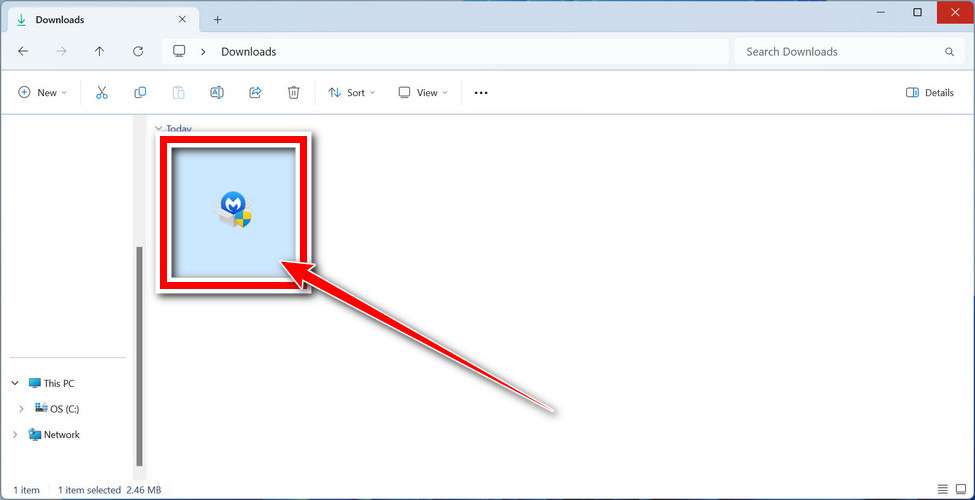
Follow the On-Screen Prompts to Install Malwarebytes
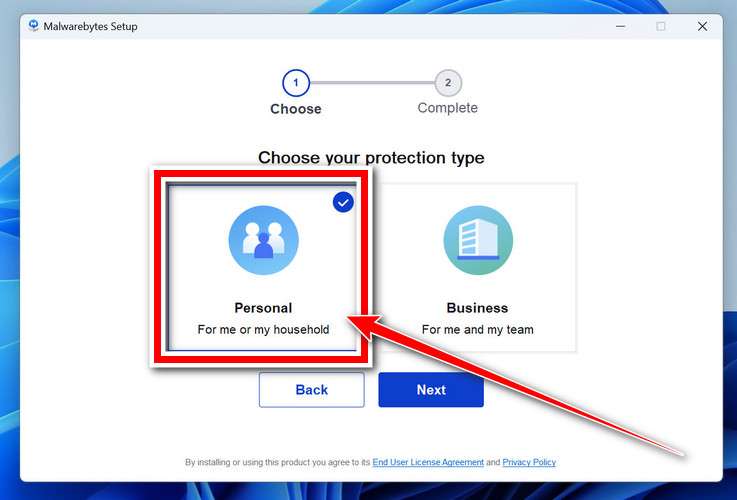
The setup wizard will walk you through a few quick screens:
-
Choose where you’re installing the program — “Personal Computer” or “Work Computer” — then click Next.
-
Malwarebytes will now install on your device. This usually takes under a minute.

-
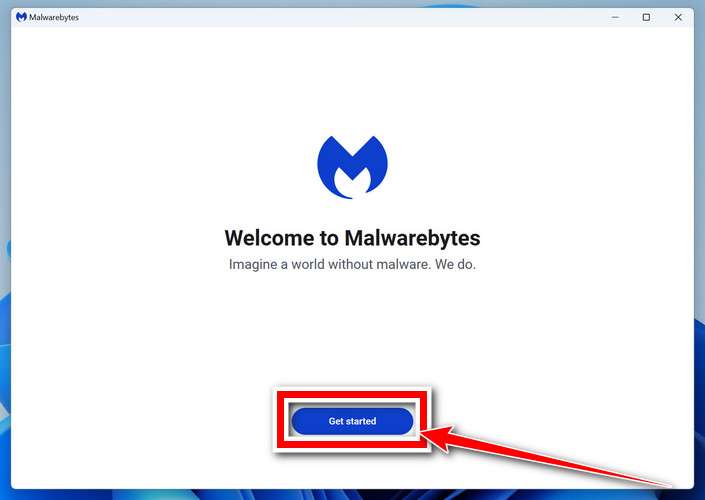
When installation is complete, the “Welcome to Malwarebytes” screen will open automatically.
-
On the final screen, click Open Malwarebytes to launch the program.

-
Enable “Scan for Rootkits”
Before scanning, turn on rootkit detection so Malwarebytes can find even the most hidden threats. Click the Settings gear icon on the left side of the screen.
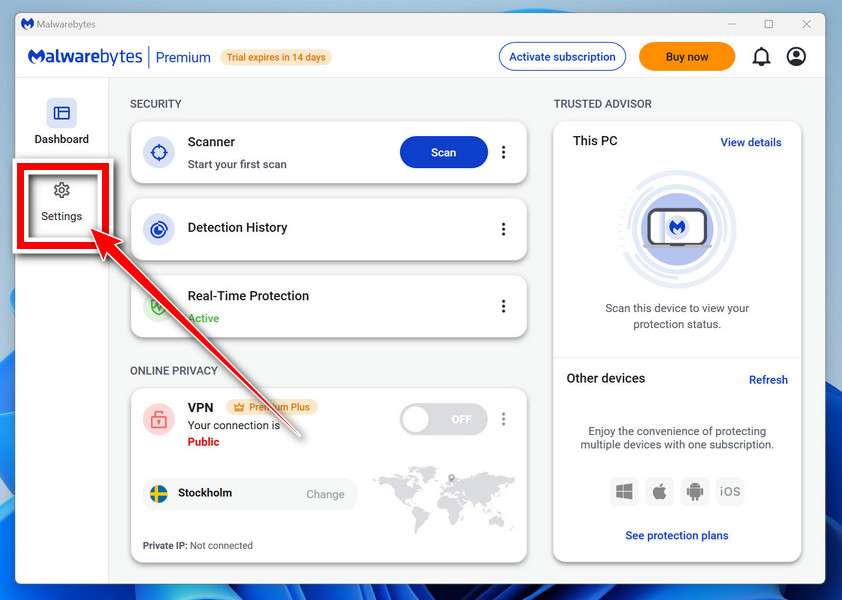
In the settings menu, find “Scan for rootkits” and click the toggle so it turns blue.

Done? Click “Dashboard” in the left pane to return to the main screen.
Start the Scan
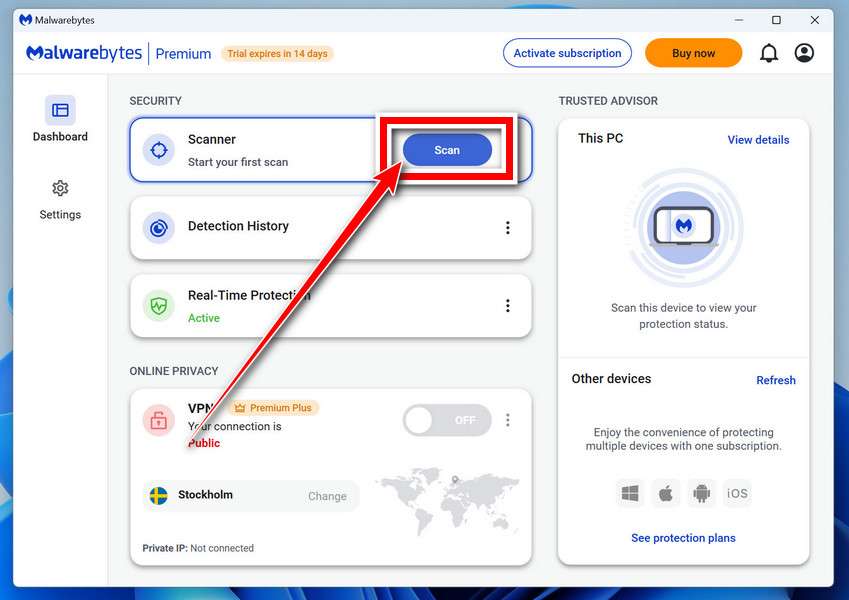
Click the blue Scan button. Malwarebytes will automatically update its virus database and start checking your computer for malware.
-
Wait for the Scan to Finish
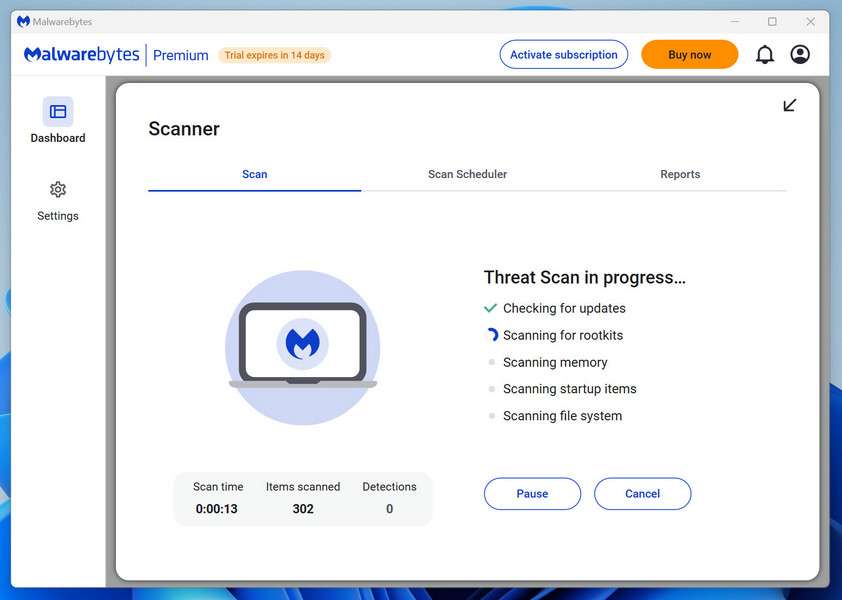
The scan checks your entire system for browser hijackers and other malicious programs, so it can take 5 to 20 minutes depending on your computer. Feel free to do something else — just check back occasionally to see the progress.
-
Quarantine the Detected Threats
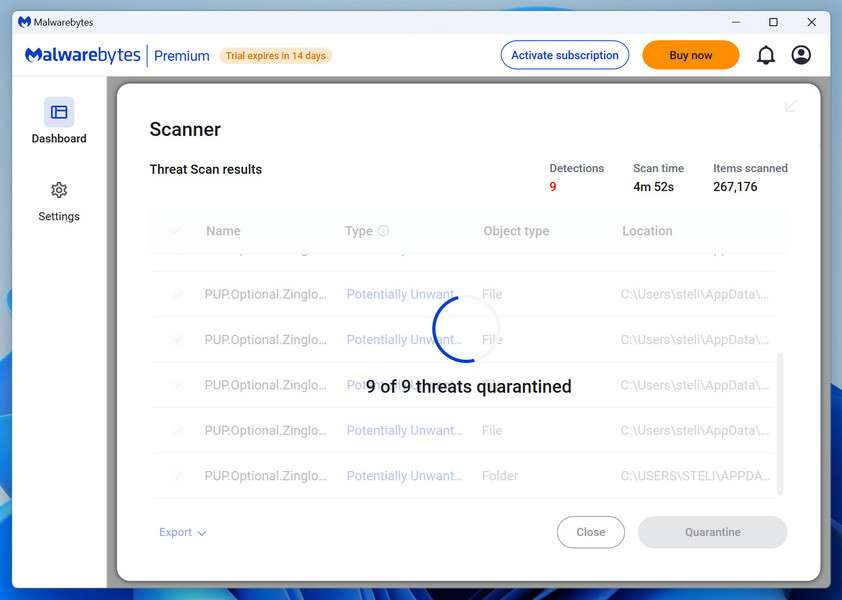
When the scan is done, you’ll see a list of everything Malwarebytes found — malware, adware, and potentially unwanted programs. Click the “Quarantine” button to remove all of them at once.
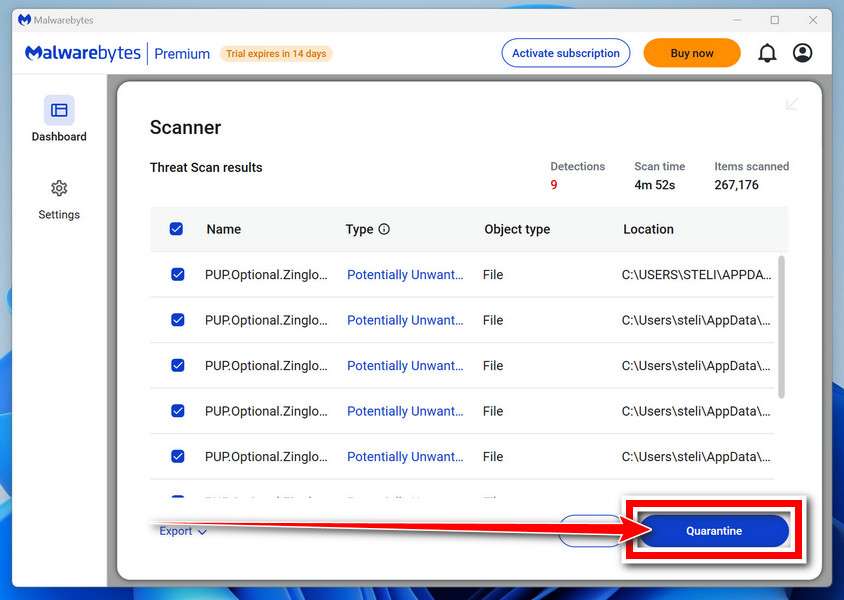
Malwarebytes will now remove the malicious files and registry entries and move them safely into quarantine.
-
Restart Your Computer
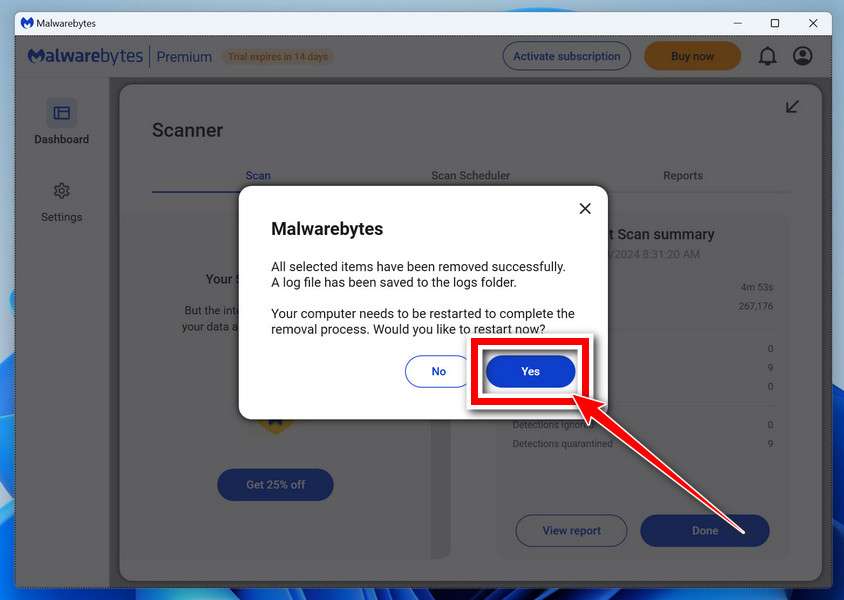
Some threats can only be fully removed after a reboot. If Malwarebytes asks you to restart, click Yes. Once you’re logged back in, Malwarebytes has finished removing the threats it found.
That’s it — your Windows PC is now clean of trojans, adware, and other malware, and should be back to running smoothly.
If you are still having problems with your computer after completing these instructions, then please follow one of the steps:
- Run a computer scan with ESET Online Scanner
- Ask for help in our Windows Malware Removal Help & Support forum.
Run a Malware Scan with Malwarebytes for Mac
Malwarebytes for Mac is a free on-demand scanner that removes the malware other security software tends to miss — adware, browser hijackers, and unwanted programs included. Cleaning an infected Mac with Malwarebytes has always been completely free, and it’s our go-to recommendation. Follow the steps below to scan and clean your Mac in just a few minutes.
-
Download Malwarebytes for Mac
Click the button below to download the latest version of Malwarebytes for Mac.
Download MalwarebytesOfficial installer for macOS. Your download starts right away.Want real-time protection? See Malwarebytes PremiumMalwarebytes Free for MacScans and removes malware at no cost -
Open the Malwarebytes setup file
When the download finishes, open your Downloads folder and double-click the setup file to begin the installation.

-
Follow the On-Screen Prompts to Install Malwarebytes
The Malwarebytes for Mac Installer will guide you through a few quick screens. Click “Continue” and keep following the prompts until the installation completes.



When the installation is complete, Malwarebytes opens to the Welcome to Malwarebytes screen. Click “Get started“.
-
Select “Personal Computer” or “Work Computer”
Malwarebytes will ask what type of computer you’re installing it on. Click either Personal Computer or Work Computer, whichever applies.

-
Start the Scan
Click the “Scan” button. Malwarebytes will automatically update its detection database and begin checking your Mac for malware.

-
Wait for the Scan to Finish
Malwarebytes will scan your Mac for adware, browser hijackers, and other malicious programs. This can take a few minutes, so feel free to do something else — just check back occasionally to see the progress.

-
Quarantine the Detected Threats
When the scan is done, you’ll see a list of everything Malwarebytes found. Click the “Quarantine” button to remove all the threats at once.

-
Restart Your Mac
Malwarebytes will now remove all the malicious files it found. Some threats can only be fully removed after a reboot — if Malwarebytes asks you to restart, allow it. Once you’re logged back in, your Mac is clean.

That’s it — your Mac is now free of adware, rogue browser extensions, and other potentially harmful software.
If you are still experiencing problems while trying to remove a malicious program from your computer, please ask for help in our Mac Malware Removal Help & Support forum.
Run a Malware Scan with Malwarebytes for Android
Malwarebytes for Android automatically detects and removes dangerous threats like malware and ransomware so you don’t have to worry about your most-used device being compromised. Aggressive detection of adware and potentially unwanted programs keeps your Android phone or tablet running smooth.
-
Download Malwarebytes for Android.
You can download Malwarebytes for Android by clicking the link below.
Get Malwarebytes for AndroidOpens Google Play in a new tab.Want real-time protection? See Malwarebytes Premium for AndroidMalwarebytes for AndroidScans your phone and removes malware at no cost -
Install Malwarebytes for Android on your phone.
In the Google Play Store, tap “Install” to install Malwarebytes for Android on your device.

When the installation process has finished, tap “Open” to begin using Malwarebytes for Android. You can also open Malwarebytes by tapping on its icon in your phone menu or home screen.

-
Follow the on-screen prompts to complete the setup process
When Malwarebytes will open, you will see the Malwarebytes Setup Wizard which will guide you through a series of permissions and other setup options.
This is the first of two screens that explain the difference between the Premium and Free versions. Swipe this screen to continue.
Tap on “Got it” to proceed to the next step.
Malwarebytes for Android will now ask for a set of permissions that are required to scan your device and protect it from malware. Tap on “Give permission” to continue.
Tap on “Allow” to permit Malwarebytes to access the files on your phone.
-
Update database and run a scan with Malwarebytes for Android
You will now be prompted to update the Malwarebytes database and run a full system scan.

Click on “Update database” to update the Malwarebytes for Android definitions to the latest version, then click on “Run full scan” to perform a system scan.

-
Wait for the Malwarebytes scan to complete.
Malwarebytes will now start scanning your phone for adware and other malicious apps. This process can take a few minutes, so we suggest you do something else and periodically check on the status of the scan to see when it is finished.

-
Click on “Remove Selected”.
When the scan has been completed, you will be presented with a screen showing the malware infections that Malwarebytes for Android has detected. To remove the malicious apps that Malwarebytes has found, tap on the “Remove Selected” button.

-
Restart your phone.
Malwarebytes for Android will now remove all the malicious apps that it has found. To complete the malware removal process, Malwarebytes may ask you to restart your device.
That’s it — your Android phone is now clean — no more malicious apps, adware, or browser redirects.
If you are still having problems with your phone after completing these instructions, then please follow one of the steps:
- Restore your phone to factory settings by going to Settings > General management > Reset > Factory data reset.
- Ask for help in our Mobile Malware Removal Help & Support forum.
Stay Protected: Block Ads and Malicious Sites
Now that your device is clean, keep it that way. Most infections start with a malicious ad or a fake download button — so blocking them at the source is your best defense.
We recommend AdGuard, which blocks malicious ads, phishing pages, and dangerous redirects before they can reach you.
👉 Download AdGuard and browse safely
The Bottom Line
WalSaved.com shows the classic signs of a Walmart gift card reward funnel, not a straightforward Walmart promotion.
The strongest warning sign is not just the $1,000 promise. It is the requirement to complete 5 recommended deals before you can “claim” the reward. Real Walmart sweepstakes are published on official Walmart properties, tied to clear rules, and do not use this kind of third-party deal wall as the claim mechanism.
If you land on WalSaved.com or a similar page, the safest move is to close it. If you already interacted with it, treat it seriously: cancel anything you signed up for, watch your accounts, secure your email, and report the page through official channels.
FAQ
Is WalSaved.com legit?
WalSaved.com raises serious red flags. A site that promises a $1,000 Walmart gift card but requires you to complete multiple “recommended deals” is usually operating as a reward funnel, not a straightforward brand promotion.
Is WalSaved.com an official Walmart website?
No. WalSaved.com is not an official Walmart domain. Real Walmart promotions should be clearly tied to Walmart’s official websites, apps, or verified channels.
Why does WalSaved.com ask me to complete 5 recommended deals?
Because that is how the site appears to make money. Each completed deal, such as a trial signup, app install, survey, or subscription, can generate affiliate revenue for the operator.
What are the “recommended deals” on WalSaved.com?
They are usually third-party offers that may include:
- App downloads
- Surveys
- Trial subscriptions
- Membership signups
- Product sample offers
- Other advertiser promotions
Some may look harmless, but others can lead to recurring charges or heavy spam.
Will I actually receive the $1,000 Walmart gift card?
Most people do not. Many users who interact with these kinds of pages end up stuck in “pending,” “verification,” or “deal not credited” loops instead of receiving any reward.
Why does the site say my deal did not count?
That is a common pattern with reward-funnel sites. They may blame cookies, browser settings, device changes, ad blockers, VPN use, or incomplete steps inside the offer. In practice, this often keeps users doing more offers without ever reaching the reward.
Can WalSaved.com lead to unwanted charges?
Yes. If any of the required deals involve a free trial, subscription, or shipping fee offer, you could end up with unexpected charges later.
I only entered my email. Is that still a problem?
It can be. Even if you did not enter payment details, your email may be added to marketing or lead lists. That can lead to more spam, scam emails, and follow-up reward offers.
I entered my phone number. What should I expect?
You may receive marketing calls, robocalls, or scam texts. Be very cautious with any follow-up messages that ask you to click a link, verify a reward, or pay a fee.
I entered payment information for one of the deals. What should I do now?
Take these steps right away:
- Cancel any trial or subscription you started
- Check your bank and card statements for pending or posted charges
- Contact your card issuer if you see suspicious billing or cannot cancel
- Consider replacing your card if you used it on multiple offers
How can I spot a fake Walmart gift card page quickly?
Watch for these red flags:
- The site is not on an official Walmart domain
- The reward is locked behind third-party deals or offers
- The page uses vague “claim now” language without real rules
- The reward status stays unclear, pending, or conditional
- Support and official terms are missing or hard to verify
Where should I report WalSaved.com?
You can report it to:
- The platform where you found the link or ad
- Your browser’s phishing or deceptive site report tool
- Your email provider or mobile carrier if it came through spam
- Walmart customer support to report brand impersonation
- The FTC if you are in the United States









I sent a report about this to facebook, I think last year. Just this morning, I got a notification that it was fraud and my post was removed–the irony is, I reported the page to Facebook, and then posted it on my own timeline to alert friends that this was a fraud.
That is a frustrating reversal, Marilyn. Automated moderation can mistake a warning post for promotion of the very scam it is exposing, especially when the post contains the scam link or imagery. Appeal the removal if the option is available, clearly state that the post was a warning, and report the original advertiser and page separately rather than resharing its live link.