

Your child messages about an exchange program. Classmates are signing up, a consent form is attached, and a payment is needed to secure the place.
The request comes from the account you already know. That familiar chat can make the next question seem unnecessary.
Overview
The message can arrive from your child’s real WhatsApp account
The WhatsApp youth exchange scam impersonates students to ask their parents for course or exchange-program fees. The account can already belong to the child.
Singapore Police describe criminals using compromised student accounts, not merely an unknown number claiming a broken phone.
In its official warning about fake youth programs, police reported at least eight cases and S$18,000 lost since September 2026.
Those totals were reported on September 28. They describe a confirmed pattern, not an ordinary dispute about a real school’s fees.
A consent form and subsidy promise make the request look reasonable
The scam uses apparent school or government paperwork, sometimes describing an exchange or AI-related course. A parent is asked to pay to reserve a place.
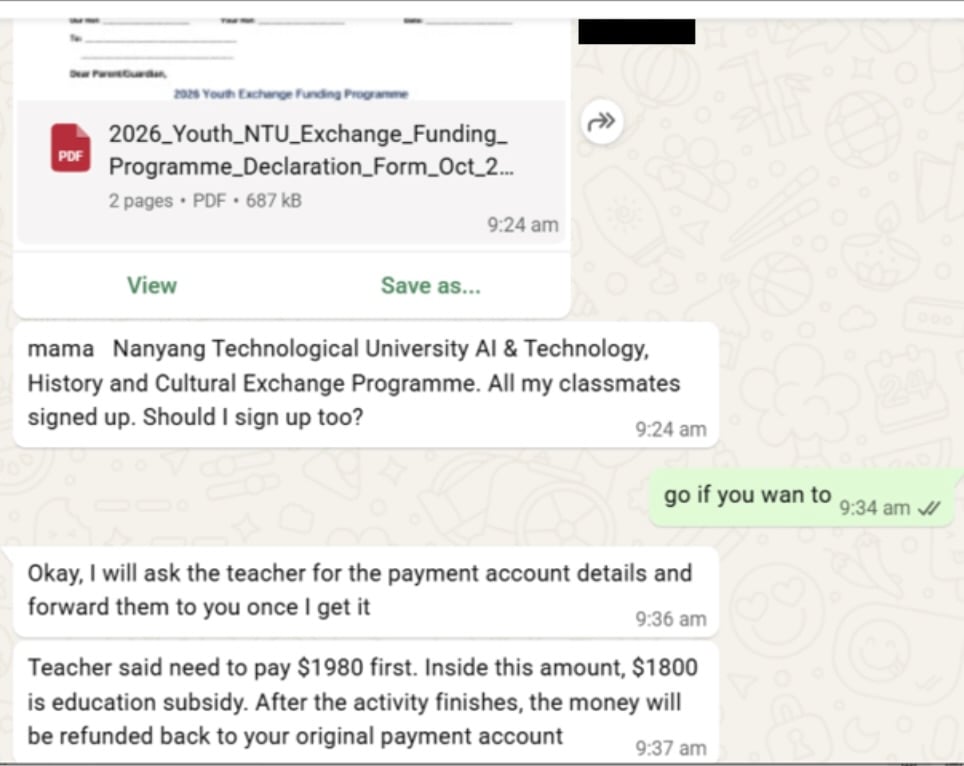
One original conversation promises that most of a S$1,980 payment will return as a S$1,800 education subsidy after the activity.
That is the scammer’s claim, not an actual entitlement. The screenshot’s NTU name doesn’t authenticate the offer or connect the institution to the fraud.
- A familiar student account introduces an attractive educational opportunity.
- A PDF or consent form borrows credible institutional branding.
- Payment is requested before the parent verifies the program.
- A subsidy or reimbursement promise makes the upfront amount easier to accept.
- Some victims are asked to pay again after a supposed processing mistake.
Confirm the child and the program through separate checks
Speak to your child independently, then confirm the actual program and payment instructions with the educational institution.
The National Youth Council’s official site also warns about fake exchange programs using unauthorized MCCY and NYC logos.
Real youth opportunities exist. The warning is about an impersonator’s payment demand, not about every exchange, AI course, or institution named in a copied form.
Why the Existing Chat Is Such Strong Reassurance
Parents are often told to be suspicious of a new number asking for money. This variation removes that obvious warning.
The account name and earlier conversation can look familiar because you’re opening the same chat you use for genuine family messages.
That history shows the account was used by your child before. It doesn’t prove who controls its current messages.
A request connected to education can also feel ordinary. Parents expect schools to organize activities and sometimes need to pay before an event.
The mention of classmates adds social pressure. A parent may worry that checking too slowly will cause their child to miss an opportunity.
The subsidy promise makes the decision appear smaller than the transfer. You’re encouraged to think about the eventual cost instead of money leaving now.
In the original chat, the parent initially agrees that the child can attend. Only afterward does the conversation introduce payment details and the large upfront amount.
Agreeing that an activity sounds worthwhile isn’t the same as verifying who should receive its fees. You can pause even after saying yes to participation.
The supposed child also says a teacher will supply the payment account. That can make the banking instruction feel like a separate school’s decision.
But the same compromised conversation is relaying both claims. Verify the teacher and payment route through the school, rather than treating the second message as confirmation.
Keep the amount clear when discussing it with family. The parent is being asked to transfer S$1,980, not merely the S$180 implied after a promised refund.
If another parent received a similar form, that alone doesn’t authenticate it. Several families can receive copies of the same unauthorized material.
Don’t subtract a promised refund when assessing an unverified payment. Until the real institution confirms it, the full amount is at risk.
You aren’t questioning your child’s honesty by checking. You’re confirming that the person typing and the organization requesting payment are who they claim to be.
How the WhatsApp Youth Exchange Scam Works
Step 1: A compromised student account reaches the parent
The attacker uses access to a student’s WhatsApp account to continue a believable family conversation. The parent doesn’t necessarily see an unfamiliar contact.
The police warning doesn’t establish one takeover method for every account. Don’t assume the student’s phone itself must have been infected.
Your child can still have their phone while someone else controls account activity. Check account access rather than assuming the device must be missing.
Step 2: A desirable course provides the reason for payment
The supposed student says they’ve been selected for an exchange or AI-related course. A place needs to be secured with money.
The request can sound conversational rather than threatening. A criminal imitating a child doesn’t need the language of a debt collector to create urgency.
Ask the real child what the program is and how they learned about it. Do that outside the potentially compromised chat.
Don’t settle for a reply promising to explain later. Pause the financial decision until you can actually verify the request.
Step 3: Copied paperwork supplies apparent institutional approval
A form carries the names or logos of schools and government bodies. The attachment makes the conversation resemble a real consent process.
In the original example above, the file and accompanying message invoke Nanyang Technological University. That doesn’t make the document an authentic university offer.
Contact the institution through its established website or your existing school communication channel. Ask about the exact program and the approved way to pay.
A phone number or email printed inside the suspicious form can’t independently verify that form. It belongs to the material you’re checking.
Step 4: A PayNow request turns consent into a transfer
The parent receives payment instructions, including PayNow QR codes in documented cases. The payment is presented as necessary to reserve participation.
A working payment method does not validate the reason for paying. A QR code can route funds without establishing a relationship to a school.
Read the recipient and amount displayed by the bank before approving anything. A discrepancy should stop the process, not trigger another explanation from the chat.
Even matching-looking details need independent confirmation. Don’t send a small test payment to determine whether the program exists.
Step 5: A supposed error creates another payment request
Some victims are told the first payment was processed incorrectly and will be refunded. They are then asked to make an additional payment.
The promise of getting the first amount back can make the second transfer feel like finishing unfinished paperwork rather than taking another risk.
Stop instead. Check the completed transaction in your actual banking records and contact the bank if you believe it was fraudulent.
The sender’s assurance that money is coming back doesn’t secure either payment. Don’t fund a second transfer to repair the first.
Verify the Program Without Following the Form’s Instructions
Talk to your child outside the questionable account
If you’re together, ask directly. Otherwise use a known voice contact or another established family route rather than continuing only in the WhatsApp thread.
Be specific: did they request this course payment, send this form, and receive these instructions? A general question about school activities can create false reassurance.
If you can’t reach them, wait. An unverified chat shouldn’t decide how much money you send while the person it represents is unavailable.
Confirm the exact opportunity with the institution
Ask whether the program exists, whether the student is participating, and which payment process applies. Those are separate parts of the claim.
A real exchange program with a similar name doesn’t validate the form you received. Confirm the specific offer and destination for the funds.
Use your school portal, an established teacher contact, or the institution’s official public website. Don’t rely on a newly supplied “program coordinator.”
Check reimbursement separately from admission
A subsidy claim should be confirmed by the organization responsible for it. A student’s apparent message isn’t enough to establish who will reimburse you.
Ask how any genuine reimbursement works before paying. Don’t accept a copied seal, government name, or apparent signature as a substitute for that answer.
If the institution says the request isn’t genuine, preserve that response with your records. It can help explain the payment to your bank.
The Student’s Account Needs Attention Too
Stopping one parent’s payment may not end the impersonation. Other relatives could receive similar requests while the account remains accessible to the attacker.
Have the student check WhatsApp’s linked devices and remove unfamiliar sessions. Police also recommend enabling the app’s two-step verification.
If access is lost, use WhatsApp’s official account-recovery guidance. Don’t pay an unknown “account expert” who sends a private offer to restore it.
Never forward a registration code to a helper. A person claiming to fix the takeover could be trying to obtain account access themselves.
Warn close contacts through a channel you still control. Explain that recent payment requests from that account should be independently checked.
Don’t announce the account is secure merely because one message was deleted. Confirm the recovery and device checks before resuming normal use.
For a minor, involve a parent or trusted adult without turning the incident into blame. Clear facts help recovery more than arguments about who clicked first.
What to Do if You Have Fallen Victim to This Scam
-
Stop all further course payments. Don’t send another transfer because the first supposedly needs replacing, verifying, or releasing.
Keep the message thread and attachment available. Avoid clicking through the document again while trying to understand the loss.
-
Contact your bank immediately. Explain that a payment request impersonating your child came through a compromised WhatsApp account.
Give the transfer time, amount, recipient, and reference. Ask whether funds can still be stopped or recalled, without assuming recovery is certain.
-
Reach the real child through another route. Establish whether they sent anything and whether they can still control their account.
Tell them not to approve unexpected login prompts or share codes with anyone offering help. Coordinate the account response as well as the payment report.
-
Secure the affected WhatsApp account. Review linked devices, remove unfamiliar access, and follow the app’s official recovery process if necessary.
Once control is restored, review two-step verification and warn relevant contacts. Don’t ask the attacker to voluntarily surrender the account.
-
Preserve payment and identity evidence privately. Keep the original course request, apparent consent form, payment details, and any actual documents you supplied.
If you sent identity information, report exactly what was included. A signed form and a full identity-card copy create different concerns.
-
Notify the institution whose name was used. Reach it through the official channel and provide a safe copy of the impersonation evidence when requested.
Make a police report for the fraud. In Singapore, ScamShield’s 1799 helpline can help with scam checks and official next-step guidance.
-
Ignore unsolicited recovery promises. Don’t pay someone who claims they can reverse PayNow transfers or recover WhatsApp by using a secret technique.
Use the bank, platform, school, and investigators you independently contacted. Keep their case references together so you can follow up consistently.
A Family Payment Habit That Helps Without Creating Panic
Agree that unusual school payments get a quick conversation before anyone transfers money. That rule should apply even when the message comes from a familiar account.
Keep the verification simple enough to use. It might mean speaking directly and checking the school portal, not interrogating every everyday family message.
Don’t use a fact visible in old chats as the only identity test. An attacker with account access may be able to read those details.
Give children permission to say their account may be compromised. Fear of getting in trouble can delay the warning to other relatives.
For genuine courses, keep consent and payment records through the school’s actual process. That makes an unexpected alternative easier to question.
The aim isn’t to reject opportunities. It’s to make sure the child, program, and payment instructions belong to the same real arrangement.
Frequently Asked Questions
Can this come from my child’s existing number?
Yes. Police describe compromised student WhatsApp accounts. A familiar number and earlier chat history do not establish who controls the current conversation.
Does an NTU, MCCY, or NYC logo authenticate the form?
No. Names and logos can be copied. Confirm the specific program and payment request through the real institution independently.
Is every AI course or youth exchange fake?
No. Genuine programs exist. The scam is an impersonator using a course story and unauthorized paperwork to obtain money from parents.
What if most of the fee is supposedly refundable?
Verify the reimbursement with the responsible institution before paying. An unverified promise doesn’t reduce the amount you could lose.
Should I pay again after a processing-error message?
Don’t follow that instruction without independent verification. Check your bank records and contact the institution and bank through trusted channels.
Does another parent receiving the same form make it genuine?
No. Several families can receive unauthorized paperwork. Confirm the exact course, subsidy, and payment instructions with the real institution before transferring money.
The Bottom Line
Don’t fund a course from a WhatsApp request alone, even inside your child’s real chat. Confirm the child, program, and payment with independent contacts.
If the WhatsApp youth exchange scam already led to payment, call the bank now. Secure the student’s account and warn other relatives before more requests arrive.

Join the discussion
0 commentsShare your experience or ask a question about this article.
Discussion
Start the conversation
Have a question or something useful to share? Add the first comment.