

Your documents still have familiar names, but a new ending has appeared and they no longer open. Nearby, an HTML note demands your attention.
If that ending is .zollo6, preserve what you see before trying the first recovery promise you find.
Overview
The filename pattern identifies a reported MedusaLocker variant
Zollo ransomware encrypts files and adds a suffix such as .zollo6. The number can vary, so identification should include the accompanying evidence.
The reported variant belongs to the MedusaLocker family. It also changes the desktop wallpaper and leaves a note named READ_NOTE.html.
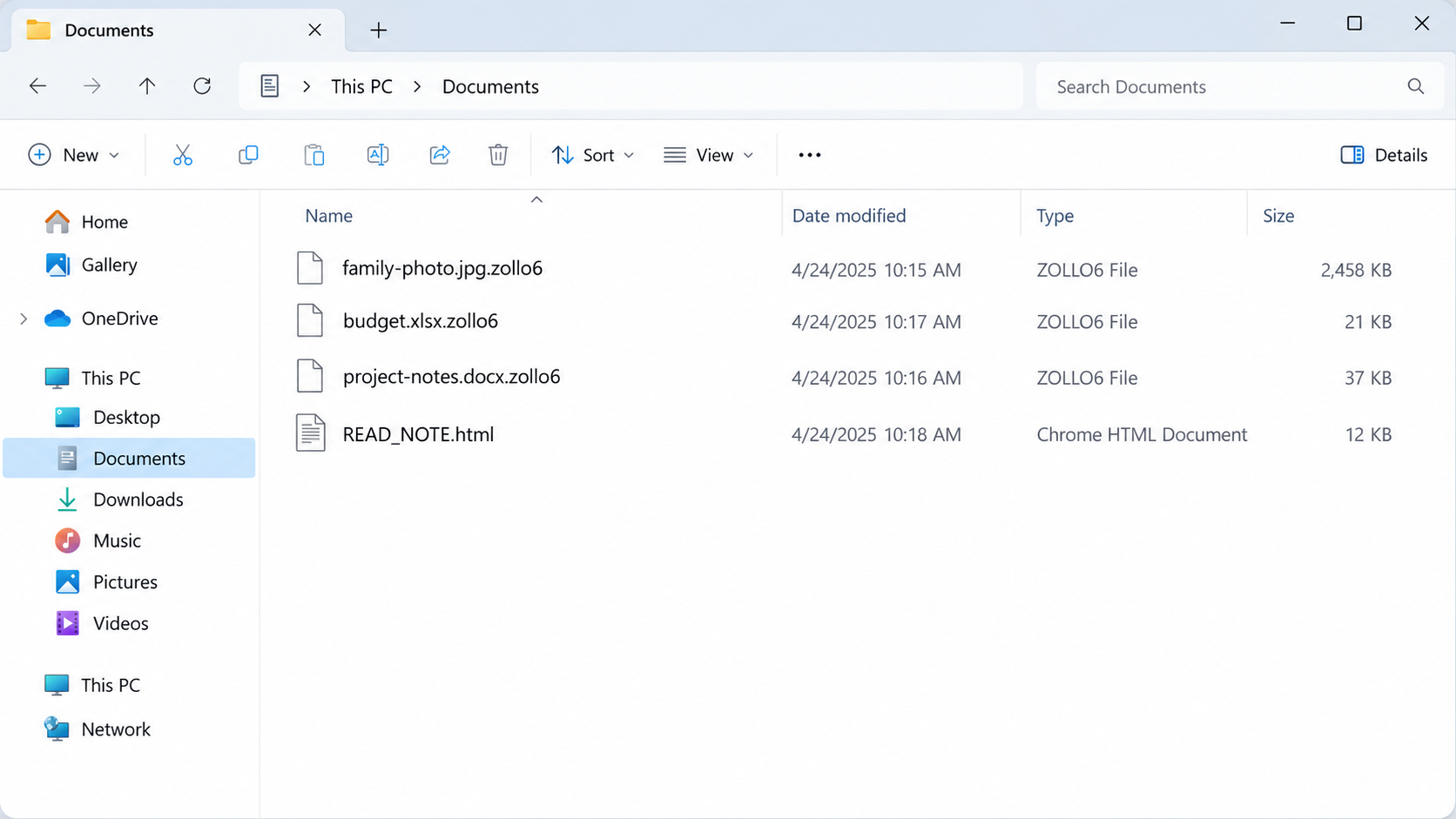
A photo originally called 1.jpg may become 1.jpg.zollo6. The added name explains the visible change, but removing it would not undo encryption.
The illustration uses made-up personal filenames and dates. It is not a directory from an actual victim or a computer deliberately infected for this guide.
The note mixes recovery promises with pressure
The demand claims RSA and AES encryption and says the attackers hold confidential information. It threatens disclosure and a higher price if contact is delayed beyond 72 hours.
Those are statements by the extortionist. The note alone cannot establish which files were taken, whether anything was uploaded or whether payment would cause deletion.
Reported contact identifiers include recovery1[at]salamati[.]vip and recovery1[at]amniyat[.]xyz. Preserve them as incident evidence, not as recommended technical-support addresses.
The offer of a small test decryption does not guarantee a working full recovery tool. It also should not persuade you to send sensitive samples.
Removal and recovery solve different parts of the incident
Zollo ransomware removal aims to eliminate malicious execution and unauthorized access. Restoring documents requires intact copies or a genuinely compatible recovery method.
- Contain affected machines and protect disconnected copies.
- Preserve the note, full filenames and useful security records.
- Investigate access and any alleged data theft.
- Restore only after the environment can be trusted again.
No Zollo sample was run for this article. The initial intrusion route and outcome for a particular victim must be investigated, not inferred from the extension.
No compatible Zollo decryptor was verified here. That is different from declaring that a tool can never become available.
Read the Changed Files Without Making Them Harder to Recover
The added suffix is a clue, not the damaged content
Windows may show an unfamiliar file type because the last part of the name changed. The original document format can still be visible earlier in the filename.
That original ending may help classify what was affected: photographs, spreadsheets, project data or other records. It does not mean the contents remain readable.
Do not perform a bulk rename as a repair attempt. It can obscure the identifying pattern while leaving the underlying encrypted data unchanged.
A recovery specialist may need untouched samples with their complete names. Keep originals separate from any working copies used for analysis.
The ransom note belongs in the evidence collection
READ_NOTE.html is a common-looking name that other attacks may also use. Match its contents, contacts and changed filenames rather than relying on the note name alone.
Preserve the file without following its links or contacting the sender. A responder can examine its text in a controlled way.
The note’s warnings against independent help serve the attacker’s interests. They are not neutral advice about which trustworthy recovery tools are technically compatible.
That does not mean experimentation is harmless. Test recognized tools on duplicates and follow their requirements rather than treating the attacker’s dishonesty as permission to improvise.
The wallpaper is a warning sign, not a complete diagnosis
A changed background can make the attack obvious, but it does not show its full reach. Shared storage or other accounts may need assessment too.
Conversely, absence of the wallpaper on a second machine does not prove its files or credentials are unaffected. Check access and changes rather than appearance alone.
MedusaLocker and other similarly named ransomware groups are not interchangeable. A guide or decryptor for a different family should not be selected because its name sounds close.
For a workplace incident, provide these identifiers to the response team. Let technical evidence determine classification rather than choosing a family from search-result wording.
How the Zollo Ransomware Attack Works
Step 1: Unauthorized Execution Reaches Accessible Data
Before the new extension appears, malicious activity has gained a way to run. The available Zollo description does not identify one universal entry method.
Investigators may examine recent downloads, email interactions, exposed services, account activity and security alerts. Which route matters depends on the incident’s own timeline.
Do not conclude that a particular employee caused the attack because they remember opening an attachment. Correlation needs checking against the execution and access records.
The same caution applies to blaming a remote-access service automatically. Family history can guide investigation without proving how this machine was compromised.
Record when files last opened normally and when the changes were first noticed. That range is often more useful than a guess about the first suspicious event.
Step 2: Encryption Makes Existing Files Unusable
The ransomware transforms file contents and adds its identifying ending. The familiar original name can remain visible even though the application can no longer read the data.
A scan can detect malicious software associated with that operation. It does not automatically reconstruct the previous contents of the documents.
Files on storage accessible to the compromised account may also be at risk. Investigate mapped drives and shared locations without assuming every connected system was encrypted.
Disconnect valuable backup media before testing recovery. An unaffected copy is useful only while it remains out of reach of the malicious environment.
If encryption is visibly continuing, obtain immediate containment help. Response teams may need to balance stopping damage against preserving evidence in memory.
Step 3: The Demand Adds a Data-Leak Threat
The note says personal or confidential information has been collected. This turns an availability problem into a possible confidentiality incident as well.
Take that possibility seriously, but investigate it separately. The words in the note do not identify which records left the environment or who received them.
Useful evidence can include account access, unusual transfer activity and the reach of compromised privileges. A responsible assessment may require specialists and preserved logs.
Do not send the attacker a list of sensitive files to ask what they have. That can disclose more information and does not produce independent verification.
For an organization, coordinate decisions about affected people, partners and reporting duties with the appropriate incident and legal teams. Avoid promising that no data escaped without evidence.
Step 4: A Deadline Tries to Make Contact Feel Like the Only Option
The reported 72-hour price warning encourages a rushed conversation. The attacker controls the demanded amount and can change its claims regardless of the printed deadline.
A small sample returned in readable form would show something about that sample. It would not establish that every file can be restored safely.
Payment also cannot independently prove that stolen data was deleted. A promise to destroy a private server is not a verifiable deletion record.
Do not interpret the deadline as a reason to reconnect backup drives or run an unknown decryptor. Those shortcuts can damage the options still available.
Use the time to contain the incident, identify important data and obtain qualified help. The response should be organized around your recovery needs, not the extortionist’s schedule.
What to Do If Your Files End in .zollo6
Separate affected systems from the network. Disconnect Wi-Fi and Ethernet, and keep removable backup media away from the suspected environment.
At work, alert the response team before changing multiple machines. A visible encrypted folder may not identify where the intrusion began.
Preserve the identifying material. Keep full filenames, the note, contact identifiers, relevant alerts and the approximate discovery time.
Do not distribute the executable or confidential samples to casual helpers. Qualified responders can specify the evidence they need and how it should be handled.
Find the last known-good copies. List disconnected drives, versioned cloud files, previous project copies and managed backups without restoring them into the compromised system yet.
Confirm that a copy is readable and recent enough for your needs. A backup job marked successful does not by itself prove its contents are intact.
Investigate accounts and possible disclosure. Assess which identities and shared locations the intruder could reach. Reset exposed access from a trusted device.
Keep the encryption and data-leak investigations distinct. Do not assume the absence of a public leak proves the attacker never accessed information.
Arrange cleanup or rebuilding before restoration. Use trusted security tools and technical assistance rather than software offered in the ransom note.
If system integrity is uncertain, a clean reinstall may be appropriate after necessary evidence and recoverable data are preserved.
Malwarebytes is relevant to malicious software detection. A completed scan does not certify that a business network, every account or all remote access is secure.
AdGuard may reduce later exposure to malicious advertising. It does not remove encryption or make an attacker-controlled recovery program trustworthy.
Report the extortion and reject guaranteed recovery offers. Preserve payment records if you already paid, and contact the relevant provider and authorities promptly.
Ask any recovery company to explain its method and limitations in writing. Do not confuse negotiating with the attacker with an independently demonstrated technical solution.
Remove Zollo Before Reconnecting Recovered Data
The dedicated removal instructions below address containment, scanning and access checks. They are separate from the file-recovery instructions that follow.
Contain the incident before running cleanup tools
Disconnect the affected computer from Wi-Fi and wired networks. Unplug external storage and leave backup drives disconnected while you assess what happened.
Pause synchronization from a clean device where possible. Otherwise, encrypted versions may replace usable cloud copies while you are trying to rescue them.
At work, contact your IT or incident-response team immediately. A ransomware screen on one computer may be the visible part of a larger intrusion.
Keep the ransom note, filenames, discovery time, and any security alerts. A specialist may need disk or memory evidence before cleanup changes the machine.
If you cannot isolate a computer and encryption is visibly continuing, seek immediate assistance about shutting it down. Powering off can lose volatile evidence.
Do not repeatedly restart, reinstall, or experiment with utilities. Those actions can overwrite recovery evidence without addressing the underlying access problem.
Use trusted scanners on an isolated personal computer
For a home computer, arrange cleanup after preserving the evidence you need. Obtain security tools through their official websites using an unaffected system.
Malwarebytes can scan for malicious programs and related unwanted software. It is an infection-removal tool, not a way to decrypt already encrypted documents.
Install a current copy, update its detection data when safely possible, and run the available comprehensive scan. Review detections before applying the recommended quarantine actions.
Keep the scan report. It can help distinguish the ransomware payload from another infection, a suspicious installer, or a remote-access program.
Windows Security also provides scan options. Microsoft Defender Offline restarts into an offline scanning environment, so save your work before starting it.
Follow Microsoft’s ransomware protection guidance rather than instructions in the criminal’s note. A note telling you to disable protection is not trustworthy advice.
If Windows will not start or the scanners cannot operate, stop improvising. Use reputable technical assistance instead of downloading a supposed one-click emergency decryptor.
Do not upload the executable to unfamiliar recovery websites or run it elsewhere for testing. A second execution can create another incident.
Verify the environment before restoring anything
A completed scan is useful, but it cannot establish that every account, remote session, or networked computer is safe.
Check for unauthorized remote-access software, suspicious accounts, changed security settings, and unknown scheduled tasks. Business environments require coordinated investigation beyond this home-computer checklist.
Change exposed passwords from a clean device. Prioritize email, cloud storage, administrator access, and any account whose credentials were saved on the affected system.
Enable multifactor authentication where supported and revoke suspicious sessions. Simply changing the password may leave an existing signed-in session active.
A trusted reinstall may be appropriate when system integrity remains uncertain. Preserve recoverable data first, and reinstall from authentic installation media.
AdGuard can help reduce exposure to malicious advertising during future browsing. It neither cleans an infected system nor reverses file encryption.
Keep backup media offline until cleanup and access checks are complete. Reconnecting your only good copy too early can turn a recovery opportunity into another loss.
Recovery Options for Zollo Encrypted Files
Prioritize usable copies that predate encryption. If none are available, preserve an encrypted archive while checking exact-variant recovery possibilities through trusted sources.
The No More Ransom catalog did not provide a verified Zollo-specific solution for this guide. Do not substitute an unrelated family tool.
A future tool may have version or key limitations. Read its documentation and work on duplicates, keeping the only original encrypted collection untouched.
Removing .zollo6 from a filename or seeing a utility finish successfully is not a recovery result. Open and validate the recovered file’s actual contents.
Follow the dedicated recovery block for the different types of surviving copies and the limits of each approach.
Make a recovery copy, not another damaged original
Keep an untouched copy of the encrypted data whenever practical. Include the ransom note and retain the original directory structure.
Use a separate destination for recovery experiments. Never let a utility overwrite your only encrypted copy or replace an intact backup.
Before sharing samples, consider their sensitivity. Choose an ordinary, nonconfidential file and ask the service about handling rules if business or personal information is involved.
The note’s name, complete filename suffix, and contact details can help identify a variant. An extension alone is not enough to establish decryption compatibility.
For example, two infections can use the same suffix while generating different keys. A familiar family name can also hide a newer, unsupported version.
Record the exact error or result from each attempt. Keep a simple checklist so another helper does not repeat risky tests on the same files.
Check recognized decryption projects
Visit the No More Ransom decryption catalog from a clean browser. Look for the actual variant and read the tool’s requirements carefully.
A tool for a related family does not automatically unlock your files. Some decryptors support only older versions, certain keys, or specific encryption mistakes.
Download through the catalog’s trusted vendor link, not a sponsored search result or an unsolicited message offering guaranteed recovery.
Test only a duplicate sample first. Successful decryption should produce a usable document or image, not merely remove the added extension.
If the utility reports an unsupported file or key, stop. Changing the filename to resemble a supported variant does not change its encrypted contents.
When no compatible tool is available, preserve your encrypted archive. Researchers sometimes release new tools later, but future recovery cannot be promised.
Look for copies that existed before encryption
Check disconnected drives, backup software, cloud version history, another computer, and files previously sent to trusted contacts. You may have more copies than you remember.
Cloud synchronization is not automatically a backup. Confirm that an earlier usable version survives and that the account itself has not been compromised.
Restore into a cleaned environment. Open a selection of documents, photos, and project files before assuming the recovered collection is complete.
Compare important dates and contents. An older spreadsheet might open perfectly while still missing the transactions you needed to recover.
Windows Previous Versions or existing snapshots may offer additional copies. Availability depends on prior configuration and whether those snapshots survived the incident.
Do not create new restore points expecting them to contain yesterday’s files. Recovery depends on copies that already existed before the damage.
Deleted-file recovery utilities are a different category. They may locate unencrypted originals in some circumstances, but they do not mathematically decrypt overwritten data.
If you want a specialist to investigate that possibility, minimize writes to the affected storage. Continued installations can overwrite remnants that might otherwise be recoverable.
Evaluate recovery offers without surrendering control
Be wary of anyone who contacts you first, claims exclusive access to a secret decryptor, or requests an advance payment in cryptocurrency.
Ask a recovery provider what method it intends to use, what evidence supports success, and whether it would negotiate with the attacker.
Get the scope, fee, privacy terms, and limitations in writing. A legitimate assessment should distinguish a possibility from a demonstrated recovery result.
Do not provide remote administrator access to an unknown helper. Recovery desperation can make a second scam feel like the only remaining option.
If you already paid, retain receipts, transaction references, wallet addresses, and correspondence. Contact the payment provider promptly and report the extortion.
Recovery is sometimes partial. Prioritize irreplaceable files, verify them individually, and keep your evidence archive until the investigation and restoration decisions are settled.
Build a Recovery Order Around What Matters Most
A large collection can make every file feel equally urgent. Start by identifying the records that would be hardest to replace or most important to operations.
For a household, that might mean irreplaceable photographs and personal records. For a business, it may involve customer commitments, financial data and current project work.
Write down which versions exist and where they are stored. A recent encrypted copy and an older readable copy solve different parts of the problem.
Test representative files before declaring a restore complete. A spreadsheet can open while missing its latest transactions, and an application may depend on several linked files.
Restore into a verified clean environment and control who can access it. Bringing damaged or unreviewed accounts back immediately can undermine the recovery.
Keep the evidence archive even after important documents return. The questions of unauthorized access and possible disclosure may continue after day-to-day work resumes.
Once recovery stabilizes, review why usable backups survived or failed. The No More Ransom prevention advice provides a starting point for improving resilience.
Make the Return to Normal Work a Deliberate Decision
Choose who will confirm that restored information is usable. The person who runs a copy job may not know whether a financial or project record is complete.
Check representative folders with their usual owners. Ask them to verify content, dates and related files before the recovery is treated as finished.
For an application database, obtain the appropriate consistency checks from its administrator. A file being readable is not always enough to resume a business service safely.
Keep a note of missing periods or records that must be reconstructed. An incomplete restore should not silently become the trusted reference for later work.
Review access separately from restored data. Bringing back a user account or old configuration without checking it may reintroduce a problem unrelated to the encrypted files.
Finally, retain a disconnected recovery copy while normal service resumes. Do not immediately overwrite every older backup with the first collection that appears to work.
Frequently Asked Questions
Does .zollo6 always identify Zollo ransomware?
It is a reported Zollo indicator, but identification should also consider the note, contacts and file behavior. The number in the ending can vary.
Can renaming an encrypted document make it work?
No. A changed name is only the visible label. Renaming does not restore the earlier data, and it can make untouched evidence harder to recognize.
Will an antivirus scan decrypt my files?
No. Detection and removal address malicious software. File restoration requires surviving readable copies or a recovery method that actually supports the affected encryption.
Does the note prove that confidential data was stolen?
No. It records an extortion claim. Investigate account access and transfer evidence, taking the possibility seriously without treating the attacker’s words as independent proof.
Should I contact the listed addresses before 72 hours?
Do not let the demand dictate your technical response. Preserve the contacts for responders and seek qualified assistance rather than rushing into payment discussions.
Is a Medusa decryptor suitable for this MedusaLocker variant?
Not on that basis. Similar names do not establish compatibility. Verify the exact tool, supported variant and requirements, and never test on your only copy.
The Bottom Line
Start Zollo ransomware removal with isolation and evidence preservation, not payment or bulk renaming. Establish a clean destination before returning readable copies to use.
Keep the leak allegation separate from encryption, and verify recovery against the exact variant. If important or shared systems are affected, involve qualified responders promptly.

Join the discussion
0 commentsShare your experience or ask a question about this article.
Your progress
Did these steps help?
Let us know how the guide worked for you.
Describe what you see and the step you reached. Keep passwords and other private information out.
Discussion
Start the conversation
Have a question or something useful to share? Add the first comment.