

Your familiar files are still there, but nothing opens. Photos, invoices, and projects now share an unfamiliar ending.
If that ending is .hexsomeware, pause before following the message on your screen. Your next decisions matter.
Overview
What Hexsomeware changes on an affected computer
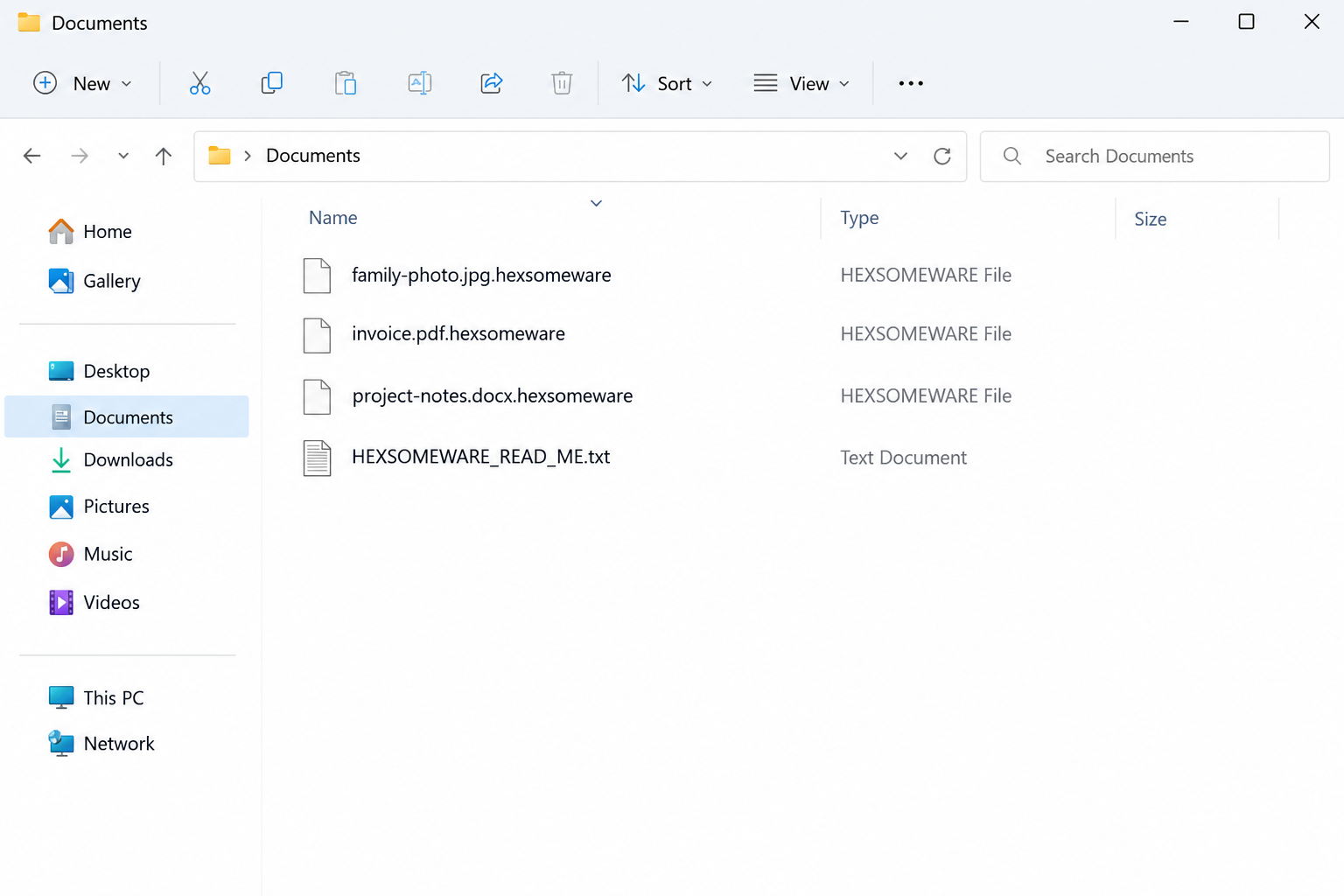
Hexsomeware is ransomware that encrypts files and adds the .hexsomeware extension. The reported sample also creates a text ransom note named HEXSOMEWARE_READ_ME.txt.
The extra extension is an identifying clue, not the cause of the damage. Removing those characters from a filename does not reverse encryption.
An affected spreadsheet might therefore remain visible in its original folder while its contents are unusable. Having the directory listing is different from having readable data.
The file-list illustration above explains these indicators. It is not a capture from a compromised reader’s computer or evidence of a particular attack date.
The ransom demand and disappearing screen
The documented behavior includes a full-screen payment demand and a request for 0.5 BTC. A text note provides another way for the attacker to deliver instructions.
The screen includes pressure about time and permanent loss. Those are the criminal’s claims, not a reliable assessment of what independent recovery might achieve.
The reported popup closes after restarting or signing out. That does not mean the underlying infection is gone, and it does not unlock encrypted files.
There is no good reason to reboot repeatedly just to make the warning disappear. On a business system, doing so can also complicate evidence collection.
The three decisions to keep separate
Hexsomeware ransomware removal is only one part of responding. Containment, cleanup, and data recovery have different purposes and should not be treated as interchangeable.
- Containment limits further access to devices, shared folders, and backups.
- Cleanup removes malicious software or rebuilds a system you can trust.
- Recovery restores usable information from verified copies or a compatible, independently checked solution.
A clean malware scan cannot promise that the attacker had no other access. An available backup cannot help safely if it is restored into an uncontrolled environment.
How the Hexsomeware Infection Works
Step 1: Ransomware reaches a system that can access valuable files
Encryption requires the malicious program to run somewhere with access to the targeted data. That might include local folders and storage reachable through the affected account.
The available case information does not establish one confirmed delivery route for every Hexsomeware infection. An extension alone cannot tell you how the attacker entered.
A recent attachment, installer, exposed remote-access service, or compromised account may deserve investigation. None should be presented as this attack’s proven starting point without supporting evidence.
Start with what changed shortly before files became inaccessible. Record suspicious downloads, unusual sign-ins, security alerts, and the approximate time of the first visible problem.
Businesses should compare those observations with endpoint, identity, and network logs. The computer showing the ransom demand may not be the first machine the intruder accessed.
For a home user, a short written timeline is still useful. It prevents later guesses from turning into apparently certain facts when asking for help.
Do not reopen a suspected installer to see whether it causes the same symptoms. Repeating the event can damage remaining files without improving the diagnosis.
Step 2: File contents are encrypted and names gain .hexsomeware
The attacker gains leverage by making useful documents unreadable. Your usual applications cannot open them, even though the folder still shows the names you recognize.
The reported .hexsomeware suffix makes affected files easier to recognize. It is not a special archive format that a normal extraction program can open.
Suppose both a photo and its editing project are encrypted. Changing their names, reinstalling the editor, or choosing another default app will not recreate the original data.
Likewise, a file repair utility is not automatically a ransomware decryptor. Repairing a broken document structure and undoing encryption are fundamentally different jobs.
Preserve representative encrypted files in their current form. A recovery specialist may need the original filenames, the note, and other incident details to identify the exact variant.
Avoid batch-renaming the entire collection. Even if the content remains unchanged, losing identifying details makes later work harder and increases the chance of confusing damaged copies.
Check connected storage carefully, but do not reconnect disconnected drives to the affected computer. A previously offline backup should remain isolated while the incident is assessed.
Step 3: Payment instructions turn disruption into pressure
Hexsomeware’s text note and full-screen demand push the reader toward a Bitcoin payment. The documented request is 0.5 BTC, whose cash value changes with the market.
That demand does not establish a fair price for recovery or a functioning support relationship. It is a condition imposed by the party responsible for the disruption.
The reported instructions use a Bitcoin address rather than a normal customer-service channel. An address identifies a payment destination, not a trustworthy business or a verified person.
A countdown can make checking backups feel dangerously slow. However, a threat about what happens next is not technical evidence that every alternative has already disappeared.
Do not assume the attacker will supply working software after payment. Even a working tool might be slow, incomplete, or unable to repair files damaged during encryption.
Payment also does not demonstrate that the machine is safe. Unauthorized accounts, stolen credentials, or another malicious component require separate investigation where there is evidence of them.
For an organization, involve its incident-response team before anyone communicates or spends money. Preserve the message so decisions are based on the actual demand, not recollection.
Step 4: Visible warnings may disappear while the damage remains
The popup’s reported disappearance after restarting or signing out can be misleading. The most noticeable symptom may vanish while encrypted documents remain exactly as inaccessible.
That creates a second risk: treating a quiet screen as permission to reconnect everything. Network drives and backup devices should not become the test of whether cleanup worked.
Check the system through a planned response process instead. The absence of a warning window is much weaker evidence than a verified rebuild and reviewed access controls.
If files were already synchronized to a cloud service, investigate version history from a clean device. Do not assume synchronization is equivalent to an independent backup.
Some services may retain older versions; others may have copied the encrypted changes. Retention settings, account access, and the timing of changes determine what is available.
Recovery should proceed from preserved evidence and trusted copies, not from the criminal’s interface. The next sections explain how to organize that work without making avoidable changes.
What to Do If Hexsomeware Encrypted Your Files
Isolate the affected device promptly. Disconnect its network connection and leave offline backup drives detached. For a workplace computer, contact IT before experimenting with cleanup or restoration.
If a shared environment is involved, tell responders which folders and systems were reachable. Avoid signing into administrative accounts on the suspected machine.
Save the ransom note and record filenames, visible demands, and approximate discovery time. Capture the warning if safely possible, without reopening a suspicious program to reproduce it.
Keep copies of encrypted files before attempting repairs. Store incident material separately from known-good backups, clearly labeled so it cannot be mistaken for clean data.
Protect accounts from a separate trusted device. Review important sign-ins and change exposed passwords where appropriate. Revoke unfamiliar sessions and enable multifactor authentication on supported accounts.
Prioritize accounts that could reach backups, remote administration, and shared storage. Password changes alone do not remove software already running on a compromised computer.
Arrange trusted cleanup or a controlled rebuild. Malwarebytes for Windows can help identify malicious files; its scan does not decrypt documents or certify that every intrusion route is closed.
Use the Malwarebytes Windows download only through a trusted route, preferably using a clean device to obtain tools needed for an isolated investigation.
Inventory recovery options before changing encrypted data. Check disconnected backups, cloud version history, and unaffected copies. Test candidate restores on a clean system before committing to a full restoration.
Ask an experienced responder to assess whether preserving a disk image would be useful. Recovery attempts should work on copies, not the only remaining evidence.
Reduce repeat exposure after recovery. Patch the operating system and applications, review remote access, and separate backups from everyday accounts. AdGuard can help filter some malicious advertising.
AdGuard is an additional browsing safeguard, not ransomware removal or decryption. Do not treat an ad blocker as protection for exposed servers, stolen accounts, or every harmful download.
Hexsomeware Removal: Secure the Environment Before Restoring
Containment comes before routine browsing or reconnecting storage. If a managed workplace system is involved, coordinate with its responders rather than running several competing cleanup tools.
The following removal guidance helps organize that process. A professional may recommend rebuilding the device when its previous state cannot be trusted.
Contain the incident before running cleanup tools
Disconnect the affected computer from Wi-Fi and wired networks. Unplug external storage and leave backup drives disconnected while you assess what happened.
Pause synchronization from a clean device where possible. Otherwise, encrypted versions may replace usable cloud copies while you are trying to rescue them.
At work, contact your IT or incident-response team immediately. A ransomware screen on one computer may be the visible part of a larger intrusion.
Keep the ransom note, filenames, discovery time, and any security alerts. A specialist may need disk or memory evidence before cleanup changes the machine.
If you cannot isolate a computer and encryption is visibly continuing, seek immediate assistance about shutting it down. Powering off can lose volatile evidence.
Do not repeatedly restart, reinstall, or experiment with utilities. Those actions can overwrite recovery evidence without addressing the underlying access problem.
Use trusted scanners on an isolated personal computer
For a home computer, arrange cleanup after preserving the evidence you need. Obtain security tools through their official websites using an unaffected system.
Malwarebytes can scan for malicious programs and related unwanted software. It is an infection-removal tool, not a way to decrypt already encrypted documents.
Install a current copy, update its detection data when safely possible, and run the available comprehensive scan. Review detections before applying the recommended quarantine actions.
Keep the scan report. It can help distinguish the ransomware payload from another infection, a suspicious installer, or a remote-access program.
Windows Security also provides scan options. Microsoft Defender Offline restarts into an offline scanning environment, so save your work before starting it.
Follow Microsoft’s ransomware protection guidance rather than instructions in the criminal’s note. A note telling you to disable protection is not trustworthy advice.
If Windows will not start or the scanners cannot operate, stop improvising. Use reputable technical assistance instead of downloading a supposed one-click emergency decryptor.
Do not upload the executable to unfamiliar recovery websites or run it elsewhere for testing. A second execution can create another incident.
Verify the environment before restoring anything
A completed scan is useful, but it cannot establish that every account, remote session, or networked computer is safe.
Check for unauthorized remote-access software, suspicious accounts, changed security settings, and unknown scheduled tasks. Business environments require coordinated investigation beyond this home-computer checklist.
Change exposed passwords from a clean device. Prioritize email, cloud storage, administrator access, and any account whose credentials were saved on the affected system.
Enable multifactor authentication where supported and revoke suspicious sessions. Simply changing the password may leave an existing signed-in session active.
A trusted reinstall may be appropriate when system integrity remains uncertain. Preserve recoverable data first, and reinstall from authentic installation media.
AdGuard can help reduce exposure to malicious advertising during future browsing. It neither cleans an infected system nor reverses file encryption.
Keep backup media offline until cleanup and access checks are complete. Reconnecting your only good copy too early can turn a recovery opportunity into another loss.
Can .hexsomeware Files Be Recovered?
There is no responsible way to promise recovery from the extension alone. Results depend on the exact infection, surviving copies, and any applicable decryption research.
Check the current No More Ransom decryption catalog. A tool for another ransomware family is not a substitute for verified compatibility.
A catalog entry can also change over time. The absence of a compatible tool today does not justify deleting encrypted files that might become useful later.
Encrypted files and backups should be kept separately. Preserve untouched originals while testing recovery on duplicates, and document which attempt produced each resulting copy.
If restoring from backup, establish the last known-good point. A copy made before the ransom screen appeared might still contain malicious software or compromised configuration.
Check application data as well as individual documents. A folder of restored invoices may be incomplete without the accounting database, attachments, and settings needed to interpret them.
Before replacing a damaged workspace, open a small selection of recovered files with their normal applications. Record any missing dates or projects while the original evidence remains available.
Make a recovery copy, not another damaged original
Keep an untouched copy of the encrypted data whenever practical. Include the ransom note and retain the original directory structure.
Use a separate destination for recovery experiments. Never let a utility overwrite your only encrypted copy or replace an intact backup.
Before sharing samples, consider their sensitivity. Choose an ordinary, nonconfidential file and ask the service about handling rules if business or personal information is involved.
The note’s name, complete filename suffix, and contact details can help identify a variant. An extension alone is not enough to establish decryption compatibility.
For example, two infections can use the same suffix while generating different keys. A familiar family name can also hide a newer, unsupported version.
Record the exact error or result from each attempt. Keep a simple checklist so another helper does not repeat risky tests on the same files.
Check recognized decryption projects
Visit the No More Ransom decryption catalog from a clean browser. Look for the actual variant and read the tool’s requirements carefully.
A tool for a related family does not automatically unlock your files. Some decryptors support only older versions, certain keys, or specific encryption mistakes.
Download through the catalog’s trusted vendor link, not a sponsored search result or an unsolicited message offering guaranteed recovery.
Test only a duplicate sample first. Successful decryption should produce a usable document or image, not merely remove the added extension.
If the utility reports an unsupported file or key, stop. Changing the filename to resemble a supported variant does not change its encrypted contents.
When no compatible tool is available, preserve your encrypted archive. Researchers sometimes release new tools later, but future recovery cannot be promised.
Look for copies that existed before encryption
Check disconnected drives, backup software, cloud version history, another computer, and files previously sent to trusted contacts. You may have more copies than you remember.
Cloud synchronization is not automatically a backup. Confirm that an earlier usable version survives and that the account itself has not been compromised.
Restore into a cleaned environment. Open a selection of documents, photos, and project files before assuming the recovered collection is complete.
Compare important dates and contents. An older spreadsheet might open perfectly while still missing the transactions you needed to recover.
Windows Previous Versions or existing snapshots may offer additional copies. Availability depends on prior configuration and whether those snapshots survived the incident.
Do not create new restore points expecting them to contain yesterday’s files. Recovery depends on copies that already existed before the damage.
Deleted-file recovery utilities are a different category. They may locate unencrypted originals in some circumstances, but they do not mathematically decrypt overwritten data.
If you want a specialist to investigate that possibility, minimize writes to the affected storage. Continued installations can overwrite remnants that might otherwise be recoverable.
Evaluate recovery offers without surrendering control
Be wary of anyone who contacts you first, claims exclusive access to a secret decryptor, or requests an advance payment in cryptocurrency.
Ask a recovery provider what method it intends to use, what evidence supports success, and whether it would negotiate with the attacker.
Get the scope, fee, privacy terms, and limitations in writing. A legitimate assessment should distinguish a possibility from a demonstrated recovery result.
Do not provide remote administrator access to an unknown helper. Recovery desperation can make a second scam feel like the only remaining option.
If you already paid, retain receipts, transaction references, wallet addresses, and correspondence. Contact the payment provider promptly and report the extortion.
Recovery is sometimes partial. Prioritize irreplaceable files, verify them individually, and keep your evidence archive until the investigation and restoration decisions are settled.
Watch for a Second Loss During Recovery
Ransomware victims are attractive targets for people selling guaranteed decryption. A confident message and a logo do not prove that someone has a working solution.
Ask what evidence supports compatibility, what work will be performed, and whether the company intends to negotiate with the attacker. Get the terms in writing.
Do not hand over remote access merely because someone recognizes the file extension. Publicly visible details can be repeated by anyone who has read a ransomware report.
Uploading documents for diagnosis creates a separate privacy decision. Use small, non-sensitive samples where appropriate and understand who receives them before submitting confidential business or personal material.
If a provider promises guaranteed restoration without examining the case, pause. Useful help explains limitations, preserves originals, and distinguishes technical work from passing money to criminals.
Report a significant incident through the appropriate local cybercrime channel. Reporting supports investigation, but it does not guarantee immediate recovery or replace containment.
Frequently Asked Questions
Does renaming .hexsomeware files make them work again?
No. The extension is a visible marker added to encrypted files. Removing it changes the label, not the encrypted contents that the original application needs.
Keep the filenames intact when preserving evidence. Test any legitimate recovery process on copies rather than experimenting with your only remaining collection.
Why did the Hexsomeware popup disappear after restarting?
The reported popup closes after a restart or sign-out. Its disappearance is not a successful decryption message and does not confirm that the device is clean.
Evaluate the actual files and the system’s security state separately. Reconnecting backup drives because the screen looks normal can put unaffected copies at risk.
Will Malwarebytes restore the encrypted documents?
Malwarebytes is an antimalware tool, not a universal decryptor. It may help remove detected malicious components, but that process does not reverse existing file encryption.
Preserve encrypted data before cleanup and plan restoration independently. For a serious compromise, a controlled rebuild may offer more confidence than relying on one scan.
Is the 0.5 BTC payment a reliable recovery option?
No payment comes with an enforceable guarantee from the attacker. A promised decryptor may never arrive, fail on some files, or leave other damage unresolved.
Investigate verified backups and legitimate recovery options first. Organizations should use their incident-response and legal processes before making decisions about extortion demands.
Can an online decryptor be trusted just because it names Hexsomeware?
No. Anyone can put a ransomware name on a download page. Check the tool’s provenance, exact compatibility, and instructions through a reputable source.
Never disable protections or pay an unsolicited stranger to try an unverified program. Even legitimate tools should be tested against duplicate files before wider use.
How can I make recovery easier if this happens again?
Maintain separate backups, including copies unavailable to everyday user accounts. Test restoration periodically so you know whether important files are genuinely recoverable.
Keep systems updated and review unnecessary remote access. The No More Ransom prevention guidance explains why independent backups remain essential.
The Bottom Line
Do not let Hexsomeware’s payment screen dictate your response. Isolate the device, preserve the encrypted files, and establish a trusted cleanup plan before reconnecting storage.
Removal and recovery are separate tasks. Check verified backups and exact-variant decryption resources, and reject anyone promising certainty without examining the evidence.
If the infection has already reached shared systems, involve qualified responders now. A coordinated investigation is more useful than repeatedly restarting until the warning disappears.

Join the discussion
0 commentsShare your experience or ask a question about this article.
Discussion
Start the conversation
Have a question or something useful to share? Add the first comment.