

A document refuses to open. Other files show the same strange ending, and a message demands that you make contact.
If you see .has, the filenames and note offer useful clues. Read carefully before taking the sender’s next instruction.
Overview
How to recognize the reported Has ransomware variant
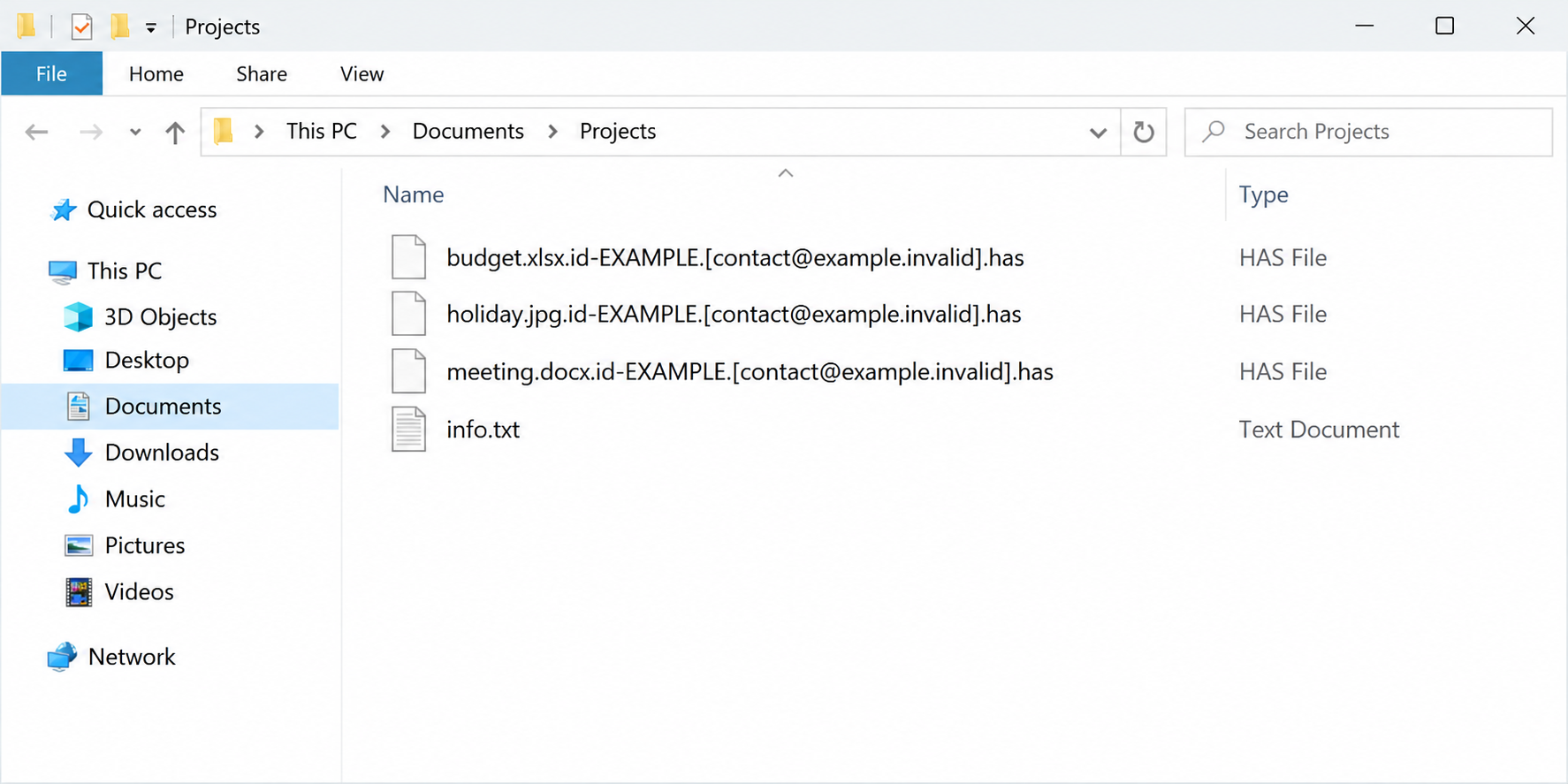
Has is a reported Dharma ransomware variant. It encrypts files and modifies their names with a victim identifier, an attacker contact address, and the .has suffix.
A documented example is 1.jpg.id-9ECFA84E.[hashhead@tuta.io].has. The original photo’s name survives, but the extra information is part of the attack’s identification system.
The affected computer also receives an info.txt note and a popup. Taken together, these details are more useful than the short extension by itself.
The illustration above uses fictional file examples to show that pattern. It is not an actual victim’s directory or a record of files we encrypted.
What the attackers say they can do
The demand claims the attackers encrypted data and obtained information they could disclose. A leak threat deserves investigation, but a written claim is not proof of exfiltration.
The documented contacts are hashhead[at]tuta[.]io and hashhead[at]mailum[.]com. They identify the reported campaign; they are not recommended support addresses.
The note offers limited test decryption and discourages independent recovery. Those promises are designed to keep the victim dealing with the attacker.
What a useful response must establish
Has ransomware removal requires more than closing the popup. You need to understand the affected environment before deciding where restored data can safely go.
- Which devices, accounts, shared folders, and backup systems may have been accessible?
- What evidence supports the encryption timeline and any claim that files left the network?
- Which clean backups or exact-variant recovery options can be independently verified?
A second question follows every proposed fix: does it remove malicious access, restore information, or merely change what appears on screen? Those are different outcomes.
How the Has Ransomware Attack Works
Step 1: An intrusion gives the encryptor access to files
Before the filename changes, something has enabled unauthorized execution. The available description does not establish the entry route for every victim of this particular variant.
Dharma’s broader history is not a substitute for examining your incident. Family associations cannot prove that your remote desktop service, email, or a particular download caused it.
Check recent authentication events, newly created users, remote-access changes, and endpoint alerts. Preserve logs before normal retention or cleanup removes information that could explain the sequence.
If several computers are affected, determine which systems were reachable from the same accounts. Shared access may matter more than the location of the first visible note.
Do not assume the intrusion started when an employee noticed a broken spreadsheet. Attackers may gain access before the damage becomes obvious.
That timing matters for restoration. A backup predating encryption can still be unsuitable as a complete system image if it contains earlier unauthorized changes.
Keep observations factual when asking for assistance. “The note appeared this morning” is useful; “an email definitely caused this” requires evidence beyond the timing.
Step 2: Encryption creates the .has filename pattern
The reported variant attaches an identifier and contact address before .has. Different victims may therefore see different identifiers while recognizing the same general arrangement.
Do not confuse that identifier with a decryption key. Its presence in a filename does not give a normal application enough information to restore the original contents.
A folder may contain both encrypted and unaffected files. Preserve that distinction rather than running a blanket renaming or file-repair operation across everything.
For example, an unchanged logo beside an unreadable accounting export does not prove the attack stopped. Some files may be skipped or fall outside accessible locations.
The safest early test is observation, not modification. Note which files fail and retain representative samples in the exact state in which they were found.
If filenames become long or awkward, resist shortening them for convenience. The embedded contact and identifier can help responders connect the files with the accompanying note.
Similarly, info.txt is a common filename used in many contexts. The name alone cannot establish ransomware; its contents and the broader symptoms provide the necessary context.
Step 3: A test-decryption offer makes payment feel safer
The attackers offer to decrypt up to three files as a demonstration, with a combined size below 3 MB and exclusions for files they consider valuable.
That offer creates an apparent way to verify their capabilities. A successful demonstration, however, would prove only that those selected files could be processed.
It would not establish that every file is recoverable, that the full tool will arrive, or that the computer can safely return to service.
Choosing a sample is also a disclosure decision. Sending financial, medical, or customer records may give the recipient information they did not previously possess.
The note provides another address if there is no reply within 12 hours. That is a contact instruction, not an independently verified expiration time for all recovery.
Do not interpret a responsive mailbox as evidence of legitimacy. Reliable communication can be part of an extortion operation just as easily as an unreliable one.
Organizations should keep negotiations and technical response under a coordinated process. An individual employee improvising contact may complicate reporting, evidence preservation, or an existing response plan.
Step 4: Leak threats add a separate layer of pressure
The threat to disclose data changes the victim’s concerns from availability to privacy. Those two problems can overlap, but they require different evidence and decisions.
Restoring a database does not answer whether someone copied it. Conversely, a ransom note claiming theft does not demonstrate that the database actually left the organization.
Responders may examine outbound transfers, account activity, accessed folders, and available monitoring records. Missing logs can limit certainty without proving either theft or safety.
If the incident involves regulated or confidential information, seek appropriate professional advice about obligations. Do not wait for an attacker to supply a supposedly definitive answer.
Paying for a deletion promise is not a technical way to verify deletion. Copies can exist outside the affected device, beyond anything the victim can inspect.
Keep the language accurate when informing colleagues or customers. Explain what is known, what remains under investigation, and which protective actions are being taken.
You do not need to dismiss the threat or announce an unconfirmed breach. Keep people informed using the evidence available, and update them when the findings change.
What to Do If Your Files End in .has
Disconnect affected machines from networks and keep backup media offline. Contact your IT or incident-response team immediately if shared systems, business records, or managed devices are involved.
Do not use an affected workstation to administer other computers. Limit further access while responders decide what evidence and systems need priority attention.
Preserve the full ransom note, a screenshot of the popup, encrypted samples, and their original names. Record when problems appeared and which users or systems noticed them.
Keep any existing communications without replying impulsively. Include message headers if correspondence already occurred, and store incident evidence somewhere separate from working recovery copies.
Secure accounts from a known-clean device. Review remote-access permissions and sessions, rotate compromised credentials, and check administrative users for changes that cannot be explained.
Enable multifactor authentication where supported. An account reset can help restrict access, but it does not repair encrypted data or erase malicious software.
Use trusted removal tools or rebuild under guidance. Malwarebytes for Windows may help detect malicious components; obtaining a clean scan is not equivalent to restoring trust after every intrusion.
The Malwarebytes Windows download is a tool route, not a Has decryptor. Do not run unknown “recovery” programs supplied by unsolicited helpers.
Make a recovery inventory: offline backups, unaffected originals, cloud versions, and application exports. Test selected restores before reconnecting production storage or replacing the only remaining encrypted copies.
Record the source and date of each copy. A successful test with one document does not establish that an entire backup set is intact.
Report the incident through the relevant cybercrime channel and follow your organization’s response requirements. If sensitive information may be involved, coordinate technical findings with appropriate privacy advice.
Afterward, harden remote access, update software, and test backups. AdGuard may reduce some malicious advertising exposure, but it cannot remove this ransomware or recover files.
Remove Has Ransomware Without Confusing Cleanup With Recovery
An encrypted document is not restored just because the program responsible has been removed. Keep recovery copies safe while addressing the environment that allowed the attack.
Use the dedicated removal process below as a response framework. On managed systems, the incident team should decide which scanning or rebuilding approach fits the evidence.
Contain the incident before running cleanup tools
Disconnect the affected computer from Wi-Fi and wired networks. Unplug external storage and leave backup drives disconnected while you assess what happened.
Pause synchronization from a clean device where possible. Otherwise, encrypted versions may replace usable cloud copies while you are trying to rescue them.
At work, contact your IT or incident-response team immediately. A ransomware screen on one computer may be the visible part of a larger intrusion.
Keep the ransom note, filenames, discovery time, and any security alerts. A specialist may need disk or memory evidence before cleanup changes the machine.
If you cannot isolate a computer and encryption is visibly continuing, seek immediate assistance about shutting it down. Powering off can lose volatile evidence.
Do not repeatedly restart, reinstall, or experiment with utilities. Those actions can overwrite recovery evidence without addressing the underlying access problem.
Use trusted scanners on an isolated personal computer
For a home computer, arrange cleanup after preserving the evidence you need. Obtain security tools through their official websites using an unaffected system.
Malwarebytes can scan for malicious programs and related unwanted software. It is an infection-removal tool, not a way to decrypt already encrypted documents.
Install a current copy, update its detection data when safely possible, and run the available comprehensive scan. Review detections before applying the recommended quarantine actions.
Keep the scan report. It can help distinguish the ransomware payload from another infection, a suspicious installer, or a remote-access program.
Windows Security also provides scan options. Microsoft Defender Offline restarts into an offline scanning environment, so save your work before starting it.
Follow Microsoft’s ransomware protection guidance rather than instructions in the criminal’s note. A note telling you to disable protection is not trustworthy advice.
If Windows will not start or the scanners cannot operate, stop improvising. Use reputable technical assistance instead of downloading a supposed one-click emergency decryptor.
Do not upload the executable to unfamiliar recovery websites or run it elsewhere for testing. A second execution can create another incident.
Verify the environment before restoring anything
A completed scan is useful, but it cannot establish that every account, remote session, or networked computer is safe.
Check for unauthorized remote-access software, suspicious accounts, changed security settings, and unknown scheduled tasks. Business environments require coordinated investigation beyond this home-computer checklist.
Change exposed passwords from a clean device. Prioritize email, cloud storage, administrator access, and any account whose credentials were saved on the affected system.
Enable multifactor authentication where supported and revoke suspicious sessions. Simply changing the password may leave an existing signed-in session active.
A trusted reinstall may be appropriate when system integrity remains uncertain. Preserve recoverable data first, and reinstall from authentic installation media.
AdGuard can help reduce exposure to malicious advertising during future browsing. It neither cleans an infected system nor reverses file encryption.
Keep backup media offline until cleanup and access checks are complete. Reconnecting your only good copy too early can turn a recovery opportunity into another loss.
Recovery Options for .has Encrypted Files
Has is associated with Dharma, but that does not mean every tool carrying the Dharma or Crysis name will decrypt this variant.
Older decryptors may apply only to particular versions or keys. Running one without confirming compatibility can waste time and complicate the condition of working copies.
Consult the current No More Ransom tool catalog and its exact instructions. Treat the extension, contact details, and note as identification evidence, not compatibility guarantees.
If no suitable tool is verified, retain encrypted originals. A future development may change the options, while deleting files removes that possibility permanently.
A restored backup is generally more useful than promises from strangers. Still, confirm it is clean, readable, and separated from the compromised accounts before relying on it.
For a business, prioritize the systems needed to resume essential work. Restoring an isolated test environment can reveal missing dependencies before staff rely on an incomplete production recovery.
Keep a simple restoration log: the source copy, the clean destination, and the checks performed. That record helps separate a successful restore from an optimistic assumption.
Make a recovery copy, not another damaged original
Keep an untouched copy of the encrypted data whenever practical. Include the ransom note and retain the original directory structure.
Use a separate destination for recovery experiments. Never let a utility overwrite your only encrypted copy or replace an intact backup.
Before sharing samples, consider their sensitivity. Choose an ordinary, nonconfidential file and ask the service about handling rules if business or personal information is involved.
The note’s name, complete filename suffix, and contact details can help identify a variant. An extension alone is not enough to establish decryption compatibility.
For example, two infections can use the same suffix while generating different keys. A familiar family name can also hide a newer, unsupported version.
Record the exact error or result from each attempt. Keep a simple checklist so another helper does not repeat risky tests on the same files.
Check recognized decryption projects
Visit the No More Ransom decryption catalog from a clean browser. Look for the actual variant and read the tool’s requirements carefully.
A tool for a related family does not automatically unlock your files. Some decryptors support only older versions, certain keys, or specific encryption mistakes.
Download through the catalog’s trusted vendor link, not a sponsored search result or an unsolicited message offering guaranteed recovery.
Test only a duplicate sample first. Successful decryption should produce a usable document or image, not merely remove the added extension.
If the utility reports an unsupported file or key, stop. Changing the filename to resemble a supported variant does not change its encrypted contents.
When no compatible tool is available, preserve your encrypted archive. Researchers sometimes release new tools later, but future recovery cannot be promised.
Look for copies that existed before encryption
Check disconnected drives, backup software, cloud version history, another computer, and files previously sent to trusted contacts. You may have more copies than you remember.
Cloud synchronization is not automatically a backup. Confirm that an earlier usable version survives and that the account itself has not been compromised.
Restore into a cleaned environment. Open a selection of documents, photos, and project files before assuming the recovered collection is complete.
Compare important dates and contents. An older spreadsheet might open perfectly while still missing the transactions you needed to recover.
Windows Previous Versions or existing snapshots may offer additional copies. Availability depends on prior configuration and whether those snapshots survived the incident.
Do not create new restore points expecting them to contain yesterday’s files. Recovery depends on copies that already existed before the damage.
Deleted-file recovery utilities are a different category. They may locate unencrypted originals in some circumstances, but they do not mathematically decrypt overwritten data.
If you want a specialist to investigate that possibility, minimize writes to the affected storage. Continued installations can overwrite remnants that might otherwise be recoverable.
Evaluate recovery offers without surrendering control
Be wary of anyone who contacts you first, claims exclusive access to a secret decryptor, or requests an advance payment in cryptocurrency.
Ask a recovery provider what method it intends to use, what evidence supports success, and whether it would negotiate with the attacker.
Get the scope, fee, privacy terms, and limitations in writing. A legitimate assessment should distinguish a possibility from a demonstrated recovery result.
Do not provide remote administrator access to an unknown helper. Recovery desperation can make a second scam feel like the only remaining option.
If you already paid, retain receipts, transaction references, wallet addresses, and correspondence. Contact the payment provider promptly and report the extortion.
Recovery is sometimes partial. Prioritize irreplaceable files, verify them individually, and keep your evidence archive until the investigation and restoration decisions are settled.
Questions to Ask Anyone Offering Paid Recovery
Ask whether the provider has a technical recovery method or plans to communicate with the attacker. Those are different services with different risks and expectations.
Request a written description of the work, pricing conditions, data handling, and failure policy. Avoid agreements that treat an impressive promise as evidence of capability.
Be particularly cautious when someone wants unrestricted remote access before explaining their approach. Access to an already compromised network should not be handed out casually.
A demonstration on one harmless sample may help assess a claim, but it cannot guarantee the rest of the collection. Understand precisely what a test establishes.
Keep control of untouched originals throughout the process. If a provider needs copies, determine where they will be stored and who can access their contents.
Recognizing the attacker’s email address does not make a provider an insider. These identifying details are public and easily repeated in a convincing sales pitch.
Frequently Asked Questions
Is every file ending in .has infected with this ransomware?
An extension alone is not a complete diagnosis. Compare the changed naming pattern, the note, the popup, and the actual loss of access.
The reported contact addresses and victim identifier help distinguish this case. Preserve those details rather than assuming a short suffix uniquely identifies every incident.
Will changing the extension back recover my documents?
No. Renaming does not undo encryption. A document can regain its old name and still contain unreadable data that its original program cannot interpret.
Leave preserved samples unchanged. Recovery tools or specialists may need the full names and accompanying note to assess the exact variant.
Does the Has note prove that my information was stolen?
No. It records the attacker’s assertion. Investigating possible data theft requires additional evidence, such as access records or signs of transfers.
Take the possibility seriously without treating the note as an independent forensic finding. Businesses should coordinate the investigation and any required notifications through appropriate professionals.
Can a free Dharma decryptor recover .has files?
Not automatically. A tool for an earlier Dharma-related variant may not work on Has. Compatibility depends on details beyond the family name.
Read the current tool’s documentation through a trusted catalog. Test only on duplicates and do not interpret a failed experiment as proof that every recovery option is exhausted.
Should I send the attackers three files for a free test?
Do not send sensitive documents simply to satisfy their offer. A test can expose additional information and does not guarantee delivery of a complete recovery tool.
If an organization is considering contact, qualified responders should handle that decision. Keep the technical assessment separate from pressure to establish a conversation.
Does removing Has stop the attackers from returning?
Removing a detected file does not prove that accounts, remote access, and other systems are secure. The original access route still needs investigation.
Review credentials, administrative changes, and exposed services before restoring normal connectivity. Rebuild affected systems when their previous state cannot be trusted.
The Bottom Line
Do not treat Has ransomware’s contacts as your recovery service. Isolate affected systems, preserve evidence, and establish a safe environment before bringing files back.
Investigate the leak claim separately from encryption, and verify any decryptor against the exact variant. A family name or successful sample test is not a guarantee.
If shared systems are affected, involve your incident team now. Start with containment and known-good copies, not the attacker’s deadline or an unsolicited recovery promise.

Join the discussion
0 commentsShare your experience or ask a question about this article.
Discussion
Start the conversation
Have a question or something useful to share? Add the first comment.