

Monthly XRP rewards sound like an update you missed. The wallet name is familiar, and checking eligibility seems harmless.
Before opening your wallet, pause. A polished rewards page can leave important questions unanswered.
Overview
The monthly XRP release offer
The Xaman monthly XRP release scam uses the identity of a real wallet to promote a supposed rewards opportunity. Reported versions advertise an airdrop or monthly payments.
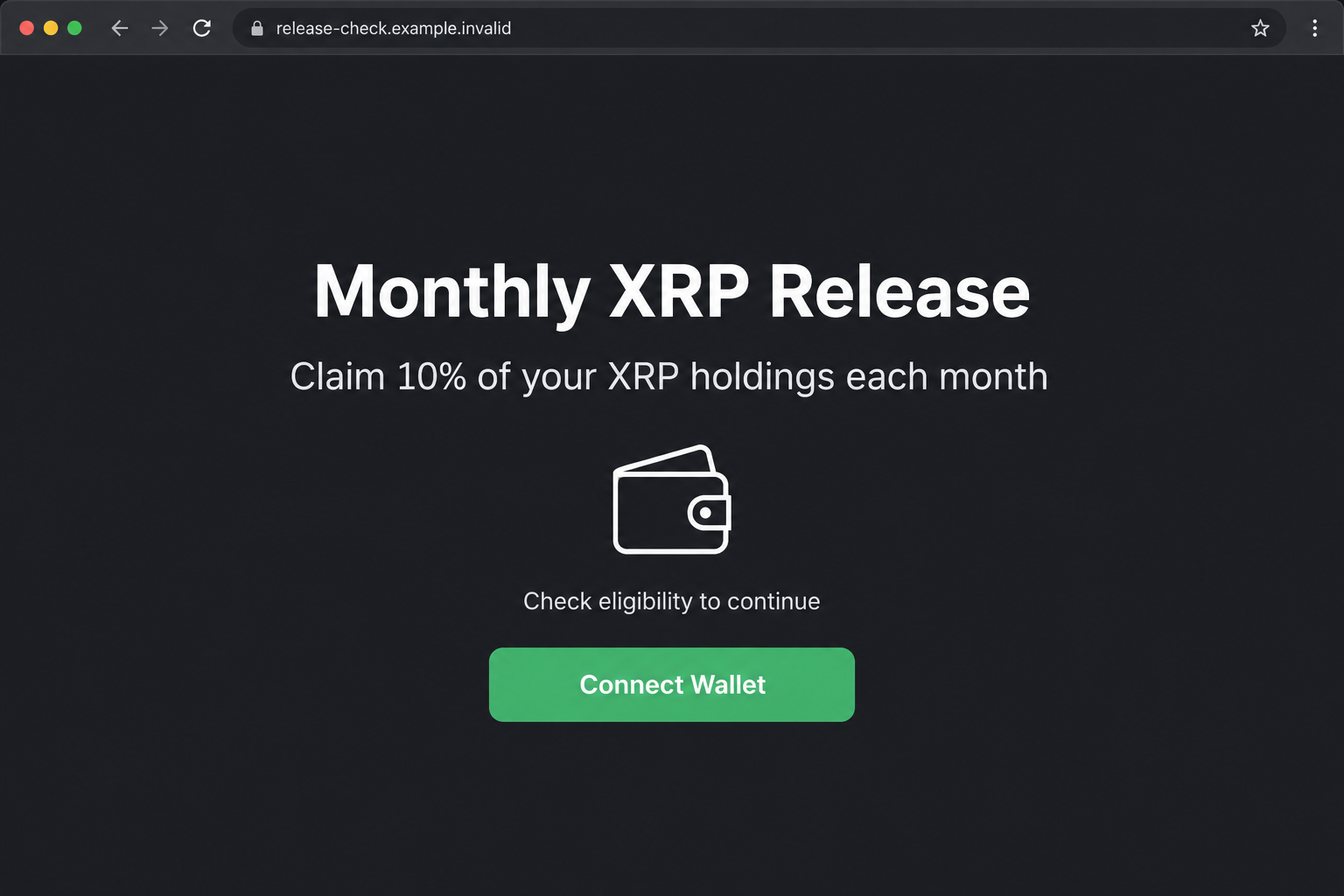
One version promises 10% of the user’s XRP holdings each month. The offer encourages visitors to interact with a wallet rather than simply read an announcement.
Reported lookalikes include xamanwallet-token[.]pro and xaman-wallet[.]com. These names resemble the brand, but resemblance does not make them official Xaman services.
The interface image above is an illustrative reconstruction, not an authenticated capture of a campaign page. It demonstrates the reward pitch without supplying a functioning destination.
Xaman is real; this promotion is not its identity
Xaman, formerly Xumm, is a self-custody wallet associated with the XRP Ledger ecosystem. Its existence does not validate every website that borrows its branding.
A genuine wallet can display a request originating elsewhere. The fact that a request opens inside a trusted application does not make its purpose trustworthy.
Official documentation also explains that the XRP Ledger does not use proof-of-stake. A page cannot establish a native staking entitlement simply by calling its offer “monthly release.”
The approval matters more than the connection label
Do not assume every wallet connection instantly transfers cryptocurrency. Viewing a public address, requesting information, and authorizing a transaction are different actions.
- A public wallet address is not a secret signing key.
- A transaction request still needs careful review before approval.
- A recovery phrase or private key can expose control far beyond one website visit.
The concern is what the offer persuades someone to approve or disclose. Without the actual request, a headline alone cannot establish the exact theft mechanism.
How the Xaman Monthly XRP Release Scam Works
Step 1: A reward announcement borrows a familiar wallet’s credibility
The opening pitch makes the benefit sound connected to a service the reader already knows. “Monthly XRP release” suggests an established program rather than a stranger’s proposal.
An airdrop version uses a similar idea: perhaps existing holders qualify for something valuable and only need to claim it. Missing out becomes the immediate concern.
That framing is particularly effective when the visitor already owns XRP. The offer appears relevant to an existing account instead of asking for a completely unrelated investment.
However, holding an asset does not mean every reward announcement mentioning it is genuine. A real balance is not evidence of eligibility for an invented program.
Look for an announcement through independently opened official channels. Following the offer’s own “support” link only keeps you inside the same unverified environment.
A copied logo or technical phrase does not solve this problem. Both are easy to reproduce, and neither demonstrates that the wallet developer authorized the promotion.
Step 2: A lookalike domain makes the claim appear official
The reported domains place the Xaman name beside wallet-related wording. That arrangement can pass a quick visual check even though the address is not the genuine service.
Read the full domain, not just the first recognizable word. Hyphens and extra terms do not prove fraud by themselves, but they do not confer affiliation either.
A browser padlock is similarly limited. It concerns the connection to the website you reached, not whether that website deserves your wallet access.
Open Xaman’s official website separately rather than searching within the suspicious page. Use trusted bookmarks or the application’s established support route when checking an offer.
If a campaign page becomes unavailable, do not chase its replacement through unsolicited messages. A dead link or failed capture does not establish authenticity or identify its operator.
The useful comparison is the service’s actual documentation and announcements. Domain styling, professional design, and a responsive chat box cannot replace that verification.
Step 3: The page presents wallet interaction as an eligibility check
The offer then asks the visitor to connect a wallet or continue through a wallet-related prompt. The stated purpose is to establish eligibility or receive rewards.
This is where vague instructions become dangerous. “Verify,” “synchronize,” and “activate” describe a supposed purpose, not the technical effect of an approval.
Read the actual request shown by the wallet. A proposed payment to an unfamiliar destination is not merely a passive check of your balance.
Do not approve a request you cannot explain in plain language. Closing the website is safer than assuming the next screen will clarify something you already authorized.
If a page asks for a recovery phrase, private key, or secret account numbers used for recovery, stop. A reward website does not need those secrets.
A public address can already be inspected on a public ledger. Asking for secret signing material to “confirm ownership” is a very different and dangerous demand.
Step 4: The victim may authorize a harmful action or expose a secret
The reported campaign seeks access to cryptocurrency through its fake reward route. The precise consequence depends on what the user approves or supplies.
Signing a payment can move funds. Disclosing a recovery secret can let another party act as the account holder, potentially creating risks beyond that one interaction.
But merely opening a page or showing a public address does not prove that assets have moved. Check the account history rather than assuming either safety or loss.
We do not have a recovered transaction payload establishing every request made by these pages. It would be misleading to invent a specific permission or automatic draining sequence.
XRP Ledger accounts also differ from Ethereum-style token allowance systems. Advice about revoking an ERC-20 approval is not automatically the correct remedy for a Xaman incident.
Use guidance for the actual ledger, account configuration, and action involved. If another wallet or network was used, identify that separately before changing permissions.
Step 5: Confusion creates an opening for more demands
If a promised reward does not appear, the victim may return to the page or ask its support channel for help. That keeps the relationship alive.
A follow-up request for an activation payment, secret, or remote session should not be trusted because it follows an earlier conversation. Each request needs independent scrutiny.
These are potential follow-up tactics, not proof that every visitor received the same instructions. The practical response is to stop expanding the exposure.
Scammers offering recovery can create another loss after the first one. Do not send cryptocurrency to “release” funds or reveal wallet secrets to someone promising a reversal.
A genuine support conversation should help you understand what happened without demanding control of your account. Start that conversation through the real application, not an unsolicited direct message.
Save the page address and relevant transaction details first. Clear records are more useful than repeatedly trying a reward button that has already proved unreliable.
What to Do If You Used the Fake XRP Rewards Page
Stop interacting with the offer. Close its pages, decline pending requests, and do not send an activation payment. Save the URL and relevant messages for reference.
If you only viewed the page, do not assume your wallet is compromised. Describe exactly what happened before taking account-changing steps.
Check your wallet’s transaction history through the genuine application or a trusted ledger explorer. Record unfamiliar destinations, amounts, transaction identifiers, and the timing of approvals.
Distinguish a rejected request from a completed transaction. A screenshot saying “connected” is not, by itself, proof of an outgoing payment.
If you disclosed recovery secrets, treat the account as compromised. Seek urgent guidance through Xaman’s established in-app support and plan protection from a clean, trusted environment.
Moving assets or changing account controls requires care on the actual ledger. Do not follow a stranger’s generic script or send funds to a supplied “safe wallet.”
If you approved an unfamiliar request, ask official support to help identify its effect. Review account access and signing arrangements as appropriate to your specific XRP Ledger account.
Do not assume an Ethereum allowance checker can undo an XRP Ledger action. Already completed transfers and future signing control are separate issues.
If you installed software, enabled remote access, or downloaded suspicious files, address that device exposure separately. Malwarebytes may help detect malware, but it cannot reverse a ledger payment.
AdGuard can help filter some harmful ads and pages. It does not inspect every wallet request or make an unverified reward offer safe.
Report suspected theft to the appropriate authorities and any relevant exchange’s genuine support. Provide transaction identifiers and a factual timeline without including your recovery phrase or private key.
Keep expectations realistic. Reporting may support investigation or intervention, but it does not guarantee a refund. Reject anyone demanding an upfront crypto payment for guaranteed recovery.
Is Your Device Infected? Run a Free Malware Scan
Slow performance, constant pop-ups, or strange behavior? These are classic signs of a malware infection. The fastest way to find out is to scan your device with Malwarebytes Free — one of the most trusted malware removal tools available.
The free version detects and removes the most common threats, including:
- Adware — the cause of those annoying pop-ups
- Browser hijackers — unwanted redirects and changed homepages
- Trojans and spyware — hidden programs stealing your data
- Potentially unwanted programs (PUPs) — software you never asked for
👉 Select your device below — Windows, Mac, or Android — then follow the simple steps to download Malwarebytes, scan your system, and remove any threats it finds. The scan usually takes 5 to 20 minutes.
Run a Malware Scan with Malwarebytes for Windows
Malwarebytes is one of the most popular and trusted anti-malware tools for Windows — and it’s completely free for removing infections. It catches threats that many antivirus programs miss, including adware, browser hijackers, and trojans. Follow the steps below to scan and clean your PC in just a few minutes.
Download Malwarebytes
Click the button below to download the latest version of Malwarebytes for Windows from the official source. The free version is all you need — it will scan your computer and remove adware, browser hijackers, and other malicious software at no cost.
Download MalwarebytesOfficial installer for Windows 11 and 10. Your download starts right away.Want real-time protection? See Malwarebytes Premium Malwarebytes Free for WindowsScans and removes malware at no cost
-
Install Malwarebytes
When the download finishes, open your Downloads folder and double-click the MBSetup file. If Windows shows a User Account Control pop-up, click “Yes” to allow the installation.

Follow the On-Screen Prompts to Install Malwarebytes
The setup wizard will walk you through a few quick screens:
-
Choose where you’re installing the program — “Personal Computer” or “Work Computer” — then click Next.

-
Malwarebytes will now install on your device. This usually takes under a minute.

-
When installation is complete, the “Welcome to Malwarebytes” screen will open automatically.

-
On the final screen, click Open Malwarebytes to launch the program.

-
Enable “Scan for Rootkits”
Before scanning, turn on rootkit detection so Malwarebytes can find even the most hidden threats. Click the Settings gear icon on the left side of the screen.

In the settings menu, find “Scan for rootkits” and click the toggle so it turns blue.

Done? Click “Dashboard” in the left pane to return to the main screen.
Start the Scan
Click the blue Scan button. Malwarebytes will automatically update its virus database and start checking your computer for malware.

-
Wait for the Scan to Finish
The scan checks your entire system for browser hijackers and other malicious programs, so it can take 5 to 20 minutes depending on your computer. Feel free to do something else — just check back occasionally to see the progress.

-
Quarantine the Detected Threats
When the scan is done, you’ll see a list of everything Malwarebytes found — malware, adware, and potentially unwanted programs. Click the “Quarantine” button to remove all of them at once.

Malwarebytes will now remove the malicious files and registry entries and move them safely into quarantine.

-
Restart Your Computer
Some threats can only be fully removed after a reboot. If Malwarebytes asks you to restart, click Yes. Once you’re logged back in, Malwarebytes has finished removing the threats it found.

That’s it — your Windows PC is now clean of trojans, adware, and other malware, and should be back to running smoothly.
If you are still having problems with your computer after completing these instructions, then please follow one of the steps:
- Run a computer scan with ESET Online Scanner
- Ask for help in our Windows Malware Removal Help & Support forum.
Run a Malware Scan with Malwarebytes for Mac
Malwarebytes for Mac is a free on-demand scanner that removes the malware other security software tends to miss — adware, browser hijackers, and unwanted programs included. Cleaning an infected Mac with Malwarebytes has always been completely free, and it’s our go-to recommendation. Follow the steps below to scan and clean your Mac in just a few minutes.
-
Download Malwarebytes for Mac
Click the button below to download the latest version of Malwarebytes for Mac.
Download MalwarebytesOfficial installer for macOS. Your download starts right away.Want real-time protection? See Malwarebytes PremiumMalwarebytes Free for MacScans and removes malware at no cost -
Open the Malwarebytes setup file
When the download finishes, open your Downloads folder and double-click the setup file to begin the installation.

-
Follow the On-Screen Prompts to Install Malwarebytes
The Malwarebytes for Mac Installer will guide you through a few quick screens. Click “Continue” and keep following the prompts until the installation completes.



When the installation is complete, Malwarebytes opens to the Welcome to Malwarebytes screen. Click “Get started“.
-
Select “Personal Computer” or “Work Computer”
Malwarebytes will ask what type of computer you’re installing it on. Click either Personal Computer or Work Computer, whichever applies.

-
Start the Scan
Click the “Scan” button. Malwarebytes will automatically update its detection database and begin checking your Mac for malware.

-
Wait for the Scan to Finish
Malwarebytes will scan your Mac for adware, browser hijackers, and other malicious programs. This can take a few minutes, so feel free to do something else — just check back occasionally to see the progress.

-
Quarantine the Detected Threats
When the scan is done, you’ll see a list of everything Malwarebytes found. Click the “Quarantine” button to remove all the threats at once.

-
Restart Your Mac
Malwarebytes will now remove all the malicious files it found. Some threats can only be fully removed after a reboot — if Malwarebytes asks you to restart, allow it. Once you’re logged back in, your Mac is clean.

That’s it — your Mac is now free of adware, rogue browser extensions, and other potentially harmful software.
If you are still experiencing problems while trying to remove a malicious program from your computer, please ask for help in our Mac Malware Removal Help & Support forum.
Run a Malware Scan with Malwarebytes for Android
Malwarebytes for Android automatically detects and removes dangerous threats like malware and ransomware so you don’t have to worry about your most-used device being compromised. Aggressive detection of adware and potentially unwanted programs keeps your Android phone or tablet running smooth.
-
Download Malwarebytes for Android.
You can download Malwarebytes for Android by clicking the link below.
Get Malwarebytes for AndroidOpens Google Play in a new tab.Want real-time protection? See Malwarebytes Premium for AndroidMalwarebytes for AndroidScans your phone and removes malware at no cost -
Install Malwarebytes for Android on your phone.
In the Google Play Store, tap “Install” to install Malwarebytes for Android on your device.

When the installation process has finished, tap “Open” to begin using Malwarebytes for Android. You can also open Malwarebytes by tapping on its icon in your phone menu or home screen.

-
Follow the on-screen prompts to complete the setup process
When Malwarebytes will open, you will see the Malwarebytes Setup Wizard which will guide you through a series of permissions and other setup options.
This is the first of two screens that explain the difference between the Premium and Free versions. Swipe this screen to continue.
Tap on “Got it” to proceed to the next step.
Malwarebytes for Android will now ask for a set of permissions that are required to scan your device and protect it from malware. Tap on “Give permission” to continue.
Tap on “Allow” to permit Malwarebytes to access the files on your phone.
-
Update database and run a scan with Malwarebytes for Android
You will now be prompted to update the Malwarebytes database and run a full system scan.

Click on “Update database” to update the Malwarebytes for Android definitions to the latest version, then click on “Run full scan” to perform a system scan.

-
Wait for the Malwarebytes scan to complete.
Malwarebytes will now start scanning your phone for adware and other malicious apps. This process can take a few minutes, so we suggest you do something else and periodically check on the status of the scan to see when it is finished.

-
Click on “Remove Selected”.
When the scan has been completed, you will be presented with a screen showing the malware infections that Malwarebytes for Android has detected. To remove the malicious apps that Malwarebytes has found, tap on the “Remove Selected” button.

-
Restart your phone.
Malwarebytes for Android will now remove all the malicious apps that it has found. To complete the malware removal process, Malwarebytes may ask you to restart your device.
That’s it — your Android phone is now clean — no more malicious apps, adware, or browser redirects.
If you are still having problems with your phone after completing these instructions, then please follow one of the steps:
- Restore your phone to factory settings by going to Settings > General management > Reset > Factory data reset.
- Ask for help in our Mobile Malware Removal Help & Support forum.
Stay Protected: Block Ads and Malicious Sites
Now that your device is clean, keep it that way. Most infections start with a malicious ad or a fake download button — so blocking them at the source is your best defense.
We recommend AdGuard, which blocks malicious ads, phishing pages, and dangerous redirects before they can reach you.
👉 Download AdGuard and browse safely
Check the Wallet, the Website, and the Request Separately
Three things can look like one experience: the website’s promise, the genuine wallet interface, and the action the wallet is being asked to authorize.
A scam page may borrow trust from the legitimate middle component. Seeing the familiar application open does not authenticate the website that initiated the interaction.
Likewise, a website can display a real public balance without knowing a private key. Public blockchain information is not proof that the site has a special relationship with you.
Before signing, ask three questions: who receives value, what changes in your account, and why would that action be necessary to collect the advertised reward?
If those answers do not match the promise, decline. Do not rely on the page’s explanation when the actual authorization says something different.
The Xaman community trust guidance emphasizes careful review. A useful application or recognizable ecosystem is not a blanket endorsement of every request.
Why the 10% Claim Needs More Than a Calculator
A percentage can make an offer feel concrete. You can imagine the next month’s balance and compare it with the amount already in your wallet.
That arithmetic says nothing about where the rewards come from, who operates the program, or whether the advertised entitlement exists at all.
The fake promotion should not be treated as native XRP staking. Xaman’s common misconceptions guidance explains the distinction between wallet services and claims about the ledger.
Some legitimate services may offer separate arrangements involving cryptocurrency. Their existence does not validate this promotion or make every product using the same asset equivalent.
The decision here is narrower and clearer: do not use these lookalike reward pages or authorize their requests. Verify any unrelated offer on its own evidence.
If the pitch arrives through a friend, contact them separately. They may have forwarded an offer without understanding it, or their social account may no longer be under their control.
A familiar messenger does not change what the wallet request does. Verify the promotion and the authorization rather than making a trust decision solely about the person sharing it.
Frequently Asked Questions
Is Xaman itself a scam?
No. Xaman is a real self-custody wallet. This warning concerns impostor promotions using its identity, not evidence that the legitimate wallet operates the fake reward scheme.
Use its genuine website and in-app support. Do not follow a campaign page’s replacement link merely because it includes the wallet’s name.
Does connecting a wallet automatically empty it?
Not necessarily. A connection or public-address disclosure is different from signing a transfer, authorizing account changes, or handing over a recovery secret.
Review what you actually approved and check transaction history. If the action is unclear, seek help through trusted wallet support before making further changes.
Are monthly 10% XRP rewards an official Xaman feature?
The reported lookalike promotion is not validated by the real wallet’s existence. A brand name and a percentage do not establish an official entitlement.
Check announcements independently. Do not approve requests on the assumption that “monthly release” means a built-in ledger reward or native staking feature.
What if I gave the page my recovery phrase?
Treat that secret as exposed. Another person may be able to control the account independently of whether the website still appears connected.
Use a trusted device and official support to plan protection. Never paste the phrase into another website claiming it can check whether the phrase was stolen.
Can antivirus reverse an XRP transaction?
No. Antimalware addresses malicious software on devices; it does not rewrite confirmed ledger history. Use it when there is a relevant download, installation, or device-compromise concern.
For suspicious transactions, preserve identifiers and report promptly. Device cleanup and wallet incident response may both be necessary, but they solve different problems.
Should I pay a recovery agent who contacted me?
Do not pay an unsolicited person promising guaranteed reversal. A request for an upfront crypto fee or wallet secrets can create a second loss.
Contact real wallet support and appropriate authorities instead. Keep your evidence, including the original offer, without publishing private account credentials.
The Bottom Line
Do not use the fake Xaman monthly XRP release pages or approve their reward requests. The promotion borrows a legitimate wallet’s identity to encourage risky account interactions.
If you already responded, identify the exact exposure first. Declined requests, completed transfers, exposed secrets, and installed software require different responses.
Start with the genuine wallet, preserve transaction evidence, and seek trusted support. Do not turn a questionable reward claim into another payment to someone offering guaranteed recovery.

Join the discussion
0 commentsShare your experience or ask a question about this article.
Discussion
Start the conversation
Have a question or something useful to share? Add the first comment.