

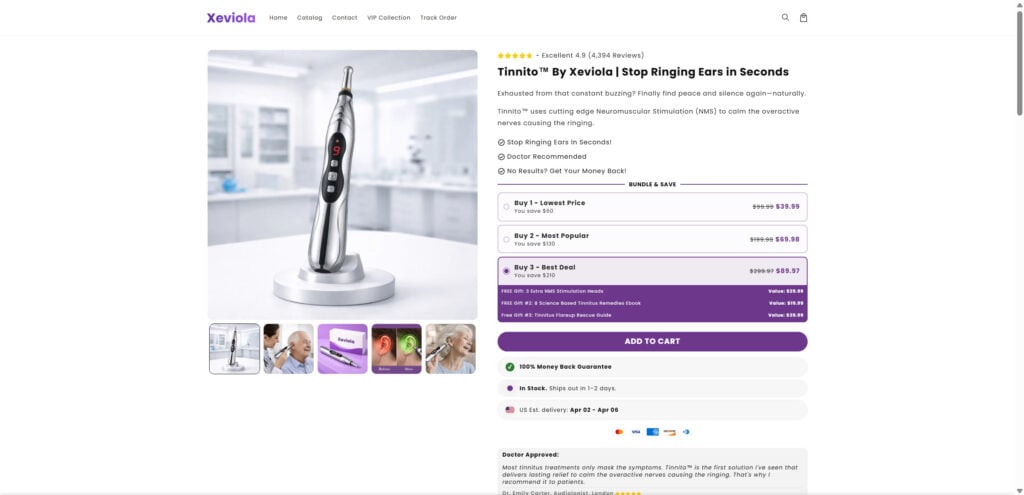
The Xeviola Tinnito Pen is promoted as a simple device that can stop tinnitus and ear ringing in seconds. Its sales pages use polished product images, medical-sounding explanations, glowing testimonials, and reassuring refund promises to make the offer look credible at first glance.
But once you look more closely, the picture changes. What appears to be sold as a special tinnitus breakthrough looks much more like a generic dropshipping product wrapped in exaggerated claims, misleading ads, and a refund process that may leave buyers frustrated and empty-handed.
Overview
What the Xeviola Tinnito Pen claims to be
The Xeviola Tinnito Pen is marketed as a fast, non-invasive solution for people dealing with ringing in the ears. The product page suggests that the device uses “Neuromuscular Stimulation” or NMS to calm the nerves behind the ear and reduce tinnitus almost immediately.
That is a very attractive message for anyone who has been struggling with constant buzzing, ringing, humming, or other persistent ear sounds. Tinnitus can affect sleep, concentration, mood, work, and overall quality of life. When a website promises near-instant relief, many people naturally want to believe it.
The problem is that the sales pitch appears to rely far more on persuasion than on trustworthy evidence.
Instead of giving shoppers a clear, transparent explanation supported by verifiable data, the website leans heavily on dramatic wording, visual tricks, and emotional reassurance. It presents the device as if it were a cutting-edge medical innovation, while the product itself appears to match cheap generic “laser acupuncture” or “meridian energy” pens widely sold on wholesale platforms for just a few dollars.
That gap between the story and the actual product is where the concern begins.
Why the marketing raises serious red flags
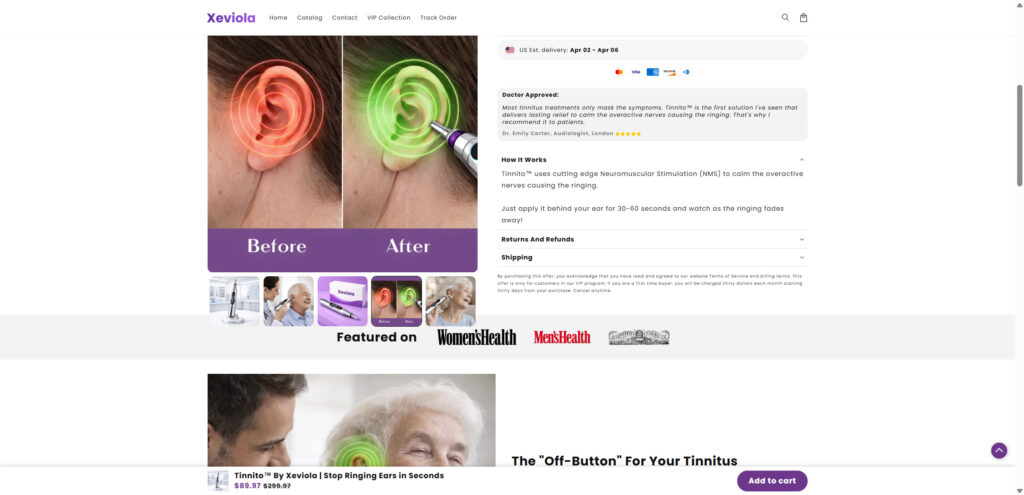
The first issue is the promise itself. The sales page frames the Xeviola Tinnito Pen as something that can stop ringing ears in seconds. That is not a cautious or limited claim. It is a bold promise aimed directly at people who are desperate for relief.
When health-related products make dramatic results sound effortless, skepticism is necessary. Tinnitus is not a simple problem with a one-size-fits-all fix. It can have many causes, and even legitimate treatment approaches are usually described with far more care and nuance.
The second issue is the way the page tries to create authority.
The site uses phrases such as:
- “Doctor recommended”
- “Clinically studied parameters”
- “Cutting edge NMS therapy”
- “Stop ringing ears in seconds”
These phrases are designed to sound reassuring, but language alone is not proof. A trustworthy health-related product should provide clear information about who made it, what standards it meets, what evidence supports it, and who exactly is endorsing it. If those details are vague, missing, or impossible to verify, the medical tone becomes part of the marketing rather than a sign of legitimacy.
The product appears to be a generic wholesale item
One of the biggest warning signs is the product itself.
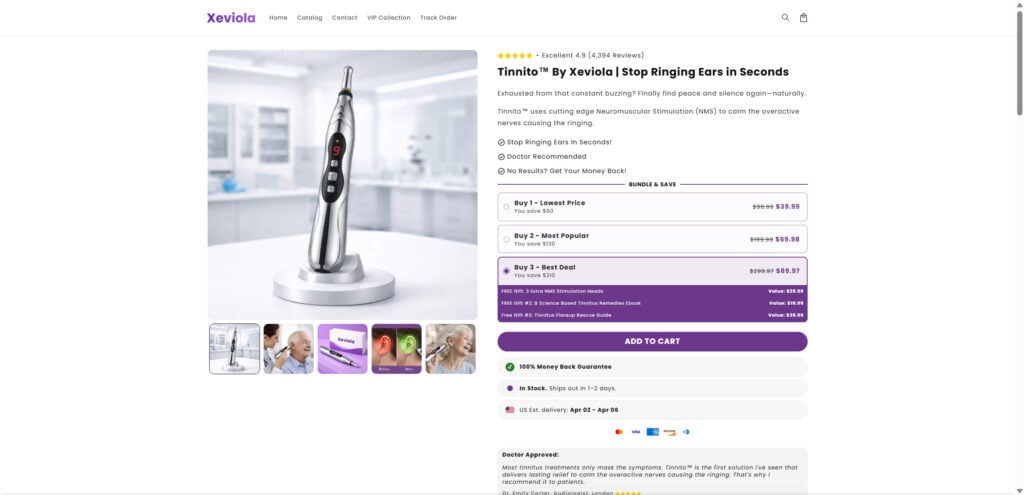
From the screenshots, the Xeviola Tinnito Pen looks nearly identical to low-cost devices sold on wholesale marketplaces under descriptions like:
- Laser acupuncture pen
- Meridian energy pen
- Electro acupuncture pen
- Physiotherapy point stimulator
These items are often listed for roughly $3 to $5 each in bulk, sometimes even less depending on the quantity ordered. That strongly suggests the Xeviola Tinnito Pen is not a unique tinnitus breakthrough, but a rebranded generic gadget being sold at a steep markup.
To be clear, rebranding on its own does not automatically mean a product is a scam. Many businesses private-label products. The problem is what happens next. When a cheap generic device is repackaged as a premium medical solution and sold with claims that it can fix a distressing health issue in seconds, the marketing crosses into much more questionable territory.
The website uses a familiar dropshipping funnel
The sales page follows a pattern often seen in aggressive dropshipping operations.
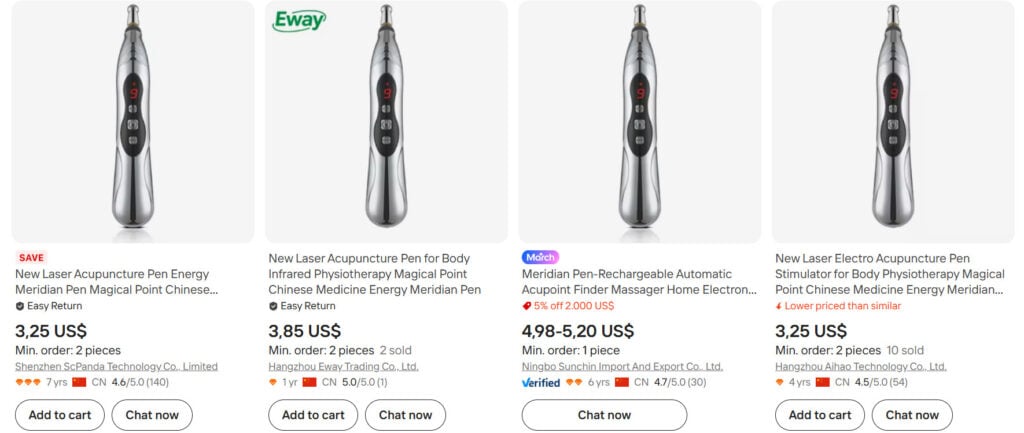
It does not just present the product and let the item speak for itself. Instead, it uses a full conversion funnel designed to push visitors toward a quick purchase. That usually includes:
- A dramatic headline
- A high review score
- A large number of reviews
- A “doctor approved” statement
- A before-and-after style visual
- Discount bundles
- Free bonus gifts
- A strong money-back guarantee
- Urgency and scarcity language
- Fine print that buyers may overlook
This formula works because it creates momentum. The shopper is given just enough comfort to feel safe, and just enough urgency to feel they should act now.
That does not mean every site with these elements is fraudulent. But when the product appears generic and the claims are unusually strong, the funnel itself becomes part of the warning sign.
The testimonials and images may not mean much
The page also features smiling customers, success stories, and polished visuals that make the product look widely trusted. Buyers see older adults holding the device and describing how it gave them peace, silence, or confidence back.
That style of testimonial is extremely common in questionable ecommerce funnels. The issue is not simply that testimonials exist. The issue is that they often replace real evidence. Consumers are expected to trust the emotional impact of the story rather than asking harder questions about whether the reviews are authentic, whether the people are real customers, and whether the results described are typical or even possible.
The same concern applies to the “featured on” logos shown on the page. These logos are often used to imply outside recognition, authority, or media coverage. But unless a buyer can independently verify that the product was genuinely reviewed or covered by those publications, the logos should not be taken as proof of credibility.
The “doctor approved” claim deserves extra scrutiny
The product page also includes a supposed professional endorsement. This is one of the strongest persuasion tools on the page because health products gain instant legitimacy when a doctor or specialist appears to approve them.
But for this kind of endorsement to carry real weight, buyers should be able to verify several things:
- The full identity of the professional
- Their credentials
- Their practice or workplace
- Their relationship to the product
- Whether the endorsement is genuine and current
If the page offers only a vague name, a generic title, or a quote that cannot be traced anywhere else, the endorsement should be treated with caution. In many deceptive product funnels, doctor quotes are little more than decoration meant to lower resistance and push the shopper toward checkout.
The hidden subscription language is especially concerning
One of the most troubling parts of the sales page is the small print about ongoing charges.
According to the screenshot, buyers may be enrolled in a VIP program with a recurring charge of $30 every month starting 30 days after purchase. That is a major red flag, especially if the shopper believes they are making a simple one-time purchase.
This is the kind of billing tactic that causes many consumers real financial problems. They buy one product, feel disappointed when it arrives, then discover later that their card has been charged again. Hidden continuity offers are common in scammy funnels because they generate revenue long after the original sale.
Any time recurring billing is buried in fine print instead of being clearly presented during checkout, buyers should slow down and assume the seller is not being fully transparent.
Refund promises may exist mainly to make the sale
The page also advertises a 100% money-back guarantee. On the surface, that sounds protective. In reality, guarantees like this often function as a psychological sales tool rather than a practical customer safeguard.
Many buyers of products like this report the same pattern:
- The item arrives late
- The device looks cheaper than expected
- It does not perform as advertised
- Customer support gives delayed or vague replies
- Refunds are stalled or refused
- Partial refunds are offered instead of full ones
- Buyers are told to return the product overseas at their own expense
- Extra units arrive, adding confusion and cost
By the time the buyer realizes the guarantee may be hard to use, the seller already has the money.
Why this appears to be a deceptive dropshipping operation
Taken together, the Xeviola Tinnito Pen shows the classic signs of a misleading dropshipping setup built around a sensitive problem.
The pattern includes:
- A cheap generic product
- Rebranding to create a special identity
- Big claims about health benefits
- AI-style or highly polished ad creatives
- Emotional testimonials
- Dubious trust signals
- Heavy upselling
- Buried subscription language
- A refund promise that may be difficult to use
- Reuse of the same product across multiple sites under different names
The result is a product that looks far more advanced and reliable online than it is likely to be in real life.
For consumers, the core issue is not just overpricing. It is that the product may be sold in a way that misrepresents what it is, what it can do, and how easy it will be to get your money back if you are unhappy.
How The Operation Works
How deceptive products like the Xeviola Tinnito Pen are sold
Operations like this usually do not rely on a single trick. They work because many small pieces come together in a way that feels convincing, especially to someone who is already worried about a real health problem.
Below is a closer look at how the Xeviola Tinnito Pen style operation typically works from start to finish.
Step 1: Start with a painful problem people desperately want to solve
The first ingredient is a problem that already carries stress, frustration, and urgency.
Tinnitus is ideal for this kind of marketing because it affects daily life in ways that are hard to ignore. People who hear constant ringing often feel tired, overwhelmed, distracted, and worried that the issue will never improve.
A deceptive seller does not need to invent the pain. The pain is real.
What they do instead is build an ad campaign around the emotional vulnerability created by that pain. They know that when a person feels worn down enough, the promise of a quick fix becomes much harder to resist.
Step 2: Use ads that look modern, medical, and reassuring
The next stage is usually the ad itself.
These ads often appear on social media, video platforms, or content sites. They are designed to look polished and credible right away. The visuals may include:
- Clean white backgrounds
- Close-up device shots
- Before-and-after images
- Animated ear graphics
- Older adults smiling with relief
- Medical-looking wording
- Calm voiceovers or AI-style narration
The goal is to create the feeling that the product is both advanced and safe.
A viewer sees a sleek pen-shaped device, hears terms like nerve stimulation or clinically studied therapy, and starts to assume there must be real substance behind the presentation. That is exactly what the seller wants. The ad only needs to earn enough trust to get the click.
Step 3: Present a generic item as a breakthrough invention
Once the shopper lands on the site, the product is no longer introduced as an ordinary gadget. It is presented as a specialized tinnitus solution with a branded name, a polished story, and a medical angle.
This is one of the most important parts of the operation.
Instead of allowing the customer to compare the item to low-cost wholesale pens, the website gives it a new identity. It becomes the “Xeviola Tinnito Pen,” not a generic electro-acupuncture pen that may cost only a few dollars from a supplier.
That repositioning changes how buyers think about the price. They are no longer comparing the item to a mass-produced gadget. They are comparing it to the stress of their symptoms and the hope of relief.
That emotional framing makes a steep markup feel easier to justify.
Step 4: Add science-flavored language that sounds convincing
After the product is rebranded, the seller gives it a technical explanation that sounds impressive but may not be meaningfully supported.
Words like “Neuromuscular Stimulation” and “clinically studied parameters” serve a specific purpose. They create the impression that the device is based on real science, even if the page does not provide clear evidence to support the claim.
For many buyers, that is enough.
Most people are not going to pause and demand a published study, manufacturer certification, or regulatory paperwork. They simply hear medical-sounding language and feel reassured that the product must have some legitimate foundation.
This kind of presentation is common in questionable health marketing because it replaces proof with tone. It sounds scientific, so it feels safer than it really is.
Step 5: Build trust with stacked reassurance signals
Once the buyer is interested, the page starts removing objections one by one.
This is where the conversion funnel becomes very deliberate. The site may use:
- 4.9-star ratings
- Thousands of reviews
- Doctor recommendations
- Publication logos
- “In stock” notices
- U.S. delivery estimates
- A 100% money-back guarantee
- Product bundles labeled as the best value
The idea is to overwhelm doubt through repetition. Each element says, in a slightly different way, “You can trust this.”
A shopper may not fully believe any one claim on its own, but when all of them appear together, the page starts to feel established and safe. That feeling is often what drives the purchase.
Step 6: Push people toward larger orders
A big part of the strategy is increasing the amount spent before the buyer has time to think carefully.
That is why bundle pricing is so common. Instead of encouraging a single purchase, the page makes the three-unit offer seem smartest. It adds “free gifts,” savings language, and “most popular” labels to guide the shopper toward a bigger cart total.
This approach works well for the seller for several reasons:
- It increases revenue immediately
- It makes the purchase feel like a better deal
- It gives the buyer more to lose if the product disappoints
- It may complicate returns if multiple units are shipped
In some cases, buyers even report receiving more units than they ordered, which can create additional confusion and make it harder to sort out what happened.
Step 7: Hide the most dangerous terms where few people look
Many deceptive product pages include important billing terms in places that shoppers are unlikely to study carefully.
In the Xeviola Tinnito Pen case, the fine print suggests that first-time buyers may be charged $30 every month as part of a VIP program beginning 30 days after purchase.
That detail matters enormously, yet it is not placed front and center where shoppers would expect to see it.
This is how continuity billing traps often work. The main page creates excitement and urgency, while the risky terms stay buried in less visible text. The customer moves through checkout thinking they are paying once, only to discover later that the transaction may have opened the door to recurring charges.
That is not a minor issue. It can turn an already disappointing purchase into a longer financial problem.
Step 8: Deliver a product that does not match the promise
After payment, the most carefully polished part of the experience is over.
What arrives may look much more like a generic imported gadget than the premium medical solution shown in the ads. The quality may feel lower, the instructions may be limited, and the product may not produce anything close to the results suggested by the marketing.
That is one of the most common complaints in dropshipping operations. The ad sells a story, but the parcel delivers something much more ordinary.
In health-related niches, that mismatch is especially troubling because buyers are not just disappointed by the product itself. They may also feel misled at a vulnerable moment, after having trusted claims tied to a real physical problem.
Step 9: Turn the refund process into a second obstacle
Many people assume the money-back guarantee will protect them if the product fails. In practice, the refund stage is often where the operation becomes most frustrating.
Buyers may run into problems such as:
- Slow replies from support
- Repetitive scripted responses
- Requests for extra information
- Pressure to accept a partial refund
- Instructions to return the product internationally
- Silence after follow-up emails
- Ongoing charges while the dispute continues
Some consumers give up because the process becomes too time-consuming or confusing. That is part of why this model can stay profitable even when buyers are unhappy. The seller does not need everyone to keep the product. They only need enough people to miss deadlines, accept partial refunds, or abandon the process altogether.
Step 10: Reuse the same product under different brand names
One reason these operations keep appearing is that the underlying product is generic and easy to relaunch.
If one site attracts complaints or negative attention, the seller can move the same device to a new domain, change the brand name, swap in fresh creatives, and repeat the process. The product stays essentially the same, while the identity around it changes.
That is why consumers should not focus only on one brand name.
The more important thing is recognizing the pattern:
- miracle-style promises
- vague medical language
- generic products sold as breakthroughs
- emotional testimonials
- aggressive upsells
- hard-to-use refund guarantees
- recurring billing hidden in fine print
When you see all of those features together, caution is warranted.
What To Do If You Have Bought This
1. Save every screenshot and record you can
Start by collecting evidence immediately. Do not wait to see whether the seller will “make it right.”
Save:
- the product page
- the claims about tinnitus relief
- the pricing and bundle offer
- the guarantee language
- the VIP or recurring billing text
- your order confirmation
- shipping emails
- the ad you clicked, if possible
This documentation will help if you need to dispute the charge.
2. Check your card statement closely
Look beyond the original purchase amount.
Review your bank or card statement for:
- duplicate charges
- extra charges
- unfamiliar merchant names
- recurring monthly charges
- any amount close to the $30 VIP billing mentioned in the fine print
If you spot anything suspicious, act quickly.
3. Photograph the package and everything inside
As soon as the item arrives, take clear photos of:
- the packaging
- shipping labels
- the product itself
- accessories or inserts
- any extra units you did not order
This helps show whether the item matches the advertising and whether the seller shipped the correct quantity.
4. Contact the seller in writing
Send a short, direct email stating that the item was not as described and that you want a full refund.
Keep the message simple. Include:
- your order number
- the date of purchase
- what was wrong with the item
- whether extra units were sent
- a request for written return instructions
Avoid long emotional messages. Clear written communication works better.
5. Do not let the process drag on for too long
If the seller delays, gives vague answers, or keeps repeating the same scripted response, do not stay trapped in endless back-and-forth emails.
Give them a short deadline. If they do not resolve the matter promptly, move to a formal dispute with your payment provider.
Time matters because many card disputes must be filed within a limited period.
6. File a dispute with your bank or payment provider
If the product does not match what was advertised, open a dispute as soon as possible.
Useful reasons may include:
- item not as described
- misleading advertising
- unauthorized recurring billing
- incorrect quantity received
- refund refused
Provide screenshots, photos, and copies of your emails. The more organized your evidence is, the stronger your case will be.
7. Ask your bank about blocking future charges
If the site enrolled you in recurring billing or you suspect it might, ask your bank or card issuer how to stop future charges.
That may involve:
- blocking the merchant
- canceling recurring authorization
- replacing your card in serious cases
This is especially important if the seller has access to your payment details and you no longer trust them.
8. Be careful with expensive overseas returns
Some sellers try to make refunds difficult by requiring the buyer to ship the item back internationally at their own expense.
Before paying for return shipping, speak with your card issuer or payment provider. In many cases, it may be smarter to pursue a charge dispute rather than spend more money sending a low-cost item overseas.
9. Report the ad and website
If you saw the product through a social media ad, report it on that platform. You can also file complaints with relevant consumer protection agencies or fraud reporting bodies in your country.
Reporting may not get your money back directly, but it can help build a record against the seller.
10. Warn other shoppers with factual reviews
Leave honest, specific reviews that describe:
- what the ad promised
- what you received
- whether extra units were sent
- whether recurring charges appeared
- how the refund request was handled
Stick to facts. Clear reviews are more useful than angry general statements.
11. Watch out for recovery scams
After being burned once, some consumers get targeted again by people promising to recover the lost money for an upfront fee.
Be cautious. Many of these “recovery services” are scams themselves.
12. Speak with a qualified medical professional about tinnitus
If you are dealing with persistent ringing or ear discomfort, it is worth talking to a licensed doctor, ENT specialist, or audiologist. Even if this product was disappointing, your symptoms still deserve proper care and a realistic discussion of safe treatment options.
The Bottom Line
The Xeviola Tinnito Pen appears to be a generic dropshipping product marketed as a premium tinnitus solution through exaggerated claims, polished ad creatives, questionable trust signals, and billing terms that deserve serious scrutiny.
The biggest problem is not simply that the product may be overpriced. It is that buyers may be led to believe they are purchasing a proven tinnitus relief device, when the reality appears much closer to a cheap rebranded gadget that may not work as advertised and may be difficult to return.
If you are considering buying it, slow down and do more research before spending any money.
If you already bought it and the experience does not match the promises, document everything, monitor your statements closely, and move quickly if you need to dispute the charge. In cases like this, careful records and fast action give you the best chance of limiting the damage.









Wow,
When I saw how cheap the product was and made in China, I had buyers remorse. When I could barely tolerate the lowest setting I said oh no. I’m calling. My card company now, thanks for the heads up!!
Calling the card issuer is the right priority, George. Stop using the device if even its lowest setting is painful or difficult to tolerate, and do not place it in or around the ear again without medical guidance. Keep the product, packaging, advertisement, and statement charge as evidence for the dispute.
Potential customers be AWARE!!!
On June 7, 2026 I bought one unit for $39.99 and was charged on that day. The quality is very poor, not working as advertised. But on 7/6/2026 today, my account is charged AGAIN $29.99 that I don’t know what it is about. There is NO customer-service phone number I can reach and complain. This is a SCAM! Do NOT fall for XEVIOLA,COM !!!
That second charge a month later is the subscription you didn’t knowingly agree to, and $29.99 is the recurring “member” price these funnels use. Since there’s no contact route, deal with the bank rather than the seller: dispute the $29.99 as unauthorised, and ask them to block the merchant and reissue the card if necessary, because these charges reappear under slightly altered descriptors. The $39.99 is worth disputing too, as not as described. Thanks for posting the dates – they help other readers recognise the pattern.
I don”t have the e mail address for Xeviola. Can you give it to me?
I am afraid we do not have one, and that is the point rather than an oversight on our part – MalwareTips is an independent review site with no connection to Xeviola, no account with them, and no contact details beyond whatever is on their own website. Where these sellers do publish an address it is usually a forwarding mailbox that is not monitored, and emails to it go unanswered by design. That is the single most common complaint we get about them.
So do not spend weeks waiting for a reply. If you need an order cancelled, a subscription stopped or money back, go to your card issuer instead: ring the number on the back of the card, dispute the charge as not as described or unauthorised, and ask them to revoke the merchant’s recurring authorisation and issue you a new card number. That works whether or not the company ever answers. Then file it at reportfraud.ftc.gov.
One caution: if you search for a support number for these brands, the results are full of fake “customer service” lines that are themselves scams. Only use what is on your card and on your bank’s own site.
Well, I guess I have been scammed by Tinnito BY Xeviola. Stupid me in good faith and too trusting in salespeople. I ordered 1one TINNITO V2 device that is “help with Tinnitus” at $39.99. When I received the order there were 2 two devices. After opening the package there was a warning that stated, “Do NOT Use This Device If You Have A Pacemaker,” which I do. This Warning was not listed on the description page. I then checked my Credit Card, and they had charger for one for $57.00 which is what I had ordered and 2 for $69.98 which I HAD NOT ORDERED. I have called their phone number and all I could do was leave a message. I checked their online page, and it looks like I don’t exist. These items have an unconditional 30-day guarantee, problem is, I can’t reach their Service to request a refund and to return the two devices.
Being trusting is not stupidity, and “in good faith” is exactly the right phrase – you behaved reasonably and they did not, so please put the self-blame aside.
Two devices when you ordered one is the actionable part. Ring your card issuer, dispute the second unit as unauthorised – you ordered one, and they cannot show otherwise – and dispute the first as not as described if it does nothing for your tinnitus. In the same call, ask them to revoke the merchant’s recurring authorisation and issue a new card number, because these sellers commonly follow up with a monthly charge. You generally have up to 120 days per charge. The extra device is legally yours to keep under the FTC’s unordered-merchandise rules, so ignore any restocking fee or demand for return postage, and do not post anything back at your own expense.
On tinnitus, since that is the real problem: there is no $39.99 device that stops it, and the ones sold this way are typically a white-noise generator or nothing at all. What genuinely helps some people is unglamorous – having your hearing tested, since tinnitus often accompanies hearing loss and a properly fitted hearing aid can mask it, along with sound therapy and CBT-based tinnitus retraining. The American Tinnitus Association at ata.org has plain, non-commercial information, and an audiologist is worth far more than any of these gadgets. Also worth mentioning it to your doctor if it started suddenly, is in one ear only, or comes with dizziness or hearing loss.
Report it at reportfraud.ftc.gov too – a medical-device claim plus an unordered second unit is the sort of complaint that gets acted on.
You are awesome thank you for your work
Thank you, Andre. I appreciate that. The goal is to help people spot the warning signs before they lose money.
Thank you, Andre. I appreciate it. The goal is to help people spot the red flags before they lose money.