

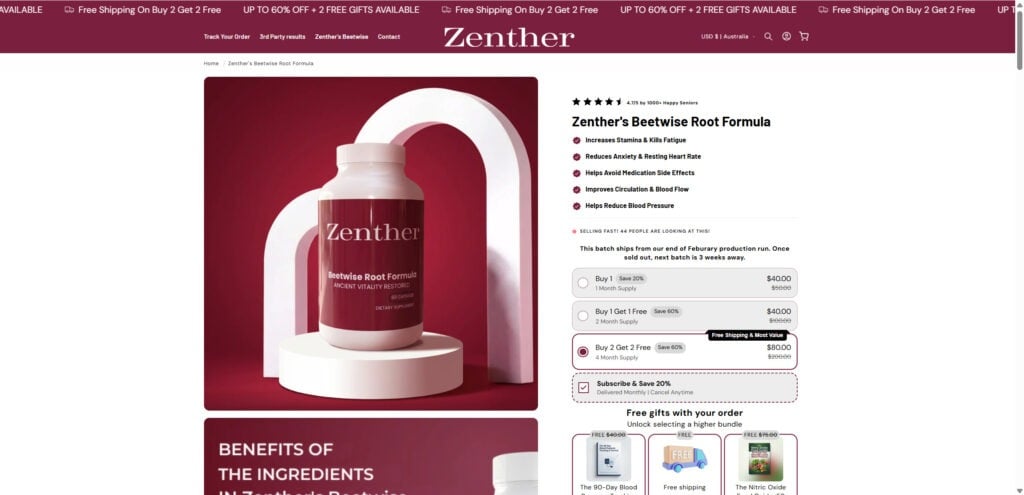
Zenther’s Beetwise Root Formula is sold as a natural solution for circulation, blood pressure support, energy, and overall vitality. On the surface, it looks like just another health supplement aimed at older adults who want to feel better without relying on more medication.
But once you look past the polished branding, the operation raises serious concerns.
The product is promoted through emotional social media ads, exaggerated health promises, questionable trust signals, and sales tactics that can leave buyers frustrated, overcharged, or stuck in subscriptions they never truly wanted. This article takes a close look at how Zenther’s Beetwise Root Formula is marketed, why so many of the claims deserve scrutiny, and what you should do if you already bought it.
Overview
What is Zenther’s Beetwise Root Formula supposed to be?
Zenther’s Beetwise Root Formula is presented as a beetroot-based supplement designed to support blood pressure, circulation, stamina, and general cardiovascular wellness. The branding is built around the idea that it offers a natural answer to problems that many older adults worry about every day.
The sales pitch is carefully constructed. It does not just say the product may support health in a general sense. It goes much further. The messaging strongly suggests that this formula can help people feel younger, have more energy, improve blood flow, reduce anxiety around blood pressure, and even avoid the downsides of prescription medication.
That is where the first major problem begins.
A supplement can be marketed as supporting normal wellness. But when the advertising starts drifting into life-changing medical territory, the line between ordinary supplement promotion and deceptive health marketing gets very thin.
Why this kind of product gets attention so easily
Products like Zenther’s Beetwise Root Formula are not sold through careful scientific explanations. They are sold through emotion.
The ads are designed to reach people who are already worried about:
- High blood pressure
- Poor circulation
- Fatigue
- Aging
- Medication side effects
- Intimacy problems
- Feeling less capable than they used to
These are very personal concerns. They affect confidence, relationships, and quality of life. That makes people more vulnerable to marketing that promises a simple, natural breakthrough.
Instead of asking shoppers to compare ingredients, research, and evidence, the sales funnel tells a story. It says, in effect, that the viewer has been missing one simple answer all along. That answer is supposedly hidden in a bottle of beetroot capsules.
That is powerful marketing. It is also exactly why consumers need to slow down and look carefully.
What the formula appears to contain
The product is framed as a special circulation formula, but the ingredient profile appears quite basic. At its core, it is sold as a beetroot supplement.
That matters because a lot of the dramatic marketing language makes the product sound far more advanced than it likely is.
Beetroot itself is not fake. It is a real food ingredient, and it has been discussed for years in relation to dietary nitrates and nitric oxide support. Some people use beetroot powder or beet juice as part of exercise routines or broader wellness habits.
But that does not mean every beetroot capsule sold online is a breakthrough product.
A simple beetroot supplement is still just a supplement. It is not magic. It is not a proven replacement for proper medical care. It is not something that should be sold through fear-driven advertising that implies major medical benefits without strong evidence.
The real issue is not that beetroot exists
This is important.
The concern is not that beetroot is fake. The concern is that a real, ordinary ingredient may be wrapped in exaggerated claims, fake authority, and manipulative sales tactics.
That distinction matters because many questionable supplement operations work this way. They do not always sell a completely fake product. Sometimes they sell a very real but low-cost generic supplement while using aggressive advertising to make it seem revolutionary.
That makes the operation harder for many buyers to spot.
A person might receive a bottle in the mail and think, “Well, something arrived, so maybe the company is legitimate.”
But that is not the full question.
The real question is whether the product was marketed honestly, whether the customer knew exactly what they were agreeing to, and whether refunds and cancellations are handled fairly. That is where many of the biggest complaints appear.
The marketing looks stronger than the evidence
One of the biggest red flags with Zenther’s Beetwise Root Formula is the gap between the strength of the promises and the quality of the proof.
The site and ads push broad claims around:
- Better circulation
- Better energy
- Lower blood pressure
- Reduced fatigue
- Less anxiety
- Improved vitality
- Reduced medication-related concerns
That is a very wide promise set for one simple supplement.
When a product claims to improve many different health issues at once, caution is warranted. The broader the promise, the more likely the marketing is trying to cast the widest possible net rather than communicate precise, honest expectations.
Consumers should ask:
- Where is the actual evidence for this specific product?
- Was this exact formula studied?
- Are the dramatic outcomes documented anywhere credible?
- Is there transparent proof behind the percentages and testimonials?
If the answer is vague, missing, or buried behind slogans, that is a warning sign.
The site leans heavily on authority signals
Another issue is the way the product is presented. The overall design tries very hard to look authoritative.
This often includes things like:
- Big media-style logos
- “As seen on” sections
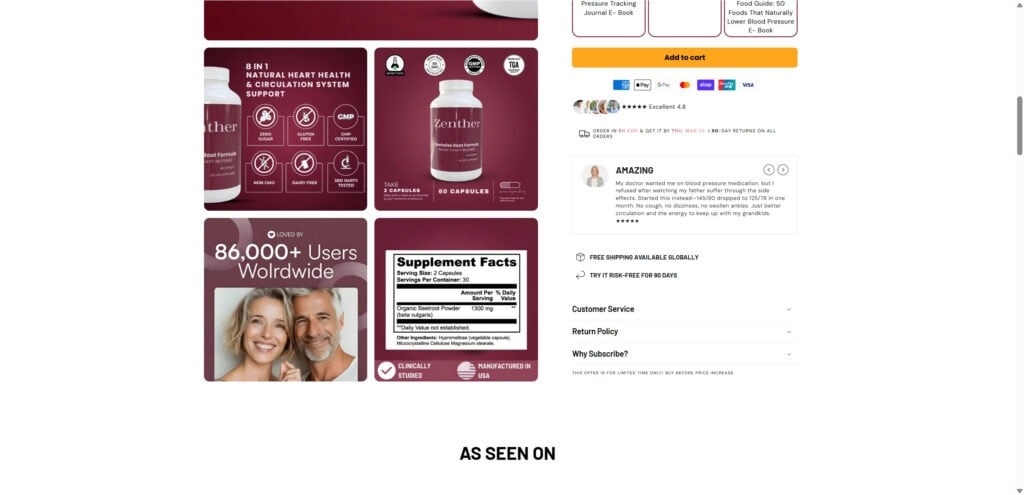
- Claims of clinical support
- “Third-party tested” language
- High user numbers
- Star ratings
- Review-style customer stories
- Professional-looking health claims
These elements are not proof by themselves.
A logo from a major publication does not mean the product was actually covered or endorsed. A “clinically studied” phrase does not necessarily mean the exact product was tested. A polished customer story does not guarantee that the person is real, the image is authentic, or the experience is typical.
When trust is being built through appearance rather than verifiable detail, buyers should pause.

The fake endorsement problem
This is one of the most serious concerns.
Zenther’s Beetwise Root Formula is being sold through marketing that relies on fake or exaggerated endorsements, fake doctors, fake stories, and AI-generated or highly manipulated images. This kind of strategy is common in low-trust supplement funnels.
The reason it works is simple.
Most people do not verify every face, every logo, or every quote they see in an ad. If a page looks professional enough, many shoppers assume someone must have checked it already.
But fake authority is one of the easiest tools for shady marketers to use.
A supposed medical expert may not be real. A customer image may be AI-generated. A success story may be invented. A logo bar may suggest coverage that never happened. A “news-style” tone may simply be a sales script disguised as public interest content.
Once those pieces are in place, the product starts feeling trustworthy before the buyer has seen any real evidence.

The customer experience is where the operation often falls apart
Many people do not discover the problem at the ad stage. They discover it after paying.
That is where complaints tend to cluster.
Common issues reported by buyers include:
- Ordering one bottle but being charged for more
- Getting enrolled in recurring refill plans they did not clearly understand
- Difficulty canceling subscriptions
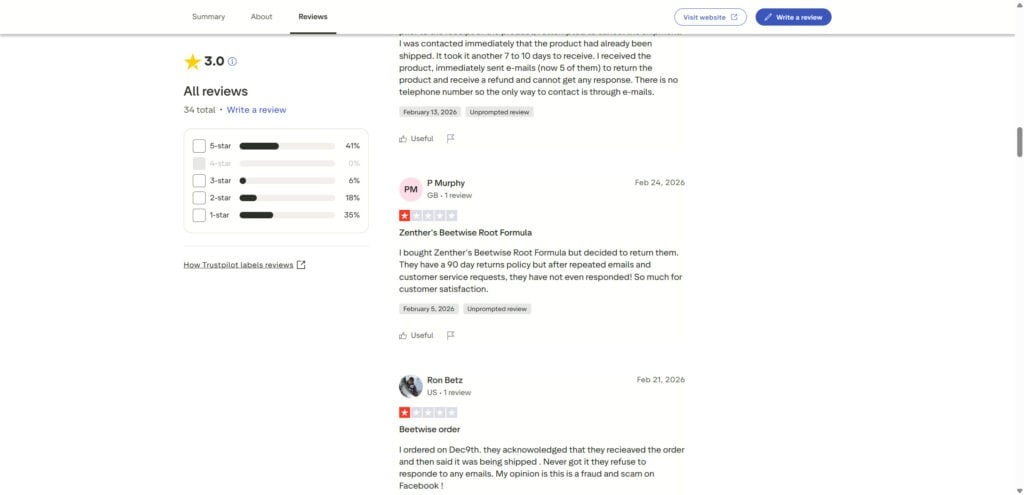
- Delayed or ignored customer service responses
- Trouble getting a refund
- Return processes that become impractical or expensive
- Being told to ship the product back overseas, sometimes to China
- Support that seems responsive in public but unhelpful in private
This pattern is extremely common in aggressive supplement funnels.
The front end of the operation is smooth, persuasive, and emotional. The back end becomes slow, confusing, and frustrating.
That contrast tells you a lot about where the real priority lies.
Why the return issue matters so much
A company can make a supplement. A company can advertise it. A company can even overhype it.
But once buyers are charged unexpectedly or blocked from getting their money back, the situation becomes much more serious.
A so-called generous return policy means very little if:
- Customers cannot get a real response
- The merchant delays until the return window is nearly over
- The return address is difficult to obtain
- The item must be shipped internationally at the customer’s expense
- Support keeps repeating scripts without resolving anything
For many people, that is the point where the operation stops feeling like an ordinary brand with aggressive marketing and starts feeling like a trap.
So is Zenther’s Beetwise Root Formula a scam or legitimate?
The most accurate answer is this:
The product may be a real supplement, but the operation around it raises major legitimacy concerns.
That is often how these businesses work. The bottle may exist. The ingredient may be real. The experience can still be deceptive.
A product does not need to be chemically fake to be sold through misleading methods.
If a business uses fake authority, exaggerated health claims, AI-generated review imagery, questionable testimonial stories, subscription traps, and refund friction, the operation itself becomes the main problem.
That is why the safer conclusion is not to treat Zenther’s Beetwise Root Formula as a trustworthy wellness brand. At minimum, it appears to be a high-risk supplement offer marketed through tactics that many consumers would consider misleading and unfair.
How The Operation Works
Step 1: A social media ad hooks the viewer through fear or embarrassment
The funnel usually begins with a highly emotional ad.
These ads are not calm or balanced. They are designed to hit a vulnerable spot. Often the message focuses on blood pressure, aging, performance issues, fatigue, or the fear that medication is taking something important away from the person’s life.
This kind of advertising is effective because it makes the viewer feel seen.
It says, in effect:
- You are struggling
- Your current solution is failing you
- Nobody is really helping you
- Here is the real answer
That formula is incredibly persuasive, especially when the topic involves pride, masculinity, aging, or long-term health worries.
Instead of offering careful advice, the ad creates emotional urgency. It tries to move the person from discomfort to impulse.

Step 2: The ad introduces a story, not just a product
Once the emotional hook is in place, the pitch usually becomes story-driven.
There may be a supposed doctor, an “insider,” a health expert, or a concerned person exposing a hidden truth. The viewer is made to feel like they are discovering something the public has overlooked.
That story format matters because it lowers skepticism.
People are often more likely to trust a narrative than a plain sales claim. A well-told story feels personal and authentic, even when it is fake.
This is where fake doctors, fake testimonials, and fake stories become so useful for questionable supplement sellers. They do not need strong evidence if they can make the reader feel emotionally invested.
Step 3: Fake authority is layered in quickly
The next stage is credibility stacking.
This usually includes several signals all at once:
- Medical-looking language
- Reference to “studies” without clear sourcing
- Professional branding
- Claims of lab testing
- Impressive numbers
- Media logos
- Review stars
- Product badges
- Customer success stories
Each one is designed to reduce hesitation.
None of them, on their own, confirm real trustworthiness.
A shopper may see all of this and think the product has already been vetted by experts, customers, and publishers. In reality, much of it may be self-created marketing material with little outside verification.
This is why questionable supplement operations often look polished. The goal is not to prove legitimacy. The goal is to simulate legitimacy.
Step 4: The offer is framed as urgent and scarce
After the page builds trust, it creates pressure.
The shopper may be told that:
- The batch is almost sold out
- Many people are viewing the product
- A limited promotion is about to end
- Free gifts are available only now
- A price increase is coming soon
These claims are classic direct-response sales tactics.
They are meant to stop the buyer from stepping away to think, compare products, or read independent reviews.
Urgency is powerful because it turns a health purchase into a race. Instead of asking, “Is this credible?”, the shopper starts asking, “Should I grab this before I miss out?”
That shift is exactly what the seller wants.
Step 5: The product is made to sound far more specialized than it likely is
One of the most effective parts of the funnel is the positioning.
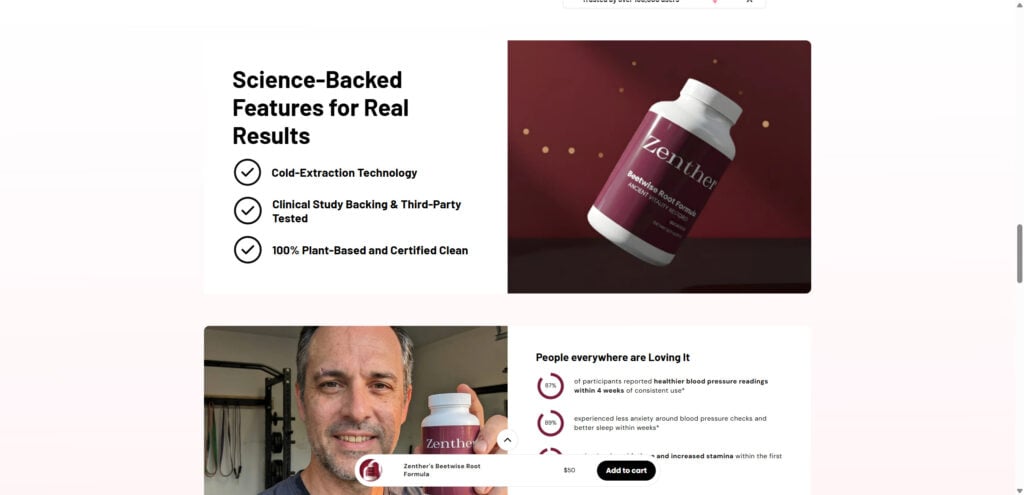
A simple beetroot powder supplement might sound ordinary. So the marketing wraps it in phrases about advanced extraction, nitrate support, science-backed performance, and targeted circulation benefits.
The result is that shoppers stop seeing a basic supplement and start seeing a breakthrough.
This is a crucial part of the operation.
A low-cost product can be sold at a premium when:
- The branding feels premium
- The problem feels urgent
- The product sounds medically sophisticated
- The testimonials sound life-changing
That does not make the product high quality. It just means the sales presentation is doing heavy lifting.
Step 6: Testimonials are used to overcome doubt
Customer stories are one of the strongest conversion tools in this kind of funnel.
The stories are often very specific. They mention daily struggles, medication frustrations, anxiety, sleep, energy, or blood pressure readings. This level of detail is designed to make them feel real.
But there are several reasons to treat these stories cautiously:
- The images may be AI-generated or heavily manipulated
- The people may not be real customers
- The quotes may be written by marketers
- The results may be exaggerated
- The stories may not reflect typical outcomes
The more emotional and perfect the testimonial feels, the more skepticism is needed.
Real customer experiences are often messy, mixed, and incomplete. Fake testimonials tend to sound cleaner and more persuasive because they are built for conversion, not honesty.
Step 7: The checkout is structured to maximize the order size
By the time the buyer reaches the pricing section, the page has usually done its job. The person is already imagining improvement.
Now the pricing is arranged to encourage a larger purchase.
Instead of a simple single-bottle offer, buyers are nudged toward bundles, free gifts, and “best value” packages. This is important because many supplement operations make far more money from multi-bottle orders than from one-time buyers.
The psychology is simple:
- If you buy more now, you save more
- If it works, you will want extra anyway
- If you buy only one bottle, you are missing the best deal
That logic pushes buyers into bigger orders before they have even tried the product once.
Step 8: Subscription revenue may be baked into the model
One of the most damaging parts of this type of operation is the refill or subscription setup.
Buyers may think they are making a one-time purchase. Later they discover recurring monthly shipments or charges that are difficult to stop.
This can happen because:
- Subscription terms were not prominent enough
- The option was preselected
- The buyer moved too quickly through checkout
- The cancellation rules were far more restrictive than expected
This is where many complaints begin.
A person who might have tolerated a disappointing product becomes much angrier when unexpected charges continue appearing. At that point, it is no longer just about whether the supplement worked. It becomes a billing and consumer rights problem.
Step 9: Support becomes difficult once money has changed hands
Before the sale, everything feels smooth.
After the sale, many operations become very hard to deal with.
Customers may run into:
- Slow email replies
- Generic scripted responses
- No real phone support
- Delayed cancellation handling
- Confusing policy language
- Requests for more time
- Repeated instructions without resolution
This is a major warning sign.
A trustworthy company does not just market well. It also handles post-purchase problems clearly and fairly. If support becomes evasive only after payment, that tells you the business may value acquisition far more than service.
Step 10: Returns are made legally possible but practically painful
This is one of the oldest tactics in questionable ecommerce.
The business offers a return policy that sounds reassuring, but the actual process is burdensome enough that many buyers give up.
That burden may include:
- Waiting days for a return authorization
- Receiving vague instructions
- Being asked to pay international return shipping
- Having to return the product to China or another distant location
- Facing long delays in refund processing
- Being told that a subscription shipment was already processed and cannot be stopped
At that point, the return policy exists more as a sales tool than a customer protection tool.
Technically, the company can say returns are allowed. Practically, many people never succeed in getting their money back.
Step 11: Public reputation management may hide private frustration
Another pattern often seen in operations like this is selective responsiveness.
A company may appear active in public spaces, especially where reputation matters. But private support requests remain unresolved.
This creates the appearance of customer care while allowing the business to keep real refund volume low.
Buyers who are not familiar with these tactics may assume that a brand with polished reviews and active public replies must be responsible. That is not always true.
What matters most is how the company behaves when a customer needs help with billing, cancellation, or a refund.
Step 12: The profit is often in the system, not the supplement
This is the bigger picture.
With operations like Zenther’s Beetwise Root Formula, the supplement itself may not be the most important part of the business. The real engine may be the sales system:
- Emotional ad creative
- Cheap trust signals
- Upsells
- Bundles
- Subscriptions
- Delayed refunds
- Difficult cancellations
In other words, the business may be optimized less around long-term customer trust and more around extracting as much value as possible from each buyer before dissatisfaction catches up.
That is why people should evaluate not just the bottle, but the entire funnel.
What To Do If You Have Bought This
1. Check immediately whether you were enrolled in a subscription
Start here, because this is often the most urgent issue.
Look through:
- Your order confirmation email
- The checkout receipt
- Any account dashboard on the site
- Your bank or card statement
Look for terms like:
- Subscription
- Refill
- Monthly delivery
- Auto-ship
- Recurring order
- Membership
If you find any sign of recurring billing, act fast.
2. Save proof of everything
Before contacting the company, gather and save your records.
Keep copies of:
- The product page
- The checkout page if possible
- Order confirmation emails
- Shipping emails
- Any subscription language
- Your bank or card charges
- Chat logs or support emails
- Screenshots of cancellation requests
Do not rely on memory. Save the evidence while it is still easy to access.
3. Contact support in writing and be direct
Write a short, clear message. Do not make it complicated.
Include:
- Your full name
- Order number
- Date of purchase
- A direct demand to cancel any recurring subscription
- A request for written confirmation
- A request for refund instructions if you want your money back
A simple message works best.
Example:
“Please cancel any active subscription linked to my order immediately. I also request written confirmation that no further charges will be made. If my order is eligible for return, please send the exact return instructions and return address today.”
Keep it firm and professional.
4. Watch your payment method closely
Do not assume one email solves the problem.
Check your card or bank account over the next several weeks for:
- Repeat charges
- New subscription payments
- Unexpected shipping fees
- Charges under similar merchant names
If another charge appears, document it right away.
5. Contact your card issuer or payment provider if support is not helping
If the company ignores you, delays too long, or refuses to stop recurring charges, escalate quickly.
You may be able to:
- Dispute the charge
- Block future charges
- Report unauthorized recurring billing
- Start a chargeback
- Report failure to honor the return policy
This is especially important if you believe you were enrolled in a subscription without clear, informed consent.
When speaking to your card issuer, explain the issue clearly:
- You bought a supplement online
- The advertising was misleading
- You may have been enrolled in recurring billing
- The merchant is not providing effective cancellation or refund support
Be organized and factual.
6. Do not rush to ship anything back without proper instructions
If the company tells you to return the product, get the full details in writing first.
You need:
- The exact return address
- The return deadline
- Whether tracking is required
- Whether the package must be unopened
- Whether international shipping is required
- Whether refund approval is guaranteed after receipt
If the return address is overseas, especially to China, calculate the shipping cost before sending anything. In many cases, the return cost can make the refund pointless.
That is one reason many buyers feel trapped.
7. Do not keep taking the supplement just because it arrived
Receiving the product does not mean you need to continue using it.
If you feel uneasy, especially if you take blood pressure medication or have a cardiovascular condition, speak with a medical professional before continuing.
Supplements that claim to affect circulation and blood pressure should not be treated casually.
Even if the product contains ordinary beetroot powder, that does not mean it is appropriate for everyone.
8. Report the ad and the business if the marketing was deceptive
If you believe the company used fake doctors, fake endorsements, AI-generated reviews, or misleading claims, report it.
You can report to:
- The social media platform where you saw the ad
- Your payment provider
- Consumer protection agencies
- Advertising oversight bodies in your country
This may not produce an instant refund, but it helps create a record. Repeated complaints matter.
9. Leave an honest review after the issue is resolved
If you had a bad experience, write a clear factual review.
Include details such as:
- What you ordered
- What you were charged
- Whether a subscription was involved
- How support handled your request
- Whether you received a refund
- Whether the return process was reasonable
Avoid emotional exaggeration. Calm, specific reviews are more useful and more credible.
10. Use this experience to build a safer buying checklist
For future supplement purchases, protect yourself by checking a few things first:
- Is the company identity clear and verifiable?
- Are the endorsements real and traceable?
- Are the reviews from trustworthy outside sources?
- Is the subscription optional and clearly explained?
- Is the return process realistic?
- Does the company have consistent support?
- Are the claims proportionate to the actual ingredients?
These checks take a few extra minutes, but they can save a lot of stress.
Why buyers find these offers convincing
They are not buying a capsule. They are buying hope
This is the part many people miss.
Most buyers are not sitting there thinking, “I want beetroot powder today.”
They are thinking:
- I want more energy
- I want to feel younger
- I want fewer health worries
- I want to avoid more medication
- I want my relationship to feel normal again
- I want to believe I can still improve
That emotional need is what the ads target.
The product becomes the symbol of a better future. Once that happens, skepticism drops and urgency rises.
The funnel is built to bypass careful thinking
At every stage, the buyer is pushed toward speed:
- Emotional ad
- Strong story
- Authority signals
- Big promises
- Scarcity
- Bundle deal
- Subscription savings
- Quick checkout
There is very little in that process that encourages reflection.
That is not accidental. It is the design.
If a shopper stops to compare products, research the company, or read independent complaints, the conversion may disappear. So the funnel is built to minimize that pause.
Older consumers are often the primary target
The themes, language, and concerns used in these ads often suggest an audience of older adults.
That does not mean older buyers are gullible. It means the marketers know exactly which worries to activate:
- Blood pressure
- Energy decline
- Aging
- Independence
- Masculinity
- Medication fatigue
- Fear of becoming weaker over time
When those worries are packaged with hopeful language and professional-looking branding, the result can be very persuasive.
That is why family members often become involved only after the purchase has already happened.
Key red flags to remember
If you want the simplest possible summary of why Zenther’s Beetwise Root Formula deserves caution, here it is.
Red flag 1: The claims are too broad
One supplement is being presented as a solution for a very wide range of issues. That is rarely a good sign.
Red flag 2: The authority signals are questionable
Fake endorsements, fake doctors, suspicious logo bars, and AI-generated review imagery are not small issues. They go to the heart of trust.
Red flag 3: The funnel relies on emotional pressure
Fear, shame, urgency, scarcity, and dramatic personal stories are all being used to drive action quickly.
Red flag 4: The subscription risk is serious
Many complaints about these operations do not center on the product itself. They center on recurring charges, refill traps, and cancellation trouble.
Red flag 5: The return process may be unrealistic
A return policy is only meaningful if it can be used fairly and affordably. If buyers are pushed into expensive overseas returns or endless delays, the policy is not truly consumer-friendly.
The Bottom Line
Zenther’s Beetwise Root Formula may look like a simple wellness supplement, but the way it is sold raises serious concerns. The operation appears to rely on exaggerated claims, fake authority, questionable review imagery, emotional ad tactics, and a checkout structure that may expose buyers to unwanted recurring charges and difficult returns.
That does not necessarily mean every bottle is fake. It means the overall business model does not inspire trust.
For most consumers, that is the point that matters most.
A supplement should not need fake doctors, AI-generated testimonial imagery, and aggressive subscription tactics to stand on its own. When a brand leans that heavily on manipulation, the safer conclusion is to stay away.
If you already bought it, move quickly, document everything, cancel anything recurring, and escalate through your payment method if support becomes evasive. The earlier you act, the better your chances of limiting the damage.

Join the discussion
10 commentsShare your experience or ask a question about this article.
Discussion
Here is my latest email I sent to Zenther:
Filed a complaint with Better Business Bureau and they told me after their investigation, they could not find a legitimate business in Wyoming with the name Zenther. Congratulations on stealing my $90 but you definitely will not do it again. Below are the facts that prove fraud!
1. Product made in China although claims they are U.S. made. Bottles in website have Made in USA on label but the bottles I received do not have that label and say distributed by a company in Dallas, TX. No one makes product in USA and ships to China for distribution then has to pay tariffs to come back into the U.S. That would be absolutely stupid.
2. Ships product to a storage facility in Indianapolis from China to repackage. Which adds to delay of receiving
3. Overcharges customer for order
4. Promises $120 worth of books only to send them out by email
5. Company claims to be based in Sheridan, Wyoming but can’t be found by BBB
6. False advertising buy 2 get 2 free for $80 and then charges $100 on order page
7. Get express shipping and it takes 2 and a half weeks to receive
8. Lies about product being made in USA when obviously it’s produced in Wuhan, China. Home of Covid
In reply to Jimmy Dooley
The BBB finding is a genuinely useful piece of evidence, so hold on to it. A Wyoming registration is a standard choice for these operations because the state requires minimal disclosure and a registered-agent service costs very little – so “no legitimate business of that name” usually means there is either no entity at all or only a shell behind an agent’s address, with the actual operator elsewhere. You can confirm it yourself for free on the Wyoming Secretary of State business search, and a screenshot of a nil result is worth having.
On the email itself, I would gently suggest you stop writing to them. Nothing you send changes the outcome, and a reply that engages simply confirms the address is live and monitored, which puts you on a warmer list. Their inbox exists to absorb complaints, not to resolve them.
Where the $90 can actually come back from: your card issuer. Dispute it as goods not received or not as described, mention the BBB finding, and ask them to block the merchant and issue a new card number. You generally have up to 120 days from the charge, so if it is still within that window, this is a phone call worth making today. Then file at reportfraud.ftc.gov, with the Wyoming Attorney General and with your own state’s, and if the domain is still live, send an abuse report to its registrar – that is often the fastest way to take one of these offline. Payment-processor complaints and chargeback ratios are the only pressure these operations genuinely feel.
For me, it’s a scam! I bought 4 bottles, used 2, zero results. I have used other beet powder and i eat beet nearly every day. When you smell the product it doesn’t smell like beet powder. When you open a capsule and taste it, it does not taste like beet powder, therefore i expect there is little to no beet in it. So i started trying to return the order. I have sent 2 emails to 2 different email accounts and got no response on either return request. Sending another today to a third email address as well as the first 2. Unfortunately i expect the same result.
In reply to dallas
Hi Dallas, thank you for sharing your experience. The fact that the product doesn’t even smell or taste like beet powder is a major concern and suggests a significant lack of quality control. Since they aren’t responding to your emails, I recommend contacting your bank to initiate a chargeback for “merchandise not as described.”
In reply to Stelian
Hey Stelian, thanks for the response. I was going through tabs to see what i could close and saw your message. Yes, about a week after no response for a third time i initiated the chargeback and had it in a few days. In my situation i found out at that time, i had 120 days to do this. Thankfully i got in before it expired. It would be interesting to having the stuff analyzed to find out what it actually is.
In reply to dallas
I ordered 4 bottles , when I saw the tracking coming out of China I sent them a email that was provided by the company website and it came back undeliverable, tried sending it again same thing . I denied the charge , today I got another charge for 4 more bottles . Denied that charge and locked my card . These people are a bunch of scammers. I hope they rot in hell .
I’ve read the whole story:
1) You never said if the product is ok or not ?
2) How do we know that this article is valid?
3) I can relate to a lot of what has been said, how do I repost somewhere else?
In reply to Charlene
Hello Charlene,
It is a real product, but it appears to be a very low-cost item, typically worth around $3 to $5 and shipped from China. Sites like this often use questionable sales tactics, such as sending more bottles than you ordered or enrolling customers in recurring “refill” charges.
Our recommendation is simple: do not buy it.