
Hot Take 3P-Matrix-lite version 2 available in the webstore (easy to use uMatrix like security using Mv3 DNR rules)

LinuxFan58

Level 16
Thread author
Nov 30, 2025
785
2,911
1,467
Hi open source 3P-Matrix-lite: version 2 has arrived in the webstore 3P-Matrix-lite - Chrome Web Store

What it does: offers 5 levels of protection with build-in whitelists to prevent website breakage.

3P-Matrix is very user friendly with presets and build-in whitelists which can be changed on the fly using a slider.
It has two smart extra features original uMatrix did not had:
- startup mode (default on 1), can be changed using drop down option to 2 to 5, but best practice is keep it at 1)
- lock website mode: protection level can be locked for a website, next time you visit this website the protection level will be set to the locked value.
this is very useful for adult websites, most work perfectly on level 4, locking it at 4, makes browsing dodgy websites a lot safer.

Level 1: allow all

Level 2: easy mode with enhanced security:
  • Build in whitelists to prevent website breakage
  • IP-address only third-party is blocked
  • HTTP third-party is blocked
  • Non-standard ports are blocked (only default port 443 is allowed)
  • Blocks all 3P-frames (except whitelisted)
  • Optionally blocks 3P-scripts on blacklisted Top Level Domains
    using a slider with 4 presets: none - user - generic - generic + country code's which are on the much abused TLD list
  • Optionally allows user to add domains to the whitelist using the tab or the show-blocks panel

Level 3: easy medium mode (as often explained by @Jan Willy with static AG Mv3 rules).
  • Same protection IP-address, HTTP, non-standard port protection and build-in whitelists as level 2, with one difference
  • In stead of blocking all 3P-frames and blacklisted 3P-scripts it blocks all 3P-frames and 3P-scripts with option to whitelist TLD's
    using a slider with 4 presets: none - browser - continent - world:
    - none (meaning no additional country codes) = only common general TLD's (which user can add or remove)
    - browser = adds the country code's of the languages enabled in the browser (some browser prevent fingerprinting)
    - continent = adds the country code's of other countries speaking the same language on the continent:
    e.g. when language is German, Austria and Zwitserland will be added
    - world = same mechanism applies, when language is Portuguese, country code Brazil will be added also
    note these advanced functions only work for extented EU-zone and 5 Eyes countries.
  • Optionally allows user to add domains to the whitelist using the tab or the show-blocks panel

Level 4: medium mode trusting domains with CDN in URL
  • Same protection IP-address, HTTP, non-standard port protection and build-in whitelists as level 2 and 3
  • Blocks 3P-scripts and 3P-frames except on the internal whitelist and URL's containing CDN
  • Optionally allows user to add domains to the whitelist using the tab or the show-blocks panel
Level 5: medium mode (everyone every used dynamic filtering with uBo or uMatrix is familiar with this mode)
  • Same protection IP-address, HTTP, non-standard port protection and build-in whitelists as level 2 and 3
  • Blocks 3P-scripts and 3P-frames
  • Optionally allows user to add domains to the whitelist using the tab or the show-blocks panel

This is an open source project with very privacy friendly usage policy.

The readme explains above with pictures: GitHub - Kees1958/3P-Matrix-lite: uMatrix-style third-party traffic control via Declarative Net Request
Privacy policy: 3P-Matrix-lite/privacy.md at main · Kees1958/3P-Matrix-lite


As posted I am nearly 68, was a developer some 45 years ago, so still learning. I noticed one quirk in the show blocks. It also shows the domains blocked by other extensions. I have to dive into it. It is a bug which is also a feature :-)
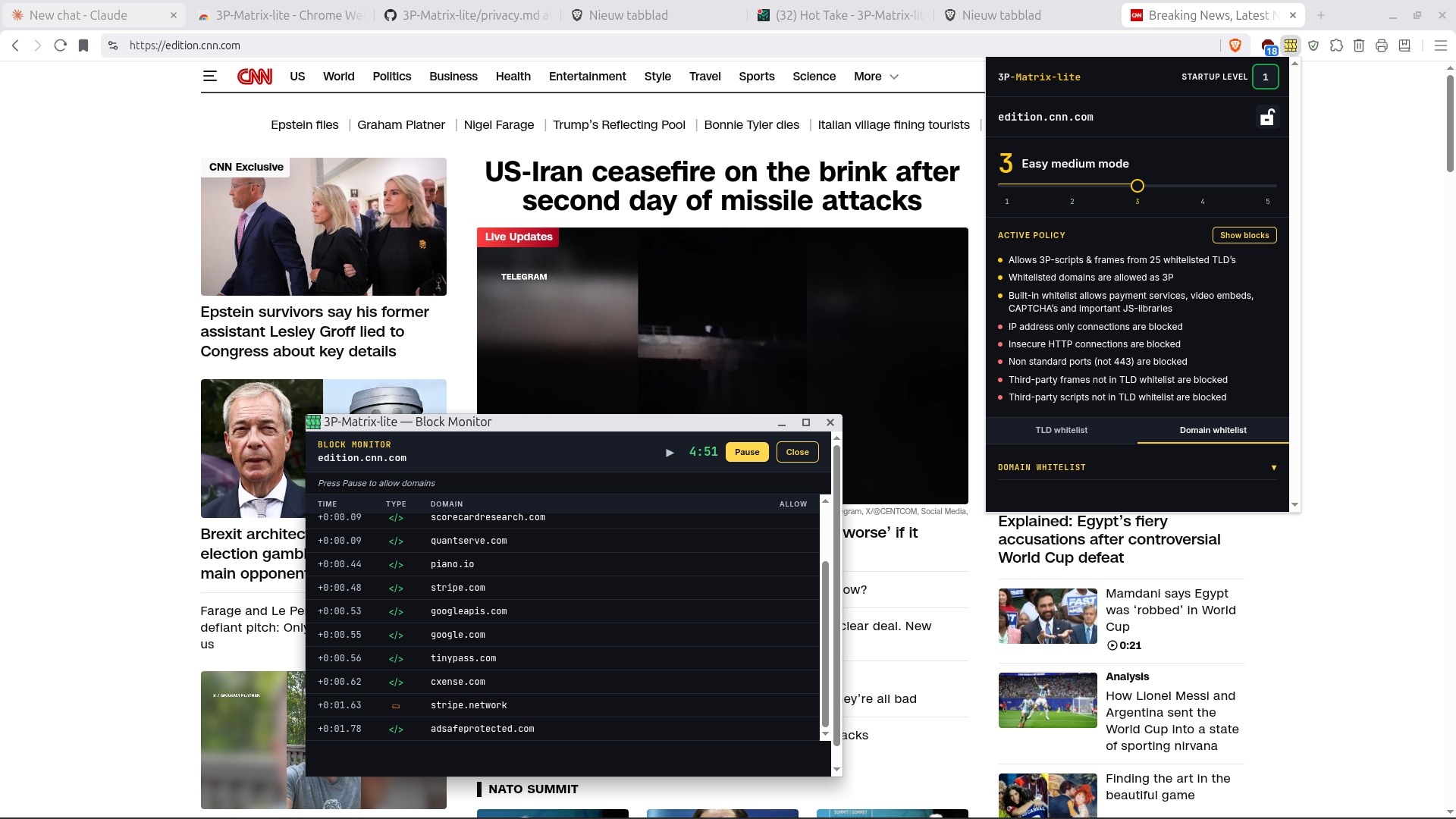
1783592256213.png
 
Last edited:
Hi open source 3P-Matrix-lite: version 2 has arrived in the webstore 3P-Matrix-lite - Chrome Web Store

What it does: offers 5 levels of protection with build-in whitelists to prevent website breakage.

3P-Matrix is very user friendly with presets and build-in whitelists which can be changed on the fly using a slider.
It has two smart extra features original uMatrix did not had:
- startup mode (default on 1), can be changed using drop down option to 2 to 5, but best practice is keep it at 1)
- lock website mode: protection level can be locked for a website, next time you visit this website the protection level will be set to the locked value.
this is very useful for adult websites, most work perfectly on level 4, locking it at 4, makes browsing dodgy websites a lot safer.

Level 1: allow all

Level 2: easy mode with enhanced security:
  • Build in whitelists to prevent website breakage
  • IP-address only third-party is blocked
  • HTTP third-party is blocked
  • Non-standard ports are blocked (only default port 443 is allowed)
  • Blocks all 3P-frames (except whitelisted)
  • Optionally blocks 3P-scripts on blacklisted Top Level Domains
    using a slider with 4 presets: none - user - generic - generic + country code's which are on the much abused TLD list
  • Optionally allows user to add domains to the whitelist using the tab or the show-blocks panel

Level 3: easy medium mode (as often explained by @Jan Willy with static AG Mv3 rules).
  • Same protection IP-address, HTTP, non-standard port protection and build-in whitelists as level 2, with one difference
  • In stead of blocking all 3P-frames and blacklisted 3P-scripts it blocks all 3P-frames and 3P-scripts with option to whitelist TLD's
    using a slider with 4 presets: none - browser - continent - world:
    - none (meaning no additional country codes) = only common general TLD's (which user can add or remove)
    - browser = adds the country code's of the languages enabled in the browser (some browser prevent fingerprinting)
    - continent = adds the country code's of other countries speaking the same language on the continent:
    e.g. when language is German, Austria and Zwitserland will be added
    - world = same mechanism applies, when language is Portuguese, country code Brazil will be added also
    note these advanced functions only work for extented EU-zone and 5 Eyes countries.
  • Optionally allows user to add domains to the whitelist using the tab or the show-blocks panel

Level 4: medium mode trusting domains with CDN in URL
  • Same protection IP-address, HTTP, non-standard port protection and build-in whitelists as level 2 and 3
  • Blocks 3P-scripts and 3P-frames except on the internal whitelist and URL's containing CDN
  • Optionally allows user to add domains to the whitelist using the tab or the show-blocks panel
Level 5: medium mode (everyone every used dynamic filtering with uBo or uMatrix is familiar with this mode)
  • Same protection IP-address, HTTP, non-standard port protection and build-in whitelists as level 2 and 3
  • Blocks 3P-scripts and 3P-frames
  • Optionally allows user to add domains to the whitelist using the tab or the show-blocks panel

This is an open source project with very privacy friendly usage policy.

The readme explains above with pictures: GitHub - Kees1958/3P-Matrix-lite: uMatrix-style third-party traffic control via Declarative Net Request
Privacy policy: 3P-Matrix-lite/privacy.md at main · Kees1958/3P-Matrix-lite


As posted I am nearly 68, was a developer some 45 years ago, so still learning. I noticed one quirk in the show blocks. It also shows the domains blocked by other extensions. I have to dive into it. It is a bug which is also a feature :-)

View attachment 298708
Nice to see continued development on this project

Thank you for sharing the update on 3P-Matrix-lite. The tiered protection-level approach with locking per-site is a sensible way to balance usability and control, especially for users who are not comfortable with granular per-domain rule building the way the original uMatrix required.

About the "show blocks" quirk you mentioned

What you are describing is a known category of behavior in Manifest V3 extensions that rely on the declarativeNetRequest (DNR) API combined with any logging or webRequest-based observation for the UI panel. A few technical points that may explain it:

  • DNR rulesets from multiple extensions can all match against the same request. Chrome applies whichever rule takes priority, but events related to blocked/matched requests can still be visible to other extensions that are also listening, depending on how the panel gathers its data.
  • If the show-blocks panel is built using webRequest or webNavigation listeners rather than purely DNR's own matchedRules reporting, it may pick up signals from network activity that were also affected by another blocker (ad blocker, tracker blocker, etc.) running in parallel.
  • This is a common source of confusion in any multi-extension setup where more than one content blocker is active at the same time, since the browser does not fully isolate visibility of network-level effects between extensions.

Since the project is open source, this is something that can be traced fairly precisely by checking which API calls populate the panel data (chrome.declarativeNetRequest.getMatchedRules versus any general request listeners). If the intent is to show only 3P-Matrix-lite's own blocks, restricting the panel strictly to DNR's matched-rules API would likely resolve the overlap.

General note

Since this is a new fork/derivative project, members interested in trying it may want to review the source on GitHub directly and consider running it isolated from other blocking extensions first to confirm behavior is as expected. As always, no verdict can be given here on safety or trustworthiness beyond what the open-source code and privacy policy already state, users are encouraged to review the code themselves given the project's transparency.