Advice Request Advice needed please: Laptop for Linux, Python, VM's etc.

Please provide comments and solutions that are helpful to the author of this topic.

MuzzMelbourne

Level 15
Thread author
Verified
Top Poster
Well-known
Mar 13, 2022
544
3,920
1,369
Australia
Hi all,

I am starting a new course and will need to learn some Linux, Python3 coding, running simultaneous VMs and ethical hacking.

My understanding is that CPU core numbers, DRAM and build quality are the important factors and storage capacity and graphics are secondary concerns.

I'm thinking Lenovo Ideapad, Ryzen 5 or Intel i5 with 16Gb(exp. 32Gb), 256Gb SSD, 15.6" LED.

Suggestions on what people consider to be ideal for this purpose would be greatly appreciated.

Cheers...
 
If you can find a model that comes with linux preinstalled, you are guaranteed to have fully compatible hardware. Nevertheless, most people just buy what they want and hope for the best. Very new hardware that just came on the market might not work well with some distros.

If the BIOS is set up to support RAID, like my wife's ASUS laptop is, you will need to disable that in the BIOS before you can install linux.

Keep in mind that the amount of RAM you have determines how many VMs you can run simultanously. The RAM requirement of each VM depends a lot on what operating system you install in it, and what programs you run in it.
 
Thanks folks,

The programming/malware side of this course is pretty basic intro type stuff I believe rather than a hard core coding. Its a general Cyber Security course(Masters) that covers lots of subjects rather than one specific area. If I have to move away from my beloved MacBook Pro(2014) and iPad Pro to do it, then I would like something I can grow into if needed rather than ringing its neck from the start.

So I'm thinking Windows 10/11 Home(OMG), Linux(distro ?), Python3(?) and a VM app that will let me run maybe 4 VMs(attack and defend machines?)

I have no idea really, so please keep the suggestions coming,

Cheers.
 
Thanks folks,

The programming/malware side of this course is pretty basic intro type stuff I believe rather than a hard core coding. Its a general Cyber Security course(Masters) that covers lots of subjects rather than one specific area. If I have to move away from my beloved MacBook Pro(2014) and iPad Pro to do it, then I would like something I can grow into if needed rather than ringing its neck from the start.

So I'm thinking Windows 10/11 Home(OMG), Linux(distro ?), Python3(?) and a VM app that will let me run maybe 4 VMs(attack and defend machines?)

I have no idea really, so please keep the suggestions coming,

Cheers.
Fedora is a popular linux distro for programmers. Kali is a popular distro for penetration testers. If you just want a good, stable, all-around distro, Kubuntu is a good choice.
I am biased against Fedora because it does not support VirtualBox by default. (It uses Gnome boxes.) For VirtualBox, you need to install a lot of dependencies first. When I tried to do so, Fedora crashed unrecoverably. And the reason it was so hard to recover was because it uses BTRFS file system by default, which is a pain to chroot into. End of rant.
 

I think your choice is ideal. I have a laptop with Linux Fedora installed, but only for scientific (mathematical) computation mostly in Python. I think it's a good idea to have 2 OS (dual boot) such as Windows and Linux. Because as far as I know (CMIW), the only Lenovo laptop that allows UEFI update with bootable ISO files is ThinkPad, the rest are using WinFlash (exe) file or Lenovo Vantage. Even though there are ways to update UEFI on Linux, some of them didn't work or very limited, at least in my case.

 
Fedora is a popular linux distro for programmers. Kali is a popular distro for penetration testers.

Yeah, I'm sort of following this guy on YouTube trying to get a few tips and he's using Kalli, so I might go for that.. I played with Ubuntu about 20 years ago and had no end of trouble, definately might fault though.

Cheers.
 

I think your choice is ideal. I have a laptop with Linux Fedora installed, but only for scientific (mathematical) computation mostly in Python. I think it's a good idea to have 2 OS (dual boot) such as Windows and Linux. Because as far as I know (CMIW), the only Lenovo laptop that allows UEFI update with bootable ISO files is ThinkPad, the rest are using WinFlash (exe) file or Lenovo Vantage. Even though there are ways to update UEFI on Linux, some of them didn't work or very limited, at least in my case.

Yes, dual boot is a good idea. It takes more work but it pays off. I have dual boot.
 

Because as far as I know (CMIW), the only Lenovo laptop that allows UEFI update with bootable ISO files is ThinkPad, the rest are using WinFlash (exe) file or Lenovo Vantage. Even though there are ways to update UEFI on Linux, some of them didn't work or very limited, at least in my case.​


Mmmmm, thanks, while I didn't understand a word(🥴), I'll be sure to put it to the sales dude at Lenovo.

Cheers.
 
Mmmmm, thanks, while I didn't understand a word(🥴), I'll be sure to put it to the sales dude at Lenovo.

Cheers.
Don't be surprised if the sales dude doesn't know much about flashing the BIOS from linux. Most people don't ever update their BIOS anyways...

Ubuntu from 20 years ago is a different animal, and Kubuntu uses what many consider a much more sophisticated and well-functioning desktop environment. With linux distros, the desktop environment is a big chunk of the operating system. It's not just cosmetics.
 
Mmmmm, thanks, while I didn't understand a word(🥴), I'll be sure to put it to the sales dude at Lenovo.

Cheers.
Well sorry if it's too technical :D. Sometimes UEFI or BIOS has the same meaning. Most Lenovo laptops except ThinkPad with Windows OS come with Lenovo Vantage, it's very easy with only one click. But in Linux is kind of a pain, since no official method from Lenovo to update it ( I agree with @shmu26). It's also critical to update it besides the OS itself like the case uncovered by ESET recently.

Lenovo.png
 
Yes, dual boot is a good idea. It takes more work but it pays off. I have dual boot.
I too have a dual boot setup, its not at all difficult, shrink the volume of your NVMe, create a 40GB space, create a bootable ubuntu 22.04 ( with GPT partition using rufus), choose the option install alongside windows and you are done. if you want to experiment with the distro don't forget to install TimeShift and create a backup before things take a wrong turn. Check out Stacer too, its a Swiss army knife in ubuntu.
 
Coffee usually helps myself. :p

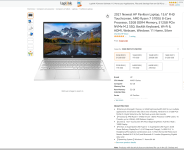
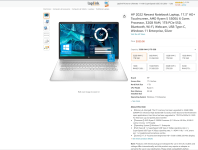
Plain and simple amazon links to some laptops that the poster think would work.
Thought so, but I ain't clicking on anything nowadays... Cheers.

(Shame I don't speak Spanish... Thanks Emanuel Tomasin though, will check out the Australian version.)
 
Last edited:
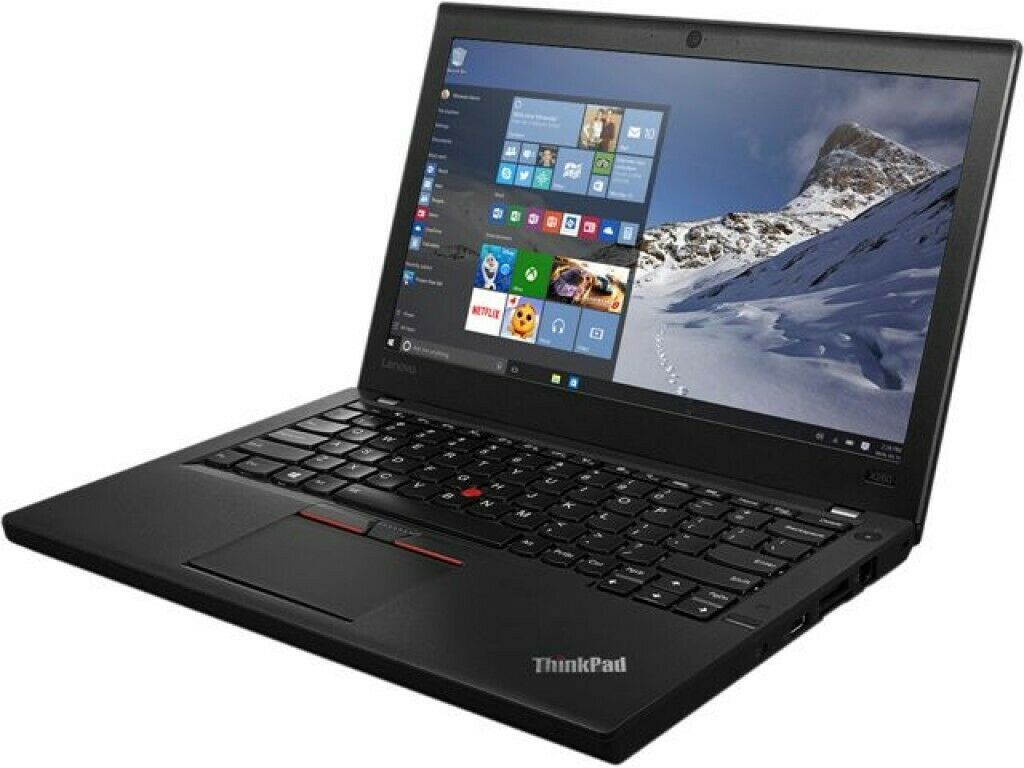
I like the look of this. Remember, I use an iPad Pro 11 as my main computer, so the screen size suits me.


With upgrades to 16Gb RAM and 1Tb SSD, it comes out at about $US420.00, nearly $US600 under my budget which I can use for other goodies.

All that worries me now is will it run Linux Kali, Python3, VMs etc for OSINT type stuff... I'm only learning at this stage.

Cheers
 
  • Like
Reactions: Nevi