Hot Take Escaping Windows: The Ultimate Guide to Migrate to Linux

The email to insiders in my case Ex Insider :)

  • More taskbar customization, including vertical and top positions
    Repositioning the taskbar is one of the top asks we’ve heard from you. We are introducing the ability to reposition it to the top or sides of your screen, making it easier to personalize your workspace.
  • Integrating AI where it’s most meaningful, with craft and focus
    You will see us be more intentional about how and where Copilot integrates across Windows, focusing on experiences that are genuinely useful and well‑crafted. As part of this, we are reducing unnecessary Copilot entry points, starting with apps like Snipping Tool, Photos, Widgets and Notepad.
  • Reducing disruption from Windows Updates
    Receiving updates should be predictable and easy to plan around, so we’re giving you more control. This includes the ability to skip updates during device setup to get to the desktop faster, restart or shut down without installing updates and pause updates for longer when needed, all while reducing update noise with fewer automatic restarts and notifications.
  • Faster and more dependable File Explorer
    File Explorer is one of the most used surfaces in Windows. Our first round of improvements will focus on a quicker launch experience, reduced flicker, smoother navigation and more reliable performance for everyday file tasks.
  • More control over widgets and feed experiences
    Widgets should feel helpful and relevant, not distracting or overwhelming. We’re introducing quieter defaults, more control over when and how widgets appear, and improved personalization for the Discover feed.
  • A simpler, more transparent Windows Insider Program
    The Windows Insider Program is how you help shape the future of Windows, and it should be easy to understand what to expect and how to participate. We are implementing changes to make it easier for you to navigate with clearer channel definitions, easier access to new features, higher quality builds, better visibility into how your feedback shapes Windows and more opportunities to engage directly with us.
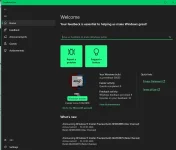
  • Improved Feedback Hub, available starting today
    Your feedback is essential to improving Windows, and it should be easy to share and see what others are saying. Today, we’re rolling out the largest update to Feedback Hub yet to our Insiders, with a redesigned experience that makes it faster and easier to submit feedback and engage with the community.
 
Improved Feedback Hub, available starting today
Yeah, a radiated Fallout 3 themed FB sure shows, how bad it is. Just nuke everything and start over. 😁

Snipaste_2026-03-20_19-09-03.webp
 
Maybe once the differences were easy to notice and real, but to me it looks like that because of the parroting of second hand information the difference only exist on on the web (and not in real life) and everyone accepts these differences as facts. Where as I have used them one after the other could not discover these differences (Cinnamon being more modern and sleek and Xfce being snappier).
Indeed, there isn't much of a resource usage difference between Cinnamon and XFCE at the moment, but when XFCE was first developed using GTK 2, it used a lot less than any other desktop environment. However, after switching to GTK 3, it became heavier than the Mate desktop environment. Overall, I believe it depends on the toolkit used to create the desktop environment.

After experiencing some issues with Xubuntu, I switched to Lubuntu on my old laptop. It was much more resource-efficient overall, but XFCE is more customizable than any other desktop environment I've ever used. I enjoyed using openSUSE Linux with XFCE for years, and it was a really smooth and powerful experience.
 
for me fedora 43 just works, everything videos & sound... fedora is my daily driver.
I think when I need to change in Q1 2029 (and not growing a little garden on my belly four feet down) I will switch to Fedora Silverblue (unmutable with flatpack). When fellow MT-members keep on hailing Fedora I might switch earlier.
 
Indeed, I enjoyed using openSUSE Linux with XFCE for years, and it was a really smooth and powerful experience.
fwiw I installed openSUSE Tumbleweek KDE Plasma about a week ago, and YES, a really smooth & powerful experience. I was sorta in awe! butI have not used it enough to get the full experience, as mostly what I do now-a-days is light-weight, so I like the more light and fast feeling at the keyboard, and fedora still gives me that plus rock solid, and sometimes I boot freeBSD which for me seems to be the lightest & fastest OS in VMware.
 
well from my limited understanding Zorin is the closest thing to windows. I have a license... But, for the masses, and that would include myself, Windows is there! Meaning is so easy right out of the box.

Now if anyone thinks they are secure, especially with Ai, and the power of the GOV, not to mention evil people with bad intentions, I think I can safely say the following: "It doesn't matter who you are, what security you have on your PC, or what operating system you run. They, or them, if it's multiple persons, can gain access, and probably without you even knowing they have done so"
 
Now if anyone thinks they are secure, especially with Ai, and the power of the GOV, not to mention evil people with bad intentions, I think I can safely say the following: "It doesn't matter who you are, what security you have on your PC, or what operating system you run. They, or them, if it's multiple persons, can gain access, and probably without you even knowing they have done so"
So when we don't notice how do you know they do?
:)
 
well from my limited understanding Zorin is the closest thing to windows. I have a license... But, for the masses, and that would include myself, Windows is there! Meaning is so easy right out of the box.

Now if anyone thinks they are secure, especially with Ai, and the power of the GOV, not to mention evil people with bad intentions, I think I can safely say the following: "It doesn't matter who you are, what security you have on your PC, or what operating system you run. They, or them, if it's multiple persons, can gain access, and probably without you even knowing they have done so"
There are numerous other reasons why a user might prefer Linux to Windows, in addition to security and privacy. These include the fact that Linux is free, open-source, responsive, customizable, low on resources for older hardware, stable, dependable, and not owned by a large tech company.
 
I think when I need to change in Q1 2029 (and not growing a little garden on my belly four feet down) I will switch to Fedora Silverblue (unmutable with flatpack). When fellow MT-members keep on hailing Fedora I might switch earlier.
I ran Silverblue for awhile, for me it became a pia. your experience may differ...
 
It feels like Microsoft really drags their feet when it comes to getting it together and actually pushing Windows forward. Microsoft touted ReFS as the upgrade to little old NTFS from 1993, introducing it to the public with Windows Server 2012. 14 years later, private users still can't take advantage of it. Meanwhile, I'm using Btrfs on Fedora Linux—a fast, modern, and full-featured file system developed with SSDs in mind.

I understand the Windows userbase is huge, but their revenue in fiscal 2025 was $281.72 billion.

Open-source code means verifiable privacy and security. I'm thankful that some people didn't give up on the cause of open, free software for the public. All the infrastructure, engineering, and organization behind the Linux movement takes a lot of work.

Instead of paying for an antivirus or a variety of other commercial software, I now have some extra cash to donate to worthy open-source projects. :)
 
Limiting the charging level to extend battery life is a feature that Linux has had for a while that I hope Windows will add someday. Although this feature can be managed with vendor-manufactured tools, it is best to have it available in the operating system itself. Linux can manage this through the distribution, desktop environment, and third-party tools. For more information, see this article:

 
This may be a minor point but maybe 15 years ago the only connection to the net was a desk PC & a lappy & children's laptops - I now have a minimum of 18 devices connected to my router, phones, wife's work phone, pads, a Windows Laptop, a Mac laptop, 3 cameras, soon another smaller Mac lappy, a printer, two smart TV's, one is an android, another TV with a fire-stick, a NAD Pro hi-fi unit etc - When relatives call most connect as guests (phones grand-kids iPads & Amazon children's pads) to my router, I'm beginning to think the OS on this desk PC which is the one I use most is becoming an irrelevancy, as its just one of so many devices? I reinstalled Windows a few days ago & I've got it just how I like it, is my reasoning as to the irrelevancy of one PC Windows or Linux, it used to matter lots now it don't seem to ?
 
Last edited:
If I understand correctly, you are asking whether you should stay on Windows on your central computer, which you use to control other devices, or switch to Linux. If this is the case, then I believe you should keep using it if everything is functioning as you would like, especially if you recently reinstalled Windows. If you are experiencing issues that Linux can resolve, then you should think about switching.

I'm going to profile you as "Rich Old Man" as we discuss profiling recently 🤣
 
That’s a fair point, the desktop OS matters less when so many services run in browsers, apps, and cloud platforms across dozens of devices. What still matters is compatibility, security updates, and how easily your devices and apps interconnect. If your PC mainly runs web apps and streaming services, consider switching to Linux if you like.
 
Ahhh Fedora! Good memories but not the distro I'd suggest for beginners. For them Linux Mint Cinnamon or or Ubuntu Cinnamon.
If any of these distros were as easy as installing GrapheneOS on Android I might have a go at it. I was ready, set, go in less than an hour after my GOS install. Can't even say that about Windows and probably not about Linux distros either. But let me know if I'm wrong.
 
If any of these distros were as easy as installing GrapheneOS on Android I might have a go at it. I was ready, set, go in less than an hour after my GOS install. Can't even say that about Windows and probably not about Linux distros either. But let me know if I'm wrong.
openSUSE tumbleweed with KDE Plasma installs itself. I was shocked& amazed! (that was my experience and only about 10 days ago)