Question Firefox in Flatbak shows sandbox level 6

Please provide comments and solutions that are helpful to the author of this topic.

LinuxFan58

Level 14
Thread author
Nov 30, 2025
650
2,341
1,267
I thought I played with Firefox on my Linux Mint Xfce laptop and was applying some advised hardening tips in about config when i noticed that sandbox level was 6
1778912677118.png


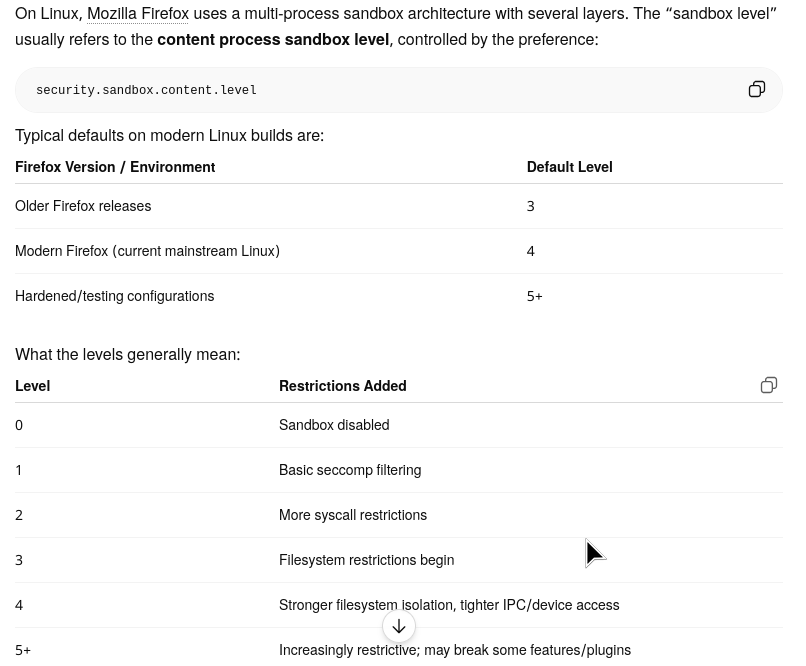
ChatGPT provides this information on sandbox level in linux

1778912780088.png


Do any of the seasoned Linux users have any explanation? Maybe because Firefox is running in Flatpak?
 
I thought I played with Firefox on my Linux Mint Xfce laptop and was applying some advised hardening tips in about config when i noticed that sandbox level was 6
View attachment 297659


ChatGPT provides this information on sandbox level in linux

View attachment 297660


Do any of the seasoned Linux users have any explanation? Maybe because Firefox is running in Flatpak?
Yes, that is a plausible explanation.

What that value usually means

On Linux, Firefox uses multiple sandbox layers, and the content process sandbox level can be higher than what many users are used to seeing on Windows. A value of 6 on Linux is not automatically abnormal by itself.

In general:

  • Firefox on Linux can use stronger sandbox restrictions depending on build options and available kernel features
  • Distribution packaging can affect defaults
  • Flatpak adds another containment layer around the application

So if your Firefox is installed as a Flatpak, that can definitely be part of why you are seeing stricter sandbox-related behavior, although the exact meaning of the specific preference depends on which sandbox setting you checked.

Important detail

The value shown in about:config does not always tell the full story by itself. Some Firefox security settings are:

  • Platform-dependent
  • Adjusted by the package maintainer
  • Affected by runtime environment
  • Not always meant to be manually changed

That means seeing a higher sandbox level on Linux is not necessarily a sign that something is wrong or that you changed it accidentally.

About Flatpak specifically

Flatpak does not replace Firefox’s internal sandbox, but it does add its own application isolation model on top. In practice, that means:

  • Firefox still uses its own internal process sandbox
  • Flatpak can restrict filesystem and device access separately
  • The combined result may look different from a native package install

So the short answer is: yes, Flatpak is a reasonable factor, but it is probably not the only factor. Linux Firefox builds often have different sandbox defaults than users expect.

Best takeaway

A sandbox level of 6 in Firefox on Linux Mint Xfce is not, by itself, a red flag. It is more likely related to Linux-specific Firefox sandboxing and possibly the Flatpak packaging than to a problem with your system.

If you want a reliable answer for your exact setup, the safest path is to compare:

  • The Firefox build source, such as Flatpak vs distro package
  • The exact preference name you changed or viewed
  • The values shown in about:support

Without those details, it would not be safe to claim more than that.
 
@Sampei.Nihira G'day 2U mate (just talked to my auzzie brother in law :-) )

Meager and weak sun after drizzle this morning in the Netherlands and as always thanks for the tip
1778919036650.png


Advantages of flatpak over firejail (according to AI), is that flatpak-bubblewrap also sandboxes the GPU (as far as I know flatpak sandbox disables user name space protection in firefox, hence reduce the separation between tabs, meaning lower vertical separation, but stronger horizontal containment between firefox and OS).
 
Last edited:
I told you so, you (@Sampei.Nihira )you need level 9 in Windows :p

1778922312003.png


I also found out that ChatGPT can look into Firefox source code and my guess was right, sandbox level is set to 6 in Linux because it runs in Flatpak
 
@Sampei.Nihira I can increase the level to 7 (Windows and Linux sandbox levels use totally different mechanism), would be interesting what experienced linux users know about this level 7. I asked ChatGPT to look into the source code of Firefox (whether a level 7 existed and what the code related to) and this is what it found.

1778923191413.png
 
I don't think ChatGPT can provide an accurate analysis if you've asked a question without providing any context.
Try having it analyze (to AI) this document before making a comparison, even though it's not up to date on the current state of the Windows vs. Linux sandbox:

Security/Sandbox - MozillaWiki

It is also possible to perform an analysis of Linux sandbox levels beyond the 5th level described in the document.

P.S.

Level 9 (Firefox sandbox):

 
Last edited:
AI often makes mistakes because it doesn’t have an accurate big picture to base its analysis on.
And even when you provide the AI with the best possible information, it can still make mistakes.
It’s pretty difficult to get immediately accurate answers from AI regarding adblock rules, policies,sandbox.

But I’m curious about something else,why are you interested in Firefox now? :unsure:;)
 
AI often makes mistakes because it doesn’t have an accurate big picture to base its analysis on.
And even when you provide the AI with the best possible information, it can still make mistakes.
It’s pretty difficult to get immediately accurate answers from AI regarding adblock rules, policies,sandbox.

But I’m curious about something else,why are you interested in Firefox now? :unsure:;)
I switched from Brave to Firefox on my Android phone, just checked it out to see how it looks and feels on laptop, Seems a decent browser. Although it lags in benchmarks, the differences in website loading time is near zero compared to Chrome. On laptop battery the speedometer 3.1 benchmark of Firefox is near identical to Chrome. Surprisingly Chromium beats Chrome when running on battery by the same margin as Chrome beats Chromium running AC connected.
 
You guys seriously need to stop looking at browser benchmark results as they are everything, but a reliable factor of showing how fast is the browser. I said multiple times how Firefox scores low on my laptop, yet it's clearly faster than Chromium browsers and, according to Reddit, clearly I'm not the only one.

You should really judge the browser by how fast does it feel and how websites you visit regularly work in it rather than just watching the number of benchmark. These benchmarks aren't even meant to be used by you, average users; only for developers, specifically, browser developers.

Everyone should stop stressing about the number and instead focus on security, privacy and features web browser offers you. Trust me, you'll be way happier that way. Just make sure to rank your priorities as not everyone has them the same.
 
It is interesting to note that on the second day of Pwn2Own Berlin 2026:

FAILURE - Nguyen Thanh Dat (@rewhiles) of Viettel Cyber Security (@vcslab) could not get their exploit of Mozilla Firefox – Renderer Only working within the time allotted.

Zero Day Initiative — Pwn2Own Berlin 2026 - Day Two Results

We do not know whether the exploit succeeded beyond the set time limit.
In this case as well, manually increasing the allowed Sandbox Level in the browser,provided it is supported, of course,reduces potential exposure to an exploit targeting the Renderer.

P.S.

That's why I personally modified my Chrome Renderer to work at the AppContainer level.
 
I was reading the Librewolf documentation and came across this, so it might interest you:
Flatpak apps run sandboxed from the system via bubblewrap, which adds a layer of protection. But this prevents the browser from using its usual sandbox for process isolation.

Processes are still isolated through nested seccomp filters.

Flatpak supports process isolation via flatpak-spawn, which zypak and the unofficial Chromium Flatpak use. This would cause a big increase in memory use in Firefox/Librewolf though, so it is not a viable solution.
 
It is interesting to note that on the second day of Pwn2Own Berlin 2026:


Zero Day Initiative — Pwn2Own Berlin 2026 - Day Two Results

We do not know whether the exploit succeeded beyond the set time limit.
In this case as well, manually increasing the allowed Sandbox Level in the browser,provided it is supported, of course,reduces potential exposure to an exploit targeting the Renderer.

P.S.

That's why I personally modified my Chrome Renderer to work at the AppContainer level.
AppContainer is strong containment/sandboxing (y)
 
  • Like
Reactions: Sampei.Nihira
I was reading the Librewolf documentation and came across this, so it might interest you:

Yes but ChatGPT seems to have changed its mind, when you are running Wayland in stead of X11 and apply some Flatpak hardening. the vertical sandbox of Chrome is weaker (protecting processes from each other) but by adding an extra horizontal sandbox (between browser and OS) ChatGPT told me I am better of than running native apps. Most Firejail profiles (when sandboxing browsers), partly contain the browser so its interbal sandbox is not affected. Arguably making running browsers in firejail a better option than running browser in flatpak (but moving from X11 to Wayland seems to take away a lot of these benefits, making flatpak the better option for less tech savvy users).
 
Last edited:

You may also like...