Technology IPv6 just turned 30 and still hasn’t taken over the world, but don't call it a failure

Gandalf_The_Grey

Level 85
Thread author
Verified
Honorary Member
Top Poster
Content Creator
Well-known
Forum Veteran
Apr 24, 2016
7,714
6
82,083
8,389
54
The Netherlands
In the early 1990s, internetworking wonks realized the world was not many years away from running out of Internet Protocol version 4 (IPv4) addresses, the numbers needed to identify any device connected to the public internet. Noting booming interest in the internet, the internet community went looking for ways to avoid an IP address shortage that many feared would harm technology adoption and therefore the global economy.

A possible fix arrived in December 1995 in the form of RFC 1883, the first definition of IPv6, the planned successor to IPv4.

The most important change from IPv4 to IPv6 was moving from 32-bit to 128-bit addresses, a decision that increased the available pool of IP addresses from around 4.3 billion to over 340 undecillion – a 39-digit number. IPv6 was therefore thought to have future-proofed the internet, because nobody could imagine humanity would ever need more than a handful of undecillion IP addresses, never mind the entire range available under IPv6.

As billions of devices and people came online, first using PCs and then wielding smartphones, conventional wisdom assumed that network operators would move to IPv6 rather than persist with IPv4.

Yet according to data from Google, the Asia Pacific Network Information Center (APNIC), and Cloudflare, less than half of all netizens use IPv6 today.

To understand why, know that IPv6 also suggested other, rather modest, changes to the way networks operate.

"IPv6 was an extremely conservative protocol that changed as little as possible," APNIC chief scientist Geoff Huston told The Register. "It was a classic case of mis-design by committee."
 
From what I understand, here in Croatia all ISPs support it, but for some reason they refuse to give IPv6 addresses to end users. They rather push users behind CGNAT. Which is a shame as I'd really like to get IPv6 address; it would solve a lot of problems.
I have IPv6 with my current ISP (changed to them 3 months ago) and most sites I visit is connecting to their IPv6 address including our MT.
Not an expert in IPv6 but two advantage that I noticed immediately.
  • Previously when I searched something in browser's private/incognito mode, I would have to click those annoying google captcha images, but with IPv6 I never see them. If I disable IPv6 then they come back.
  • Other advantage is torrenting. I get connection to more peers now. Direct connection to other IPv6 peers is now available unlike the CGNAT restrictions of IPv4 peers where bypassing the restriction requires port forwarding and that usually requires a paid VPN with the feature.
 
Previously when I searched something in browser's private/incognito mode, I would have to click those annoying google captcha images, but with IPv6 I never see them. If I disable IPv6 then they come back.
That happens because you have your own dedicated IPv6 address you don't share with other ISP customers. IPv4 is shared resource (due to limited amount of IPv4 addresses your ISP has) so you might get an IP address that someone used before for spreading spam, scamming or spreading malware. Hence the reason why you get to solve captchas when you switch to IPv4.
Other advantage is torrenting. I get connection to more peers now. Direct connection to other IPv6 peers is now available unlike the CGNAT restrictions of IPv4 peers where bypassing the restriction requires port forwarding and that usually requires a paid VPN with the feature.
I'm not behind the CGNAT, but it is relatively easy to get dynamic IPv4 address from ISP here. You just need to send them a simple e-mail with request and they'll assign you IPv4 address.

Currently, the only way for me to get IPv6 address is through Cloudflare WARP.
 
That happens because you have your own dedicated IPv6 address you don't share with other ISP customers. IPv4 is shared resource (due to limited amount of IPv4 addresses your ISP has) so you might get an IP address that someone used before for spreading spam, scamming or spreading malware. Hence the reason why you get to solve captchas when you switch to IPv4.
Yeah, I know this. I was just saying how IPv6 solved one of the annoying issues for me.
BTW, AdGuard for Android has a bug that prevents IPv6 from working, allowing only IPv4 to function. The only way to fix this issue is to disable and then enable protection. Sometimes a complete exit is also required.
I'm not behind the CGNAT, but it is relatively easy to get dynamic IPv4 address from ISP here. You just need to send them a simple e-mail with request and they'll assign you IPv4 address.
I think you meant a static IP address. Also known as Real IP. We have that here but they usually make it available only for a high tier package, otherwise they demand extra charge for a real IP every month.

Anyway, gradually all ISPs would start to make IPv6 available. In the Cloudflare radar, I'm surprised to see India on top with 71% IPv6 Traffic.
 
Yeah, I know this. I was just saying how IPv6 solved one of the annoying issues for me.
BTW, AdGuard for Android has a bug that prevents IPv6 from working, allowing only IPv4 to function. The only way to fix this issue is to disable and then enable protection. Sometimes a complete exit is also required.
I stopped using AdGuard for Android. Turns out Brave + Rethink DNS app (with Zero Trust DNS) work even better than AdGuard. Rethink DNS in DNS and Firewall mode has anti-censorship abilities which can help on some restricted networks. It helps me with WhatsApp at my public work Wi-Fi which sometimes struggles to send/receive messages.
I think you meant a static IP address. Also known as Real IP. We have that here but they usually make it available only for a high tier package, otherwise they demand extra charge for a real IP every month.

Anyway, gradually all ISPs would start to make IPv6 available. In the Cloudflare radar, I'm surprised to see India on top with 71% IPv6 Traffic.
No, I meant you they will get you dynamic IP address without any fees. They do have fees for static IP address and it's usually somewhere from 65-100€ per month, depends on the ISP.

Ouch, this hurts... 😢
Screenshot_2.png
 
Last edited:
I stopped using AdGuard for Android. Turns out Brave + Rethink DNS (with Zero Trust DNS) work even better than AdGuard. Rethink DNS in DNS and Firewall mode even has anti-censorship abilities which can help on some restricted Wi-Fi networks.
Great to know. I always use the same browser on PC and mobile so Brave is not an option at the moment since Edge is my preferred browser on PC. Things may change when Edge stops supporting MV2 adblockers.
No, I meant you they will get you dynamic IP address without any fees. They do have fees for static IP address and it's usually somewhere from 65-100€ per month, depends on the ISP
I see. So it's dynamic IP but not behind CGNAT, so even if the IP changes, port forwarding can still work if set up correctly.
 
Great to know. I always use the same browser on PC and mobile so Brave is not an option at the moment since Edge is my preferred browser on PC. Things may change when Edge stops supporting MV2 adblockers.
Doesn't Edge on Android support extensions? If so, you can install uBlock Origin.
I see. So it's dynamic IP but not behind CGNAT, so even if the IP changes, port forwarding can still work if set up correctly.
Exactly.
 
  • Like
Reactions: Parkinsond
Doesn't Edge on Android support extensions? If so, you can install uBlock Origin.

Exactly.
Yeah, but it crashed many times when I tested. Also it takes some time for extensions to load. If I click on a link on a social media like let's say, Twitter then the link opens with cookie popup, empty placeholders or even ads sometimes if not blocked by DNS before uBO or AdGuard (slower than uBO) loads.

In Croatia, 5.7% is lower than expected 🤔
Even in my poor country it's 22.3% which is higher than I expected.
IMG_20260103_011210.jpg
 
Yeah, but it crashed many times when I tested. Also it takes some time for extensions to load. If I click on a link on a social media like let's say, Twitter then the link opens with cookie popup, empty placeholders or even ads sometimes if not blocked by DNS before uBO or AdGuard (slower than uBO) loads.

In Croatia, 5.7% is lower than expected 🤔
Even in my poor country it's 22.3% which is higher than I expected.
View attachment 294238
National regulator in 2024 report said it is planned for ISPs to switch to IPv6, but there's no official date when should that happen. And if our ISPs aren't forced to do something, they won't do it.
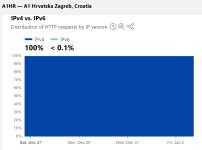
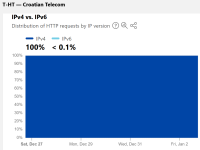
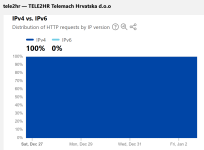
In 2011, 64% of ISPs said they started transitioning to IPv6. Fast forward to 2026, well... these are the results by ISPs with national coverage.

Screenshot_1.pngScreenshot_3.pngScreenshot_2.png

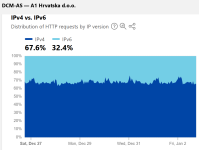
My ISP is A1, HT is the national telecom (owned by Deutsche Telekom) and Telemach is the newest one that expanded rapidly after United Group bought Tele2 which didn't offer fixed services. From all ISPs, I expected Telemach to introduce IPv6 first as they have limited number of IPv4 addresses, have the newest technology and the fastest network in the country. I guess I was wrong for expecting that.

A1 has another AS31012, which apparently has better IPv6 stats and I'm under that AS, however, I'm yet to hear someone in local forums saying they got IPv6.

Screenshot_5.png
 
  • Like
Reactions: simmerskool
but for some reason they refuse to give IPv6 addresses to end users.
You mean you don't get an IPv6 address at all, or you don't get a static address in the ISP portion of IPv6? I am behind a CGNAT. My IPv4 address changes on router reboot, but so does my IPv6 address because the ISP portion changes on reboot. My Android IPv6 address changes every day, and my Windows address changes every 7 days.
 
  • Like
Reactions: simmerskool
You mean you don't get an IPv6 address at all, or you don't get a static address in the ISP portion of IPv6? I am behind a CGNAT. My IPv4 address changes on router reboot, but so does my IPv6 address because the ISP portion changes on reboot. My Android IPv6 address changes every day, and my Windows address changes every 7 days.
I don't get IPv6 at all, just dynamic IPv4 address. My ISP simply doesn't give them to anyone.

Screenshot_1.png


When I open ISP router internal page it clearly says I only get IPv4 address.

Screenshot_2.png
 
It seems so freaking bizarre that ISPs don't adopt IPv6 more aggressively. I think you’re probably right, though; it likely also has to do with government policies and outlooks.
Nah, not here. HAKOM (national regulator) encourages them to adopt IPv6 since 2011, but they couldn't care less which is why even though it's one of the "priorities", they never set them a date by which they have to comply and adopt IPv6. ISPs have total freedom to choose their prices and offer services they want, pretty much. As long as you aren't called Croatian Telecom then your prices are decided by HAKOM to keep the competition healthy (they said they'll stop with this practice soon now that we have three nation-wide ISPs).
 
  • Like
Reactions: simmerskool