

Advice Request Is Avast becoming scareware?
- Thread starter RaduGL
- Start date
You are using an out of date browser. It may not display this or other websites correctly.
You should upgrade or use an alternative browser.
You should upgrade or use an alternative browser.
Please provide comments and solutions that are helpful to the author of this topic.

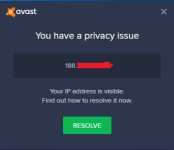

Just a marketing "gimmick" to buy their paid version(s).
Waits to hear the answer as well, as seen that popup a few times myself, then again Avast could be trying to sell there VPN service with that popup

That just " a litle agressive marketing " just ignore these kind of emergency privacy msgs.
Interesting. I looked up "scareware" altho' the name should be self-explanatory. Definition.
Someone who isn't a fan of Avast might think it is pushy advertising and marketing gimmicks preying off the internet privacy thing trending everywhere nowadays. It's scareware if it's fake, according to the wiki. Otherwise, it's ignore-ware.
Edit: again? I'm proofing my post and people post the same things above me at the same time. Wow! So I post really quick or it looks funny.
Someone who isn't a fan of Avast might think it is pushy advertising and marketing gimmicks preying off the internet privacy thing trending everywhere nowadays. It's scareware if it's fake, according to the wiki. Otherwise, it's ignore-ware.
Edit: again? I'm proofing my post and people post the same things above me at the same time. Wow! So I post really quick or it looks funny.

They certainly scared me away when they owned a datamining firm, no thank you.
Yeah might switch away from Avast when 1903 launches possibly, Hard decision though as been using Avast Free since 2006 on all household systems

It's just a way for you to get Avast paid products or use their VPN. There is a way you stop these from appearing.
~LDogg
~LDogg
You can stop them by preventing an Avast process from connecting to the internet, but if you have to stop a process your antivirus uses to stop ads... it's time to stop using it. I myself used Avast for several years before they went downhill.
Seems anything that Malwarebytes touches, unfortunately go downhill.You can stop them by preventing an Avast process from connecting to the internet, but if you have to stop a process your antivirus uses to stop ads... it's time to stop using it. I myself used Avast for several years before they went downhill.
~LDogg

- Jul 28, 2014
- 1,989
- 8,250
- 2,889
I would argue that most free AVs that offer similar services like VPNs and such also employ similar tactics to make you buy them, but I would consider the way that avast has decided to phrase their ads to seem like an urgent alert highly unethical.
Most users would be able to see this as a scare tactic and know not to worry, however there are still people that would fall for this "scam" and they would be the ones that are most vulnerable to caving into their scareware.
Most users would be able to see this as a scare tactic and know not to worry, however there are still people that would fall for this "scam" and they would be the ones that are most vulnerable to caving into their scareware.

Block avastGUI.exe in firewall outgoing rule and all ads are gone.

If you want a VPN ,you can get way better deals than what Avast offers

Friend once called me and ask me if i can come to help him about computer. He used Avast and message was "your data is not secure, buy our product (forgot what is called).
For me this is scamming and Avast should be ashamed. I wonder how many people they rob that way.
For me this is scamming and Avast should be ashamed. I wonder how many people they rob that way.

This is definitely scammy advertising, but still just advertising. True scareware uses social engineering where the trick is to get the user to click on a malware link.
Easy fix is advised by @Pat MacKnife.
Now, let's see how long this thread can get!
Easy fix is advised by @Pat MacKnife.
Now, let's see how long this thread can get!

i for myself when i use avast from time to time, i always use it in gaming mode. So i do not get any popups at all. It makes all silent.
Since uninstalling Avast I've had no popups either!

You may also like...
-

-
 Battle Bitdefender Free vs Avast Free in 2025: Full Review, Pros & Cons, Which to Choose?
- Started by Bot
- Replies: 26
-
 Question Google "Results about you": Has any one used? How were your experiences?
- Started by Wrecker4923
- Replies: 3
-
Serious Discussion I intercepted Brave's network traffic for 48 hours
- Started by Miravi
- Replies: 33