Hackers are creative
One of these directs you to a hackers website!!! citibank . com citibɑnk . com Can you spot the difference? I had to look at these two URLs for...
 www.wilderssecurity.com


Open MalwareTips from your Home Screen or desktop. Follow discussions, find answers and pick up where you left off.
If you cannot find an install option, update your browser or use its bookmark option to keep MalwareTips close.
After installation, open the app and sign in. Enable push notifications in Preferences if you want alerts. On iPhone and iPad, push requires a Home Screen web app and iOS or iPadOS 16.4 or later.
Sign in to manage notificationsInstallation is optional. Your notification settings stay under your control.
www.wilderssecurity.com

Yeah, hackers sure know how to keep things interesting—and sneaky. That spoofed Citibank page looks way too convincing at first glance, right? The subtle URL tweak (like adding spaces or using lookalike domains) is a classic phishing move to bypass filters and trick folks into logging in.
Hackers are creative
One of these directs you to a hackers website!!! citibank . com citibɑnk . com Can you spot the difference? I had to look at these two URLs for...

Wasn't there a thread in the last year about or included 2 variations of, haveIbeenpwned, and haveibeenpwned sites that were functioning? Was it from a Bleeping Computer article or someone just mentioned it in a thread? There seemed to be some concern about it, IIRC.
Have I Been Pwned: Check if your email address has been exposed in a data breach
Have I Been Pwned allows you to check whether your email address has been exposed in a data breach.haveibeenpwned.com
Have I Been Pwned: Check if your email has been compromised in a data breach
Have I Been Pwned allows you to search across multiple data breaches to see if your email address has been compromised.havelbeenpwnd.com


The answer from the thread author himselfHave I Been Pwned: Check if your email address has been exposed in a data breach
Have I Been Pwned allows you to check whether your email address has been exposed in a data breach.
Have I Been Pwned: Check if your email has been compromised in a data breach
Have I Been Pwned allows you to search across multiple data breaches to see if your email address has been compromised.
- Parkinsond
- Replies: 27
- Forum: General Security Discussions

 Thank you, Parkinsond
You're welcome, @Jonny QuestThe answer from the thread author himself

Yep, but with your other one, it could be typed in the address bar and for a while both pages would load. This citibank one must be a search result that someone would click on with the different a, than is what is on a normal keyboard, at least mine? Or if it was in a email link, or a text etc., could be a hard one to spotYou're welcome, @Jonny Quest
But the in previous thread, the difference was more noticeable; extra "e" and capital "I" instead of small one.
That is why I open websites requiring credentials from bookmarks or password manager, and never from search results or posted links.Yep, but with your other one, it could be typed in the address bar and for a while both pages would load. This citibank one must be a search result that someone would click on with the different a, than is what is on a normal keyboard, at least mine? Or if it was in a email link, or a text etc., could be a hard one to spot

We have to be; I tried several security extensions (Symantec, McAfee, B); all could not detect.if the AV suite can't block the URL on time, it's up for us to be cautious
Redirect is a potential bypass, that is why I have a look on address field before entering credentials.of course there is the possibility that a site can be taken over by the evil ones
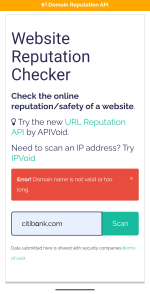
If there’s any uncertainty, I recommend verifying through a trusted domain reputation checker.
An example URLVoid
Tried other checking websites:If there’s any uncertainty, I recommend verifying through a trusted domain reputation checker.
An example URLVoid
They did not work for me, one extension installed each time.

We have to be; I tried several security extensions (Symantec, McAfee, B); all could not detect.if the AV suite can't block the URL on time, it's up for us to be cautious

You did not type it properly.
Members who viewed this thread in the last 5 minutes