I had a conversation with ChatGPT on the effectiveness. of uBol's malware protection.
What strikes me is that in the answers facts (but theoretical edge cases) are mixed with discussions (e.g. on reddit and forums) leading to the often parroted opinion that uBoL also has a strong anti-malware and malvertising protection.
Because ChatGPT is very stubborn in mixing edge cases with opinions, I added the following context conditions
- Yes uBol has real world value as malvertising protection, but so do AdGuard and AdBlock, so let's get the malvertising out the equation (all adblockes do) and not focus on the value of uBol, but on the added value of using the Malicious URL and badware filter in uBol (so only those 2 filters).
- Most of the HTTP links on URL haus/Malicious URL filter are botnets and C&C servers. A DNS service with malware protection has way more sources (and updates them continuously), so let's assume I use a DNS service with malware protection
- Modern browsers already block loading mixed content (HTTP content on HTTPS), which reduces the HTTP risk.
- When you look at Github the update frequency of uBol is on average every two week, meaning the URL Haus and uBol badware list are on average a week old
- Most HTTPS malware is short lived (e.g. 99% is taken down or cleaned up within 48 hours), so do your home work and take that in to account also
This was the response of ChatGPT.
View attachment 297975
Not happy enough with MARGINAL and INCIDENTAL security benefits, I pushed the discussion to the controversial statement
that uBol has ZERO value when it comes to malware protection. ChatGPT pushed this back that blocking mixed content in browsers did not block all HTTP traffic, e.g. you can stil down load from a HTTP website, the many hxxp 123.456.7.8/i and /sh and /bin entries you can usually see on URL haus which are not all blocked by the build in download protection of your browser. But this software is directed to (linux based) servers, so what harm can they do on a Windows PC or a Linux desktop where you first have to enable the execute bit (on Linux desktop)?
To rule this out I added the following condition
- Okay I am getting bored about the edge cases (you are a stubborn AI), let's assume I add the following rule (as a DNR) in uBol
||HTTP://*$denyallow=IPadres of your router|your favourite insecure HTTP website
- Added five pages of most recent malware links of URL Haus, so ChatGPT could check how many HTTPS websites had the status on-line
- Reminded ChatGPT that this was a less than 5 minutes old list, while uBol with its low frequent filter updates uses an outdated version and (very important) uBol uses only the most recent (short) version with on average 5 to 6 thousend URL's (while DNS sources often have hundreds of thousends actual links).
This was the response of ChatGPT
View attachment 297976
Don't matter operationally (no practical value) is not zero but good enough for me

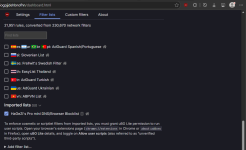
Because the lists are updated every 12 hours (see picture below), I dare to say that ChatGPT's first response (minimal value) is true for uBo and the second (no practical value) applies for uBol
 View attachment 297977