Privacy News Updated Google privacy policy says your Gmail might be used for advertising

AFEH

Level 68
Verified
Top Poster
Well-known
On October 16, Google issued an update to its privacy policy, spotted by Android Authority.
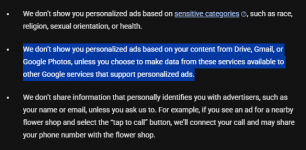
The ad personalization section used to include a clear limit on data from certain apps.

1792846065940.png

This equivocation opens the door to using data from apps like Gmail and Photos in ads when it’s shared with other Google services, and it just so happens Google has a mechanism for doing that, with Personal Intelligence.
The company released Personal Intelligence in early 2026, allowing users to hand data from multiple apps to Google AI products.
The idea is that the added context from your existing data will lead to better AI answers, but it’s also proving to be a privacy minefield.
 
What's new in this? Google never step way from show you advertisements using your data.
Indeed, one of the huge advantages of having an account, companies have to obey the privacy laws or face lawsuits. I have all scripted features off, including "SMART" ones.
Code:
https://myaccount.google.com/data-and-privacy

capture_10242026_182327.jpg capture_10242026_182934.jpg
 
Last edited:
Same thing as with every single product of theirs, ads, bloat and invasive pursue goals. I remember when I tried to use G Voice just to notice that isn't available in every country, and also to see that those things that i do with, get sent back to them, and iirc along the EULA, there was a rule stating that they shouldn't use you for marketing purposes.
They are just collecting the fees of the so-called "free" service 😁
 
what's great about proton
is their transparency
because of this you can use it for multiple purposes
and their server are hosted in netherlands and switzerland
there no reason not to use it. even for the average joe
proton idea reminds me of yahoo back in 2013
 
I had a free Zoho email for a while before deleting the account; alias feature was paywalled among other extra features.
You must use your own custom domain (e.g., info@yourcompany.com). The free plan allows you to add one custom domain, and you can create free aliases under it. If you are using a personal, generic @zoho.com account, the alias system is completely unavailable
 
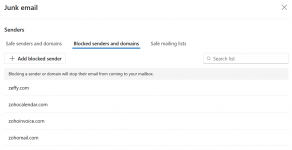
I blocked Zoho domains from reaching my Outlook.com inbox; too much spam was coming from them and they couldn't do anything regarding it, except suspend the accounts. I got tired of forwarding them spam mails daily so I just blocked Zoho services altogether. My junk folder is now completely empty.

Screenshot_1.png
 
I blocked Zoho domains from reaching my Outlook.com inbox; too much spam was coming from them and they couldn't do anything regarding it, except suspend the accounts. I got tired of forwarding them spam mails daily so I just blocked Zoho services altogether. My junk folder is now completely empty.

View attachment 300869
Blocking the zoho.com and zohomail.com domains altogether on your Microsoft Outlook account is the most definitive way to stop that traffic.


Since Zoho offers free and low-cost business email tiers, spammers frequently abuse their infrastructure to send mass blasts. I don't face any spam from them. My experience is great with zohomail.
 
Zoho Mail actually does use the exact same standard protection technologies as Gmail and Outlook—including Zoho Threat Protection, SPF/DKIM authentication, IP reputation tracking, and AI-driven content filters.
The critical difference is not the technology they use, but the different types of data these companies are allowed to analyze to build their filters. It comes down to a fundamental trade-off between privacy and convenience:

1. Data Scanning vs. Privacy First

• Gmail and Outlook: These giants process massive, global oceans of data. While they state they don't scan emails for consumer ads anymore, their massive machine-learning models constantly scan billions of user inboxes globally to learn exactly what spam looks like in real time.
• Zoho Mail: Zoho builds its core business model entirely around strict user privacy. According to the Zoho Privacy Policy, they actively limit how aggressively their algorithms read or analyze consumer email data. Because they don't scan private data as aggressively, their filters don't "learn" new spam tactics quite as quickly as Google or Microsoft.

2.

Catching Outbound vs. Inbound Spam

Every email provider is much better at filtering inbound mail (protecting their users from the outside) than stopping outbound mail (stopping bad users signed up on their own service).
• The Problem: Zoho’s inbound protection works well for people who use Zoho Mail. However, because spammers were using Zoho accounts to target your Outlook email, you were entirely reliant on Zoho's outbound team catching them before they clicked send.
 

Recently browsing

Members who viewed this thread in the last 5 minutes

Back
Top