

vulnerabilities in the 5 most popular browsers

viktik

Level 25
Thread author
Verified
Well-known
Sep 17, 2013
1,492
1
3,766
2,368
Hazaribagh
cyberraiden.wordpress.com
There has been a 42% increase in the number of vulnerabilities discovered in the most popular browsers: Google Chrome, Mozilla Firefox, Internet Explorer, Opera and Safari.

1,035 vulnerabilities were discovered in the 5 most popular browsers in 2014.

728 vulnerabilities were discovered in the 5 most popular browsers in 2013.

Internet Explorer has a market share of 99% percent, Firefox and Chrome are installed on 64% and 65% of PCs running Windows OS. Between them they have 924 vulnerabilities.

Patches are made available very quickly for vulnerabilities in browsers, which is positive because it indicates that browser vendors are serious about security.
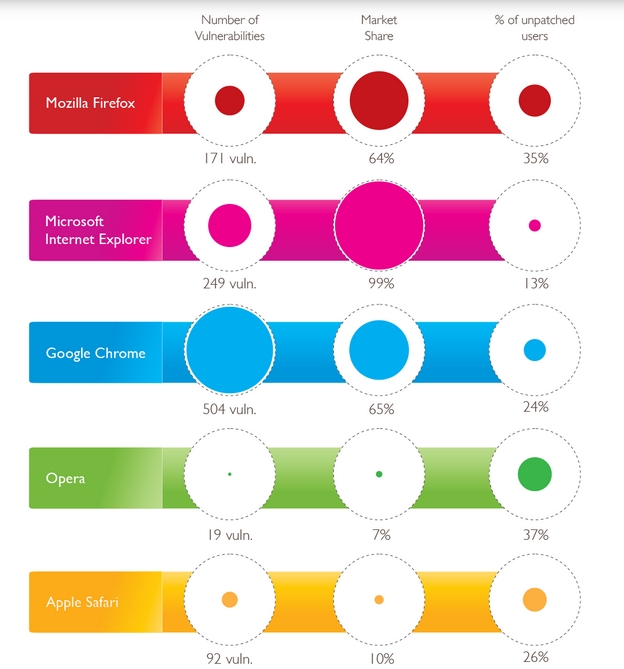

WEB BROSWER VULNEREBILITY 2014.jpg
 
Opera with 19 vulmerabilities, it looks most secure browser!

Very little pen-testing of Opera... never-the-less, it isn't widely used, so it doesn't matter if it has vulnerabilities as malware writers won't bother with it... too much work\effort, for very little gain.

Opera is the safe bet.
 
  • Like
Reactions: FreddyFreeloader
I've been toying with Opera for quite a while....and I love it! Plus,Chromodo is still not updating at a decent speed...(It's giving me an SSL error since 2 weeks ago and can't access my Google Apps account through it)

Welcome to my PC,Opera....
 
Market shares is one to be a minor factor of having a holes of vulnerabilities but again malware writers are finding where huge money expanses. Actually Opera is really one of the reliable browser that anyone should take consider of problems in surfing due to crashes and slowdowns.
 
Market shares is one to be a minor factor of having a holes of vulnerabilities but again malware writers are finding where huge money expanses. Actually Opera is really one of the reliable browser that anyone should take consider of problems in surfing due to crashes and slowdowns.
I mentioned the market share, as it literally makes no sense, the percentages they have listed.. Which leads me to wonder just how "accurate" this review is?
 
I would hardly change my browsers based on this little review/survey.
 
I do not see the point in this. Let's take a look at some facts:

1. Google chrome pays extremely well to people who find vulnerabilities in it, several time higher than competitors like Mozilla. If you are a security researcher, which browser do you think you would want to spend your time finding vulnerabilities?

2. Does the number of vulnerabilities mean anything? No. Many of these are things like info leak vulnerabilities etc.

3. For modern browsers like chrome and IE, you need multiple exploits to achieve reliable malware code execution and escape the sandbox. Compared to a single remote exec. exploit for firefox and opera.

4. Opera uses chrome's Blink engine. Not sure about the article writers, but I would presume vulnerabilities in blink would be considered under chrome, even though opera may be vulnerable as well.