Serious Discussion What do you think Linux needs to take over home users market?

They should limit the number of Distro's from over 600 to 4 to 5 main stream OS-builds with max 3 to 4 desktop variants for each. This economy of scale could provide better hardware driver support. All other programmers wanting to make impact could help to make libre-office bette rcompatible with Microsoft office.

But since that is never going to happen, Windows will face more competition from Android on the desktop (easy phone integration) than Linux.
 
The main barrier for me. I'm not ready to go distro hopping or disco dancing. ;)
But have the looks for it :-) OT is you new FZ avatar from the period he talked in the Johhny Carson show (when I recall right about copy right and privacy)?

Guess you should have been around at that time to appreciate the humor of the song.
 
Last edited:
Ubuntu pushing the use of snaps and other decisions make it worthy of being referred to as the Windows of the Linux world, but I want more control over how the distribution operates.
Snaps is the Ubuntu way of offering confinement as a protection method. I don't like snap because it doesn't have fine grained control over the \home directory - it is allow all access to home or nothing. Firefox needs access to .mozilla in home and cannot work without home. I want to give it access to .mozilla and forbid access to \Documents which houses my bread and butter. Anyways, you are free to remove snap and use an alternative like Flatpak.

Then Ubuntu added this security feature where it asks you when firefox needs access to home and you can deny interactively. But last I used that feature in Ubuntu 25 it was buggy - when firefox asks for access it automatically retries several times per request. So I had to hit deny deny deny deny. Would have been simpler if the snap Design allows for more fine grained control. I remember Flatpak allows this level of control.

Selilnux is not better in this regard. And I have since moved towards using separate accounts including one where I make my documents and don't use Firefox. Selinux is better at minimizing privileges and thats why I use it. I haven't fully explored this privilege business yet but I have blind faith . :D

Selinux is strong where an action requires transitioning into another <something>_t labled task. It has fine grained controls. And since my sudo requires Yubikey, even if my password is known/captured, the transition cannot take place. And many tasks require transitioning and are labled differently. You can find out more about each _t label and the transition rules. Which is more than what you can do to elicit some protection proof of a commercial AV's blackbox behavioral component.

U can enable Yubikey to assist sudo in Ubuntu, use least privileged accounts, use Flatpak, and get a good percentage of the protection. So I wouldn't discard Ubuntu. Yubikeys costs only $25 and it's benefits has lasted me for more than 10 yrs - well worth the investment - cheaper than an AV subscription. If Ubuntu is your home, you don't have to go far away from home.
 
Last edited:
Linux can never become a serious alternative to home users unless Microsoft goes bankrupt and windows just dies and withers away. The main reason it can never be an alternative is the the contract Microsoft have with its OEM partners, laptop manufacturers etc and that supremacy in numbers gives them so many loyal users who only knows one OS, comfortable with only one OS and does even know there is a good enough free alternative even exists. So the only scenario where linux becomes a major player is the bankruptcy of Microsoft.
 
They should limit the number of Distro's from over 600 to 4 to 5 main stream OS-builds with max 3 to 4 desktop variants for each. This economy of scale could provide better hardware driver support. All other programmers wanting to make impact could help to make libre-office bette rcompatible with Microsoft office.

But since that is never going to happen, Windows will face more competition from Android on the desktop (easy phone integration) than Linux.
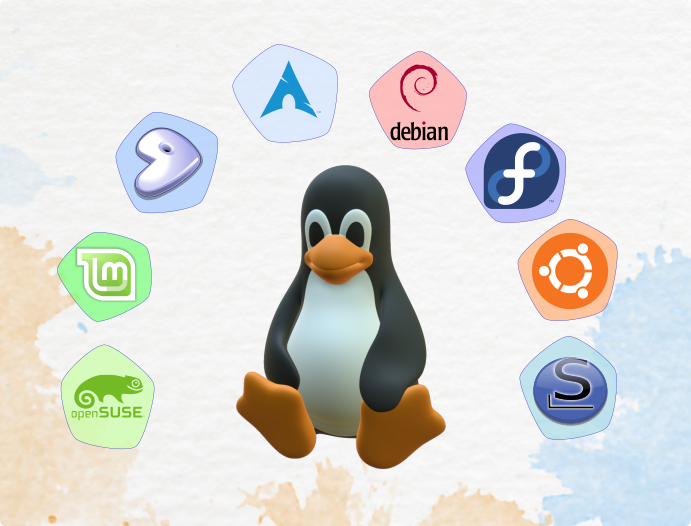
That's basically the situation today. The "big three" distros are Debian, Arch Linux, and Fedora. Otherwise, there are a few other lone wolves with unique package managers and philosophies: openSUSE, Gentoo, Slackware, NixOS.

Everything else is just a minor fork of these. Building a real, independent distro is out of reach for most projects. It's like reinventing the wheel. Amazon, for example, based Amazon Linux on Fedora. SteamOS is based on Arch Linux.

There's a small handful of "real" distros, while the dozens of other options are just forks of the main distros. Why the small forks? There are several motivations:
  • Usability and app curation: This is the biggest. You just want a major distro to look different and come with a different selection of default apps, which can make it friendlier and more accessible.
  • Philosophical splits: Sometimes you don't like a new decision by a major distro, e.g. systemd migration. Then you might fork it without systemd.
  • Optimization: A good example is CachyOS. Major distros want to maintain broad CPU support and stability, so they don't tap modern CPU instructions/optimizations like they could.
  • Security or update cycles: A minor fork can apply niche hardening that doesn't work in the mainstream. They may either want faster package updates, or conversely, slower and better tested package updates.
 
Last edited:
Most of Europe will gradually move away from MS. Their motto seems to be 'we do it better than the US and we need indpendence". France and Germany are the leaders. MS may not go bankrupt - they will have support from the home boys, but their power will be chipped away.

And India has BOSS and Maya. China has KylinOS. Turkey has Pardus. Russia has Astra. Venezuala has Canaima. North Korea has Red Star. Sourh Korea has Gooroom.

We don't need an 'international OS'. All we need is to standardize on some file formats, like ODT.

So what do we do when there's a sinking ship ? We bail.
 
That's basically the situation today. The "big three" distros are Debian, Arch Linux, and Fedora. Otherwise, there are a few other lone wolves with unique package managers and philosophies: openSUSE, Gentoo, Slackware, NixOS.

Everything else is just a minor fork of these. Building a real, independent distro is out of reach for most projects. It's like reinventing the wheel. Amazon, for example, based Amazon Linux on Fedora. SteamOS is based on Arch Linux.

There's a small handful of "real" distros, while the dozens of other options are just forks of the main distros. Why the small forks? There are several motivations:
  • Usability and app curation: This is the biggest. You just want a major distro to look different and come with a different selection of default apps, which can make it friendlier and more accessible.
  • Philosophical splits: Sometimes you don't like a new decision by a major distro, e.g. systemd migration. Then you might fork it without systemd.
  • Optimization: A good example is CachyOS. Major distros want to maintain broad CPU support and stability, so they don't tap modern CPU instructions/optimizations like they could.
  • Security or update cycles: A minor fork can apply niche hardening that doesn't work in the mainstream. They may either want faster package updates, or conversely, slower and better tested package updates.

I watched a short video by Tux Channel on youtube that more or less parallels your comment, with main distinction "purer linux" does not use systemd.
 
that's why I suggested openSUSE /
The GDM authentication not working with Yubikey is not a Selinux problem.

SUSE just recently moved to Selinux, and chatGPT told me they used the Fedora Selinux policies and built from there. Given their short time (since 2025) using Selinux, it most probably has not matured yet, but I may be wrong there.

Anyhow, solved the Fedora 44 user_u problem. After login, the icons now appear as normal. And everything, I think, is working. Now I have true user_u confinement, yay!
 
Hmm, I did not expect this. FB has just showed me this post, clearly my anti-tracking "works". 😶

capture_05022026_170909.jpg

 
I've experimented with Linux several times: Linux always has many, many, many times more updates than Windows, every month!
I love to use the latest updates, thus the reason I use Insider and I update BIOS monthly. I would only consider Rolling Release Linux, it is like Mac or Android.

 
The thing that always makes me laugh when it comes to Linux. At Linux forums I see people complaining about Microsoft Windows updates. I've experimented with Linux several times: Linux always has many, many, many times more updates than Windows, every month!
Acadia
There are over 600 Linux distributions; some receive updates hourly, some every two years, and some fall somewhere in between. Which distribution did you test?
 
I asked CHatGPT to make Linux Mint (Xfce) auto update, but even after following up all advices I still see update manager icon in the taskbar telling me there are updates (which I update maually), so when someone has tips, please post them.
 
The GDM authentication not working with Yubikey is not a Selinux problem.
Well, worked wtih chatGPT, and it turns out to be 2 part problem - polkit and selinux. Selinux would only be a problem if you confined your admin account to staff_u.

ChatGPT is not very smart and keeps trying polkit variations when a permissive selinux setting made it work. I had to correct her and made her change course. So anyways Gnome authentication now works with Yubikey.
 
I asked CHatGPT to make Linux Mint (Xfce) auto update, but even after following up all advices I still see update manager icon in the taskbar telling me there are updates (which I update maually), so when someone has tips, please post them.
From the Linux Mint Forum:
In the standard format the automated update is subject to a random delay which can make it look like it isn't going to happen.
There is also the added bonus that mintupdate cannot update itself.
 
well both fedora / gnome & openSUSE KDE Plasma have software GUI that are perhaps described as semi-automatic, they tell you there's updates, and you push a button, and then depending on the update, you might need to reboot... or you can run the command in terminal. I often prefer the terminal, you get a better understanding of that the computer is doing. my 2 cents fwiw
 
Now I have true user_u confinement, yay!
Turns out to be a Bad Idea. The user_u has not been fully developed by the Fedora team. And when you run as user_u, some of the daemons, which used to have their own contexts, now also run as user_t, like: accounts. The transformation rules aren't there yet for them to become/move into their own context. And so you get no containment of the daemons whatsoever. So I reverted all accounts back to staff_u. And verified that the deamons : accounts and polkit , run in their own context.
 
Last edited: