Introduction
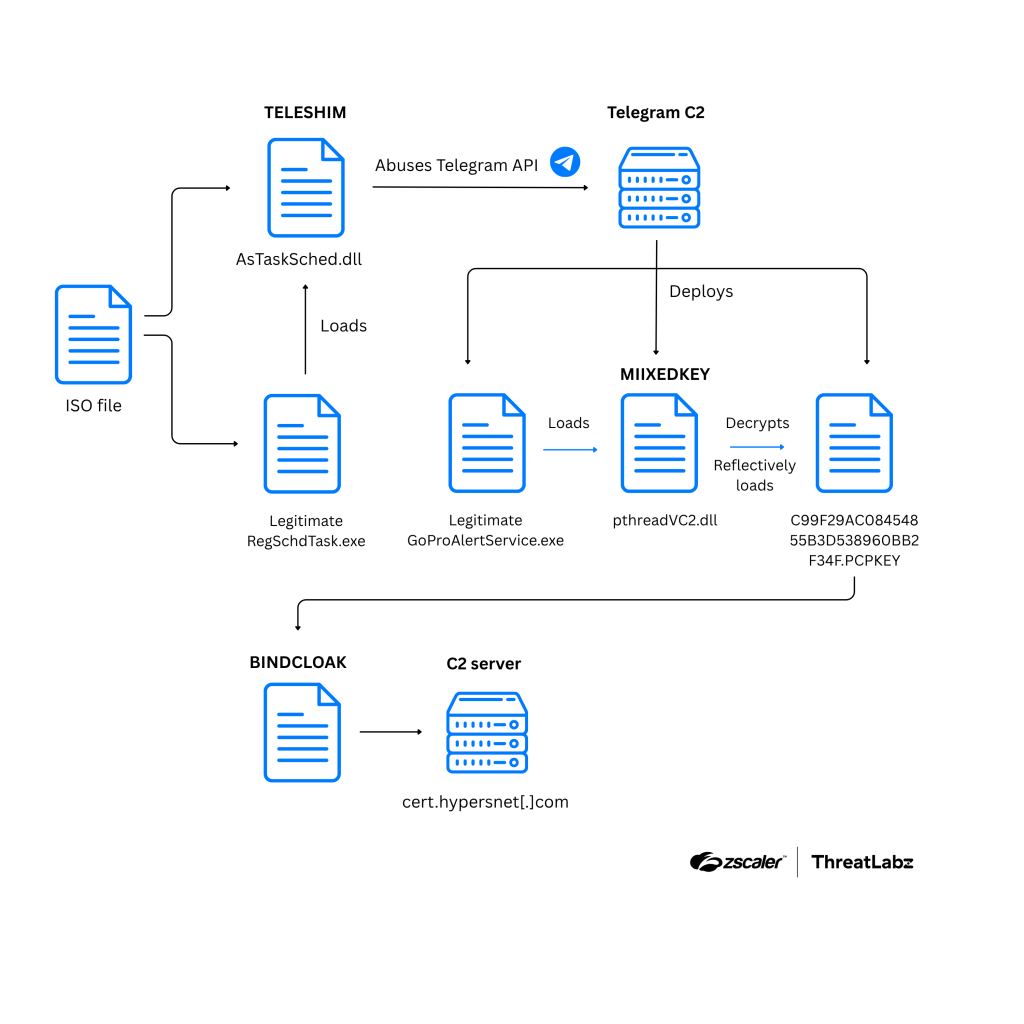
In July 2026, Zscaler ThreatLabz observed new activity by a threat actor with links to East Asia targeting government entities in the Middle East. During analysis, ThreatLabz captured post-compromise activity and uncovered previously undocumented malware tooling, including TELESHIM, MIXEDKEY, and BINDCLOAK. The campaign used a multi-stage attack chain to establish and maintain access on infected systems, with TELESHIM abusing the Telegram API for command-and-control (C2) communication to blend in with legitimate internet traffic.
ThreatLabz examines a targeted attack against Middle East governments using a multi-stage attack chain with new tooling that we named TELESHIM and MIXEDKEY.

www.zscaler.com
This blog post (Part 1) explores the technical details of the multi-stage attack chain, focusing on TELESHIM, MIXEDKEY, and the post-compromise activity observed during the campaign. A follow-up post (Part 2) will provide a detailed technical analysis of the BINDCLOAK C2 implant.
Key Takeaways
- In July 2026, ThreatLabz observed activity by a threat actor linked to East Asia targeting government entities in the Middle East.
- ThreatLabz identified full post-compromise activity leading to the discovery of previously undocumented malware tooling.
- The campaign used a multi-stage attack chain to deploy TELESHIM, MIXEDKEY, and BINDCLOAK on infected systems.
- TELESHIM and MIXEDKEY used heavy code obfuscation techniques leveraging control flow flattening (CFF), mixed boolean arithmetic (MBA), and opaque predicates to hinder reverse engineering. TELESHIM also used various techniques to detect the presence of virtualization-based analysis environments.
- The threat actor leveraged environmental keying by encrypting BINDCLOAK using a decryption key derived from the infected machine’s volume serial number. This helps ensure the payload decrypts and executes only on intended targets.
- TELESHIM abused the Telegram API for C2 communication to blend in with legitimate internet traffic.