

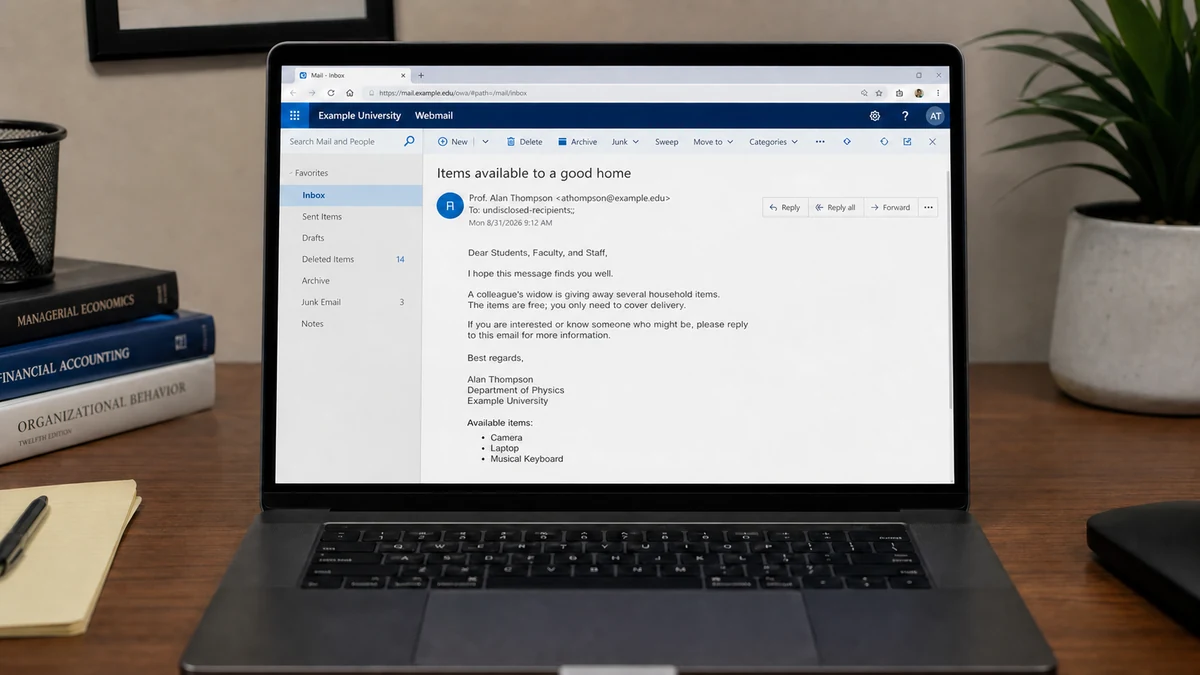
A professor appears to share an unusually generous offer with the university community. A widow is clearing out her late husband’s belongings, and expensive items are free to anyone willing to cover delivery.
The message arrives through an academic channel people already trust. That familiarity makes the shipping payment feel like the practical final detail, not the entire reason the offer exists.
Overview
A student paid €145 after trusting a university source
A recent student report describes a teacher’s university account posting news about a widow giving away belongings from her deceased husband. The recipient was told only shipping needed to be paid.
The student sent €145 by SEPA transfer and recognized the scam about an hour later. They contacted the bank promptly but feared the payment could not be recovered.
The account holder later said the teacher’s email had been compromised. That detail explains why ordinary sender checks were less useful: the message may have traveled through a real institutional account even though the professor did not write it.
The story matches a documented university giveaway campaign
This is not a new form of generosity that happens to resemble fraud. University security teams have repeatedly documented the same deceased-relative and shipping-fee script.
In May 2026, the University of Twente warned staff and students about free pianos, laptops, and consoles offered through compromised accounts. The message claimed the items came from a late partner’s collection and required the recipient to cover shipping.
University of Illinois Chicago also describes free-item giveaway scams in which criminals pose as faculty or students and request delivery money by wire or bank transfer.
The free item is bait for an advance payment
The item may change from a piano to a MacBook, camera, welding equipment, game console, furniture, or entire list of valuables. The deceased spouse, professor, and moving story make the giveaway feel compassionate rather than commercial.
Common warning signs include:
- An expensive item is offered without inspection.
- The owner cannot arrange local pickup.
- A specific shipper or mover must be used.
- Payment goes to a person unrelated to the professor.
- The conversation leaves the university system.
- The recipient must decide quickly.
- New insurance or storage costs appear after shipping is paid.
- The sender discourages calling the professor directly.
The Free Items Scam does not need to deliver counterfeit goods. There is usually no item to ship. Every operational detail exists to support the payment request.
Why a Real Professor’s Email Can Carry a Fake Offer
Email authentication answers a limited question. It can help show which system sent a message, but it cannot guarantee that the authorized human account holder intended it.
If a criminal steals a professor’s password, session cookie, or multi-factor approval, messages can come from the real mailbox. The address, display name, signature, and earlier conversation history may all look correct.
A compromised account also gives the criminal a useful audience. University directories and contact lists contain students, colleagues, department groups, vendors, and people likely to recognize the sender.
The scammer may search the mailbox for writing style and relationships. A message can mention the right department or event while remaining fraudulent.
Spoofing is another possibility. A lookalike address or manipulated display name can imitate a professor without access to the real account. That is why the reported facts should distinguish a confirmed compromise from a message that only appeared authentic.
In the student case, the recipient said the account was definitely compromised. Readers dealing with a new message should still verify whether the institution confirmed that conclusion.
Two-factor authentication lowers risk but does not make compromise impossible. Attackers can steal active sessions, use phishing pages that relay codes, send repeated approval prompts, or exploit recovery procedures.
The practical lesson is not to distrust every professor. It is to verify any unusual financial request through a second channel, even when the mailbox itself is genuine.
How the Free Items Scam Works
Step 1: A university identity is compromised or copied
The operator gains access to an academic mailbox or creates a lookalike sender. A faculty identity supplies authority and a ready-made community of recipients.
The message may be posted to a class group, internal board, department list, or campus email.
Step 2: A deceased relative explains the generous giveaway
A widow, professor, doctor, or retiring employee supposedly needs to rehome valuable possessions quickly. Grief discourages blunt questions about price and ownership.
The item is presented as emotionally important and destined for someone who will appreciate it.
Step 3: The victim is moved to private contact
The email may provide a personal address, telephone number, WhatsApp account, or supposed widow to contact. Moving the conversation makes university monitoring less effective.
The new contact already knows the script and responds as if referred by the professor.
Step 4: Local pickup is made impossible
The item is in storage, another city, a moving truck, or a deceased person’s home. The owner is traveling, elderly, grieving, or unable to meet.
These explanations prevent inspection, serial-number checks, and direct confirmation that the item exists.
Step 5: A fake shipper calculates the fee
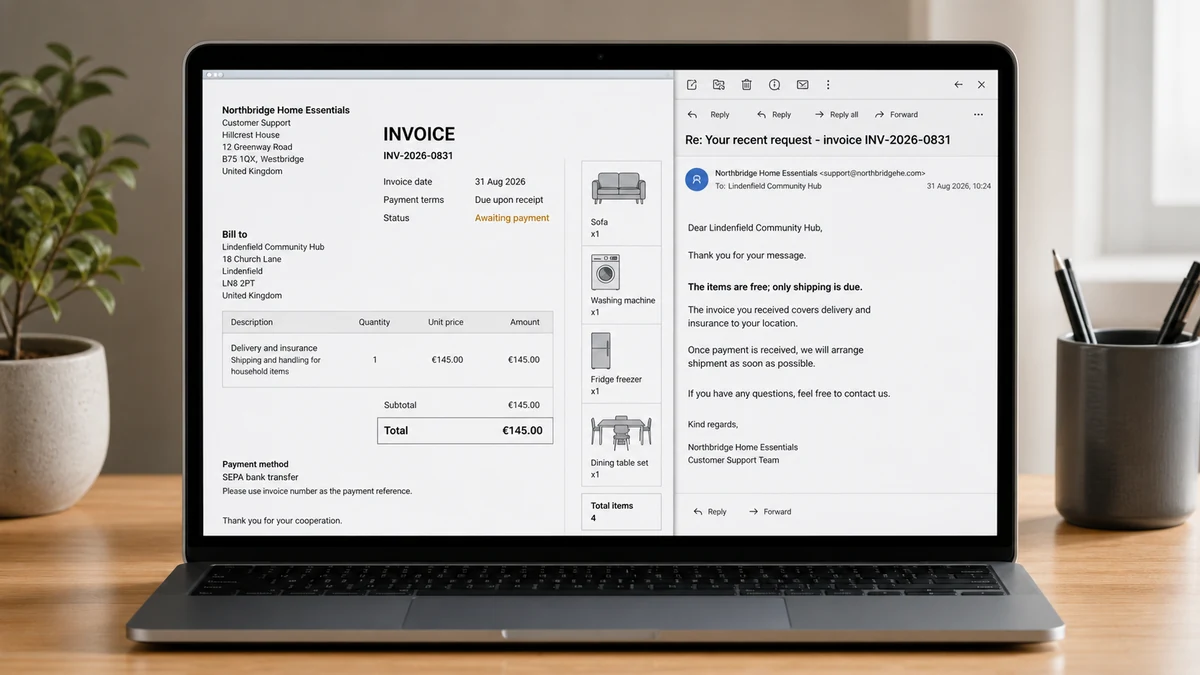
The victim receives an invoice for moving, insurance, packaging, or delivery. The shipper may have a generic website, copied logo, tracking page, and professional email signature.
The “owner” and “shipper” can be the same operator using different accounts.
Step 6: The transfer is sent and another cost appears
After the first payment, the package is supposedly delayed by insurance, customs, storage, fuel, or address verification. The victim is told previous money will be lost unless the new fee is paid.
A real tracking event never develops because no package entered a carrier network.
Step 7: The compromised account targets more people
As long as the university access remains active, the scammer can contact classmates, staff, and outside correspondents. Replies may be deleted or hidden with mailbox rules.
Victims who complain publicly may then be approached by fake recovery services.
The Item List Is Designed to Catch Different Desires
Older versions focused on pianos because genuine owners sometimes give them away to avoid moving costs. That real behavior gives the scam a believable foundation.
Newer lists add laptops, consoles, cameras, musical equipment, tools, drones, and furniture. One message can appeal to students, parents, artists, gamers, musicians, and resellers at the same time.
The value does not need to be realistic. The victim sees a rare opportunity and focuses on being first, while the scammer needs only a fraction of the supposed item’s price.
Photographs may be stolen from marketplace listings, auction houses, reviews, or manufacturers. A reverse-image search can reveal the source, but an image with no match is not proof of ownership.
Serial numbers can also be copied. Verification must include live possession, such as a video call showing a requested detail, and an independent plan for local collection.
Even live video needs caution. Recorded footage can be replayed, and a compromised professor may not be the person who appears on screen.
A safe local giveaway allows inspection before money changes hands. If delivery is genuinely necessary, the recipient should choose and contact the carrier independently rather than pay a shipper selected by the stranger.
Do not accept a low fee as proof. Criminals often set the first amount below the victim’s threshold for extensive verification.
The Fake Shipper Is a Second Confidence Trick
The donor’s role creates desire, while the shipper’s role creates procedure. Separating them makes the payment feel like a normal transaction between independent parties.
The moving company may ask for dimensions, address, preferred delivery date, and insurance choice. Collecting these details makes a nonexistent shipment feel customized.
An invoice can include a registration number, warehouse photograph, tracking portal, and customer-service line. Each element must be verified outside the documents supplied by the sender.
Search the address on maps and business registries. A residence, virtual office, unrelated warehouse, or copied address does not establish that a carrier holds the item.
Call a number found independently. If the only working contact is a mobile number or messaging account inside the email, the business identity remains unverified.
Check how payment is collected. A company invoice directing a SEPA transfer to an unrelated individual should be explained and confirmed before any money moves.
Do not rely on a tracking code until the real carrier recognizes it. A fake portal can move the parcel from “packed” to “insured” to “held” whenever another fee is needed.
If the supposed donor refuses a carrier chosen by the recipient, the shipping arrangement is controlling the payment rather than solving a delivery problem.
The safest version of a remote giveaway uses an established carrier selected directly by the recipient, transparent ownership evidence, and payment terms confirmed with that carrier.
Compare the invoice date, business name, tax number, currency, and bank beneficiary. Small contradictions often reveal that templates were copied from unrelated companies.
Search the telephone number and email address in quotation marks. Reports tied to other products, cities, or names show that the same contact route is being recycled.
Ask for the mover’s written cancellation policy before paying. A page created only after the request or terms that exclude every refund do not solve the missing-item problem.
Never pay a second company to “verify” the first shipper when both contacts came from the donor. Independent verification means leaving the entire chain supplied by the offer.
How to Verify a University Giveaway
Contact the professor using a channel you already know or a number from the official university directory. Do not reply to the questionable message and ask whether it is genuine; the criminal may control that mailbox.
Notify the university IT or security team. They can review sign-in history, message headers, forwarding rules, and reports from other recipients.
Ask for in-person pickup. If the item is supposedly nearby but pickup is refused, there is no reason to trust a remote shipping arrangement.
Search exact phrases from the email. Giveaway campaigns reuse wording about late husbands, loving homes, movers, and shipping. A match with university warnings is strong evidence.
Examine the payment recipient. A professor’s recommendation does not explain a transfer to an unrelated personal account in another jurisdiction.
Independently locate the carrier. Real movers have verifiable registration, addresses, telephone history, and payment policies. Do not use a link or telephone number supplied inside the giveaway thread.
Ask whether normal carrier payment is available at collection or delivery. A demand for an irreversible person-to-person transfer weakens the shipping story.
Wait. A genuine donor wants the item placed responsibly and can tolerate verification. A criminal needs speed before the university disables the account.
Company, Address, and Fulfillment Checks
The professor’s name is not the sender’s identity
A real university address can be controlled by someone else. Confirm the offer with the professor by telephone, in person, or through another established channel.
Ask campus IT whether the account has been reported as compromised.
The item’s location remains unverifiable
The supposed property is usually in storage or too far away for inspection. Request local pickup, a live possession check, and a serial number before discussing delivery.
Refusal does not prove every giveaway is fraudulent, but it removes the evidence needed to send money safely.
The shipper may be another role played by the scammer
A website and invoice do not establish a transport company. Verify registration, address, telephone history, and carrier credentials outside the supplied links.
Do not pay a personal beneficiary merely because the invoice carries a company logo.
No item enters a traceable delivery network
A genuine shipment creates a carrier reference that can be confirmed on the carrier’s independently found site. Fake tracking pages display whatever status the operator chooses.
Repeated insurance and storage fees indicate that fulfillment is only a payment story.
Why Victims Should Not Blame Themselves
The student who reported the €145 loss described shame and sleeplessness. Those reactions are common, but they assign responsibility to the wrong person.
The victim checked the most reassuring fact available: the offer came through a university staff identity. The criminal deliberately invested effort in defeating that trust check.
Education about scams does not create immunity. Timing, authority, grief, generosity, and a manageable first payment can align for anyone.
Shame also helps criminals. A person who stays silent is less likely to warn classmates, contact the bank quickly, or provide the evidence that closes a compromised account.
Report the event without self-punishment. Describe what was seen, what was paid, and how the deception worked. That information can prevent the next transfer.
University staff should avoid criticizing recipients in public alerts. Clear explanations and rapid notification build a culture where suspicious messages are reported early.
The professor whose account was compromised may also feel responsible. Account theft makes the professor another victim, unless evidence shows knowing participation.
Recovery scammers exploit distress after the payment. Emotional support from family, friends, or a counselor can make it easier to reject promises of a guaranteed refund.
What to Do if You Have Fallen Victim to This Scam
- Stop every further payment. Do not pay insurance, customs, storage, refund, or account-release fees. There is no package to protect.
- Contact your bank immediately. Ask for a SEPA recall or fraud review and provide the beneficiary name, IBAN, amount, time, and false shipping story. Recovery is not guaranteed, but speed matters.
- Notify university IT. Send the original message as an attachment so headers are preserved. Identify the professor or account that appeared to send it.
- Warn the professor through another channel. Do not rely on a reply to the compromised mailbox. The owner needs to reset access and remove malicious forwarding rules.
- Save all evidence. Keep the offer, item photographs, private contact, shipping invoice, website, payment request, transaction record, and every new fee.
- Report the recipient account. Ask the receiving bank or payment service to flag the beneficiary for advance-fee fraud.
- Change exposed credentials. If you entered a university password on any linked page, reset it from the official portal and revoke active sessions.
- Run Malwarebytes if you opened files. Scan the device when the message included an attachment, archive, installer, or suspicious document that may carry malware.
- Use AdGuard for additional protection. It can block many known phishing pages and malicious ads, but it cannot determine whether a genuine mailbox has been hijacked.
- Report the fraud locally. Use the university security office, national cybercrime portal, and police. U.S. readers can also use ReportFraud.ftc.gov.
- Tell other recipients. A quick, factual warning can stop payments while the institution investigates and removes the message.
- Ignore recovery contacts. No hacker or agent can guarantee a SEPA refund in exchange for another fee.
Frequently Asked Questions
Can a scam email really come from a professor’s genuine account?
Yes. A stolen password, session, or approval can let a criminal send through a real mailbox. Verify unusual financial requests through a different channel.
Are all free pianos and household giveaways scams?
No. Real local giveaways exist. The danger is an unseen item paired with a required payment to a shipper or recipient selected by the stranger.
Why do scammers mention a deceased husband or partner?
The story explains generosity, urgency, and the owner’s absence while making direct questions feel insensitive. It also appears repeatedly in documented university campaigns.
Can a SEPA transfer be recalled?
A bank can tell you whether a recall or fraud request is available. Success depends on timing and the receiving bank, so report immediately and distrust guaranteed-recovery offers.
Does a tracking page prove the item was shipped?
No. Fake carrier sites can display invented events. Confirm the tracking number through a carrier you located independently and ask whether it exists in the real network.
Should the professor be blamed for the loss?
Not without evidence of participation. A professor whose account was stolen is also a victim. Report the account so the university can investigate and stop further messages.
The Bottom Line
The Free Items Scam hides an ordinary advance-fee fraud behind an unusually trusted sender. A real professor’s address, a sympathetic widow, and genuine product photographs can all lead to a nonexistent shipment.
Verify the offer outside email, inspect the item before paying, and choose any necessary carrier yourself. If “free” becomes a bank transfer to unlock delivery, the shipping fee is not a side cost. It is the product the scammer came to sell.








