

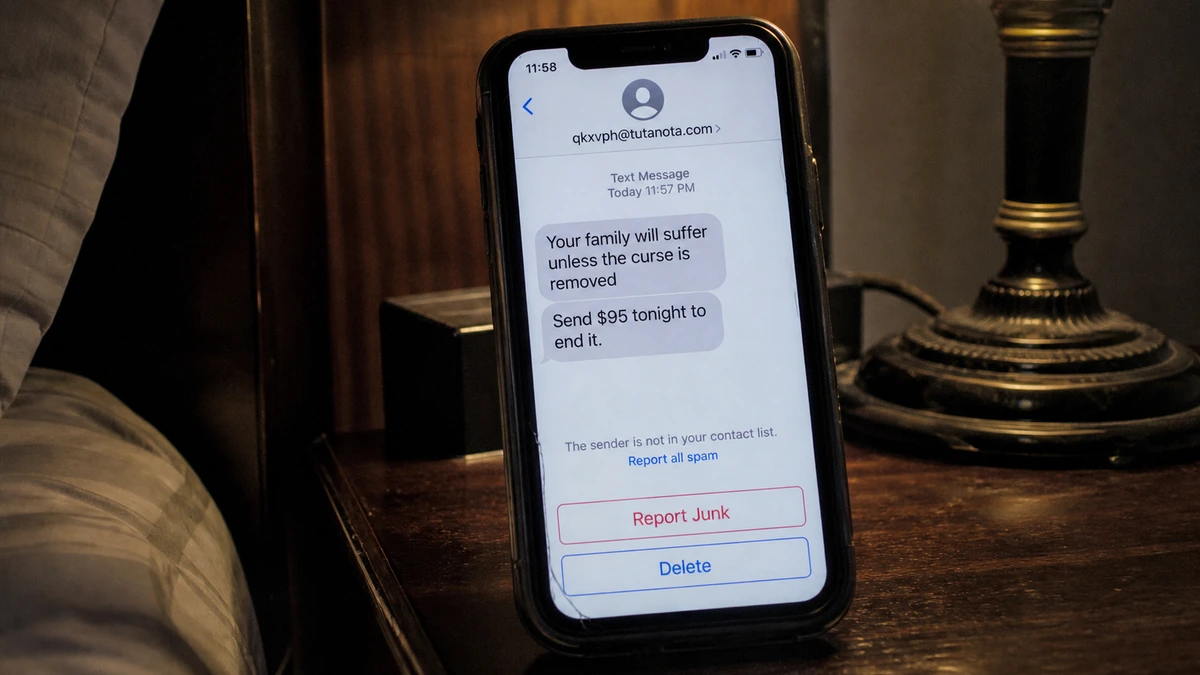
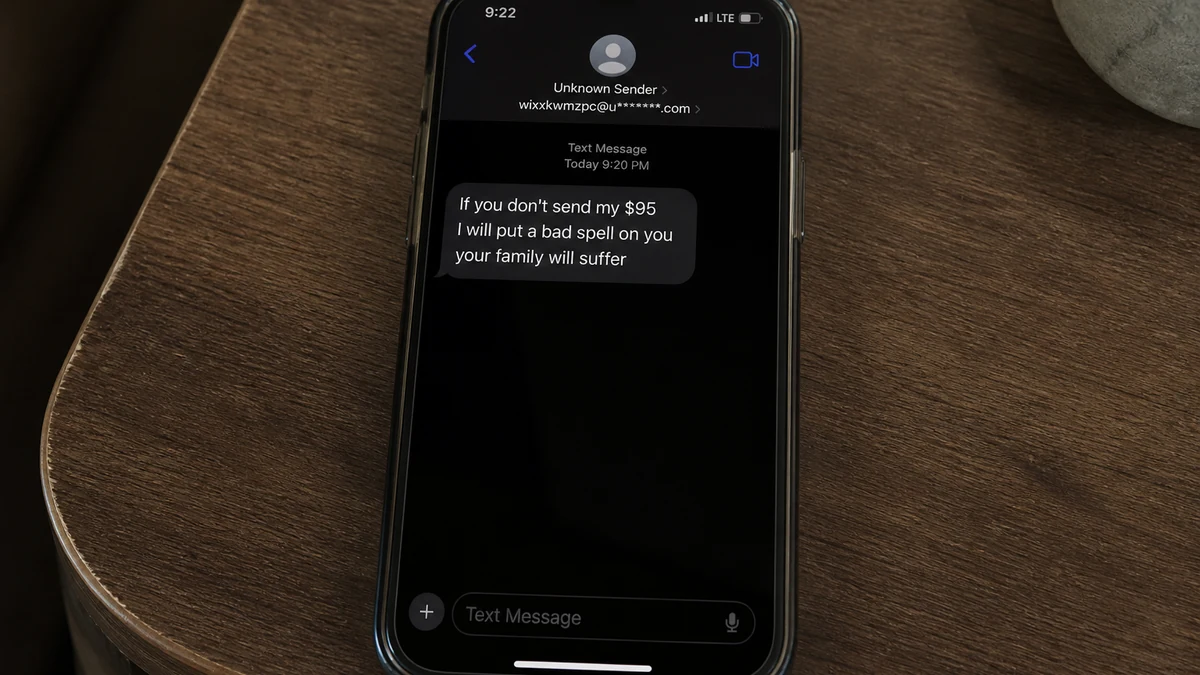
The witch curse text does not begin with a delivery problem, a bank alert, or a prize. It claims that a stranger has placed a spell on the recipient and knows how to make the recipient’s family suffer.
Then comes a price: $95 to make the danger disappear. The language is theatrical, but the fear it creates can feel very real when the threat lands without warning on a personal phone.
Overview
The sender invents an invisible emergency
The fake witch curse text scam claims that the sender, an ancestor, or a supposed spiritual practitioner has placed a curse, bondage, disease, or bad luck on the recipient. Because the alleged harm cannot be inspected or disproved in the moment, the sender tries to make fear stand in for evidence.
The $95 payment is presented as the only escape
The message does not offer a verifiable service. It creates the danger and sells the cure in the same breath. In the report we reviewed, the sender demanded $95 and implied that refusal would expose the recipient and family members to serious harm.
The real weapon is psychological pressure
There is no evidence in the message that the sender has supernatural power or access to the family. What the sender does have is a phone number, an alarming script, and a payment demand. That combination is enough to make some recipients answer before they have time to think.
- The threat arrives unexpectedly from an unknown email address or number.
- The sender claims private knowledge without providing anything independently verifiable.
- Graphic consequences are used to keep the recipient emotionally off balance.
- A relatively small payment is framed as the fastest way to protect loved ones.
- Replying can lead to larger demands, repeated harassment, or the sale of an active number to other scammers.
What the Reported Message Actually Said
The public report showed a text delivered from an email address to a phone. The writer claimed to be a witch, referred to ancestors and bondage, threatened the recipient’s family with illness and misfortune, and asked for $95 to stop it. The wording jumped between supernatural claims and a very ordinary request for money.
That contrast matters. A genuine warning would not require the threatened person to buy protection from the same stranger who created the supposed danger. The sender controls every part of the story: the curse, the deadline, the consequences, and the price of relief.
Nothing in the message demonstrated that the sender knew the recipient, had contacted relatives, or possessed information beyond the phone number. The threat was broad enough to fit almost anyone. Family, disease, sleep, accidents, and bad luck are common fears precisely because they can make a mass-produced message feel personal.
How the Fake Witch Curse Text Scam Works
Step 1: The scammer obtains a reachable phone number
The number may come from a breached database, a marketing list, a public profile, or simple automated dialing. Receiving the message does not prove that the sender has investigated the recipient. It often proves only that a message could be delivered.
Email-to-text gateways can make the sender line look unusual because the message appears to come from an email address rather than a normal mobile number. That odd route is not evidence of supernatural access. It is simply one way to send text content to a phone.
Step 2: The sender opens with an impossible-to-measure threat
A stolen card can be frozen and a parcel can be tracked. A claimed curse has no account page, reference number, or objective test. The scammer uses that ambiguity to keep the victim arguing inside the scammer’s fictional world.
The wording may borrow from religion, folk beliefs, spiritual cleansing, black magic, psychic readings, or ancestral punishment. The decoration changes, but the commercial logic stays the same: believe the threat first, then pay the person who says only they can remove it.
Step 3: Family members are added to raise the stakes
Many people will take a risk with their own safety that they would never take with a child, parent, or partner. Threatening loved ones makes the recipient feel responsible for preventing an imagined catastrophe. It also discourages the calm delay needed to verify the claim.
Broad statements such as “your family will suffer” are designed to invite the recipient to fill in the blanks. A recent illness, an argument, or an ordinary run of bad luck can suddenly appear connected to the message even though the sender knew none of it.
Step 4: A manageable price is offered as instant relief
The first demand may be small enough to seem worth paying just for peace of mind. In this report it was $95. That amount is not proof of restraint. It can be a test to learn whether the recipient is frightened, responsive, and willing to send money.
Once a payment succeeds, the sender can invent another ritual, ingredient, fee, or newly discovered danger. The victim may be told that the first payment started the cleansing but a larger payment is required to finish it.
Step 5: A reply confirms that fear is working
Even a reply that says “leave me alone” confirms that the number is active and that a person read the threat. A conversation also gives the scammer new material. If the recipient mentions a relative, health problem, town, or belief, those details can be recycled as supposed proof of special knowledge.
This is why it is safer to preserve the message without entering a debate. Blocking and reporting deny the sender additional information while keeping evidence available if the behavior escalates.
Step 6: Payment is moved to a hard-to-recover channel
The sender may request a payment app, gift card, cryptocurrency, bank transfer, or another channel that offers speed and limited recovery. A demand for secrecy often appears at this point. The recipient may be told that discussing the ritual will make it fail or worsen the curse.
Secrecy protects the scammer, not the victim. A trusted friend can often see immediately that the threat and the paid cure came from the same source.
Step 7: The pressure expands if the first demand succeeds
Payment does not purchase safety because there was no verified danger to remove. It proves that the story produced money. That can trigger repeat demands from the same sender or new approaches using different identities.
The recipient may also be targeted with a recovery pitch. A second stranger claims to be a stronger psychic, investigator, or payment specialist who can fix the first problem for another fee. This is the same victim being monetized twice.
Why This Message Can Feel Personal Even When It Is Not
Threat scripts are written around universal anxieties. Almost everyone can think of a family member who is vulnerable, a recent setback, or an uncertain future. When a message names those themes, the brain naturally searches for connections.
This effect becomes stronger after the sender asks questions. A recipient may unintentionally supply a name, a concern, or a religious belief and then experience the scammer’s repetition of that detail as a revelation. It is information gathering, not proof of hidden knowledge.
Public data can add another layer. Names, relatives, birthdays, memorial posts, and home towns are commonly exposed through social media and data brokers. A scammer who repeats a public fact still has not demonstrated an ability to cause harm.
The right question is not whether the sender’s story feels eerie. It is whether any claim can be verified independently. In this case, the only concrete action was the request to transfer $95 to the person making the threat.
When a Threat Should Be Taken Beyond the Spam Folder
Most curse-payment messages are psychological extortion. However, recipients should not dismiss a message that includes a specific address, schedule, weapon, planned act, recent surveillance, or another credible sign of real-world intent.
The FBI’s Threat Intimidation Guide advises people to preserve electronic threats and record details rather than deleting the evidence. If a threat appears immediate or identifies a specific physical act, contact local emergency services or law enforcement.
Do not confront the sender or arrange a meeting. Preserve screenshots, the full sender address or number, dates, times, payment instructions, and any platform profile. A screenshot is useful, but retaining the original message can preserve metadata that an investigator or provider may need.
If the text is broad, supernatural, and tied only to a payment demand, report it as spam and block the sender after preserving it. The FTC explains how to forward suspicious texts to 7726 and report them through ReportFraud.ftc.gov.
How to Respond Without Feeding the Extortion
Start by putting distance between the message and any decision. Do not pay for reassurance. Do not ask the sender to prove the curse, and do not disclose which part frightened you most.
Take screenshots that show the sender, full message, timestamp, and payment demand. If the message came through email-to-text, save the visible email address. Then use the phone’s report-junk feature, forward the message to 7726 if supported by your carrier, and block the contact.
Tell someone you trust what happened. Saying the script out loud often exposes its structure: a stranger invented a danger, threatened loved ones, and offered to remove the danger for money. That is extortion dressed in supernatural language.
Recipients who feel persistently frightened should seek support from a trusted community leader or licensed mental-health professional who will not demand money to neutralize the message. Avoid contacting online “curse removal” services found through ads, because those searches can lead directly to a second payment scheme.
Why Paying for Peace of Mind Usually Creates More Fear
A payment may produce a short feeling of relief, but it gives the sender a powerful signal: this recipient will spend money to reduce uncertainty. The sender can restore that uncertainty with one more message.
The next claim may say the ritual uncovered a stronger curse, another relative is affected, or special materials are required. There is no independent endpoint because the seller controls the diagnosis and the cure.
Receipts, photos of candles, certificates, or recordings do not make the threat verifiable. They only document that the sender created more content around the same unsupported claim.
This pattern resembles other fear-based messages, including the fake Trojan and sextortion email scam, where a stranger claims invisible access and demands payment before an invented deadline.
It also explains why recovery offers are dangerous. Someone who claims to track the witch, reverse the payment, or guarantee protection for another fee is extending the same business model.
A payment note such as “gift” or “personal” does not make the demand safer. It may simply reduce the protections normally attached to a purchase and make the transfer harder to challenge.
If the sender asks for a gift card, keep the receipt and card details after contacting the issuer. Do not send additional photographs of the card or PIN to anyone offering help.
What Email-to-Text Delivery Can Tell You
An email address in the sender field may indicate that a carrier gateway delivered the message to SMS. It does not reveal the sender’s physical location or prove that the address belongs to the person described in the text.
Preserve the exact address, including spelling and domain, because the carrier or provider may use it in an abuse review. Do not send a test email, since that gives the operator another confirmed way to reach you.
If repeated messages arrive from changing addresses, carrier-level spam controls may help. Continue preserving examples and report the pattern rather than negotiating with each new identity.
For comparison, the “Your Time Is Ticking Away” blackmail scam uses different imagery but the same pressure: frightening claims, no verifiable proof, and payment presented as the only escape.
Company, Address, and Fulfillment Checks
No identifiable company was disclosed
The message did not identify a registered business, licensed service, written terms, or accountable operator. A threatening sender cannot become legitimate merely by assigning a price to the threat.
No verifiable business address was provided
There was no office or service location that could be independently confirmed. The only route was an unsolicited electronic message. That absence removes the ordinary accountability a customer would expect before buying any service.
The sender identity could not be authenticated
An email address displayed inside a text thread is not proof of identity. Addresses can be created quickly, abandoned, or impersonated. The recipient had no reliable way to connect the sender to a real person with a verifiable history.
There was no measurable fulfillment
The proposed product was relief from a danger that the seller alone claimed existed. There was no objective starting condition, deliverable, completion test, or refund standard. That makes the promise impossible to verify and easy to extend indefinitely.
What to Do if You Have Fallen Victim to This Scam
- Stop communicating and do not send another payment. A follow-up demand is evidence that the first payment encouraged the scheme, not proof that a new danger appeared.
- Preserve the complete threat. Save screenshots, the original message, sender address, phone number, timestamps, usernames, and all payment instructions.
- Contact the payment provider immediately. Ask whether the transfer can be stopped, reversed, or disputed. Be direct that the payment followed an extortion threat.
- Protect the payment account. Change its password, enable multi-factor authentication, review connected cards and bank accounts, and remove any unknown device or session.
- Report the sender. Use the messaging platform’s abuse tools, report spam texts through your carrier, and file a report with the FTC. USA.gov lists the appropriate reporting routes for different scams.
- Escalate specific physical threats. If the sender names a location, plan, weapon, or imminent action, contact local law enforcement or emergency services and retain the original evidence.
- Scan devices if you opened a link or installed anything. A trusted security tool such as Malwarebytes can check for unwanted software. A scanner cannot reverse a payment or remove a supposed curse, but it can help after a malicious download.
- Reduce future exposure. Review social-media privacy settings and consider an ad and tracker blocker such as AdGuard to limit some malicious pages. It will not stop ordinary SMS messages, so carrier reporting and blocking still matter.
Be cautious with anyone who contacts you after a report and promises recovery for an upfront fee. Recovery scammers often use the same fear and urgency as the original sender.
Frequently Asked Questions
Can a text message place a curse on me?
The message provides no verifiable mechanism or evidence that the sender can cause supernatural harm. It does demonstrate a conventional extortion attempt: create fear, demand money, and discourage independent advice.
Why did the sender ask for only $95?
A modest first demand can feel easier to pay and can test whether the recipient is responsive. If it succeeds, the sender may invent additional fees or sell the active contact to other scammers.
Should I reply so the sender knows I am not afraid?
No. A reply confirms that the number reaches a person and can reveal which claims affected you. Preserve the evidence, report the message, and block the sender instead.
How did the sender get my phone number?
Phone numbers circulate through breaches, lead lists, public profiles, app data, and automated dialing. Possession of the number does not mean the sender knows your family or has been watching you.
Should I report a supernatural threat to police?
A generic curse tied to payment can be reported as fraud and spam. If the message includes a credible physical threat, precise personal details, stalking, or imminent intent, preserve it and contact local law enforcement.
What if I already paid and the sender wants more?
Do not pay again. Contact the payment provider immediately, secure the account, document every demand, and report the extortion. The next fee will not create a reliable endpoint.
The Bottom Line
The fake witch curse text scam turns an unverifiable supernatural claim into a very ordinary $95 payment demand. Its power comes from surprise, family-focused threats, and the temptation to buy immediate peace of mind.
Preserve the evidence, do not engage, block and report the sender, and treat any specific real-world threat seriously. You do not need to purchase protection from the stranger who invented the danger.








