

A polished supplement page can feel reassuring within seconds. The bottle looks clinical, the language sounds precise, and the discount seems unusually generous.
Saffron Advanced deserves a slower look. Several details around its promises, recurring-order option, refund process, and seller identity matter before any card is entered.
Overview
A real product page does not prove every marketing promise
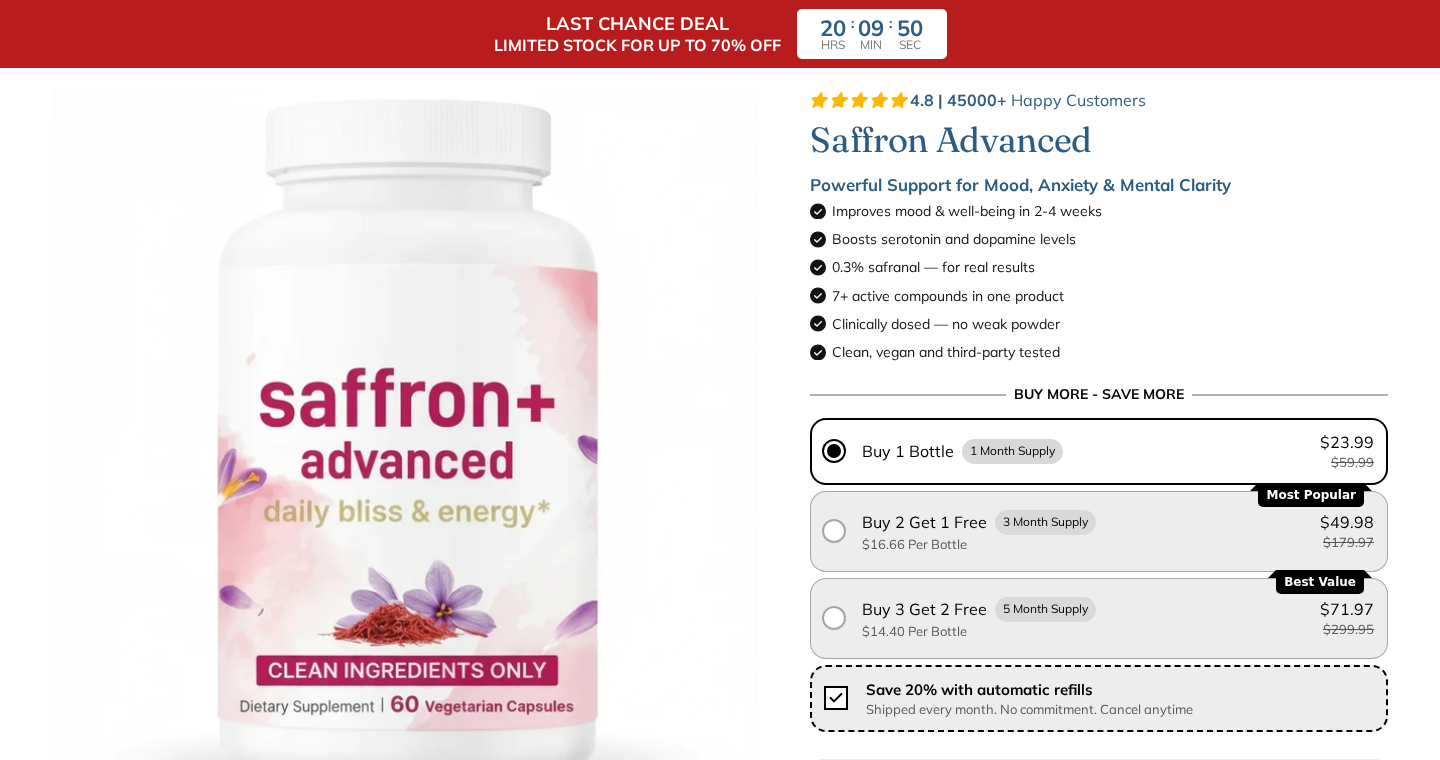
Saffron Advanced is offered through Borniu as a capsule blend for mood, stress, motivation, energy, and mental clarity.
The page names familiar ingredients, including saffron extract, ashwagandha, rhodiola, magnesium glycinate, turmeric, passionflower, and L-theanine.
Those ingredients exist, and some have been studied. That does not automatically validate the page’s promised timetable, combined effect, or suitability for every buyer.
The recurring-order choice is the most important checkout detail
During our review, the purchase panel displayed a selected box offering 20% savings with automatic monthly refills.
The nearby text said shipments would arrive every month, with no commitment and cancellation available. A selected option can still surprise a hurried shopper.
Buyers should confirm whether they are placing one order or authorizing future charges before pressing the final purchase button.
The seller provides policies, but traceability remains limited
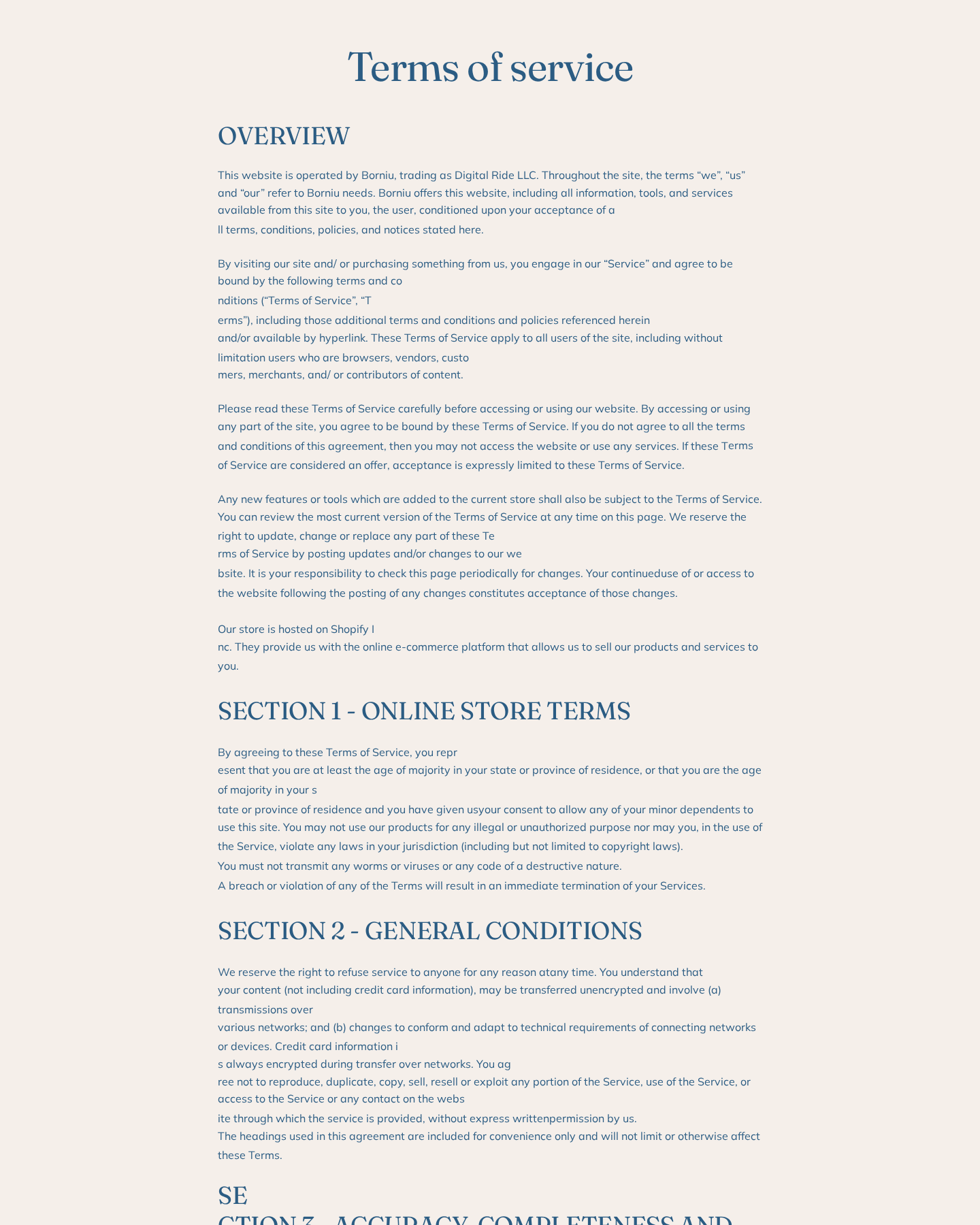
The terms identify Borniu as trading through Digital Ride LLC. They say the store is hosted on Shopify and governed by New Zealand law.
The visible contact route centers on an email address and web form. We did not find a clearly displayed customer-service phone number or headquarters address.
That does not prove fraud. It does make independent verification, urgent cancellation, and cross-border dispute handling less straightforward.
- The sales page promotes mood and clarity benefits within a short period.
- A monthly automatic-refill option appeared selected during our inspection.
- The advertised 90-day guarantee carries instructions and timing conditions.
- The return address printed on a parcel is not necessarily an accepted return destination.
- Physical return shipping can remain the buyer’s responsibility.
- The site names Digital Ride LLC but shows limited public-facing business details.
Our conclusion is not that every bottle is counterfeit. The concern is a high-pressure supplement funnel where important billing and refund details deserve careful reading.
What Saffron Advanced Claims to Do
The page positions Saffron Advanced as broad emotional and cognitive support rather than a simple single-ingredient capsule.
It says the formula can improve mood and well-being, support serotonin and dopamine levels, reduce mental fog, and deliver noticeable results within weeks.
Marketing language also emphasizes a standardized 0.3% safranal content. Specific-looking numbers can create an impression of medical precision.
However, a standardized extract percentage describes the ingredient. It does not prove the finished mixture produces every result presented by the seller.
The formula combines several compounds that may influence alertness, relaxation, digestion, or medication response differently.
A buyer cannot infer personal safety from phrases such as clean, vegan, natural, third-party tested, or clinically dosed.
Meaningful verification would require a complete label, exact quantities, lot information, testing documentation, and an identifiable manufacturer connected to the bottle.
What the Ingredient List Can and Cannot Establish
Saffron has research involving mood symptoms, but studies use defined extracts, doses, populations, and comparison periods.
Results from one preparation should not be transferred automatically to an online blend with multiple ingredients and its own serving instructions.
Ashwagandha and rhodiola are commonly sold for stress or fatigue. Both can cause side effects and may be unsuitable with certain conditions or medicines.
Magnesium glycinate supplies magnesium, although the useful amount depends on elemental magnesium rather than the compound’s total weight.
Turmeric products vary in curcuminoid content and absorption. Passionflower and L-theanine are also marketed for calmness, but evidence and individual response vary.
Combining recognizable ingredients creates a persuasive story. It does not substitute for evidence on the precise finished product.
Anyone pregnant, nursing, treating a mental-health condition, or taking prescription medication should consult a qualified clinician before using a multi-ingredient supplement.
Never stop prescribed treatment because an advertisement compares a supplement with an established therapy. That decision belongs in a clinical conversation.
How the Scam Works
Step 1: An emotional ad reaches someone seeking relief
The funnel begins with a common frustration, such as persistent stress, poor motivation, mental fog, or feeling unlike yourself.
Advertising can present that experience as a hidden biological problem that ordinary advice failed to recognize.
The message works because it sounds personal. It offers a simple explanation while the viewer is tired of complicated answers.
Step 2: Scientific vocabulary creates borrowed authority
Terms involving neurotransmitters, standardized extracts, active compounds, and clinical dosing make the page appear more authoritative.
These words can describe real scientific concepts. Their presence does not show that the specific bottle achieved a clinical outcome.
A careful reader should ask which study tested this finished formula, who funded it, and whether the measured endpoint matches the advertisement.
Step 3: Ratings and customer counts reduce hesitation
The page displays a high rating and more than 45,000 happy customers. Large numbers encourage buyers to assume the decision is already settled.
On-site testimonials are controlled by the seller. Unless review collection and verification are explained, the figures cannot be independently audited.
Photographs, names, and enthusiastic quotations are not equivalent to medical evidence or a transparent independent review history.
Step 4: Bundle pricing makes the largest order feel sensible
One bottle appears beside larger packages with lower per-bottle prices. Labels such as most popular and best value direct attention toward quantity.
The shopper begins comparing savings rather than deciding whether the product is needed at all.
Buying several bottles also raises the amount at risk if the order disappoints or the refund process becomes difficult.
Step 5: The automatic-refill discount can change the transaction
The inspected page showed an automatic-refill discount selected beneath the bundle choices. That selection changes a one-time purchase into recurring delivery.
A shopper focused on the headline price may overlook the checkbox, especially on a small screen or after scrolling through persuasive claims.
The key question is not whether cancellation is promised. It is whether the buyer knowingly authorizes each future shipment and charge.
Step 6: The guarantee sounds simpler than the complete policy
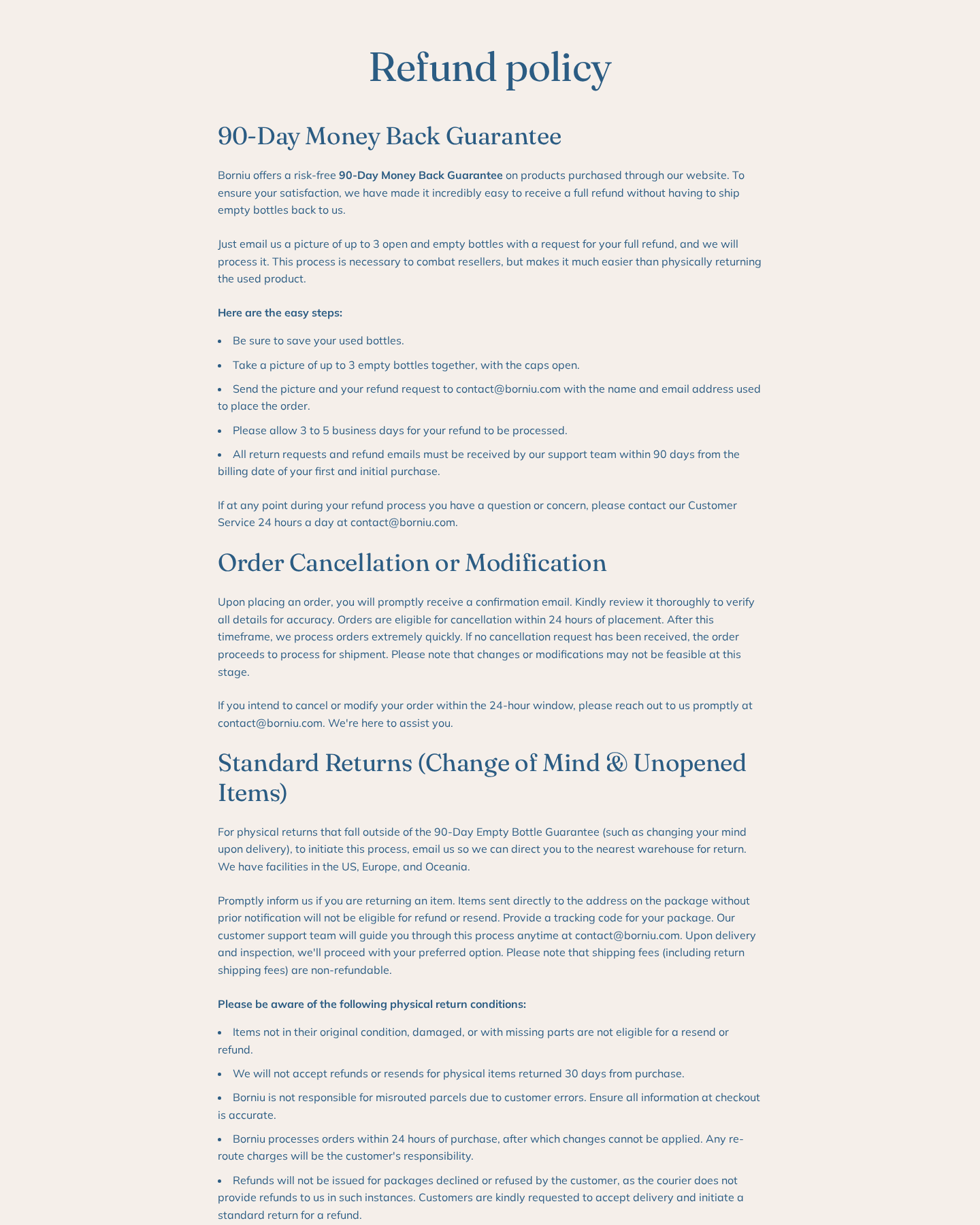
The sales page presents a reassuring money-back promise. The detailed policy requires contacting support within the stated window and following its evidence instructions.
For the empty-bottle route, buyers are told to keep used containers and provide photographs of up to three opened bottles.
Other physical returns require prior contact. The policy warns that sending merchandise to the parcel address without authorization may disqualify the return.
Step 7: Distance and limited support can wear down a dispute
Email-only support is manageable when replies are prompt. It becomes frustrating when a recurring charge or deadline requires immediate action.
Cross-border terms, different warehouses, nonrefundable shipping, and inspection conditions can prolong a straightforward refund request.
This final friction is why screenshots, receipts, labels, tracking records, and dated cancellation messages are essential.
Why the Automatic Refill Deserves Special Attention
Recurring delivery is not inherently fraudulent. Many legitimate merchants offer subscriptions with clear consent and convenient cancellation.
The risk rises when the recurring choice is preselected, visually secondary, or revealed after the shopper has anchored on a discounted price.
Before payment, inspect the order summary for phrases such as automatic refill, monthly shipment, subscription, membership, continuity, or recurring billing.
Take a screenshot showing the final quantity, total, frequency, and checkbox state. Save the confirmation email and the policy version displayed that day.
If only one bottle is wanted, remove every recurring option and confirm the total again. Do not assume choosing one bottle means one charge.
After ordering, check the receipt for the next shipment date. A subscription may be recorded there even when the sales page felt ambiguous.
Reading the 90-Day Guarantee Carefully
The policy says the 90-day period runs from the first billing date, not from the day a customer decides the formula is ineffective.
That difference matters when delivery is slow or the buyer waits several weeks before beginning the bottle.
The seller asks for pictures of opened or empty bottles under its primary guarantee process. Buyers should preserve containers until any refund is complete.
Cancellation or order modification is described as available within 24 hours. After processing begins, changes may no longer be feasible.
For standard unopened returns, the instructions say to contact support first so the seller can provide the nearest warehouse.
They also say outbound and return shipping charges are nonrefundable in applicable cases. That can reduce the practical value of a refund.
A guarantee is only as useful as its procedure. Read every condition before purchase, not after support rejects an informal return.
Company, Address, and Fulfillment Checks
The named operator is easy to state but harder to verify
The terms say Borniu operates while trading as Digital Ride LLC. That is the legal name a buyer should compare with receipts and card statements.
We did not see a registration number or clearly displayed headquarters address beside that identification on the pages reviewed.
A company name without matching registration details gives consumers fewer anchors for resolving cross-border complaints.
The governing-law clause points to New Zealand
The terms state that New Zealand law governs the service. That location may differ from the shopper, payment processor, warehouse, and parcel origin.
Different jurisdictions do not prove misconduct. They can make enforcement, returns, and consumer-rights questions more complicated.
Before ordering, ask support for the legal entity’s complete address and confirm whether that information appears on the invoice.
The return warehouse is not presented as headquarters
The refund policy says customers may be directed to facilities in the United States, Europe, or Oceania.
It specifically warns against returning merchandise to the address printed on the package without first obtaining instructions.
That means the parcel origin cannot safely be treated as the manufacturer, corporate office, or approved return location.
Support depends heavily on one email channel
The visible policies direct customers to contact@borniu.com. A web form is also available, but a clear public phone route was not prominent.
Send a pre-purchase question about cancellation, recurring billing, and returns. The quality and speed of the reply provide useful practical evidence.
If the response is vague, automated, or avoids naming the legal seller, do not assume support will improve after payment.
Warning Signs to Check Before Ordering
Look for a complete Supplement Facts panel rather than a decorative ingredient list. Exact serving quantities matter when several active compounds are combined.
Ask for the identity of the finished-product manufacturer and the laboratory report tied to the current lot number.
Do not accept a generic quality badge as proof. A useful test record names the laboratory, sample, method, result, and date.
Compare the sales claim with the disclaimer. A page promising broad emotional change may later describe the product only as general wellness support.
Search the legal entity, not merely the bottle name. Product branding can change while billing and fulfillment remain with another company.
Review the final checkout on both price and frequency. Discounts should never distract from the words that authorize repeat charges.
What to Do if You Have Fallen Victim to This Scam
- Capture the transaction record. Save the sales page, refill selection, receipt, confirmation, policies, parcel label, and every support exchange.
- Send a direct cancellation. State that you cancel all recurring shipments and revoke authorization for future charges. Request written confirmation.
- Contact the card issuer. Explain whether the disputed charge was unauthorized, recurring, duplicated, or tied to goods not delivered as described.
- Watch for another billing attempt. Review statements and transaction alerts. Ask whether a merchant token must be blocked, not only the card replaced.
- Follow the published refund procedure. Keep bottles, photograph requested items, obtain the correct return location, and use tracked shipping when required.
- Protect exposed accounts. If you reused a password, change it everywhere. Scan the device with Malwarebytes if a download or suspicious redirect occurred.
- Reduce malicious advertising. AdGuard can block many deceptive ad and tracking paths, although it cannot replace careful checkout review.
- Report unresolved conduct. Provide documents to the relevant consumer-protection agency and advertising platform. Include dates, totals, and the legal seller name.
Frequently Asked Questions
Is Saffron Advanced definitely a scam?
We cannot establish that every order is fraudulent or every bottle is fake. Our concern centers on aggressive claims, limited traceability, and the selected refill option.
Does the product page enroll buyers in automatic refills?
During our inspection, a checked option offered 20% savings with monthly shipments. Buyers should verify its state immediately before completing payment.
Does saffron have scientific research behind it?
Yes, specific saffron extracts have been studied. That evidence does not automatically prove this multi-ingredient product delivers every advertised benefit.
Is the 90-day money-back guarantee unconditional?
No. The policy describes deadlines, photographs, prior contact, return-routing requirements, and situations where shipping costs remain nonrefundable.
Who appears to operate the Borniu store?
The site’s terms identify Borniu as trading through Digital Ride LLC. The reviewed pages did not prominently display a full office address or telephone number.
What should I check before buying any mood supplement?
Confirm exact ingredient amounts, manufacturer identity, lot testing, interactions, purchase frequency, cancellation steps, and the legal company accepting payment.
The Bottom Line
Saffron Advanced combines recognizable ingredients with confident health language, large social-proof figures, steep discounts, and a recurring refill choice.
That package deserves caution. Verify the formula, company, billing frequency, and refund conditions before ordering, and never let a countdown make the decision for you.








