

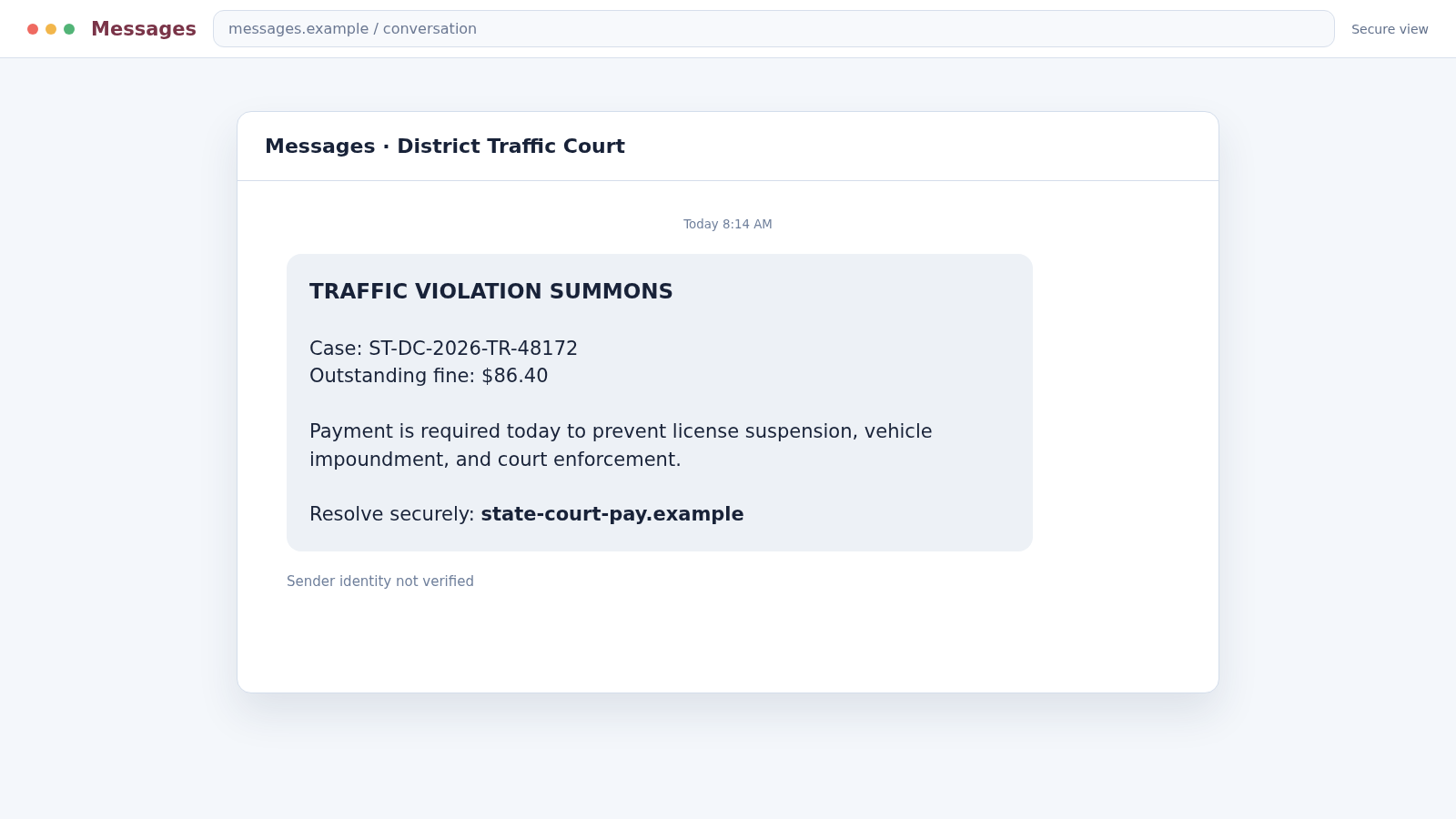
The text reads like a summons squeezed onto a small screen. It names a court, lists a case number, and warns that an unpaid traffic violation could lead to a suspended license or bench warrant.
There is also an easier option: pay immediately through the link or QR code. The traffic court text scam relies on that moment of relief, before the recipient checks whether the case exists.
Overview
The message imitates a court summons rather than an ordinary bill
The traffic court text scam claims that the recipient missed a payment, ignored a ticket, or must attend a hearing. It may display a state seal, judge’s name, badge number, court clerk, hearing time, and official-looking case reference.
Those details are meant to create authority, not provide verification. Federal and state agencies have warned about campaigns using invented court names, officials, case formats, and websites.
The threat list is deliberately overwhelming
Fake notices often threaten several consequences at once: license suspension, vehicle impoundment, default judgment, prosecution, wage withholding, debt collection, higher fines, credit damage, or arrest.
Real court procedures vary by jurisdiction, but an unsolicited text demanding immediate payment through its own link should not be treated as a valid order. The correct court can confirm a case independently.
The link, QR code, or payment line is the real destination
The notice may lead to a cloned government page that collects more than a supposed fine. Common requests include:
- Full name, address, phone number, and email
- Driver’s license number and vehicle information
- Social Security number or date of birth
- Credit or debit card number, security code, and billing address
- A login, one-time passcode, or identity-document image
- A small “processing fee” used to test whether the card works
The collected information can support card fraud, identity theft, account takeover, and more targeted government-impersonation scams.
A Nationwide Scam With Local-Looking Details
The FTC has warned about messages claiming an overdue DMV ticket and threatening driving penalties. In 2026 it also reported a spike in texts containing images of fake traffic-hearing notices and payment QR codes.
NHTSA separately warned that scammers were using its name to demand payment for traffic violations. NHTSA does not issue traffic tickets and does not contact the public to collect traffic fines.
Courts and law-enforcement agencies in several states have published similar alerts. The names, seals, dates, and URLs change, but the underlying message remains remarkably consistent.
This variation matters because some courts legitimately send opt-in reminders. A blanket claim that no court ever texts would be inaccurate. The difference is that a genuine reminder can be verified through the court’s independently located records and does not rely on threats or an unfamiliar payment route.
Why the Fake Notice Looks So Official
Public websites list real court names, titles, addresses, and staff. A scammer can copy those facts while inventing the case number, alleged violation, amount, and payment destination.
A formal image also hides the sender’s writing style. Instead of a plain message, the text may attach a document-like graphic with a seal, signature block, and QR code.
The recipient may have recently driven, received a real citation, moved, or renewed a vehicle registration. The fraudster usually does not know this. Ordinary coincidence makes the mass message feel personally timed.
Fear does the rest. Few people want to risk a warrant or license suspension while they research whether a notice is authentic, so a modest online payment can feel like the safer choice.
How the Traffic Court Text Scam Works
Step 1: Bulk messages impersonate courts, DMVs, or regulators
The campaign sends texts to large lists of phone numbers. The sender may claim to represent a district court, municipal court, traffic division, DMV, police unit, or federal transportation agency.
Area codes and state names can be matched approximately, but perfect targeting is unnecessary. Almost every adult can imagine that a traffic or parking record might have been overlooked.
Step 2: Invented case details create a paper trail
The text includes a case reference, judge, clerk, badge number, violation date, or hearing schedule. The details are presented as if the recipient has already received earlier notices.
This framing discourages questions. The victim is made to feel late, negligent, and one step away from enforcement, even though no valid citation or court record has been shown.
Step 3: Threats compress the decision window
The message says action is required within hours or by the end of the day. It piles on severe consequences that supposedly begin automatically if the deadline passes.
Scammers use short deadlines because authenticating a court, searching a docket, or speaking with a trusted person would expose inconsistencies.
Step 4: A link or QR code hides the destination
The payment route may use a lookalike domain with words such as court, DMV, state, citation, gov, or pay. A subdomain can put official-looking words at the beginning while the registered domain remains unrelated.
A QR code makes inspection even harder because the destination is not visible until scanned. The victim is encouraged to move directly from the notice to a browser form.
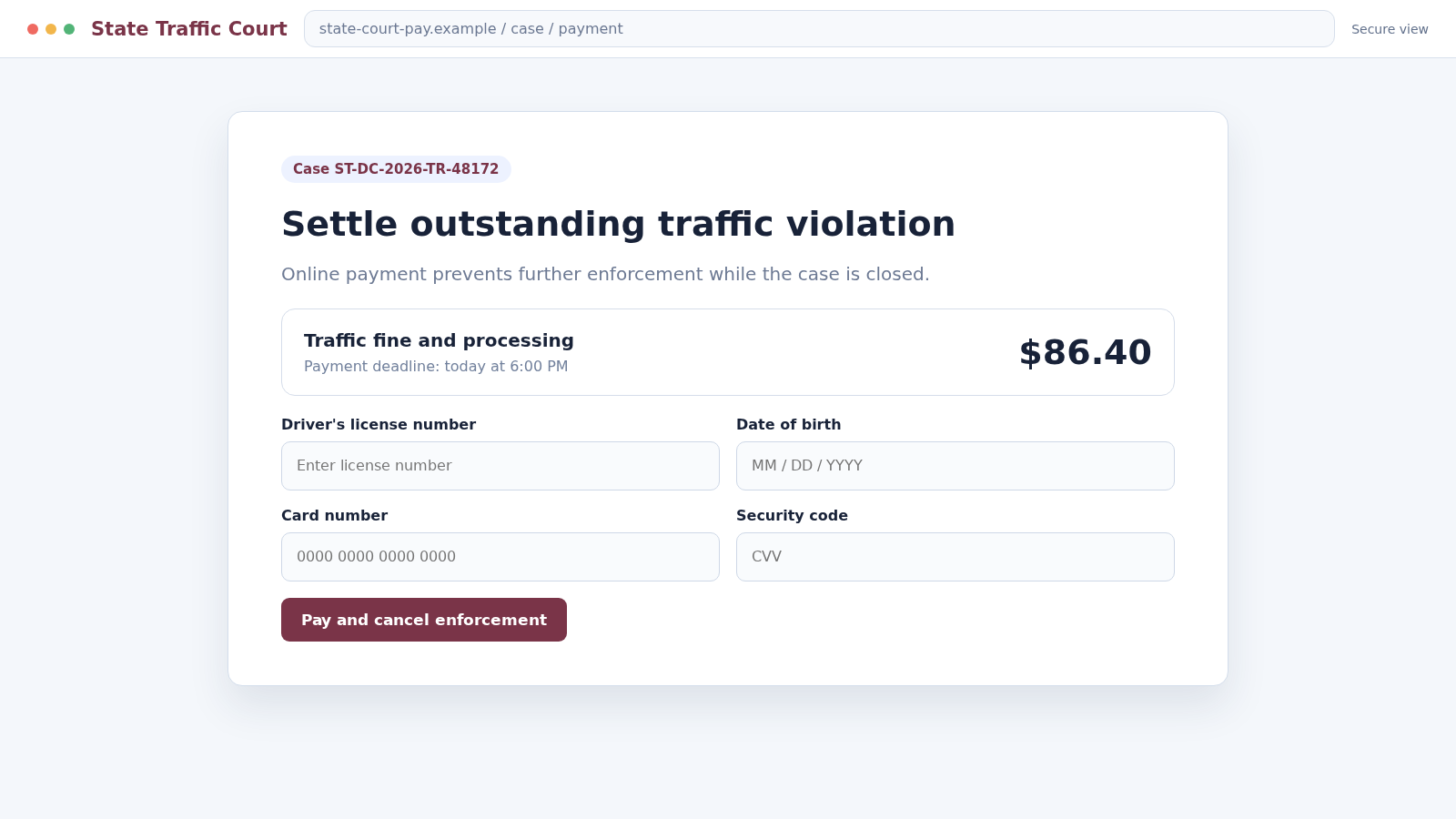
Step 5: The fake portal collects identity and card data
The page asks for a driver’s license number, vehicle plate, address, and birth date to “find” the violation. It may display a generic match regardless of what is entered.
A payment screen then requests card information and sometimes a Social Security number. The fine may be small enough that the victim focuses on resolving it rather than questioning the amount.
Step 6: A real security check is abused
The criminal may attempt a card transaction while the victim remains on the page. If the bank sends a one-time code, the fake portal asks for it as a final court verification.
That code may authorize a purchase or wallet enrollment. A page that rejects one card and asks for another may be harvesting multiple payment methods.
Step 7: A fake receipt delays discovery
After submission, the site can issue a receipt number, downloadable confirmation, or message saying enforcement is paused. None of this proves a court received payment.
The victim may not check the card statement or official court records until fraudulent charges appear. By then the phishing domain may be gone.
Step 8: Stolen details fuel follow-up impersonation
The operator now knows the victim responded to legal pressure. A second message may claim the first payment failed, an additional fee is due, or an officer needs identity verification.
Other criminals may use the same data for insurance, toll, tax, jury-duty, or police impersonation. The next contact can sound more convincing because it includes information submitted earlier.
Company, Address, and Fulfillment Checks
The court name must match an actual jurisdiction
Search the official state or local judicial website independently and confirm that the named court exists. Generic names such as “State District Traffic Court” may not match the jurisdiction’s real structure.
Check the case through the official docket or clerk. Do not use the notice’s link, number, or search instructions to do this.
The payment address reveals the break in authority
Government-looking words inside a URL do not make it official. Inspect the registered domain and compare it with the court website you found independently.
Physical addresses can also be copied. A real courthouse address on a fake page does not prove that card data or money is being sent there.
Support should answer through the official clerk’s office
Call the clerk using the number on the verified court website. Provide the supposed case number and ask whether the court sends notices or accepts payments in the manner described.
A scam support line will confirm every invented detail. Independent contact breaks that closed loop.
The receipt must connect to a real case
A confirmation page, transaction ID, or emailed PDF can be generated automatically by a fake site. It has value only if the official court can match it to a genuine case.
If no case exists, preserve the receipt as evidence for the bank and investigators. Do not pay a second fee to “release” or “correct” the first one.
Warning Signs in a Traffic Court Text
- You never received an original citation or mailed notice.
- The court name, judge, clerk, or case format cannot be verified.
- The message threatens several extreme penalties within hours.
- A link or QR code is the only way to review the allegation.
- The domain is not the court’s official government address.
- The page requests a Social Security number to pay a small fine.
- Payment is demanded by gift card, cryptocurrency, transfer, or payment app.
- A supposed clerk asks for a one-time bank or card code.
Do not try to prove the text false by interacting with it. Verify the underlying case through the real court and let that evidence guide your response.
How to Verify a Ticket Without Using the Message
Start with the original citation if one exists. It should identify the issuing agency, court, violation, response deadline, and approved methods for checking or paying the matter.
If no paper record is available, find the state or local court website independently. Navigate from a recognized government portal, then use the published case search or clerk’s contact details.
Search requirements differ by jurisdiction. A court may use a citation number, case number, name, birth date, or driver’s license information. Enter sensitive details only after confirming the government domain and secure process.
Ask the clerk how genuine notices are delivered and whether text reminders require prior enrollment. This matters because some courts do send limited reminders, while the scam turns a reminder into an unsolicited demand for money.
When a real balance exists, pay through the official court system and save the receipt. Do not let a coincidental real ticket persuade you that the unrelated text link is safe.
What to Do if You Have Fallen Victim to This Scam
- Stop using the link or QR code. Close the page and do not submit another payment. Do not call numbers or reply to addresses shown in the notice.
- Contact the court independently. Find the official judicial website and clerk’s number yourself. Ask whether the case, fine, hearing, and payment record exist.
- Call the card issuer or bank. Report that card details were entered on a fraudulent government-impersonation page. Request a replacement card and dispute unauthorized transactions.
- Protect exposed identity information. If a Social Security number or driver’s license was submitted, create a recovery plan at IdentityTheft.gov and follow state guidance for the license.
- Freeze your credit if necessary. Contact all three nationwide credit bureaus through their official sites. Review reports for new inquiries or accounts you do not recognize.
- Change reused passwords. If the fake page collected a login, secure that account and the connected email first. Turn on multifactor authentication and review recovery settings.
- Save evidence without revisiting the page. Keep the text, sender number, notice image, URL, case reference, QR screenshot, receipt, bank entry, and any follow-up communication.
- Scan the device after suspicious downloads. If the page opened a file, installed an app, or behaved unexpectedly, run Malwarebytes. It can help find malicious software that may have accompanied the phishing page.
- Block repeat malicious destinations. AdGuard can reduce exposure to known scam domains, deceptive ads, and trackers. It cannot decide whether a court case is real, so independent docket verification remains necessary.
- Report the message. Forward the text to 7726, use the messaging app’s junk-report option, and file a report with the FTC. Notify the impersonated court if it requests examples.
- Ignore recovery and enforcement follow-ups. A caller offering to cancel a warrant or recover the payment for another fee is likely extending the same fraud.
Frequently Asked Questions
Do courts ever send legitimate text reminders?
Some courts send opt-in reminders, so local practice matters. Verify every unexpected notice through the official docket or clerk, especially when it demands payment or personal information.
Does NHTSA collect traffic-ticket payments?
No. NHTSA is a federal vehicle-safety regulator and does not issue traffic tickets or contact people to collect traffic-violation fines.
Can a real judge or courthouse name appear in the scam?
Yes. Public details can be copied into a fabricated notice. A correct name or address does not validate the case, URL, QR code, or payment destination.
What if I really have an unpaid ticket?
Resolve it through the court or agency that issued the original citation. Use contact and payment details from its verified website, not from an unsolicited message.
Is the QR code safer than a text link?
No. A QR code can open the same kind of phishing site while hiding the destination until it is scanned. Do not scan an unexpected payment code.
What if I paid but received a confirmation?
Ask the official court whether the payment reached a real case. If it did not, contact the bank immediately and preserve the confirmation as fraud evidence.
The Bottom Line
The traffic court text scam makes an invented case feel urgent by combining official-looking details with severe legal threats. The convenient payment route is where card and identity theft can begin.
Do not answer the message, scan its code, or trust its support line. Find the real court yourself, verify the case, and pay only through an official channel tied to a citation you can confirm.








