

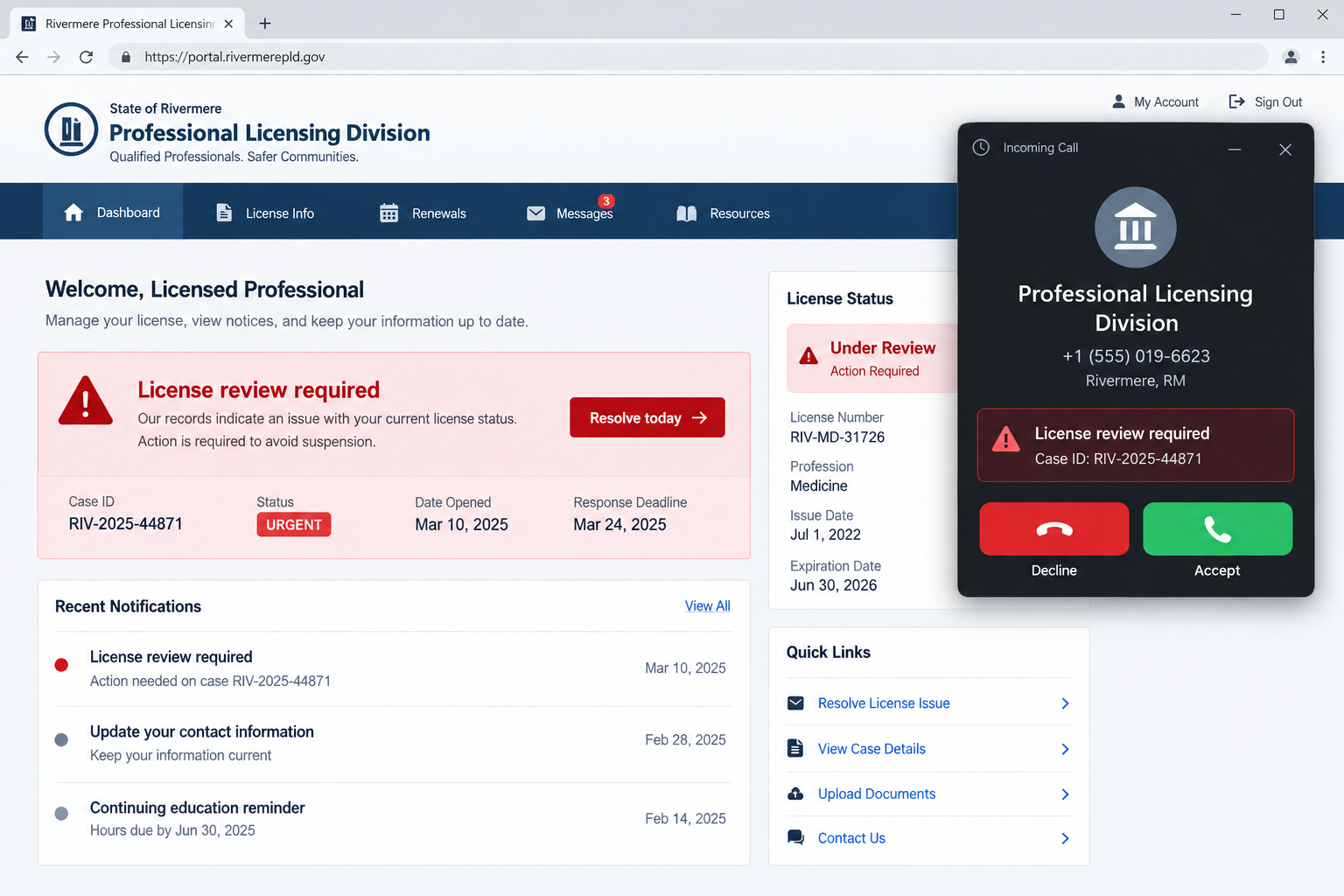
A fake medical license call scam often begins with a detail that feels impossible for a stranger to know: your license number, specialty, clinic, or home address.
The caller says a case has already been opened and that waiting could cost you the right to work. Before the demand for money arrives, the fear has done most of the work.
Overview
The caller turns a professional credential into leverage
A fake medical license call scam targets the part of a clinician’s life that cannot be casually replaced. Physicians, nurses, pharmacists, therapists, dentists, and other licensed workers depend on an active credential for income and reputation.
The scammer claims the license is expiring, suspended, connected to an investigation, or being used by criminals. The supposed solution is immediate cooperation with the caller.
That cooperation may mean paying a renewal charge, security bond, fine, or verification deposit. None of those labels changes the basic fact that an unexpected caller is demanding money under threat.
Real public records make the false case sound personal
Licensing boards publish searchable information so patients and employers can verify professionals. Criminals can use the same records to learn a target’s full name, license type, number, status, work location, and renewal date.
Other details may come from clinic websites, professional profiles, data brokers, breached databases, or social media. Accurate information proves that the caller researched the target, not that the caller represents a board.
Caller ID, copied seals, badge numbers, case references, and emailed documents can all be fabricated. Verification must happen after ending the contact and using the board’s independently obtained website or telephone number.
The FBI has documented thousands of complaints
On September 17, 2026, the FBI warned about widespread government and law enforcement impersonation scams. Its Internet Crime Complaint Center recorded 3,322 complaints involving fraud tailored to medical practitioners between January 2025 and July 2026, with reported losses exceeding USD 37 million.
The FBI says scammers may claim a medical license is expiring or was used in a crime, then threaten revocation while demanding payment. Government authorities do not call or text people to demand prepaid cards, cryptocurrency, cash couriers, or sensitive information.
Warning signs include:
- an unexpected call saying a license will be suspended within hours;
- a claim that the license was used for prescriptions, money laundering, or another crime;
- pressure to remain on the line and keep the matter secret;
- caller ID that appears to show a real board or police department;
- a case number that can only be checked through the caller’s link or extension;
- a demand for prepaid cards, cryptocurrency, wire transfer, or cash;
- instructions to move money to a protected or evidence account;
- threats against the target’s license, practice, family, immigration status, or reputation.
Why This Threat Can Bypass Ordinary Skepticism
A clinician may ignore a generic prize message but react immediately to a licensing problem. The scam is designed around a realistic fear: an unresolved complaint can affect employment, insurance participation, hospital privileges, and patient trust.
The caller may sound calm rather than aggressive. A measured voice, legal vocabulary, and references to compliance procedure can feel more credible than an obvious threat.
Some operators divide the roles. One person poses as a board investigator, another as law enforcement, and a third as a payment or court officer. Transfers between departments create the appearance of an active case.
Secrecy is framed as professional responsibility. The target may be told not to alert clinic staff because the investigation is sealed or because coworkers could be involved.
Staying on the telephone blocks the easiest reality check. The scammer hears every objection, supplies an answer, and prevents the target from calling the real board.
Payment is often described as temporary. A bond, verification deposit, or evidence transfer sounds recoverable, which makes a large amount easier to rationalize.
How the Fake Medical License Call Scam Works
Step 1: Public records identify a valuable target
The criminal searches board databases, clinic directories, and professional profiles. A current license and visible practice make the person both believable to impersonate and likely to fear professional disruption.
Information collected at this stage may include a license number, renewal month, office address, employer, specialty, and names of colleagues.
Step 2: The first call announces a serious problem
The caller claims to represent a licensing board, health department, regulator, police unit, or federal agency. The story may involve an expiring credential, fraudulent prescriptions, identity theft, or a criminal investigation.
The target is told that ordinary mail was ignored or that the matter has reached an emergency stage. This invented history makes the surprise call seem like the final notice rather than the first contact.
Step 3: Real details and spoofed caller ID establish authority
The operator recites the target’s correct license number and workplace. A second incoming call may display a genuine agency number even though the criminal spoofed the caller ID.
Documents arrive by email or text with copied letterheads, signatures, barcodes, and case references. Visual polish cannot authenticate the sender.
Step 4: The victim is isolated from independent advice
The scammer says the case is confidential and warns that discussing it could obstruct an investigation. The target may be ordered to leave the clinic, close the door, or stay connected while traveling to a bank or store.
This instruction protects the fraud from a colleague, attorney, bank employee, or family member who would recognize the pattern.
Step 5: A payment is presented as the only way to preserve the license
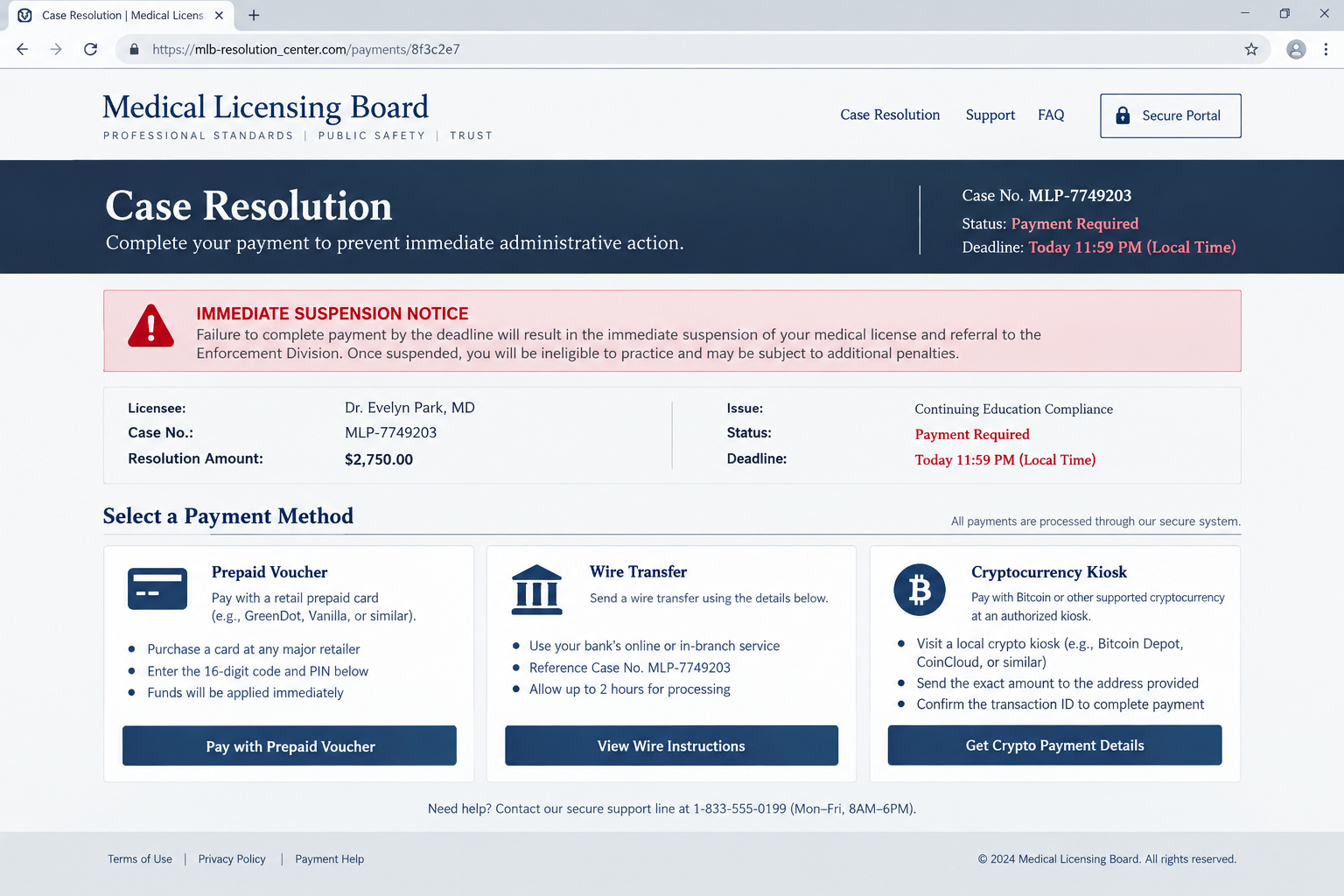
The demand may be called a renewal fee, compliance fine, bond, escrow payment, identity verification, or temporary security deposit. The name changes, but the payment bypasses normal board billing.
Prepaid cards, cryptocurrency kiosks, wires, peer-to-peer transfers, and cash couriers are favored because recovery is difficult.
Step 6: Each payment creates a new procedural obstacle
After the first transfer, another official claims that the amount was incomplete, the transaction triggered a tax, or a second jurisdiction must clear the case.
The victim is reminded that stopping now would waste the earlier payment and allow the suspension to proceed. This is how one urgent fee becomes a series of losses.
Step 7: The criminals reuse the identity and case story
Copies of identification, professional documents, banking details, and voice recordings can support later account fraud or impersonation.
The victim may also receive a recovery call from someone claiming the payment was found. An upfront recovery charge is another stage of the same fraud.
How to Verify a License Problem Safely
End the call. A genuine investigator can provide formal contact information, and no legitimate process becomes invalid because you independently verify it.
Type the licensing board’s official address yourself or use a trusted government directory. Do not use a link, QR code, extension, or callback number supplied by the caller.
Check the public license record for status and notices. Then call the main number published on the official site and ask for the enforcement or licensing unit.
If a caller names an investigator, ask the real board whether that person works there and whether the case number exists. Do not merely call the number printed on the document.
Review the board’s normal payment process. Renewal fees and disciplinary matters are handled through established portals and written procedures, not gift cards, cryptocurrency kiosks, or a courier.
Tell a supervisor, compliance officer, attorney, or trusted colleague. Confidentiality claims from a stranger do not prevent you from obtaining independent professional advice.
If the call alleges a crime, contact local law enforcement through its published non-emergency number. A real agency will not object to verification.
What the Scammer May Know and Why
A correct license number is often public. Many boards provide it with issue dates, expiration dates, disciplinary history, and practice locations.
Clinic pages can reveal specialties, biographies, direct telephone numbers, and staff relationships. A professional networking profile may add education and employment history.
Data breaches and broker records can supply private addresses, dates of birth, previous telephone numbers, and relatives. Combining public and leaked data creates the illusion of a confidential government file.
Voice cloning is not required for the scam to work. However, recordings from public talks, voicemail greetings, or earlier calls can help criminals impersonate colleagues or leave convincing follow-up messages.
Knowing information is not the same as possessing authority. The decisive test is whether the claim exists in the agency’s real system when you contact it independently.
Payment Methods Reveal the Real Purpose
A licensing authority does not need secrecy around a legitimate fee. It can issue an invoice, cite the legal basis, accept payment through an official portal, and provide review or appeal rights.
Scammers choose payment routes that separate the victim from those protections. A prepaid card code can be redeemed immediately, while cryptocurrency can move through several wallets within minutes.
A wire to an individual, unrelated business, or overseas account does not become legitimate because the caller calls it escrow. Verify the named beneficiary with the real agency before sending anything.
Cash courier instructions are especially revealing. Government employees do not collect boxes of currency, gold, or gift cards from private homes as part of a license investigation.
A bank employee who questions the payment is not interfering with the case. The scammer may tell the victim to lie about the purpose because honest disclosure would stop the transfer.
Company, Address, and Fulfillment Checks
The agency name must lead to an independently verified office
Search the official state or national directory and confirm that the named board exists, has jurisdiction over your profession, and publishes the same main number.
Do not trust a search advertisement or map listing without comparing it with the government’s primary domain.
The caller’s identity must be confirmed outside the call
Ask the real office whether the employee, badge number, and case reference exist. Caller ID and emailed identification cards are not independent evidence.
A refusal to let you hang up is itself a reason to end the contact.
The address and payment recipient must match the real authority
Compare the address on the notice with the board’s published office. Check whether the payment beneficiary is the government entity, not a person, private company, wallet, or unrelated account.
Small spelling changes and mailbox addresses can hide an impersonation.
The promised resolution must exist in the official system
A real renewal, fine, or disciplinary order produces a record that can be checked through the board. A caller’s promise to clear the case after payment is not fulfillment.
Request written confirmation through the verified portal before treating any professional restriction as genuine.
What to Do if You Have Fallen Victim to This Scam
- Stop all contact and further payments. Do not pay a final fee to close the file. Block the numbers only after preserving messages, voicemails, emails, and payment instructions.
- Contact the payment provider immediately. Tell the bank, card issuer, wire service, cryptocurrency exchange, or prepaid card company that the transaction resulted from impersonation fraud. Ask whether it can be frozen or recalled.
- Notify the real licensing board. Use contact details from its official site. Confirm your actual license status and provide the impersonation evidence so the board can warn other professionals.
- Protect your professional accounts. Change exposed passwords from a clean device, enable multifactor authentication, review recovery details, and sign out unfamiliar sessions.
- Protect identity documents. If you sent identification, license copies, tax data, or personal records, follow the identity-theft recovery process for your country. US victims can start at IdentityTheft.gov.
- Alert your employer or practice. Criminals may contact coworkers or patients using information learned from you. Give security and compliance teams the numbers, domains, names, and timeline.
- Check the device. If you installed software or opened an unusual attachment, disconnect the device and run a full Malwarebytes scan. Seek professional incident response if clinical or business systems were involved.
- Reduce malicious follow-up. AdGuard can help block known deceptive pages and intrusive ads, but it cannot undo information already shared. Continue monitoring email, financial, and professional accounts.
- Report the fraud. File a local police report and a complaint with the relevant cybercrime authority. US victims can report the scheme at IC3.gov and ReportFraud.ftc.gov.
- Reject recovery callers. Nobody needs an upfront fee, remote access, or cryptocurrency to return stolen funds. Refer recovery efforts to the original payment provider and law enforcement.
Frequently Asked Questions
Can a licensing board call me about a real problem?
It may contact professionals, but an unexpected demand for immediate payment through gift cards, cryptocurrency, a wire, or courier is not a normal regulatory process. End the call and verify through the official board.
How did the caller get my license number?
License numbers and practice details are often public. Other information may come from professional profiles, data brokers, or breaches.
Does the correct caller ID prove the call is real?
No. Caller ID can be spoofed. Call the agency back using the main number you find independently.
Would a real board ask me to keep an investigation secret?
A legitimate matter may have confidentiality rules, but an official will not use secrecy to stop you from speaking with an attorney, employer, or the agency through verified channels.
Can paying the fee prevent license suspension?
Not when the demand comes from an impersonator. Only the real board can explain your status, fees, deadlines, and appeal rights.
What if I gave information but did not pay?
Secure the affected accounts, notify the real board, monitor identity and financial records, and report the attempt. Personal and professional data can still support follow-up fraud.
The Bottom Line
A fake medical license call scam uses public professional records, spoofed authority, and a career-threatening deadline to make an abnormal payment feel necessary.
Hang up and contact the licensing board through its real website. No badge number, case file, or caller ID is more reliable than independent verification.








