

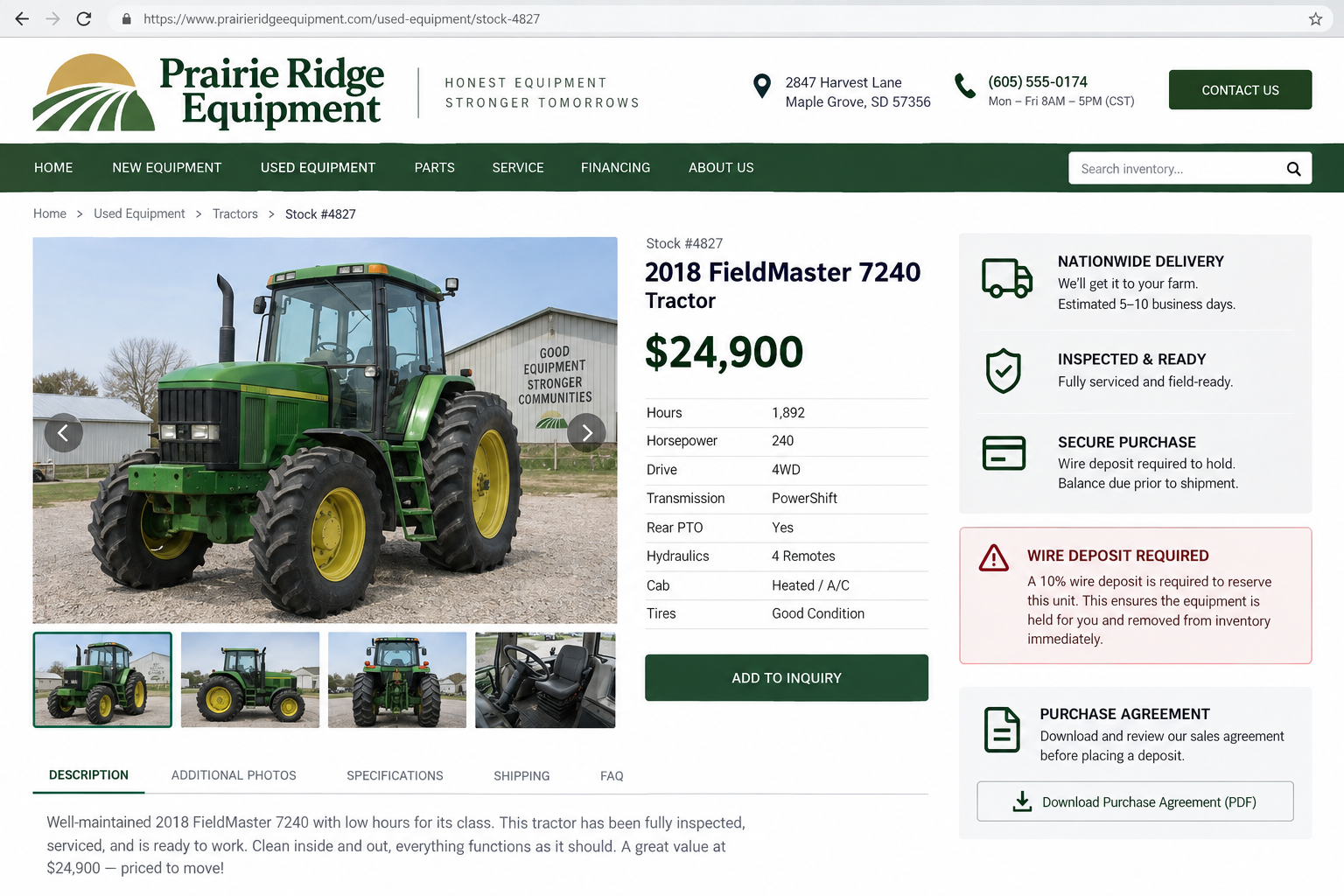
A farm equipment website scam can look like an unusually good business opportunity rather than a suspicious online purchase. The tractor has a stock number, service history, purchase agreement, and delivery date.
The seller sounds knowledgeable and knows that harvest schedules do not wait. By the time the machine fails to arrive, the payment may be far beyond the reach of an ordinary refund.
Overview
Criminals impersonate equipment businesses, not just individual sellers
A farm equipment website scam may copy the name, inventory, address, employee identities, and photographs of a real dealership. Other campaigns invent a polished dealer from scratch and surround it with convincing business details.
The listing is promoted through social media advertising, marketplace posts, or paid search results. A buyer sees a tractor, skid steer, harvester, trailer, or attachment at a price that seems low but not impossible.
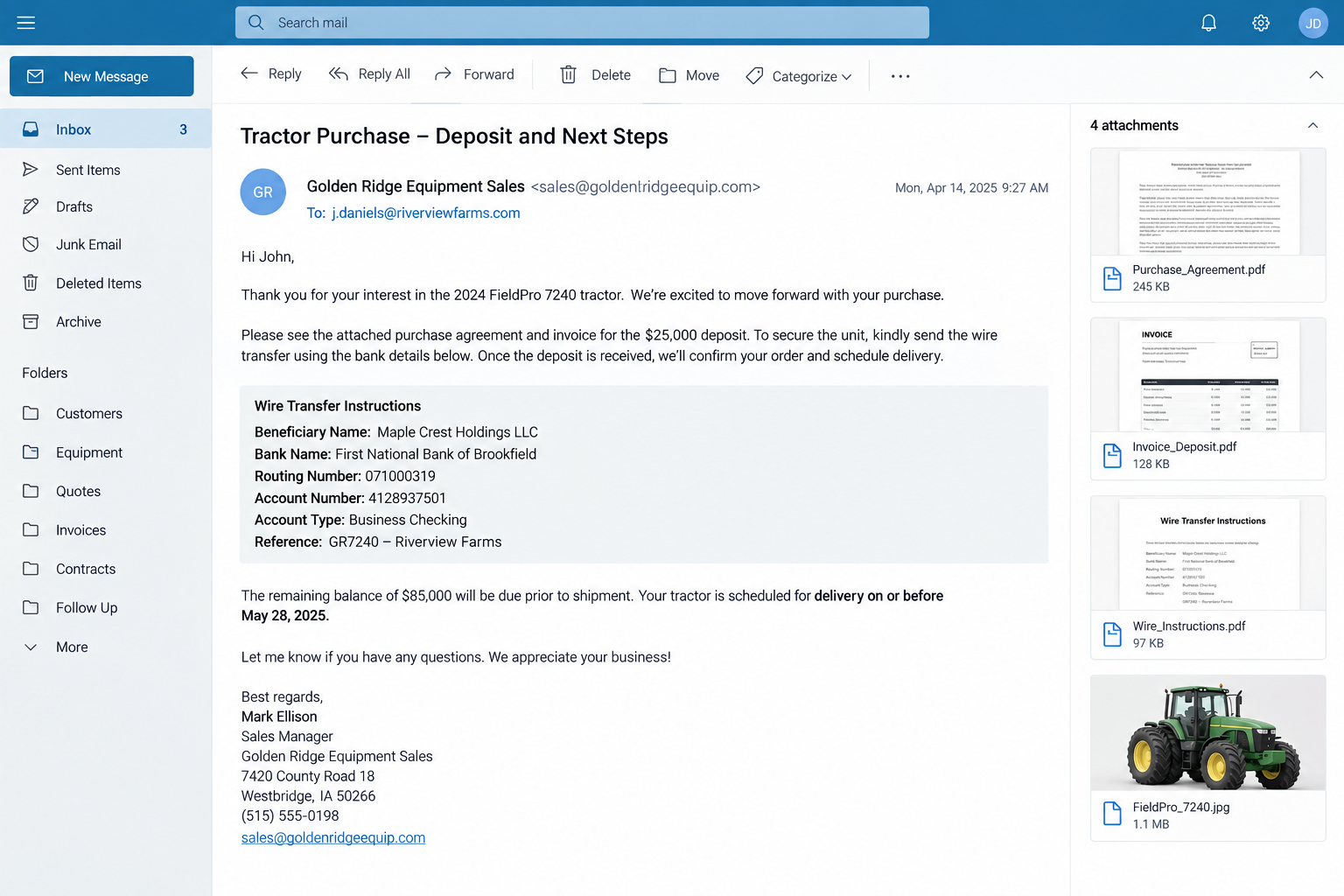
Contact moves to email or telephone, where the seller supplies an invoice and purchase agreement. Those documents create the impression of a normal commercial transaction while directing money to the criminal.
The wire request turns a fake listing into a major loss
Farm machinery can cost tens or hundreds of thousands in USD. Even a deposit represents far more than the amount lost in a typical fake-store order.
The scammer prefers a bank wire because the funds can be moved quickly and the buyer cannot use ordinary card chargeback protections. Cryptocurrency or payment apps may be offered as alternatives.
Delivery is scheduled after payment, sometimes with a freight company, driver name, tracking document, or insurance certificate. The truck never arrives because the equipment was never owned by the seller.
The FTC has received reports from affected farmers
On September 15, 2026, the Federal Trade Commission warned that scammers were impersonating farm equipment businesses. The agency described social media ads and search results that led to fake tractor offers, purchase agreements, invoices, wire payments, and deliveries that never happened.
The FTC says the criminal may stop responding or invent a problem with the delivery truck. It advises buyers to research the company independently and remember that paid search results can belong to impersonators.
Warning signs include:
- a machine priced substantially below comparable listings;
- a sponsored result using a dealer’s name but different contact details;
- stock photographs copied from another dealer or auction;
- refusal to allow an in-person or independent inspection;
- a seller who claims another buyer will send a deposit within hours;
- wire instructions naming a person or unrelated company;
- a sudden change in beneficiary or bank account;
- delivery insurance, release, storage, or customs fees added after payment.
Why a Professional Website Is Easy to Manufacture
An equipment dealer’s real inventory provides criminals with everything needed to build a copy. Photographs, specifications, prices, stock numbers, staff biographies, and addresses are publicly visible.
A domain that differs by one word or letter can host the duplicate. The fraudster may also create business listings, social profiles, and advertisements that point back to the fake site.
The tractor photographs are often genuine. They may belong to a real dealer, previous auction, rental fleet, or farmer whose listing was copied without permission.
Knowledgeable conversation is not ownership. Specifications can be read from the stolen listing, and common service questions have predictable answers.
Documents are equally easy to imitate. An invoice, purchase agreement, inspection report, tax form, or certificate can be produced from a template and filled with stolen business details.
The buyer’s real operational pressure helps the deception. When a machine is needed before planting, harvest, or a contract deadline, delaying for an inspection feels expensive.
How the Farm Equipment Website Scam Works
Step 1: A real machine listing is copied or invented
The criminal takes images and specifications from a genuine dealer, auction, or marketplace post. A believable stock number and service description are added.
The advertised price is chosen to attract serious buyers while leaving room for a story about liquidation, consignment, repossession, retirement, or excess inventory.
Step 2: Ads and search placement intercept demand
Sponsored social posts target agricultural regions and interests. Paid search advertising may place the fake dealer above the authentic business when a buyer searches for a model or company name.
The advertisement may lead directly to the copy or encourage a call to the criminal’s number.
Step 3: A salesperson answers practical questions
The operator discusses hours, attachments, tires, service, transportation, taxes, and financing. Fast answers create confidence because the conversation resembles a real equipment sale.
Requests for a live video or inspection are delayed with claims that the machine is off-site, being serviced, already loaded, or located in a restricted yard.
Step 4: Business paperwork makes the sale look formal
The buyer receives an invoice, purchase agreement, identification, company registration, and delivery schedule. Logos and addresses may belong to an innocent real dealer.
The contract matters only if the named seller is genuine and actually controls the machine. A PDF cannot establish either fact.
Step 5: The deposit is sent by wire transfer
The scammer asks for a reservation deposit or full payment. Wire instructions may name an account that does not match the dealership or may change shortly before the transfer.
The buyer is told the unit will be removed from inventory as soon as a receipt is sent, creating pressure not to pause.
Step 6: Delivery updates keep the buyer waiting
A supposed dispatcher confirms a date. Fake bills of lading, insurance documents, tracking portals, or driver details create the impression that the tractor is moving.
Delays are blamed on the truck, weather, permits, customs, inspection, or a mechanical problem.
Step 7: Extra charges appear or contact ends
The criminal requests release, storage, insurance, or redelivery fees. Paying does not bring the machine closer because no shipment exists.
Eventually the site disappears, the telephone is disconnected, or the real dealership confirms that it never listed or sold the equipment.
How to Verify the Machine Before Sending Money
Start with the equipment, not the seller’s story. Request the full serial number, then verify its format and history through the manufacturer, dealer network, lien records, or an appropriate equipment database.
Ask for a live video inspection in which the seller performs actions you choose: show the serial plate, start the engine, move the machine, display the hours, and place a handwritten code beside it.
A prerecorded video is not enough. Details requested during the call should appear in real time, and the surroundings should match the claimed location.
Hire an independent mechanic, local dealer, auction representative, or inspection service to see the equipment physically. The cost is small compared with a lost wire.
Contact the dealership through a telephone number found independently. If the seller copied a real business, the genuine staff can confirm whether the salesperson, stock number, and bank account are theirs.
Search the listing photographs with reverse image search. The same tractor at another dealer, in another state, or sold months earlier is a decisive reason to stop.
Compare the price with current auction and dealer listings. A major discount requires verifiable evidence, not merely a liquidation explanation.
Wire Instructions Need Their Own Verification
Treat payment verification as a separate task from equipment verification. A legitimate-looking machine and salesperson do not prove that the bank instructions are correct.
Call the verified dealership number and read back the beneficiary, bank, routing information, and invoice amount. Do not use the telephone number in the email that carried the instructions.
The beneficiary should match the legal selling entity. An account owned by an employee, holding company not disclosed in the contract, unrelated logistics firm, or out-of-area person needs a documented explanation verified independently.
Never accept a last-minute bank change by email alone. Business email compromise can redirect a genuine deal even when the equipment and seller are real.
Ask your bank about wire fraud controls and whether a callback, beneficiary validation, or cooling period is available. A rushed seller should not dictate your bank’s safety process.
Credit cards and established escrow services may offer stronger recourse, but an escrow site supplied by the seller can also be fake. Find and verify the service independently.
What Delivery Paperwork Can and Cannot Prove
A bill of lading is a document, not a live shipment. Criminals can alter a carrier’s logo, invent a driver, and create a tracking page under another deceptive domain.
Call the carrier through the number on its real corporate website. Provide the shipment reference without using any link or extension from the seller.
Confirm the pickup address, equipment description, shipper, destination, and current status. A carrier that cannot find the reference is not transporting the tractor.
Insurance certificates should be verified with the insurer or broker named on the form. Do not assume a policy number proves coverage.
A genuine shipment should connect several independent records: a real machine, verified owner, legitimate seller, traceable carrier, and payment recipient that matches the contract.
Questions to Ask During a Live Inspection
Ask the seller to show the cold engine start, dashboard hours, serial plate, tires, hydraulics, attachments, and any visible wear in one continuous call.
Request a view of today’s handwritten code beside the machine. This simple step helps distinguish a live inspection from recycled photographs or a prerecorded walkaround.
Compare the serial number shown in the video with the invoice, lien search, service records, and manufacturer information. A mismatch should stop the transaction.
Let the independent inspector choose additional tests. A genuine seller of high-value machinery should expect careful due diligence before an irreversible payment.
Company, Address, and Fulfillment Checks
The legal seller must match the website and invoice
Compare the company name in business registries, domain records, terms, invoice, bank beneficiary, and tax documents. Differences need a clear, independently verified explanation.
A valid registration does not prove the person contacting you controls that company.
The address must contain a verifiable equipment operation
Check maps, street imagery, property records, and local directories. Call a neighboring business or local dealer if necessary.
A mailbox, vacant lot, residence, or stolen dealer address cannot store the advertised fleet.
The telephone and email must be reached independently
Use contact details from a known dealer directory, manufacturer locator, or registry. Ask whether the named employee and listing are genuine.
Do not let the person who sent the invoice also perform the verification.
The machine and delivery must be proven before payment
Obtain a live inspection, serial verification, and carrier confirmation. Fulfillment is ownership plus physical control, not a tracking screenshot.
Leave the deal if independent inspection is refused.
What to Do if You Have Fallen Victim to This Scam
- Call the bank’s fraud department immediately. Ask for an urgent wire recall and beneficiary-bank notification. Provide the amount, time, receiving account, invoice, and reason for fraud.
- Contact the receiving bank. Your bank may do this formally, but direct fraud reporting can help flag the account before funds move further.
- Stop every additional fee. Do not pay for insurance, release, storage, customs, replacement transport, or recovery. The invented shipment will not become real.
- Preserve the complete sales file. Save ads, URLs, emails, telephone numbers, contracts, invoices, wire instructions, serial numbers, photographs, tracking pages, and call notes.
- Notify the impersonated dealership. Use independently verified contact information. The real company can warn customers and seek removal of copied sites and advertisements.
- Report the advertisement and domain. Send evidence to the social platform, search provider, marketplace, domain registrar, and hosting provider.
- Secure exposed accounts. If you created a login or sent identity and tax documents, change reused passwords, enable multifactor authentication, and monitor for business identity fraud.
- Scan any downloaded files. Purchase agreements can carry malicious content. Run a full Malwarebytes scan if you opened unusual archives, installers, or macro-enabled documents.
- Reduce repeat exposure. AdGuard can help filter deceptive advertisements and known malicious domains, but always verify sellers and inventory independently.
- File official reports. Contact local police and the relevant agricultural or consumer authority. US victims can report at ReportFraud.ftc.gov and IC3.gov.
Frequently Asked Questions
Is a low tractor price enough to prove a scam?
No single price proves fraud, but a large discount combined with wire-only payment, refused inspection, and unverifiable ownership is extremely dangerous.
Can a purchase agreement protect me?
Only if the contracting party is genuine, reachable, and owns the equipment. A criminal can produce a professional agreement with stolen details.
Should I trust a sponsored search result?
No. Advertising placement is not dealer verification. Find the business through a manufacturer directory or independently typed website.
How can I verify a tractor photograph?
Use reverse image search, request a live video with specific actions, and send an independent inspector to the claimed location.
Can a bank wire be recovered?
Sometimes, if banks act before the funds move. Contact the fraud department immediately; speed and complete beneficiary details matter.
What if the dealer says inspection is impossible?
Do not send money. A seller asking for a large irreversible payment must provide a safe way to verify the machine and ownership.
The Bottom Line
A farm equipment website scam uses real machinery photographs, copied dealer identities, and formal paperwork to turn an online listing into a costly wire transfer.
Verify the machine, seller, bank beneficiary, and carrier through separate trusted channels. If the deal cannot survive an independent inspection, it is not a deal worth funding.








