Social Security Document Email Scam: Fake PDF Malware Download Exposed
Written by: Lapain Epuran
Published on:
A message about Social Security benefits can carry unusual emotional weight. When it adds a three-day deadline, even cautious recipients may feel compelled to investigate.
This email does not begin with an obvious payment demand. Its deception unfolds through a PDF and a viewer that should never be installed.
Overview
A Protected Benefits Notice With a Three-Day Deadline
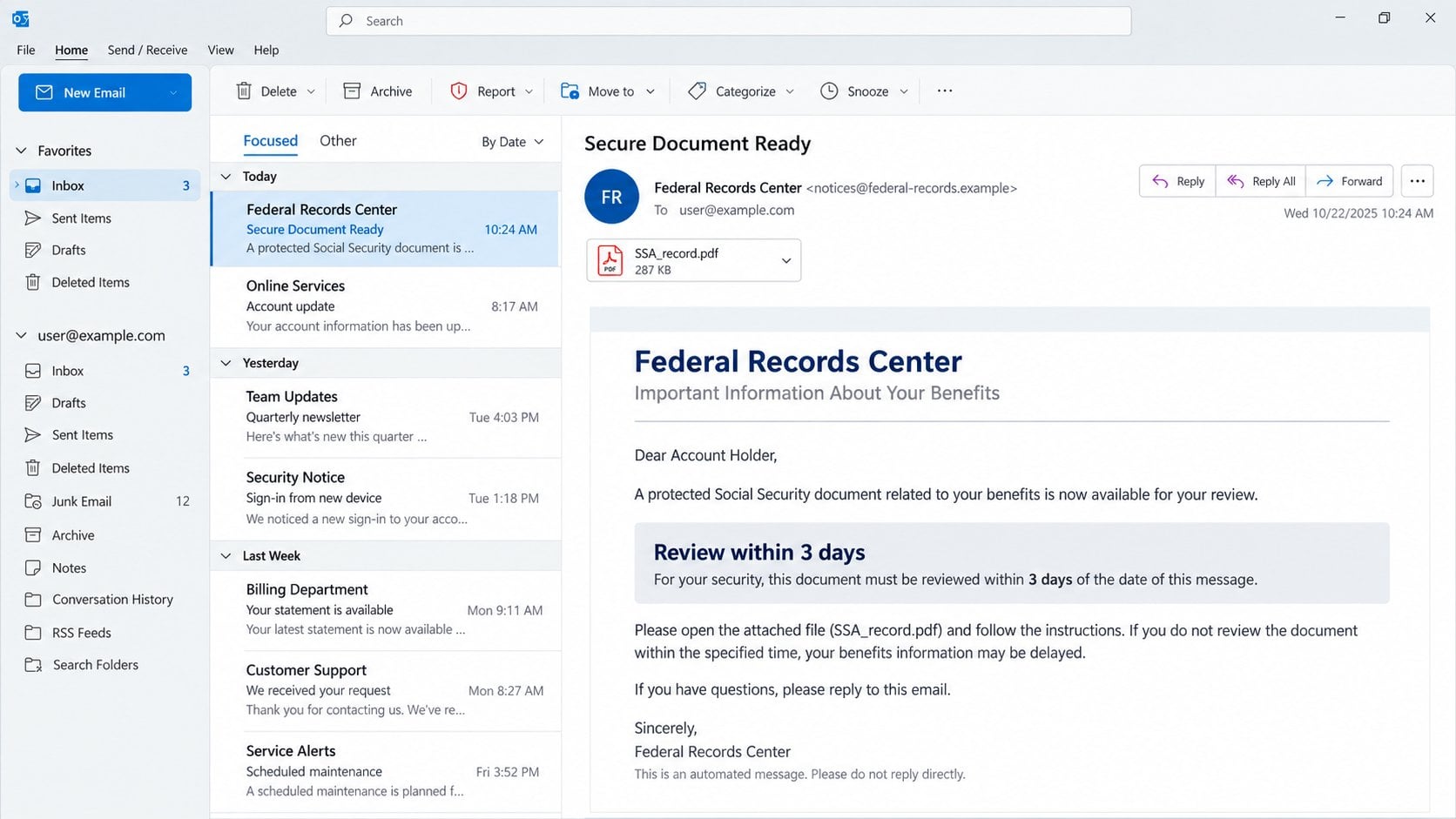
The Social Security Administration Document email claims that an important notice is waiting in the recipient’s my Social Security account.
It instructs the reader to open an attached file named “SSA_record.pdf” and complete the requested review within three days.
The message warns that delay may affect benefits, entitlements, or earnings records. That threat creates concern without describing any genuine account issue.
Official-sounding phrases such as “Protected Messaging” and “Office of Records & Earnings” are used to create institutional authority.
The email may also include oddly specific webmail advice. That detail sounds helpful, yet it is unrelated to how federal benefit records are delivered.
The PDF Is Only the First Stage
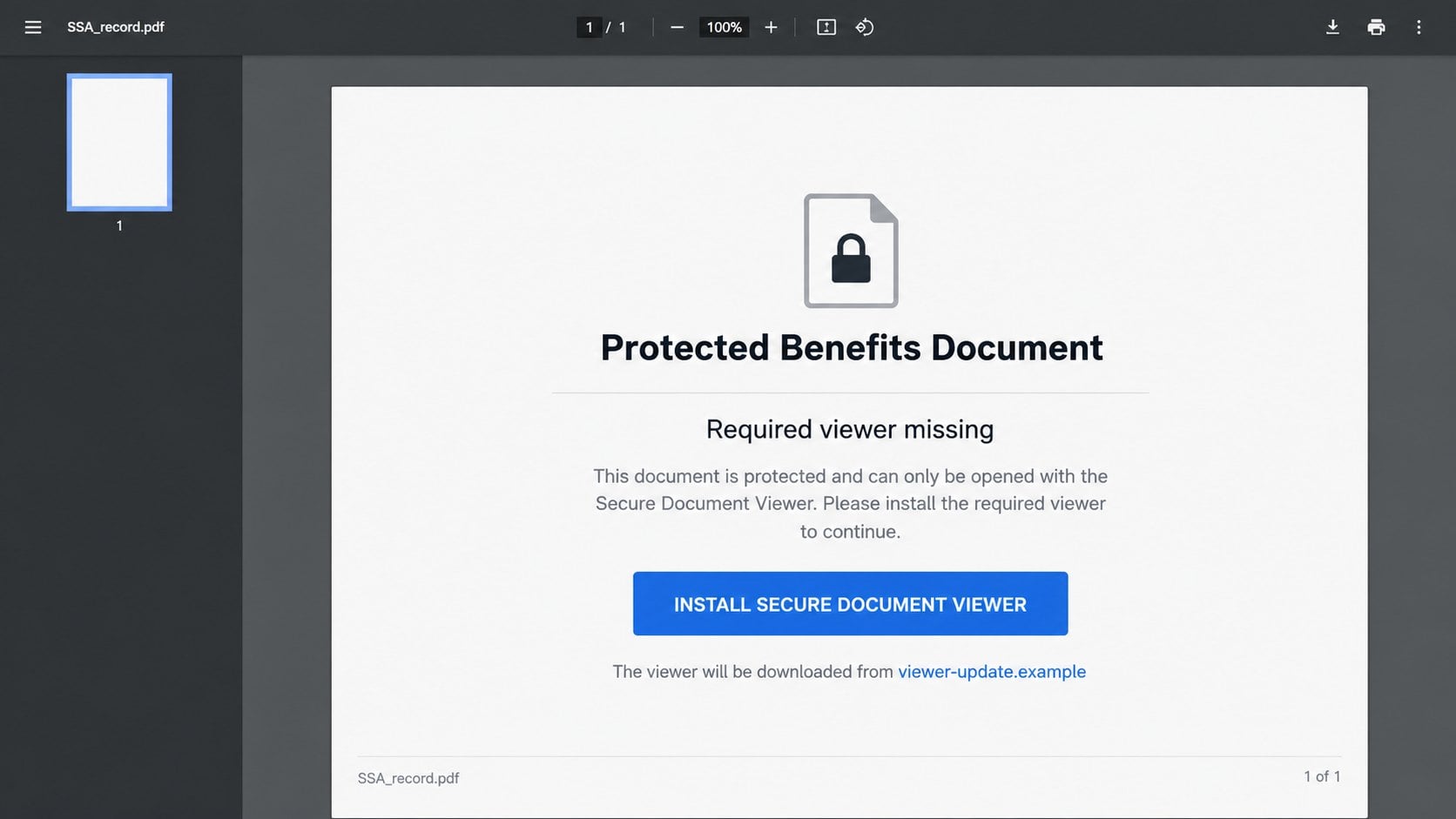
Opening the PDF does not reveal a benefits letter. Instead, it claims the computer lacks a required secure document viewer.
A large installation button directs the user toward an external download. The requested software is not an official Social Security application.
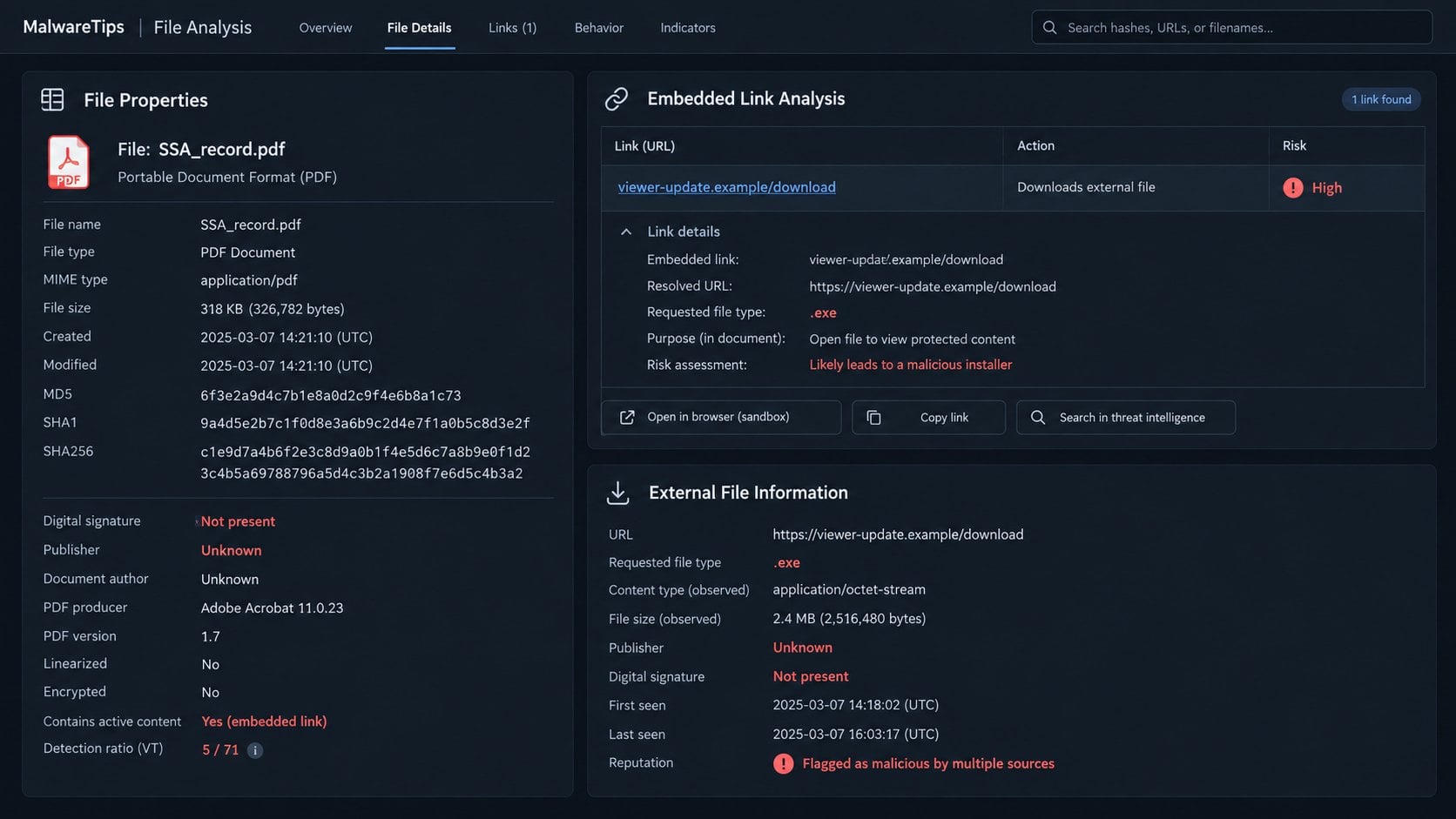
PDF files can contain clickable links. Their presence does not make the linked program part of the document or approved by the agency named.
The observed download was unavailable during analysis, so the exact payload could not be confirmed. The delivery pattern is consistent with malware installation.
Possible payloads include information stealers, remote-access trojans, keyloggers, ransomware, or downloaders that install additional threats later.
This Is Malspam, Not a Routine Phishing Form
The campaign differs from an ordinary password page. It tries to persuade the recipient to run software on the computer.
The sender impersonates a federal benefits agency.
The email threatens consequences within three days.
An attached PDF appears to contain the notice.
The PDF reports a fabricated viewer problem.
An external button offers an unknown executable.
The installer lacks a trusted publisher and signature.
Running it may compromise the entire device.
The Social Security Administration did not send this campaign. Its identity is being used to make a malicious installation request appear necessary.
Receiving or reading the email does not automatically infect the computer. Risk increases when the attachment’s link is followed and downloaded software is executed.
How the Social Security Document Email Scam Works
Step 1: The Message Targets Benefits and Personal Records
The email refers to Social Security benefits, earnings, and entitlements. Those subjects affect retirement, disability, identity records, and long-term financial planning.
Recipients may worry that ignoring the notice could interrupt income. The attacker relies on that fear before providing any verifiable case number.
The campaign can reach people who do not currently receive benefits. Many still maintain a Social Security record and consider the subject relevant.
Mass distribution makes perfect targeting unnecessary. A small response rate can justify sending the same story to thousands of addresses.
Step 2: A Three-Day Window Compresses Decision Time
The notice says review must occur quickly and suggests that delay can affect the recipient’s record. No real policy explanation accompanies the warning.
Deadlines make independent verification feel risky. The victim may open the attachment first and plan to confirm it later.
Real agencies provide established account routes, published telephone numbers, mailed notices, and clear appeal procedures. They do not depend on surprise software installers.
An urgent instruction without a verifiable matter identifier should be treated as a reason to slow down.
Step 3: The Attached PDF Lowers Initial Suspicion
Many people view PDF files as passive documents. Attackers exploit that reputation because a PDF feels less dangerous than an executable attachment.
The file itself may contain only text, graphics, and a hyperlink. Antivirus filtering may therefore treat it differently from a directly attached program.
Opening the PDF introduces a second layer. The user now sees a document-like page rather than the suspicious email interface.
This separation can weaken caution. The recipient may believe the PDF has already passed a security check and trust its next instruction.
Step 4: The PDF Invents a Missing Viewer
The document says protected content cannot display because a secure viewer is absent. It offers a button to install the supposed requirement.
Modern PDF readers do not need agency-specific executables for ordinary benefit notices. A legitimate portal displays documents through supported software or the browser.
“Install this viewer” is a classic malware pretext. The attacker transforms a failed document experience into permission to run code.
The prompt may look polished and technically plausible. Its design cannot explain why the download comes from an unrelated external server.
Step 5: The Link Delivers an Untrusted Program
The installation button can open a website or initiate a download. The resulting file may use a reassuring name and familiar application icon.
Windows may display an unknown publisher warning. Criminals often instruct victims to ignore that protection or approve additional prompts.
An executable can begin making changes immediately after launch. It does not need macros, another document, or a second successful login.
The final payload may change between deliveries. One campaign can rotate files as security products block earlier versions.
Step 6: Malware Operates Beyond the Original Email
An information stealer may collect browser passwords, cookies, cryptocurrency wallets, autofill data, and stored payment details.
A remote-access trojan can give criminals interactive control. They may browse files, capture screens, execute commands, or install additional malware.
Ransomware can encrypt local and connected storage. A downloader may remain quiet while bringing in a more specialized payload later.
The computer can appear normal during early activity. Absence of pop-ups or slowdowns does not establish that execution was harmless.
How to Verify a Social Security Notice Safely
Use the Official Account Without the Email
Open a new browser window and type the official Social Security website address yourself. Do not follow the message or attachment links.
Sign in through the known account route and check notices, messages, and benefit records. A genuine time-sensitive matter should appear there.
If nothing matches, keep the email for reporting. Do not install software merely because the online account lacks the promised document.
Call a Published Government Number
Find contact information on the agency’s official website or prior official correspondence. Never call a number supplied only inside a suspicious message.
Describe the subject, claimed deadline, and filename. Staff can explain whether such a notice exists without asking you to run a viewer.
Be cautious if someone calls back requesting remote access. Government representatives do not need control of your computer to discuss an account notice.
Inspect the Attachment Without Following Its Instructions
A workplace security team can examine the PDF inside a controlled environment. Personal users should avoid clicking embedded buttons or enabling special features.
Check whether the document directs users to an unrelated domain. A benefits notice should not outsource mandatory software through an unknown host.
Consider the requested file type. A PDF that demands an executable crosses from reading a notice into installing a program.
Check the Publisher Before Running Software
Right-click the downloaded file and inspect its properties without launching it. Look for a valid digital signature and recognizable publisher.
An unknown publisher, missing signature, unusual location, or mismatched filename strongly supports deletion and security review.
Do not rely on the icon. Executables can display familiar PDF, browser, shield, or government-style icons without being connected to those services.
What to Do If You Fell Victim to the Social Security Document Scam
The response depends on whether you opened only the email, viewed the PDF, downloaded the installer, or actually ran it. Execution requires the strongest response.
Stop interacting with the message and save essential evidence.
Do not reopen the attachment. Preserve the sender, headers, PDF name, download address, and approximate time of each action.
Photograph or capture warnings without relaunching the program. Workplace users should contact their security team immediately.
Disconnect an affected device after execution.
If the installer ran, turn off Wi-Fi and unplug Ethernet. This can interrupt remote control, data theft, and additional downloads.
Do not connect external drives. Leave the device powered on if professional responders advise preserving memory for investigation.
Run trusted security scans from a safe process.
Use Malwarebytes for a full scan, alongside the built-in operating system protection. Follow organizational incident procedures on managed computers.
AdGuard can reduce exposure to known malicious destinations later, but it cannot reverse software that already executed.
Change important passwords from another clean device.
Begin with the primary email account, banking, cloud storage, and password manager. Replace every credential stored in the affected browser.
Use unique passwords and enable strong multifactor authentication. Do not perform these changes from the possibly infected computer.
Review accounts for stolen sessions and financial abuse.
Sign out existing sessions, revoke tokens, and examine recent activity. Information stealers may capture cookies that bypass a password change.
Contact banks or card issuers about unexplained activity. Freeze cards or accounts when sensitive financial information was stored on the device.
Seek professional cleanup when execution occurred.
A clean scan is reassuring but cannot prove every persistence mechanism is gone. High-risk systems may need forensic review or a complete rebuild.
Restore personal files only from known-good backups. Avoid restoring unknown executables, scripts, or installers from the compromised profile.
Report the impersonation and monitor identity records.
Report the email through the provider and appropriate government channels. Keep case numbers, screenshots, and copies of any fraudulent correspondence.
If identity data was exposed, consider fraud alerts or credit monitoring. Watch benefit records and tax-related accounts for unauthorized changes.
Is Your Device Infected? Run a Free Malware Scan
Slow performance, constant pop-ups, or strange behavior? These are classic signs of a malware infection. The fastest way to find out is to scan your device with Malwarebytes Anti-Malware Free — one of the most trusted malware removal tools available.
The free version detects and removes the most common threats, including:
Adware — the cause of those annoying pop-ups
Browser hijackers — unwanted redirects and changed homepages
Trojans and spyware — hidden programs stealing your data
Potentially unwanted programs (PUPs) — software you never asked for
👉 Select your device below — Windows, Mac, or Android — then follow the simple steps to download Malwarebytes, scan your system, and remove any threats it finds. The whole process takes about 5 minutes.
Malwarebytes for WindowsMalwarebytes for MacMalwarebytes for Android
Run a Malware Scan with Malwarebytes for Windows
Malwarebytes is one of the most popular and trusted anti-malware tools for Windows — and it’s completely free for removing infections. It catches threats that many antivirus programs miss, including adware, browser hijackers, and trojans. Follow the steps below to scan and clean your PC in just a few minutes.
Download Malwarebytes
Click the button below to download the latest version of Malwarebytes for Windows from the official source. The free version is all you need — it will scan your computer and remove adware, browser hijackers, and other malicious software at no cost.
(The link opens in a new page where your download will start)
Install Malwarebytes
When the download finishes, open your Downloads folder and double-click the MBSetup file. If Windows shows a User Account Control pop-up, click “Yes” to allow the installation.
Follow the On-Screen Prompts to Install Malwarebytes
The setup wizard will walk you through a few quick screens:
Choose where you’re installing the program — “Personal Computer” or “Work Computer” — then click Next.
Malwarebytes will now install on your device. This usually takes under a minute.
When installation is complete, the “Welcome to Malwarebytes” screen will open automatically.
On the final screen, click Open Malwarebytes to launch the program.
Enable “Scan for Rootkits”
Before scanning, turn on rootkit detection so Malwarebytes can find even the most hidden threats. Click the Settings gear icon on the left side of the screen.
In the settings menu, find “Scan for rootkits” and click the toggle so it turns blue.
Done? Click “Dashboard” in the left pane to return to the main screen.
Start the Scan
Click the blue Scan button. Malwarebytes will automatically update its virus database and start checking your computer for malware.
Wait for the Scan to Finish
The scan checks your entire system for browser hijackers and other malicious programs, so it can take several minutes. Feel free to do something else — just check back occasionally to see the progress.
Quarantine the Detected Threats
When the scan is done, you’ll see a list of everything Malwarebytes found — malware, adware, and potentially unwanted programs. Click the “Quarantine” button to remove all of them at once.
Malwarebytes will now remove the malicious files and registry entries and move them safely into quarantine.
Restart Your Computer
Some threats can only be fully removed after a reboot. If Malwarebytes asks you to restart, click Yes. Once you’re logged back in, your PC is clean and you can continue with the next steps in this guide.
When the scan finishes, click Quarantine to remove everything Malwarebytes found. That’s it — your Windows PC is now clean of trojans, adware, and other malware, and should be back to running smoothly.
If your current antivirus allowed this malicious program on your computer, you may want to consider purchasing Malwarebytes Premium to protect against these types of threats in the future. If you are still having problems with your computer after completing these instructions, then please follow one of the steps:
Malwarebytes for Mac is a free on-demand scanner that removes the malware other security software tends to miss — adware, browser hijackers, and unwanted programs included. Cleaning an infected Mac with Malwarebytes has always been completely free, and it’s our go-to recommendation. Follow the steps below to scan and clean your Mac in just a few minutes.
Download Malwarebytes for Mac
Click the button below to download the latest version of Malwarebytes for Mac.
When the download finishes, open your Downloads folder and double-click the setup file to begin the installation.
Follow the On-Screen Prompts to Install Malwarebytes
The Malwarebytes for Mac Installer will guide you through a few quick screens. Click “Continue” and keep following the prompts until the installation completes.
When the installation is complete, Malwarebytes opens to the Welcome to Malwarebytes screen. Click “Get started“.
Select “Personal Computer” or “Work Computer”
Malwarebytes will ask what type of computer you’re installing it on. Click either Personal Computer or Work Computer, whichever applies.
Start the Scan
Click the “Scan” button. Malwarebytes will automatically update its detection database and begin checking your Mac for malware.
Wait for the Scan to Finish
Malwarebytes will scan your Mac for adware, browser hijackers, and other malicious programs. This can take a few minutes, so feel free to do something else — just check back occasionally to see the progress.
Quarantine the Detected Threats
When the scan is done, you’ll see a list of everything Malwarebytes found. Click the “Quarantine” button to remove all the threats at once.
Restart Your Mac
Malwarebytes will now remove all the malicious files it found. Some threats can only be fully removed after a reboot — if Malwarebytes asks you to restart, allow it. Once you’re logged back in, your Mac is clean.
Once the scan is done, remove every threat it detected. Your Mac is now free of adware, rogue browser extensions, and other potentially harmful software.
If your current antivirus allowed a malicious program on your computer, you might want to consider purchasing the full-featured version of Malwarebytes Anti-Malware to protect against these types of threats in the future. If you are still experiencing problems while trying to remove a malicious program from your computer, please ask for help in our Mac Malware Removal Help & Support forum.
Run a Malware Scan with Malwarebytes for Android
Malwarebytes for Android automatically detects and removes dangerous threats like malware and ransomware so you don’t have to worry about your most-used device being compromised. Aggressive detection of adware and potentially unwanted programs keeps your Android phone or tablet running smooth.
Download Malwarebytes for Android.
You can download Malwarebytes for Android by clicking the link below.
In the Google Play Store, tap “Install” to install Malwarebytes for Android on your device.
When the installation process has finished, tap “Open” to begin using Malwarebytes for Android. You can also open Malwarebytes by tapping on its icon in your phone menu or home screen.
Follow the on-screen prompts to complete the setup process
When Malwarebytes will open, you will see the Malwarebytes Setup Wizard which will guide you through a series of permissions and other setup options. This is the first of two screens that explain the difference between the Premium and Free versions. Swipe this screen to continue. Tap on “Got it” to proceed to the next step. Malwarebytes for Android will now ask for a set of permissions that are required to scan your device and protect it from malware. Tap on “Give permission” to continue. Tap on “Allow” to permit Malwarebytes to access the files on your phone.
Update database and run a scan with Malwarebytes for Android
You will now be prompted to update the Malwarebytes database and run a full system scan.
Click on “Update database” to update the Malwarebytes for Android definitions to the latest version, then click on “Run full scan” to perform a system scan.
Wait for the Malwarebytes scan to complete.
Malwarebytes will now start scanning your phone for adware and other malicious apps. This process can take a few minutes, so we suggest you do something else and periodically check on the status of the scan to see when it is finished.
Click on “Remove Selected”.
When the scan has been completed, you will be presented with a screen showing the malware infections that Malwarebytes for Android has detected. To remove the malicious apps that Malwarebytes has found, tap on the “Remove Selected” button.
Restart your phone.
Malwarebytes for Android will now remove all the malicious apps that it has found. To complete the malware removal process, Malwarebytes may ask you to restart your device.
After the scan, tap Remove Selected to delete all detected threats. Your Android phone is now clean — no more malicious apps, adware, or browser redirects.
If your current antivirus allowed a malicious app on your phone, you may want to consider purchasing the full-featured version of Malwarebytes to protect against these types of threats in the future. If you are still having problems with your phone after completing these instructions, then please follow one of the steps:
Restore your phone to factory settings by going to Settings > General management > Reset > Factory data reset.
Now that your device is clean, keep it that way. Most infections start with a malicious ad or a fake download button — so blocking them at the source is your best defense.
We recommend AdGuard, which blocks malicious ads, phishing pages, and dangerous redirects before they can reach you.
Software installation is usually framed as a solution to frustration. The user wants the important document and sees one obstacle standing in the way.
The PDF supplies its own diagnosis. Because the error and remedy appear together, recipients may never ask whether the diagnosis is genuine.
Protected-document language sounds security-conscious. Ironically, the supposed protection becomes the reason for weakening the computer’s real defenses.
Government impersonation increases obedience. People may accept unusual instructions because they assume federal systems use specialized technology.
The three-day deadline adds perceived consequences. A cautious pause feels like a threat to benefits rather than a normal safety step.
The attachment also creates distance from the original sender. Once inside the PDF, attention shifts from email authenticity to document access.
Unknown software can perform actions far beyond displaying one file. Its permissions may expose every account and document available to the user.
No urgent notice justifies bypassing trusted download channels. Important records should become easier to verify, not dependent on anonymous executables.
Protection Against Document-Based Malware
Configure email systems to isolate attachments containing external links. Sandboxing can reveal redirect and download behavior before delivery.
Block executable downloads from newly observed or low-reputation domains. Allow exceptions only through documented software deployment processes.
Standard users should not have local administrator rights. Reduced privileges can limit what a malicious installer changes after execution.
Application control provides stronger protection than filename rules. Approved software policies can prevent unknown programs from launching at all.
Keep browsers, PDF readers, operating systems, and security tools current. Updates remove weaknesses that malicious documents may attempt to exploit.
Disable automatic forwarding from personal to corporate mailboxes. Mixed account use makes it harder to apply consistent scanning and retention.
Teach users that a viewer request is a software installation decision. It deserves the same scrutiny as any program downloaded from the web.
Maintain offline or immutable backups. Malware that reaches shared drives can otherwise turn one deceptive attachment into broad data loss.
Document the internal reporting path. Employees should know whom to contact before experimenting with a file that refuses to open.
After any execution, examine identity and endpoint evidence together. A stealer infection can become an account compromise even after the file is removed.
Frequently Asked Questions
Did the Social Security Administration send this PDF?
No. The agency is being impersonated. The external viewer installation and untrusted download are incompatible with a legitimate benefits notice.
Can opening the email alone infect my computer?
Ordinarily, simply reading the message does not execute the advertised payload. The major risk begins when the linked installer is downloaded and launched.
Is the attached PDF itself malware?
It functions as a delivery lure containing an external link. Its purpose is to persuade the recipient to retrieve and run another file.
What malware does the fake viewer install?
The exact payload was not confirmed. Campaign operators can rotate stealers, trojans, ransomware, or downloaders while keeping the same email story.
Should I change passwords after running the installer?
Yes, from a different clean device. Treat browser-stored credentials and active sessions as exposed until the computer receives a thorough security review.
Can antivirus guarantee the device is clean?
No single scan offers an absolute guarantee. Multiple trusted scans and professional assessment are appropriate after unknown software executed.
The Bottom Line
The Social Security Document email uses benefits anxiety, a three-day deadline, and a fake PDF viewer to move victims from reading into running unknown software.
Check notices through the official account, never install a viewer from an attachment, and isolate the device quickly if any downloaded program was executed.
10 Rules to Avoid Online Scams
Here are 10 practical safety rules to help you avoid malware, online shopping scams, crypto scams, and other online fraud. Each tip includes a quick “if you already got hit” action.
Stop and verify before you click, log in, download, or pay.
Most scams win by creating urgency. Verify using a trusted method: type the website address yourself, use the official app, or call a known number (not the one in the message).
If you already clicked: close the page, do not enter passwords, and run a malware scan.
Keep your operating system, browser, and apps updated.
Updates patch security holes used by malware and malicious ads. Turn on automatic updates where possible.
If you saw a scary “update now” pop-up: close it and update only through your device settings or the official app store.
Use layered protection: antivirus plus an ad blocker.
Antivirus helps block malware. An ad blocker reduces scam redirects, phishing pages, and malvertising.
If your browser is acting weird: remove unknown extensions, reset the browser, then run a full scan.
Install apps, software, and extensions only from official sources.
Avoid cracked software, “keygens,” and random downloads. During installs, choose Custom/Advanced and decline bundled offers you do not recognize.
If you already installed something suspicious: uninstall it, restart, and scan again.
Treat links and attachments as untrusted by default.
Phishing often impersonates delivery services, banks, and popular brands. If it is unexpected, do not open attachments or log in through the message.
If you entered credentials: change the password immediately and enable 2FA.
Shop safely: research the store, then pay with protection.
Be cautious with brand-new stores, “closing sale” stories, and prices that make no sense. Prefer credit cards or PayPal for dispute options. Avoid wire transfers, gift cards, and crypto payments.
If you already paid: contact your card issuer or PayPal quickly to dispute the transaction.
Crypto rule: never pay a “fee” to withdraw or recover money.
Common patterns include fake profits, then “tax,” “gas,” or “verification” fees. Another is a “recovery agent” who demands upfront crypto.
If you already sent crypto: stop paying, save evidence (wallet addresses, TXIDs, chats), and report the scam to the platform used.
Secure your accounts with unique passwords and 2FA (start with email).
Use a password manager and unique passwords for every account. Enable 2FA using an authenticator app when possible.
If you suspect an account takeover: change passwords, sign out of all devices, and review recent logins and recovery settings.
Back up important files and keep one backup offline.
Backups protect you from ransomware and device failure. Keep at least one backup on an external drive that is not always connected.
If you suspect infection: do not connect backup drives until the system is clean.
If you think you are a victim: stop losses, document evidence, and escalate fast.
Move quickly. Speed matters for disputes, account recovery, and limiting damage.
Stop payments and contact: do not send more money or respond to the scammer.
Call your bank or card issuer: block transactions, replace the card if needed, and start a dispute or chargeback.
Secure your email first: change the email password, enable 2FA, and remove unfamiliar recovery options.
Secure other accounts: change passwords, enable 2FA, and log out of all sessions.
Scan your device: remove suspicious apps or extensions, then run a full malware scan.
Save evidence: screenshots, emails, order pages, tracking pages, wallet addresses, TXIDs, and chat logs.
Report it: to the payment provider, marketplace, social platform, exchange, or wallet service involved.
These rules are intentionally simple. Most online losses happen when decisions are rushed. Slow down, verify independently, and use payment methods and account controls that give you recourse.
Hello! I'm Lapain Epuran, your go-to source for detailed and honest product reviews. From tech gadgets to miracle cures, I provide insights to help you make informed choices. Join me as we discover what's truly worth your time and money.