

A familiar name appears above a car finance compensation offer. The ad looks like helpful money advice, and the next step seems harmless: answer a few questions to see whether you qualify. It is easy to click before asking who is actually collecting the answers.
That question matters. Some misleading car finance ads borrow Martin Lewis’s credibility while steering drivers toward a commercial service with terms the headline barely mentions.
Overview
What are the fake Martin Lewis car finance ads?
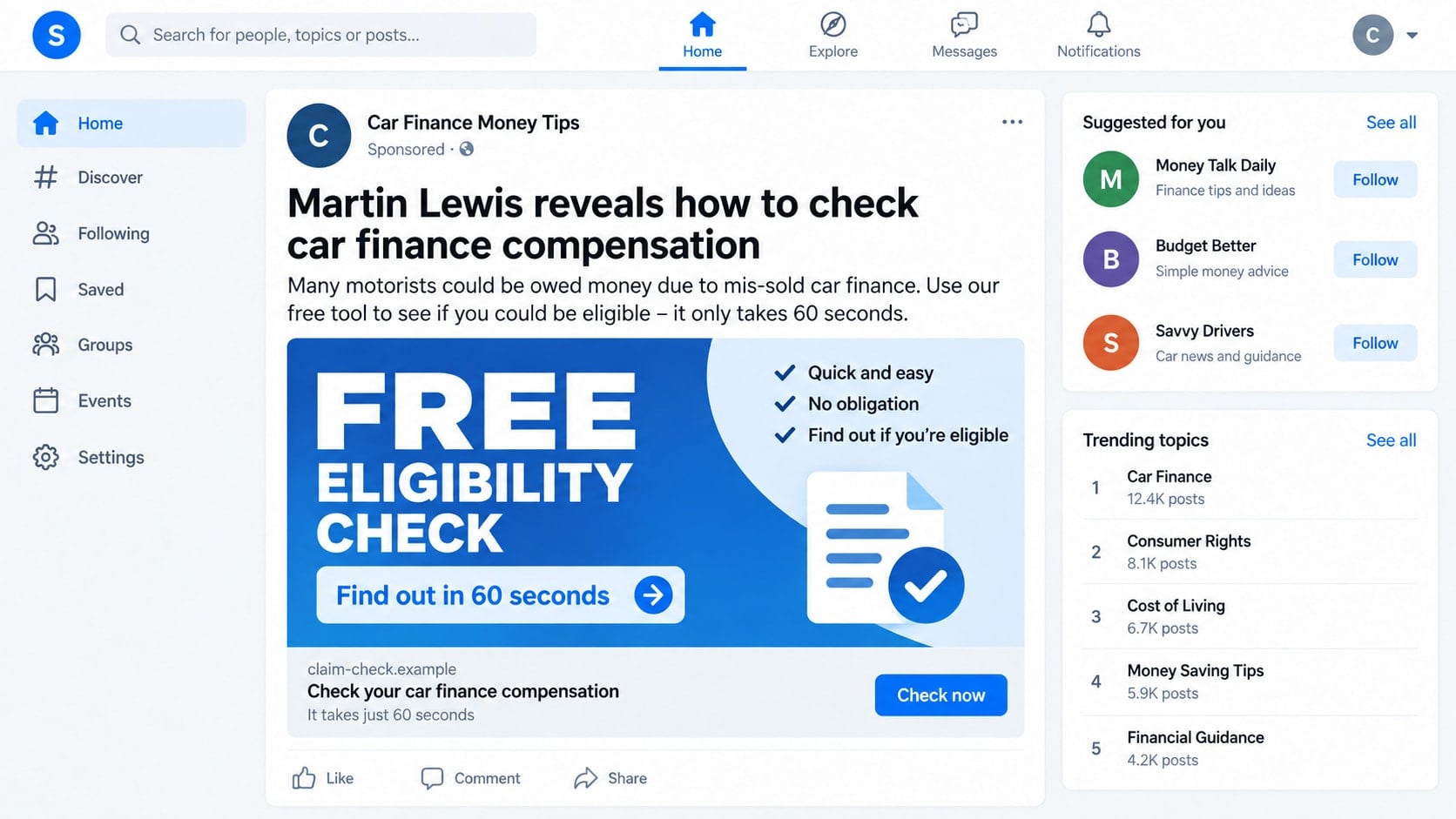
These promotions imply that Martin Lewis recommends a particular compensation service, or disguise commercial claims marketing as independent financial guidance. A copied name, edited clip, or news-like layout can make the advertiser’s own offer appear to have outside approval.
The concern is not imaginary. In April 2026, the Financial Conduct Authority said it banned misleading advertisements by Conclusive Financial Ltd, trading as PCP Refunds. Its announcement described unauthorized edited Martin Lewis clips, improper use of the FCA logo, and inadequate information about charges. The firm removed the banned ads.
Misleading marketing is not the same as every claims service being a scam
That regulatory action does not mean Martin Lewis participated in the advertising, nor does it establish that all car finance claims companies are fraudulent. A real commercial service can still use misleading advertising. An outright impersonation scam may go further and steal data or payments.
This article explains the advertising and signup risks without treating those categories as identical. A genuine compensation issue does not authenticate an ad, and a regulated business name does not establish that a particular account or landing page belongs to it.
What is at stake for drivers?
- Agreeing to paid representation while believing you are only checking eligibility.
- Sharing identity and finance information with an unidentified advertiser.
- Signing more than one agreement for the same complaint.
- Overlooking fees, cancellation terms, or a free direct route.
- Trusting a payout promise that no advertisement can establish for you.
As of September 2026, the FCA’s car finance scheme faces a legal challenge and parts are suspended. Its current guidance says lenders do not yet need to calculate or pay compensation under the scheme while that process continues. Claims of an immediate guaranteed scheme payout deserve particular skepticism.
How the Martin Lewis Car Finance Ad Scam Works
Step 1: A real consumer issue supplies the hook
Car finance compensation is a real subject, so a driver may already have seen news about it. An advertiser does not need to invent the entire story. It can attach an exaggerated or misleading commercial pitch to a topic that people recognize.
The result is a credibility shortcut. You remember hearing about compensation and assume the ad offers the next official step. In reality, the existence of a complaints process says nothing about who bought the advertisement or what their form authorizes.
Separate three questions: whether your agreement might qualify, who is offering assistance, and what that assistance costs. An ad that answers only the first question with a confident headline has not resolved the other two.
Step 2: A borrowed endorsement makes the offer feel independent
Martin Lewis’s name can be placed beside an eligibility button, or a clip can be edited so general guidance appears connected to one company. A viewer may assume that the button leads to a service he personally recommends.
A genuine statement taken from another context does not establish permission to use it in an advertisement. Likewise, a regulator’s logo is not a badge certifying the offer. The FCA’s action shows why those visual signals cannot replace verification.
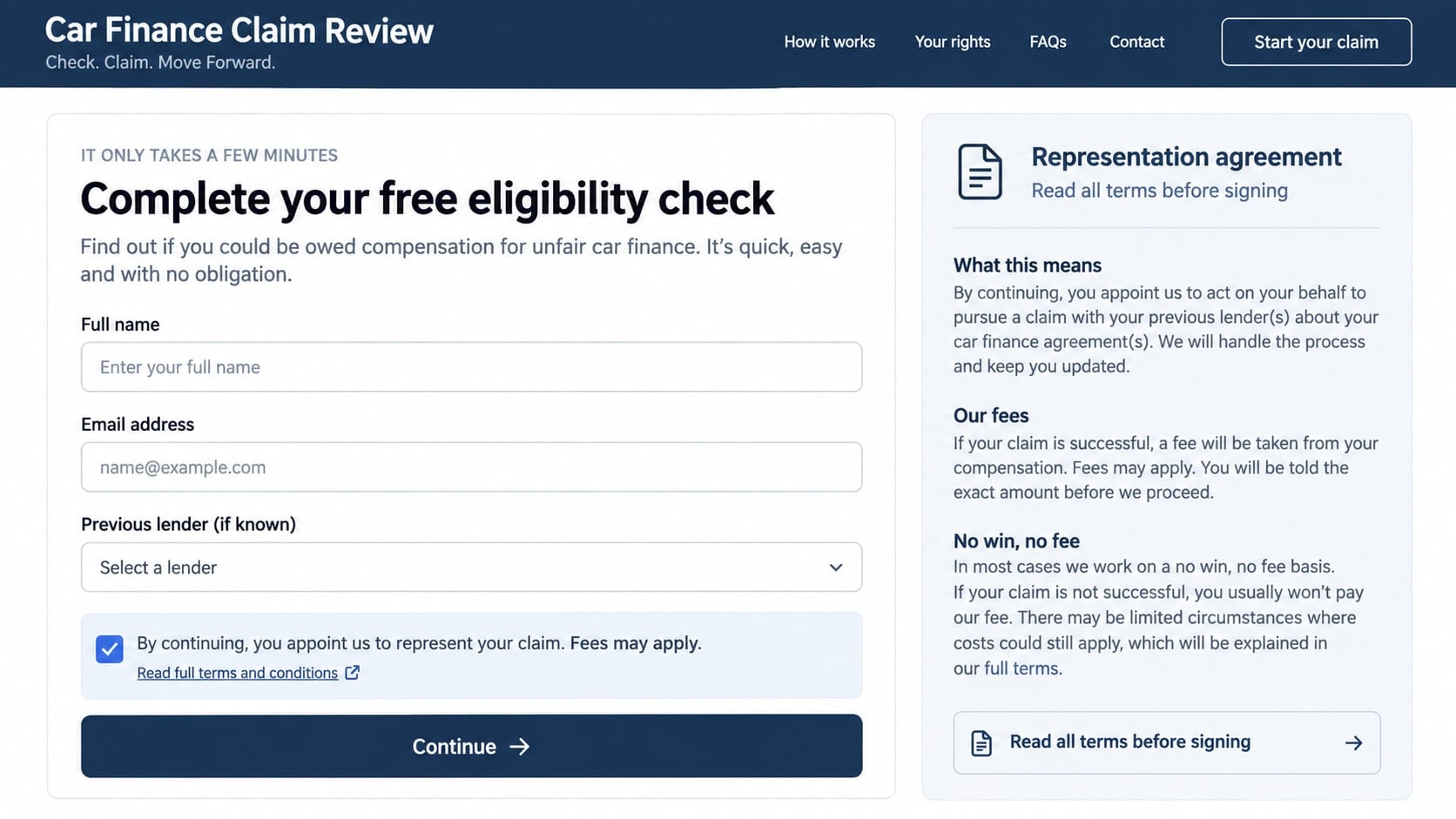
The images here are representative reconstructions, not copies of the banned advertisements. They illustrate the implied endorsement and signup transition. No generated screen should be read as evidence that a named individual approved a particular service.
Step 3: A free check starts a commercial relationship
The landing page asks for details that seem relevant: a name, previous address, lender, vehicle, or finance dates. Because those questions fit the topic, the reader may focus on completing the form rather than identifying the company collecting it.
A free initial check and a free end-to-end service are different offers. A page can charge nothing at the first step while introducing a paid agreement later. What matters is whether that transition is made clear before you consent.
Read the wording beside the final button. If it authorizes representation, instructs a firm to act, or incorporates an agreement, you are doing more than requesting general information. Save the terms before submitting rather than assuming they will remain available afterward.
Step 4: The headline distracts from the actual charges
A prominent no-win-no-fee message can lead a reader to assume there are no meaningful costs to consider. The important questions are what happens if compensation is paid, whether taxes are included, and whether cancellation or other charges apply.
In June 2026, the FCA warned that some “car finance money tips” ads concealed their commercial purpose and that using a claims company could take a substantial share of compensation. Its warning also highlighted the risk of people signing multiple agreements without realizing it.
Do not compare services using only the largest advertised compensation figure. A figure in an ad is not a personalized assessment. Compare the complete charge structure and your direct alternatives before deciding whether paid representation offers value to you.
Step 5: Follow-up contact can add pressure or confusion
After submitting a form, you may receive calls from a claims company or another business named in the consent terms. That contact is not automatically fraudulent, but it can be confusing if the original page appeared to be an independent advice site.
Ask how the caller obtained your details and what agreement they believe you signed. Request a copy rather than confirming details to an unknown voice. Do not let a claim that your file is already open prevent you from checking the record.
An outright scammer may also use the same subject to demand a release payment or banking credentials. That is a separate escalation, not a documented feature of every misleading ad. Never supply a bank password or security code to receive compensation.
Step 6: The consumer discovers a different deal from the one expected
The problem may become visible when an agreement arrives, a cancellation charge is mentioned, or another firm says it also represents you. At that point, continuing to click new comparison ads can make the paper trail even harder to untangle.
Pause and identify each business separately. Record the date, website, agreement, and contact details associated with each signup. A clear list helps distinguish a lead-sharing relationship from two separate representation contracts.
Do not assume that every disputed agreement is automatically void, or that every demanded fee must be paid. Request the supporting documents and use the appropriate complaints process. Legal and regulatory outcomes depend on the actual service, terms, and conduct.
Identity, Contact, and Payment Checks
Identify who paid for the advertisement
Look beyond the account’s friendly name. Find the legal advertiser, trading names, privacy notice, and business responsible for the landing page. An account describing itself as money tips may still be promoting a paid claims service.
Check where each button leads before entering information. If the ad, website footer, and agreement name different entities, ask for an explanation. Several businesses can legitimately be involved, but the relationship should not be hidden from the consumer.
Verify the appropriate regulator and contact details
Check a claims management company’s details through the FCA’s official services. A law firm may have a different relevant legal regulator. Match the contact information, not just the name, because impersonators can copy a genuine registration.
Return to the independently verified firm to confirm any uncertain website or caller. A regulator logo pasted on a landing page is not enough. Nor is a registration number that belongs to another business with no demonstrated connection to the ad.
Read fees and cancellation terms together
Keep a copy of the agreement in a form you can retrieve later. Check the charge calculation, taxes, cancellation provisions, and what happens if you handle the complaint yourself. Ask for a plain-language explanation of anything that remains unclear.
Do not sign a second agreement just because another ad promises a better result. Establish whether a first agreement exists and how it can be ended. An apparently free comparison can become expensive if it creates overlapping obligations.
Compare the direct complaint route
The FCA’s current car finance complaints guidance explains the process and available options. Start there for up-to-date scheme information rather than relying on an advertiser’s payout calendar or eligibility promise.
You do not have to appoint a claims company simply because you have concerns about a finance agreement. Paid assistance is a choice to evaluate, not a prerequisite created by an ad. Consider the complexity of your circumstances and seek independent help if needed.
What to Do if You Have Fallen Victim to This Scam
- Save the advertisement and the signup record.
Capture the account name, wording, destination address, and date. Keep confirmation emails, downloaded agreements, and the privacy notice you were shown. These details help establish what you understood the offer to be when you acted.
A screenshot of the final contract alone may not show the misleading endorsement that brought you there. Preserve both stages, but do not return to a suspicious page if doing so requires another login or submission.
- Find out whether you actually appointed a representative.
Contact the independently verified business and request your agreement, consent record, fee schedule, and cancellation information. Ask whether it has already contacted a lender on your behalf and under which authority.
If several companies are calling, keep separate records. Do not give each one fresh authorization just to obtain information. Tell them clearly that you are asking about an existing claimed relationship, not creating a new one.
- Challenge misleading terms through the correct channel.
Explain in writing how the advertisement or form differed from the service you were enrolled in. Request a specific remedy, such as an explanation, cancellation, or review of disputed charges. Keep copies and note response deadlines given by the relevant process.
The regulator’s consumer guidance explains complaint routes for claims management companies and law firms. Follow the route that fits the actual provider. Do not assume a decision about one advertiser automatically cancels an unrelated contract.
- Protect financial accounts if a scammer obtained payment access.
If you paid an unexpected release fee or disclosed card information, contact your bank using its official app or known number. Describe the transaction accurately and ask about disputes, card replacement, and any other necessary restrictions.
If you shared banking credentials or security codes, say that explicitly. A complaint about misleading advertising and an account takeover require different responses. The bank needs to know which exposure occurred.
- Review identity and document exposure.
List what you provided: address history, finance documents, identity images, account numbers, or login details. Ask the verified business about its handling of your information. If the recipient was an impersonator, follow the appropriate identity-fraud reporting guidance for your country.
Watch for follow-up callers who know your lender or car details. Familiar facts can come from the original submission. They do not prove that a new caller works for your bank, regulator, or a trusted representative.
- Deal with any unsafe downloads separately.
A normal complaint should not require giving an unknown agent remote control of your device. If you installed software from the ad or caller, remove untrusted tools and use Malwarebytes to check for malware. Change exposed passwords from a trusted device.
AdGuard can help reduce some deceptive ad exposure while browsing. It cannot decide whether a representation agreement is fair or whether a compensation claim qualifies. Keep independent verification at the center of the decision.
- Report the misleading promotion and verify the real claim.
Report the ad to the platform and provide relevant evidence to the FCA or the appropriate legal regulator. Identify the exact promotion rather than alleging wrongdoing by every business using similar words.
Then return to your lender’s verified contact route and the regulator’s current guidance. You can address the advertising problem without abandoning a potentially legitimate complaint about your finance agreement.
Frequently Asked Questions
Does Martin Lewis endorse the service shown in an ad?
Do not infer that from his name, image, or a clip. The FCA has documented unauthorized edited clips in car finance advertising. Verify any claimed endorsement through an independent official source before treating it as a recommendation.
Are all car finance compensation offers fake?
No. There is a genuine regulatory issue and a complaints process. The risks discussed here involve misleading promotions, unclear commercial terms, and impersonation. A real underlying issue does not make every advertisement or caller trustworthy.
Does a free eligibility check mean the whole service is free?
No. It may refer only to the initial assessment. Read what happens when you proceed, whether representation begins, and what charges can follow. A free first step should not be confused with a promise of free assistance throughout.
Can I complain directly to my lender?
Yes, the FCA provides guidance for consumers who want to contact their lender directly. Check its current instructions for your circumstances. You should not be told that appointing the advertiser is the only way to raise a concern.
Will compensation arrive immediately after I register?
No advertisement can guarantee that. Eligibility and timing depend on the agreement and the applicable process. The scheme’s legal challenge affects current timing, so use the FCA’s latest guidance instead of relying on a countdown or a promised payment date.
What if I signed with more than one claims company?
Request the agreements and establish what each company is authorized to do. Review cancellation and complaint options before making further commitments. Get independent advice if obligations conflict; do not assume another signup automatically replaces the first.
The Bottom Line
A recognizable name can make a commercial car finance ad feel like independent guidance. Slow down at the point where advice becomes a form, and a form becomes an agreement. Identify the advertiser, verify any endorsement, and read the costs.
Misleading ads do not erase legitimate consumer rights, and legitimate rights do not validate misleading ads. Keep those issues separate, use the official complaint information, and choose any paid representative knowingly.








