

AI Systems offers a tempting shortcut: let artificial intelligence create referral income while a ready-made system handles the difficult work.
The pitch speaks to people who feel late to the AI boom. Its fee structure and reported follow-up behavior tell a less effortless story.

Overview
What AI Systems promises
Advertisements for AI Systems or AI Systems Access describe an online opportunity that supposedly uses AI, referral fees, and automated tools to generate income.
The sales story suggests that ordinary users can start without technical experience, a developed product, an audience, or a complicated business plan.
Some versions center on a presenter or testimonial explaining how the method unlocked recurring earnings after conventional jobs or online ventures failed.
What buyers reportedly encounter
The path can move from a social advertisement into a long sales presentation, an initial payment, additional offers, platform signups, and persistent calls or texts.
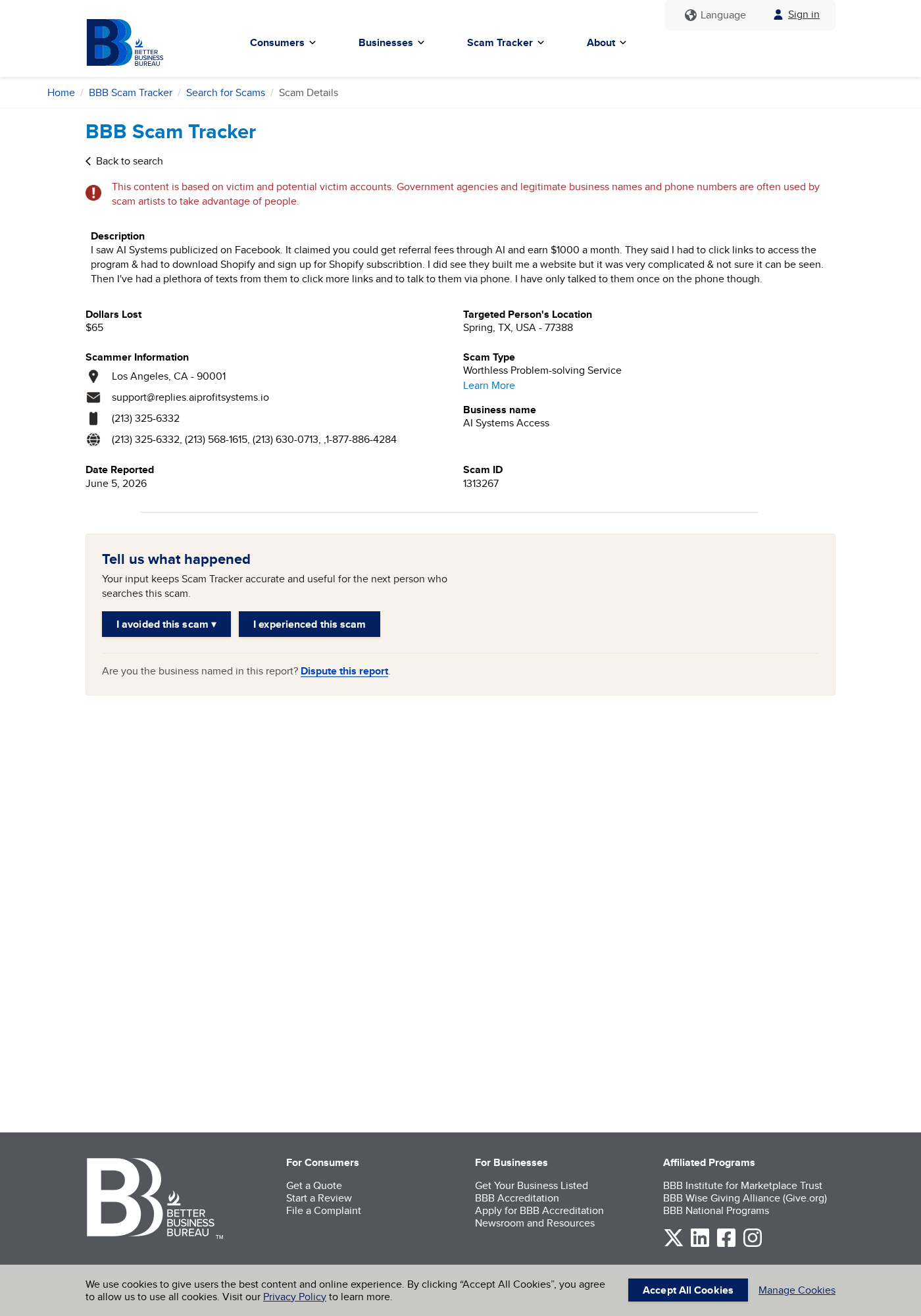
One BBB Scam Tracker report describes paying `$65` after seeing a Facebook promotion claiming up to `$1,000` each month through AI referral fees.
The reporter said the process then involved Shopify instructions and numerous messages containing more links and invitations to speak by phone.
Why the offer raises serious concerns
The income promise is much clearer than the underlying business economics. Buyers are shown aspiration before receiving a verifiable explanation of customers, costs, or margins.
Our review found references to several paid components rather than one transparent all-inclusive purchase.
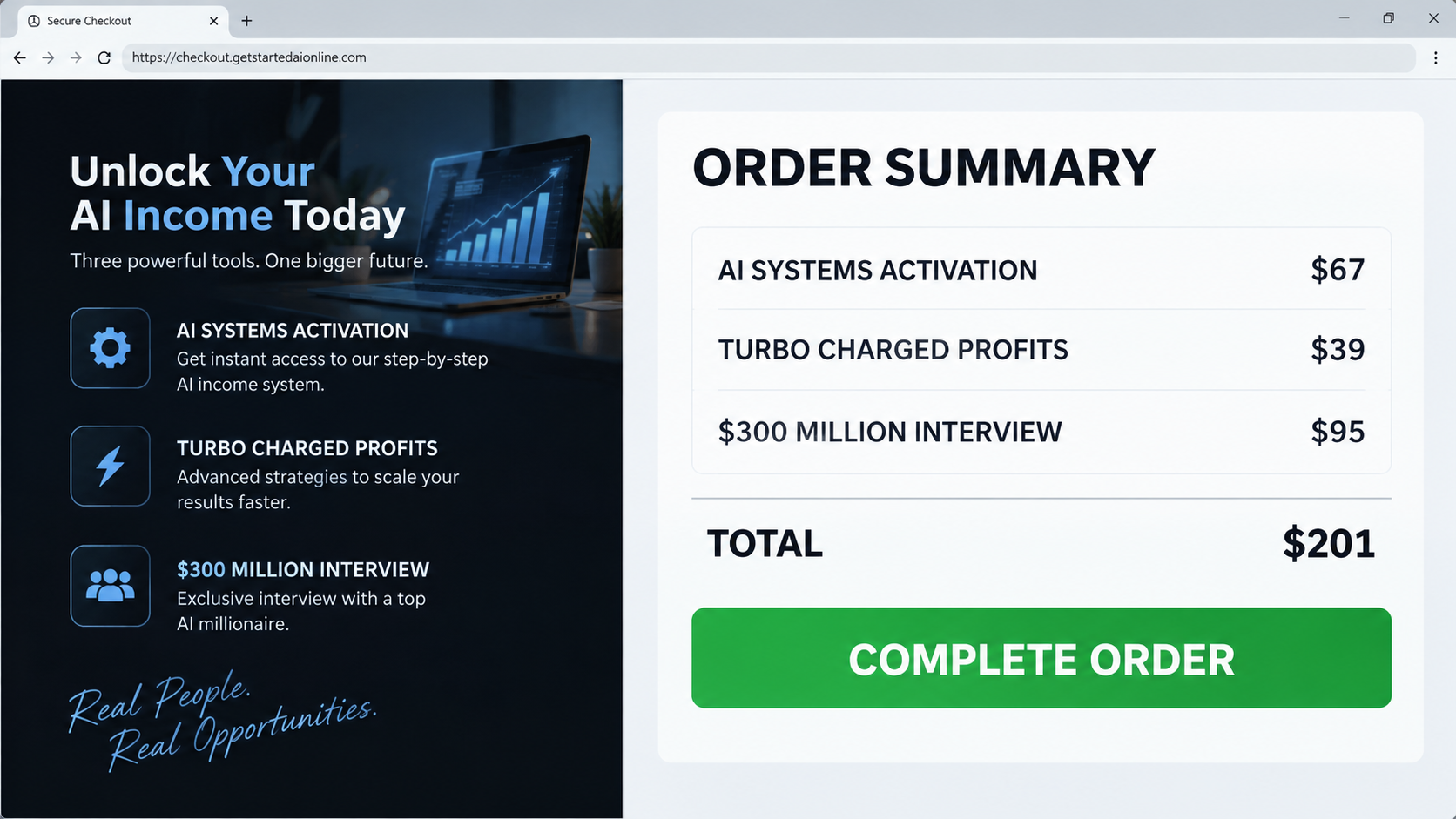
- An “AI Systems Activation” offer was presented at `$67`.
- “Turbo Charged Profits” appeared as a separate `$39` charge.
- A “`$300` Million Interview” offer appeared at `$95`.
- A public complaint described a `$65` loss and continued follow-up messages.
- The promise of easy monthly income lacked independently verified typical results.
The exact sequence can change. The stable pattern is a low-friction promise followed by more complicated spending, setup, and sales contact.
Is AI Systems a Scam?
The reviewed evidence supports treating AI Systems as a high-risk moneymaking offer rather than a dependable income system.
The pitch relies on exceptional earnings language while leaving ordinary buyers without audited results, transparent economics, or a clear single-price path.
A BBB Scam Tracker report identifies “AI Systems Access,” describes a financial loss, and recounts the switch from income claims to Shopify setup and repeated contact.
Scam Tracker reports are consumer accounts, not court judgments. They still provide meaningful warning evidence when the described pattern matches the observed funnel.
Buying training or software does not guarantee a profitable business. Any real venture requires a product, customers, acquisition costs, support, taxes, refunds, and sustained work.
AI can assist with tasks. It does not create free money, remove commercial risk, or ensure that referral commissions exceed advertising and platform costs.
For those reasons, consumers should avoid the offer unless the seller supplies verifiable company information, complete pricing, realistic disclosures, and evidence of typical outcomes.
How the AI Systems Scam Works
Step 1: The advertisement turns AI anxiety into opportunity
The campaign meets viewers where curiosity and insecurity overlap. People see rapid AI growth and worry that everyone else is already earning from it.
The ad promises a prepared system rather than a skill-building process. Little or no experience is framed as an advantage, not a limitation.
Income figures draw attention while practical variables remain vague. The viewer is encouraged to click before understanding the work.
Step 2: A long presentation supplies the success story
The next page may use an extended video featuring a narrator, testimonial, or character who supposedly discovered the method.
The presentation spends time on frustration, freedom, urgency, and transformation. The operational model receives less precise explanation.
Long videos also create sunk attention. After watching, the viewer may feel that leaving means wasting both time and a rare opportunity.
Step 3: The first payment feels small beside the promise
An entry charge around `$65` or `$67` can seem reasonable when the presentation implies future monthly income near `$1,000`.
This comparison is psychological, not financial evidence. A low price does not validate the system or prove that typical customers recover the fee.
Before paying, a buyer should receive a written description of every included service, recurring charge, technical requirement, and refund condition.
Step 4: Additional offers appear after commitment
Once the first payment succeeds, separate upgrades may be presented as necessary for faster activation, better profits, exclusive interviews, or advanced guidance.
Each amount can feel manageable alone. Combined, the reviewed `$67`, `$39`, and `$95` items reach `$201`.
That total does not include external platform costs, domains, advertising, applications, subscriptions, or services introduced later.
Step 5: The buyer is routed into other platforms
The BBB report says the buyer was instructed to download Shopify and sign up for a subscription.
Shopify is a legitimate ecommerce platform. Its involvement does not validate the marketer’s income promise or make the outside offer trustworthy.
A functional store still needs products, lawful claims, traffic, payment processing, fulfillment, customer support, and profitable customer acquisition.
Step 6: Calls and texts keep the prospect engaged
After payment, continued messages can direct the buyer to more links, calls, onboarding steps, upgrades, or financing discussions.
Repeated contact keeps momentum alive and creates opportunities to collect more information or sell higher-priced services.
Never assume a caller knows your business needs because they have your order details. They may simply be following a conversion script.
Step 7: Results become the buyer’s responsibility
If earnings fail to appear, sellers can blame incomplete implementation, insufficient advertising, refusal to upgrade, poor mindset, or lack of patience.
That structure protects the promise from falsification. Success is credited to the system, while failure is assigned to the customer.
A credible program defines realistic outcomes, typical expenses, refund rights, and the conditions required to evaluate performance.
The Hidden Economics Behind “Easy AI Income”
Referral revenue requires real conversions
A referral commission exists only when another person completes a qualifying action under a valid program’s rules.
Traffic does not appear automatically. It usually requires content, an audience, search visibility, partnerships, paid advertising, or direct outreach.
Even genuine affiliate programs can reject commissions, delay payment, deduct refunds, close accounts, or change rates.
A store creates expenses before profit
Launching a Shopify account may introduce platform fees, domain expenses, apps, design work, payment costs, customer service, and advertising.
A seller discussing revenue without these expenses presents only one side of the equation. Profit is what remains after every cost and refund.
Ask for documented median net profit, not screenshots of gross revenue or isolated success stories.
AI output still requires judgment and responsibility
AI-generated pages, ads, and product descriptions can contain inaccurate claims, copyrighted material, fabricated testimonials, or policy violations.
The store owner remains responsible for what is published, what customers receive, and how data is processed.
Automation can make mistakes faster. It does not transfer legal or financial responsibility to the software.
Income Claims That Should Trigger Caution
Promoters should possess written evidence supporting income representations before showing them to consumers.
A prominent figure such as `$1,000` monthly needs context: typical results, time period, participant count, expenses, skill, advertising spend, and failure rate.
Fine print stating that results vary does not repair a presentation built around atypical outcomes.
Be wary when testimonials describe rapid success but provide no verifiable business, traffic source, dates, or net-profit records.
Stock footage, AI avatars, copied biographies, or fabricated media articles can make a fictional success narrative feel documented.
Search distinctive testimonial phrases in quotation marks. Reuse across unrelated offers suggests a scripted asset rather than an independent account.
How to Evaluate Any AI Business Opportunity
Ask what specific product or service a paying customer receives. “AI automation” is a technology description, not a complete business model.
Identify who pays the commission, why that company pays it, and what qualifying transaction must occur.
Request the written compensation plan. It should explain rates, reversals, thresholds, exclusions, payment timing, and account-termination rules.
Calculate every required cost for 12 months, including software, advertising, domains, platform fees, apps, payment charges, refunds, and taxes.
Ask for typical net results after those expenses. An earnings screenshot without costs can turn a loss into apparent success.
Check whether revenue depends mainly on recruiting new purchasers into the same opportunity. That is different from selling genuine value to outside customers.
Search the presenter, company, address, testimonial language, refund policy, and payment descriptor separately. One clean search result proves very little.
Read advertising-platform comments critically. Positive replies can be filtered, incentivized, fabricated, or posted by affiliates.
Ask for a demonstration using a new account, realistic budget, continuous screen recording, and complete expense ledger.
Refuse any demand to decide during the call. A legitimate opportunity remains understandable after independent review.
Show the documents to an accountant, attorney, or experienced business owner who receives no commission from your purchase.
If the seller discourages outside advice, labels skepticism a mindset problem, or threatens lost access, leave the conversation.
Run a small written forecast before paying. Include realistic conversion rates, refund assumptions, advertising losses, and the value of your working time.
If the opportunity makes sense only when every optimistic assumption succeeds, it is not a resilient business plan.
Company, Address, and Fulfillment Checks
The offer name does not identify an accountable company
“AI Systems Access” is broad enough to sound technical while revealing little about the legal merchant behind payment and support.
Match the checkout entity, terms, privacy policy, receipt, email sender, and card descriptor. Preserve every variation.
A trustworthy operator should provide an exact registered name, jurisdiction, customer-service route, and clear responsibility for refunds.
The reported address needs independent confirmation
The BBB report lists Los Angeles, California 90001, but does not establish a complete verified operating address.
A city and ZIP code are not enough to locate management, deliver a legal notice, or confirm that a business operates there.
Virtual mailboxes, borrowed addresses, and unrelated offices commonly appear in short-lived online offers.
Several contact numbers do not equal reliable support
The report lists multiple numbers, including `(213) 325-6332`, `(213) 568-1615`, `(213) 630-0713`, and `1-877-886-4284`.
Multiple lines can support aggressive sales follow-up while refund requests remain unanswered. Test the official support route in writing.
Do not disclose additional data when an unexpected caller already knows your name, order, or email. Order information may circulate among sales teams.
Digital delivery still requires a traceable supply chain
There may be no physical warehouse, but the offer still has processors, software accounts, affiliates, contractors, and fulfillment platforms.
Determine who hosts the purchased material, who bills recurring services, who controls your store, and who can cancel access.
If a representative asks you to open credit accounts or borrow money for “working capital,” stop and seek independent financial advice.
A business opportunity should never require surrendering remote computer access, online banking credentials, or one-time verification codes.
What to Do if You Have Fallen Victim to This Scam
- Stop additional purchases. Do not buy upgrades, coaching, traffic packages, credit services, or recovery help while reviewing what happened.
- Build a complete transaction timeline. Save advertisements, videos, checkout pages, receipts, numbers, messages, platform signups, and every promised refund term.
- Cancel connected subscriptions. Review Shopify, apps, domains, email tools, and other platforms individually. Cancel through each official account.
- Contact payment providers promptly. Describe unauthorized charges or material misrepresentation accurately and supply the preserved records.
- Secure financial and business accounts. Change reused passwords, enable multifactor authentication, revoke unknown access, and remove unfamiliar collaborators.
- Protect your credit. If representatives encouraged financing or collected identity data, inspect credit reports and consider freezes with all major bureaus.
- Report the offer. File complaints with the FTC, BBB Scam Tracker, advertising platform, payment processor, and relevant state authority.
- Check the device. Run Malwarebytes if you installed files or opened suspicious links. Use AdGuard to block malicious ads and tracking.
Document cancellation before deleting accounts. Screens showing active plans, users, domains, and billing dates can be essential during a dispute.
Frequently Asked Questions
Can AI really help someone build an online business?
Yes, AI can assist with research, drafting, support, and automation. It cannot guarantee customers, lawful marketing, profitability, or passive income.
Is Shopify involved in the alleged scam?
Shopify is a legitimate independent platform. Being directed there does not validate the outside seller or its earnings claims.
Why are there several AI Systems prices?
The funnel appears to separate activation and upgrades. Exact offers can change, so preserve the checkout shown during your transaction.
Does a testimonial prove the system works?
No. A testimonial cannot establish typical results without verified identity, records, expenses, timeframe, and representative outcome data.
What if the company promises a refund by phone?
Request written confirmation with the amount, date, reference number, and processing time. Continue monitoring until funds actually return.
Should I pay someone to recover my money?
Be extremely cautious. Guaranteed recovery for an upfront fee is a common follow-up scam targeting people already identified as buyers.
The Bottom Line
AI Systems sells certainty around a business model that requires costs, customers, judgment, and work. Its layered fees and reported follow-up behavior are major warnings.
Do not fund the next upsell hoping it unlocks the original promise. Stop, preserve evidence, cancel connected services, and pursue recovery through trusted channels.








