

AeroChill AC is being promoted online as a portable air cooler that can cool rooms quickly, lower energy bills, and replace expensive air conditioning. The ads look polished, the reviews look enthusiastic, and the discounts look urgent.
But before buying, consumers should understand what this product appears to be, how it is marketed, and why the AeroChill operation raises serious red flags.
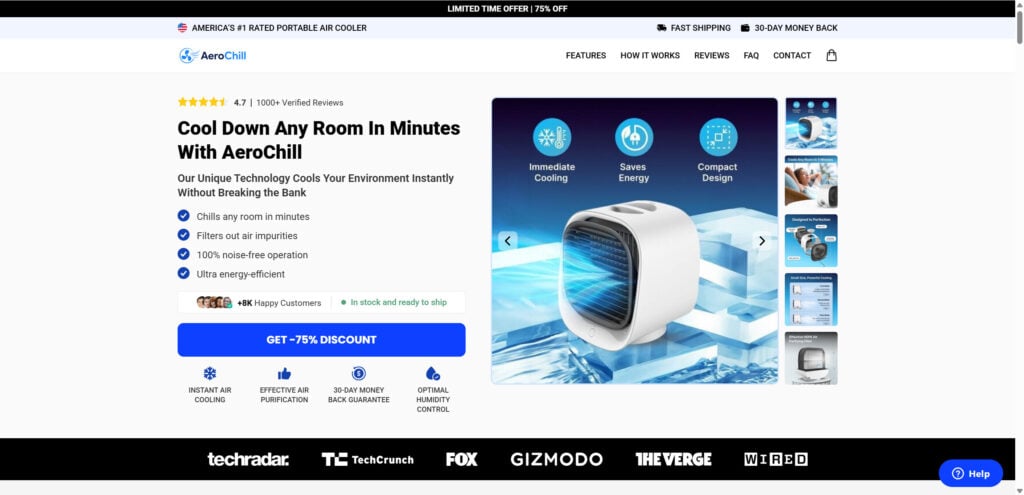
Overview
AeroChill AC is promoted on sites like AeroChill.org as a powerful portable air cooler that can “cool down any room in minutes,” purify air, humidify dry spaces, and help users avoid expensive electricity bills. The sales page also claims it can cool up to 215 square feet and work in as little as 90 seconds.
The problem is that AeroChill appears to be marketed far beyond what a small desktop fan can realistically do.
This is not a real air conditioner. A real AC uses a compressor, refrigerant, and an exhaust system to remove heat from a room. A small water-based fan or evaporative cooler only blows air through or around water. It may feel slightly cooler if you sit directly in front of it, especially in dry air, but it cannot cool an entire room like a proper air conditioner.
That difference matters because AeroChill is not being advertised as a simple personal fan. It is framed as an AC replacement, with big claims about room cooling, summer heat relief, and lower energy bills.
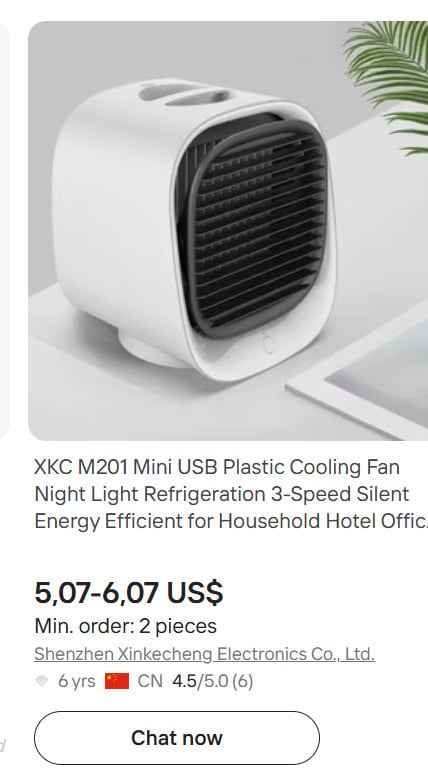
There are also several red flags. Similar small cooling fans appear to be widely available from China-based suppliers at very low wholesale prices, suggesting AeroChill may be a generic product rebranded with aggressive marketing. The site uses familiar dropshipping tactics: huge discounts, urgent stock warnings, glowing reviews, “verified customer” labels, expert-style endorsements, and media logos that are not clearly verified.
The reviews should also be treated carefully. AeroChill.org claims a 4.7 rating, 1,888 reviews, and a 97% recommendation rate, but the site appears to highlight mostly 4- and 5-star feedback. If negative reviews are filtered out or hidden, the review section does not show the full customer experience.
Another concern is the return process. The sales page promotes a 30-day money-back guarantee, but connected policy pages include strict conditions: the item may need to be unused, in original packaging, approved by support, shipped back at the customer’s expense, and possibly excluded if bought at a discount. In practice, that can make refunds difficult after a buyer opens and tests the product.
There is also a risk of being pushed into bundles, upsells, or multiple-unit orders through the checkout funnel. For a low-cost generic fan, this can turn a small purchase into a much bigger loss if returns are denied or shipping costs are high.
Bottom line: AeroChill AC may ship a real product, but shoppers should not expect a true air conditioner. It looks more like a small personal cooling fan sold through exaggerated claims, viral ads, and restrictive refund terms.
How The Operation Works
Step 1: The Product Is Positioned As A Breakthrough Cooling Solution
The first step is emotional positioning.
AeroChill is not marketed as a small desk fan. It is presented as a smart answer to summer heat, high electricity bills, expensive AC units, and uncomfortable rooms.
The sales copy speaks to common frustrations:
- “My room is too hot.”
- “My electric bill is too high.”
- “I cannot afford a real AC unit.”
- “My apartment has poor cooling.”
- “Fans only push warm air around.”
- “I need something portable.”
- “I need relief now.”
That message works because the problem is real. Heat makes people uncomfortable. Poor sleep, hot rooms, and high utility bills are frustrating. A small device that promises fast cooling for a low price sounds like a practical solution.
The operation uses that frustration to lower skepticism. Instead of making the buyer think like a technical shopper, it makes them think like someone who just wants quick relief.
Step 2: The Product Name Makes A Small Fan Sound Like An Air Conditioner
The name “AeroChill AC” or “AeroChill Portable AC” is important.
Most consumers hear “AC” and think air conditioner. That creates an immediate mental image of actual cooling power. But the product itself appears closer to a personal evaporative cooler or small desktop fan.
That difference is huge.
A real AC lowers air temperature by moving heat out of a room. A small water fan mainly moves air across water or a damp surface. It may cool the air directly in front of it, especially in dry conditions, but it cannot cool a room like a compressor-based unit.
The marketing benefits from that confusion. A shopper may not stop to ask whether it has a compressor, exhaust hose, BTU rating, refrigerant, or EnergyGuide label. They simply see “portable AC” and assume it cools like an AC.
Step 3: The Website Uses Big Claims Early
The AeroChill.org page quickly stacks claims on top of each other.
It says the product can:
- cool any room in minutes
- cool up to 215 square feet
- work in 90 seconds
- purify air
- humidify dry spaces
- reduce energy costs
- run silently
- work for bedrooms, offices, dorms, and outdoor spaces
- replace expensive air conditioners
- help during heatwaves
This technique is common in aggressive product funnels. The goal is to create a flood of benefits before the buyer has time to question the mechanics.
Instead of explaining the actual cooling capacity in measured terms, such as BTU, wattage, airflow volume, water tank size, or room temperature reduction test results, the page relies on broad lifestyle promises.
That makes the product feel more powerful than the technical details may justify.
Step 4: Fake Or Unverified Media Logos Create Instant Trust
Many versions of this type of offer use media logos, “as seen on” graphics, award-style badges, or “America’s #1” claims.
These elements are designed to borrow trust from recognizable institutions. Even if a shopper does not click anything, the visual impression is powerful. It tells the brain, “This product has been featured, reviewed, tested, or approved.”
But consumers should be very careful here.
A real media mention should be easy to verify. The website should link to the actual article, review, broadcast segment, or independent test. If the logos are not clickable, lead nowhere, or do not connect to real coverage, they should be treated as decoration, not proof.
AeroChill.org uses “America’s #1 Rated Portable Air Cooler” and “rated as the most effective portable cooler of 2026” style claims, but the page does not clearly show a transparent independent test behind those statements.
That is a warning sign.
Step 5: AI Images And Videos Make The Product Look More Impressive
The user flagged the operation as using AI images and AI videos. This fits the pattern seen across many modern dropshipping campaigns.
AI media can make a cheap gadget look like a polished invention. It can create clean product shots, perfect lifestyle scenes, fake home environments, and smooth demonstration videos without needing real testing.
In cooling product ads, AI or edited videos may show:
- visible cold mist
- dramatic airflow
- people relaxing in cool rooms
- fake temperature drops
- simulated ice effects
- fake lab-style comparisons
- staged before-and-after comfort scenes
- product closeups that hide scale and limitations
This matters because video can be more persuasive than text. If people see a device apparently cooling a whole room or producing icy air, they may trust the visual more than the specifications.
But polished visuals are not proof. A real cooling claim should be backed by measured temperature data, test conditions, room size, humidity level, runtime, and power draw.
Step 6: The Reviews Create A Wall Of Social Proof
AeroChill.org uses a large review section with many glowing comments. The reviews mention Dallas heat, Florida parents, rented apartments, dorm rooms, better sleep, low electricity bills, and cooling shared spaces. The page claims 1,888 reviews and a 97% recommendation rate.
That kind of review wall is designed to make the buyer feel safe.
But several details reduce confidence.
First, the site says it is showing 4 and 5 star reviews. If lower ratings are filtered or excluded, the shopper is not seeing a balanced picture.
Second, the review submission form says reviews appear once approved. That means the site may control what appears publicly.
Third, the reviews are written in a very sales-friendly pattern. They often repeat the core claims: it cools rooms, saves money, replaces AC, works all night, and helps during summer heat.
Fourth, the connected terms say testimonials may use fictional names and associative pictures.
That does not automatically prove every review is fake, but it means readers should not treat those names and images as verified independent customer identities.
The FTC has specifically warned against fake or false consumer reviews and testimonials, including AI-generated reviews or testimonials from people who did not actually use the product.
For shoppers, the practical rule is simple: seller-controlled reviews are weaker evidence than independent reviews from trusted platforms.
Step 7: The Discount Makes The Buyer Feel Like They Found A Deal
AeroChill.org uses “75% off” messaging and “limited time offer” language. This is a classic conversion tactic.
The discount makes the buyer feel lucky. It also makes the decision feel urgent. If the product is supposedly normally much more expensive, the current price feels like a limited opportunity.
But with generic dropshipping products, the “regular price” is often inflated. The crossed-out price may not reflect a normal market value. It may simply be there to make the sale price feel better.
This is especially important when similar fans can be found from China-based suppliers for much less.
A product sold for $49, $79, or more can feel premium if the page says it was originally $129 or $199. But if the base product is a low-cost generic fan, the discount may be part of the illusion.
Step 8: The Checkout Can Increase The Order Value
Once a buyer clicks the discount button, the page may redirect through other domains or checkout systems. In the case of AeroChill.org, the discount link attempted to redirect through another domain before opening a checkout flow.
These funnels often try to increase the order value through:
- buy 2, get 1 offers
- bundle discounts
- “most popular” packages
- checkout add-ons
- shipping insurance
- priority processing
- extended warranty
- post-purchase one-click upsells
- extra units offered after payment
- countdown timers
- “your cart is reserved” messages
This is where the multiple-unit risk comes in.
Some buyers may believe they selected one AeroChill, but the final order may include several units. Other buyers may click an upsell thinking it is a confirmation button. Some may be charged for a bundle because the default option was preselected.
Before paying, the customer must check the cart line by line.
Step 9: The Product Ships From Overseas Fulfillment
The connected terms state that products are manufactured in China and delivered from warehouses in China. They also warn about possible import duties, customs issues, and delays.
This does not automatically make the product a scam. Many legitimate products are made in China.
The issue is transparency. If the sales page gives the impression of a premium breakthrough brand, but the terms reveal overseas generic fulfillment, the buyer may not understand what they are really buying.
Longer shipping also creates another problem: refund windows may become harder to manage, support may be slower, and returns may require approval before the customer even knows where to send the product.
Step 10: The Return Policy Creates Friction
The sales pitch says “30-Day Money Back Guarantee” and “100% Risk-Free.” But the connected return policy has many conditions.
Customers may need to:
- contact support first
- request approval within 30 days
- provide photos
- explain why they want to return it
- keep the product in brand-new condition
- keep the original packaging
- pay return shipping
- use a specific return address
- provide tracking
- wait for inspection
- accept that reduced-price goods may not be refundable
The terms also say opened products may not be returnable.
This is the trap.
A customer buys the product because the page says it cools a room. To test that claim, they must open and use it. But once opened, the seller may argue it is no longer eligible for return.
That is why “30-day guarantee” language should be read carefully. The real policy may be much less generous than the headline suggests.
Step 11: Complaints Become Hard To Resolve
If the product disappoints, the customer may contact support and receive delay tactics.
Common problems in this type of operation include:
- support asking for photos repeatedly
- support offering only a partial refund
- support insisting the product must be unused
- support saying the item was bought at a discount
- support requiring overseas return shipping
- support providing a return address late
- support claiming the return window expired
- support blaming user expectations
- support saying the product works as a personal cooler, not a room AC
By the time the buyer realizes the process is difficult, the refund window may be closing.
This is why it is important to act quickly if you already ordered.
Step 12: The Same Model Repeats Under Different Names
AeroChill appears to fit a larger pattern used by many online gadget funnels.
The product name may change. The website may change. The images may change. The media logos may change. But the structure stays the same:
- generic product
- big claim
- fake urgency
- fake or filtered reviews
- AI ads
- inflated discount
- confusing checkout
- difficult returns
- overseas fulfillment
- short-lived sales pages
This is why consumers often see the same product sold under multiple names. One week it may be AeroChill. Another week it may be AirBreeze, ChillWave, FrostAir, Coolify, or another brand name.
The operation is not built around a trusted long-term brand. It is built around performance ads and fast conversions.
What To Do If You Have Fallen Victim
- Check your order confirmation immediately
Look at the confirmation email carefully. Confirm the product name, quantity, total price, shipping cost, taxes, and merchant descriptor.
If you expected one AeroChill but see two, three, or more units, save that email right away.
- Take screenshots of the sales page
Save screenshots of every claim that influenced your purchase, including:
- “cool any room”
- “90 seconds”
- “215 square feet”
- “75% off”
- “30-day money-back guarantee”
- review claims
- media logos
- expert endorsements
- checkout totals
- refund wording
These screenshots may help if you need to dispute the charge.
- Email support as soon as possible
If you want to cancel, do it quickly. Some connected policies mention very short cancellation windows, such as 12 hours.
Use clear wording:
“I am requesting immediate cancellation of my order and a full refund to my original payment method. Do not ship additional units or add any upgrades.”
- Ask directly about extra units
If you were charged for more than expected, write:
“I ordered one unit only. I did not authorize additional units. Please refund the unauthorized quantity immediately and confirm the corrected order in writing.”
Keep the message short and direct.
- Do not open every unit
If multiple units arrive, keep extra units sealed. Some return policies require original packaging and unused condition.
Open only what is necessary to document what was sent.
- Photograph the package and product
Take clear photos of:
- shipping label
- package
- product box
- product itself
- instruction manual
- country-of-origin label
- barcode
- any damage
- all units received
This helps prove what arrived.
- Test the product carefully
If the claim was that it cools a room, document the test honestly.
Use a simple thermometer if possible. Note the room size, temperature before use, temperature after 30 minutes, and whether the device only cooled the air directly in front of it.
- Request a refund in writing
Use calm, firm wording:
“The product does not match the advertised claims. It was promoted as a portable AC that can cool a room, but it performs like a small personal fan. I am requesting a refund under the advertised 30-day guarantee.”
- Do not accept endless delays
If support keeps asking for the same information, offers only a tiny partial refund, or refuses to provide a return address, move quickly.
Refund windows are time-sensitive.
- Contact your payment provider
If the seller refuses to help, contact your credit card issuer, bank, or PayPal.
Use dispute reasons such as:
- item not as described
- misleading advertising
- product sold as AC but received a small fan
- unauthorized quantity charged
- merchant refuses advertised refund
- refund policy contradicts sales page
- product does not perform as advertised
- Mention the return contradiction
If the seller says opened products cannot be returned, explain that you had to open the product to test the cooling claims.
A guarantee that cannot be used after testing the product may be misleading.
- Monitor your card
Watch for repeat charges, unknown merchant names, or additional transactions. Some funnels use post-purchase upsells or add-ons.
If you see a charge you did not authorize, report it immediately.
- Report the ad
If you saw the product through Facebook, Instagram, TikTok, YouTube, or another platform, report the ad as misleading.
Include screenshots if the platform allows it.
- Leave an honest review elsewhere
Do not rely only on the seller’s review form. If you had a poor experience, consider leaving a factual review on independent platforms.
Stick to verifiable facts: what was advertised, what you ordered, what arrived, what it did, and how support responded.
- Be careful with recovery scams
After buying from questionable sites, you may receive emails or ads promising refunds, compensation, or chargeback help.
Do not pay anyone upfront to recover your money. Work directly with your bank, PayPal, or card issuer.
The Bottom Line
AeroChill AC may ship a real product, but the marketing around it raises serious concerns. It appears to be a generic China-made personal cooling fan promoted as a powerful portable air conditioner through exaggerated claims, fake or unverified media logos, AI-style ads, filtered reviews, and urgency-based sales tactics.
The biggest risk is expectation. Buyers may think they are getting a room-cooling AC alternative, but the product is unlikely to perform like a real air conditioner. At best, it may provide close-range personal airflow.
If you are considering AeroChill, treat it as a small desk fan, not a real AC. If you already ordered and feel misled, document everything, contact the seller quickly, and dispute the charge if the advertised guarantee is not honored.








