

The mug in the video seems almost impossible: luminous flowers appear suspended inside crystal, every edge catches the light, and a handmade-looking gift costs less than an ordinary cup. The advertisement invites you to buy before the timer ends.
What arrives, if anything arrives, may tell a very different story. A few checks before checkout can reveal why the product photo looks better than any real listing should.
Overview
What is the AI crystal mug scam?
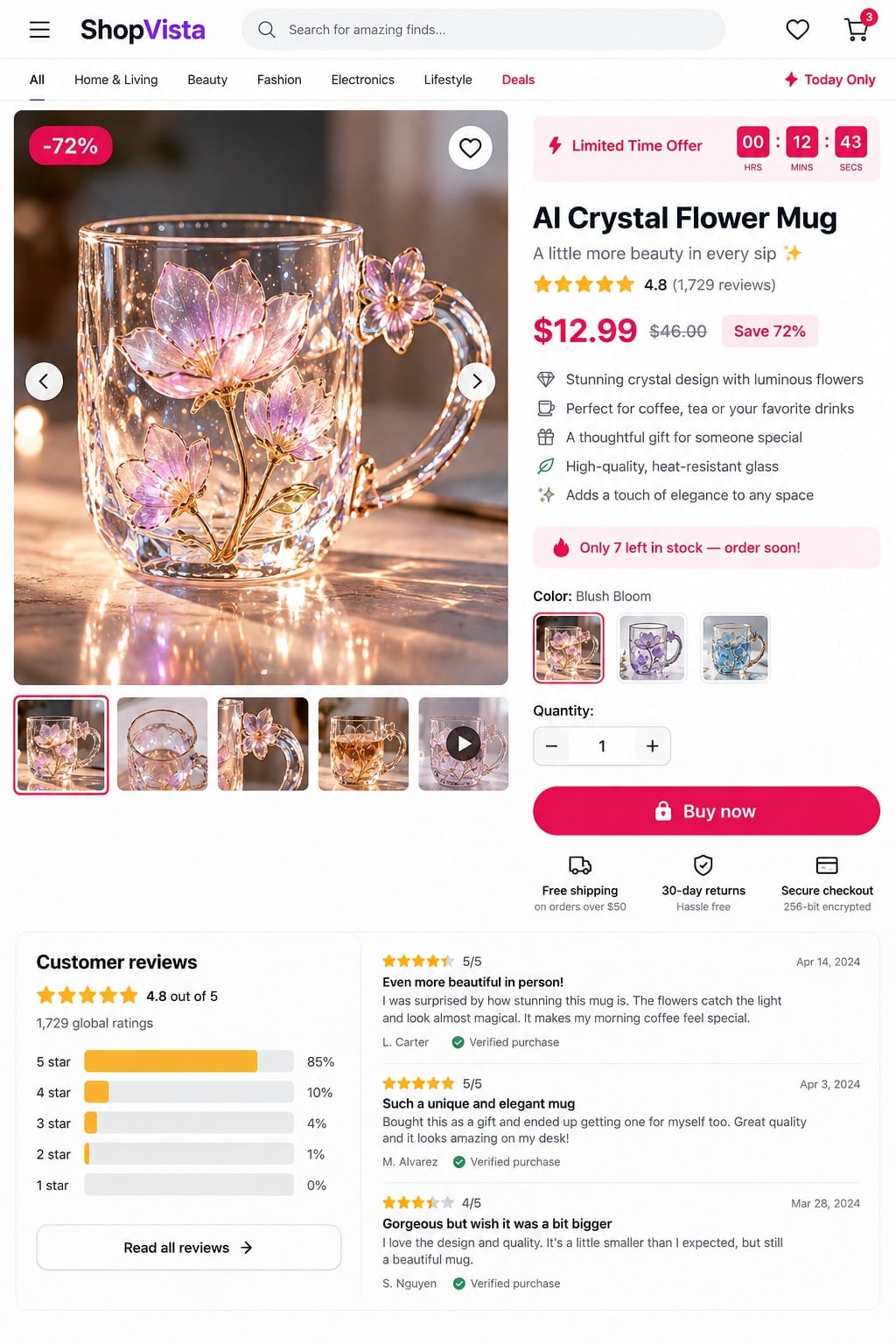
The AI crystal mug scam refers to social-media ads and online listings that use synthetic, heavily edited, or otherwise misleading images to sell a spectacular flower mug. The advertised object may appear to contain glowing crystal petals, intricate glasswork, and lighting effects that are difficult or impossible to reproduce at the listed price.
Buyers may receive a cheap resin or printed cup, a smaller object, a product that does not resemble the image, or nothing at all. The scam is not the use of AI by itself. The deception occurs when a seller presents an invented or misrepresented image as a truthful photograph of merchandise it will deliver.
Why is this product so easy to want?
The image is built for sharing. It combines a familiar item with craftsmanship that seems rare, making the mug feel like an affordable discovery rather than an ordinary purchase. A short video can add sparkling movement and make synthetic detail harder to inspect frame by frame.
Gift shopping adds urgency. A buyer may imagine the recipient’s reaction before checking the store. A steep discount, free shipping, and a countdown timer then make research feel like the only thing standing between the shopper and a perfect present.
Which warning signs appear in these listings?
- Flowers, handles, or reflections change shape between images.
- The design seems internally lit without a visible power source.
- Every review is glowing and uses the same polished tone.
- The seller has no verifiable business identity or physical return address.
- Product images appear on unrelated stores under different names.
- The price is implausibly low for the claimed handwork and materials.
- The returns policy makes buyers ship internationally at their own expense.
- The advertisement promises a crystal item while fine print describes resin or acrylic.
Unusual glass mugs and flower designs do exist, and a visually dramatic advertisement is not automatic proof of fraud. The key question is whether the seller can substantiate the exact item, materials, dimensions, and fulfillment terms shown in the listing.
How the AI Crystal Mug Scam Works
Step 1: A perfect product appears in a social feed
The ad is usually a short video, carousel, or sponsored post placed between familiar content. It may claim the mug is going viral, selling out, or available only through a closing sale. The product image receives more attention than the seller’s name.
Generative tools can create forms that look plausible at a glance but fail under inspection. Petals may merge into the wall of the cup, handles may connect incorrectly, and reflections may not follow the shape of the glass. Video motion can hide those inconsistencies.
The ad account may be new or may previously have posted unrelated material. Comments can be restricted, filtered, or filled with generic praise. Do not treat engagement counts as proof that customers received the pictured object.
Step 2: The landing page manufactures a limited opportunity
After the click, the store repeats the best image beside a large discount. A timer, low-stock message, and pop-ups about recent buyers make the offer feel temporary. These elements can reset on every visit and may not reflect real inventory.
The page may claim the mug was reduced from $59.99 to $14.99, with free worldwide shipping. Compare that total with the claimed materials, handwork, protective packaging, and delivery distance. A price is not impossible merely because it is low, but the economics should make sense.
Important details are often vague. “Crystal” can describe a visual style rather than lead crystal or even glass. “Handcrafted” may refer to no identifiable process. Read the material field and dimensions instead of relying on the product name.
Step 3: Copied content creates false reassurance
The store may copy photographs, policies, review text, and trust badges from other websites. Several storefronts can sell from the same template while presenting different company names. Reverse image searches may reveal that the hero image predates the shop or appears with conflicting descriptions.
Five-star reviews inside the page are controlled by the seller. Check independent sources, but evaluate those too. A burst of reviews using similar phrases or discussing only fast shipping without describing the mug offers little reassurance.
Look for original evidence: a continuous product video from several angles, accurate measurements beside a common object, care instructions matching the material, and customer photos that consistently show the same design.
Step 4: Checkout captures payment and personal information
The buyer enters a name, address, email, telephone number, and payment details. A padlock in the browser shows that the connection is encrypted; it does not show that the seller will fulfill the order fairly.
Some stores process the agreed charge but ship poor merchandise. Others add hidden subscriptions, use misleading currency conversion, or collect card data on an unsafe form. Save the product page, total, and terms before paying because the page can change later.
Use a credit card when practical because it generally provides a clearer dispute route for merchandise that never arrives or is not as described. Avoid cryptocurrency, gift cards, wire transfers, or payment through an unknown person.
Step 5: Tracking delays the moment of discovery
A confirmation email may contain a tracking number that remains in “label created” status, describes a very small parcel, or shows delivery to the wrong area. Long estimated windows can push the buyer closer to a payment-dispute deadline.
The seller responds with scripts about customs, warehouse backlogs, or a reshipment. Those events can occur in legitimate commerce, so focus on evidence: carrier scans, parcel weight, destination, and whether the promised replacement receives independent tracking.
Mark the latest dispute date on a calendar. Do not let repeated promises cause you to miss the protection period offered by the card issuer or marketplace.
Step 6: The received mug bears little resemblance to the ad
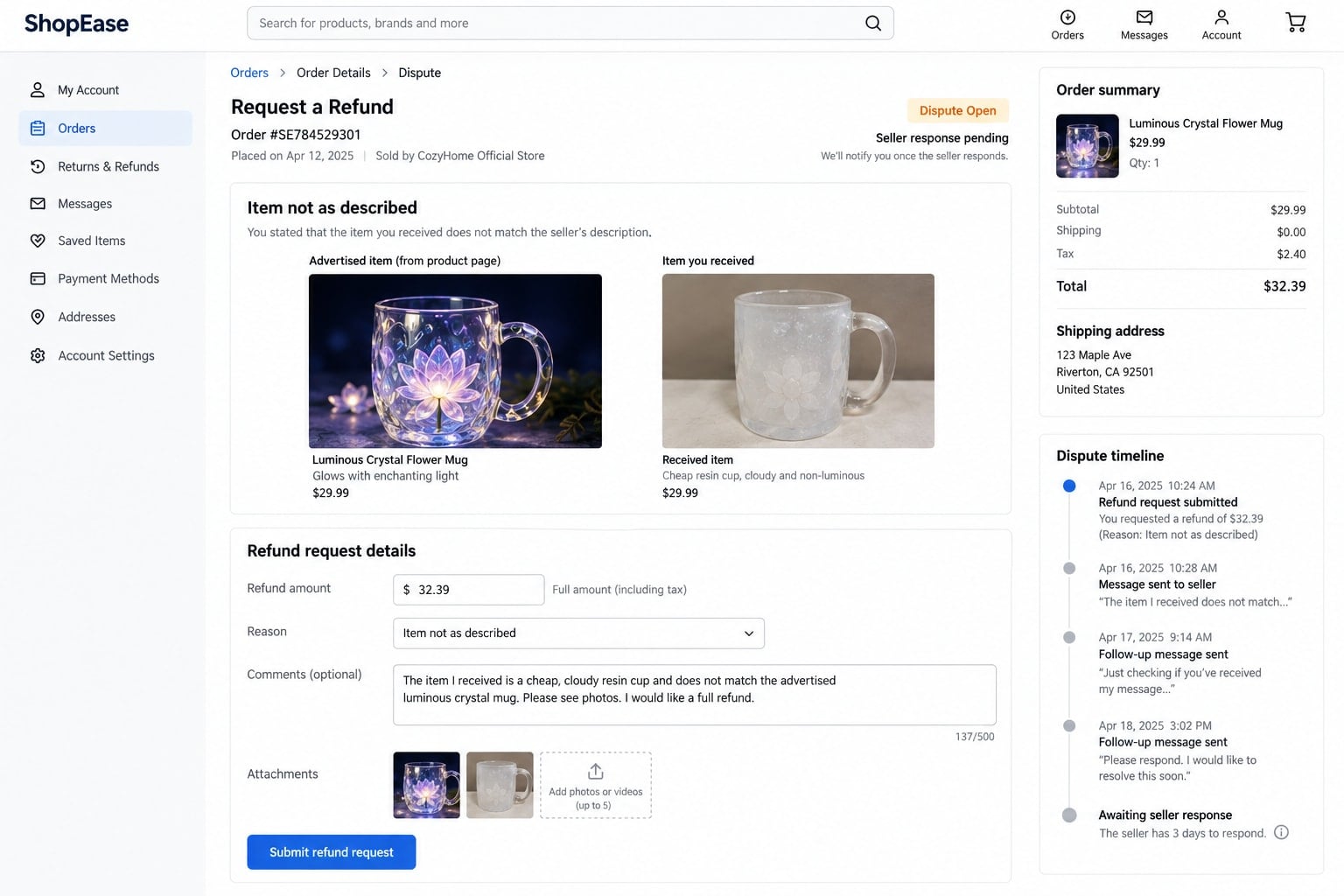
The package may contain a cloudy plastic cup, a flat flower print, weak colors, or a generic mug available elsewhere for far less. In other cases, the size and material match fine print that was easy to overlook but contradict the dominant advertising impression.
The reconstructed dispute page below illustrates the gap between a luminous listing image and a cheap resin item. It is not a record from a particular buyer or proof against every seller using a similar product name.
Photograph the unopened parcel label, packaging, and item from several angles. Include a ruler where dimensions matter. Keep the product rather than discarding it until the dispute process tells you what to do.
Step 7: The refund process becomes another obstacle
The seller may offer a small partial refund, insist that the item is close enough, or require return shipping to a distant address. Postage can exceed the purchase price. A local-looking store name does not guarantee a local returns facility.
Another tactic is to delay while asking for the same photos repeatedly. Keep every reply and submit required evidence through the payment provider before its deadline. Do not close a dispute merely because the seller promises a refund outside the system.
A stranger may later offer help recovering the payment for an upfront charge. That is a separate advance-fee risk. Your card issuer, marketplace, and consumer-protection agency do not need a social-media recovery agent to receive a report.
How to Check the Seller, Listing, and Product Photos
Identify the business behind the storefront
Look for a legal business name, working contact method, physical return address, and consistent presence outside the sales page. Search the exact domain with terms such as reviews, complaints, and returns. Read results critically rather than relying on one rating.
Check when the domain appeared and whether the store’s history matches claims such as “family business since 2012.” A recently created site is not automatically fraudulent, but an invented history is a clear reason to leave.
Examine product imagery for internal consistency
Compare the handle, rim, flower count, reflections, and background across every image. AI-generated objects often change between views. A legitimate seller should be able to show the same physical design consistently.
Run a reverse image search on the main picture and a video frame. If unrelated stores use it for different materials or dimensions, find the earliest credible source. Copied imagery does not prove which seller, if any, has the real product.
Read specifications and return terms together
Write down the stated material, volume, dimensions, light source, care method, shipping origin, and return destination. Ask how a glowing effect works. If the answer contradicts the image or avoids basic construction details, do not order.
Check whether opened goods can be returned, who pays postage, how quickly a claim must be opened, and whether sale items are excluded. A generous headline such as “30-day guarantee” can be undermined by conditions deeper in the policy.
Choose a payment route with recourse
Prefer a credit card or a reputable marketplace checkout that records the listing and offers buyer protection. Read the protection terms; a payment logo in the footer does not guarantee that the checkout actually uses that service.
Never send an extra customs, insurance, or redelivery payment to an account provided in a private message. Verify carrier charges through the carrier’s own website using a tracking number you entered yourself.
What to Do if You Have Fallen Victim to This Scam
- Save the original offer and order details.
Capture the advertisement, product page, materials, measurements, price, promised delivery time, return policy, order confirmation, and seller contact details. Save the URL and date because the page may later disappear or change.
Keep copies outside the seller’s account area. If access is removed, you will still have the representation that influenced the purchase.
- Document what arrived.
Photograph the shipping label before opening if possible, then record the packaging and item from several angles. Show defects, material differences, scale, and missing features clearly. Keep the parcel weight if it helps explain the mismatch.
Do not alter, repair, or throw away the item while a return or dispute is active. Follow the payment provider’s instructions about retaining evidence.
- Request a refund in writing.
State the specific difference between the listing and the item, then request the remedy promised by the policy and applicable law. Avoid a long argument about whether an image was made with AI; “item not as described” is usually the clearer issue.
Set a reasonable response deadline and keep the conversation in writing. Do not accept a coupon for another order if you want a refund.
- Open a payment dispute before the deadline.
If the seller does not resolve the problem, contact the card issuer or marketplace through its official route. Provide the saved listing, correspondence, delivery record, and comparison photos. Explain whether the item was counterfeit, materially different, or never received.
The Federal Trade Commission’s online shopping guidance recommends checking sellers and keeping records. Dispute rights depend on the payment method and circumstances, so act promptly.
- Secure payment and account information.
Review the card for unexpected charges and watch for a hidden recurring payment. If the checkout was suspicious or card details may have been captured outside a recognized processor, ask the issuer whether replacement is appropriate.
Change any password reused on the store. If a download or browser extension was required, remove it and run a Malwarebytes scan. Buying a poor product alone does not mean the device is infected.
- Report the advertisement and store.
Report the ad to the social platform with the mismatch evidence. Submit a consumer report to the relevant national agency; U.S. shoppers can use ReportFraud.ftc.gov. Report non-delivery or false tracking to the marketplace and carrier where relevant.
Write factual reviews that distinguish the seller, exact domain, and order. Avoid accusing unrelated stores that happen to sell a flower mug with a similar name.
- Reduce exposure to the next copy of the ad.
Block the advertiser and revoke notification permission for the store. AdGuard can reduce some misleading advertisements and tracking, but no blocker can judge the truth of every product photograph or guarantee fulfillment.
Expect the same creative to return under another store name. Search the image and seller each time rather than assuming a redesigned page represents a new, trustworthy business.
Frequently Asked Questions
Is the AI crystal flower mug a real product?
Decorative glass and resin flower mugs are real, but a particular viral image may be synthetic or heavily edited. Verify the exact seller’s original photos, material, construction, and customer evidence rather than assuming every similar mug is identical.
Is using an AI product image illegal?
Laws differ, and AI imagery can be used for concepts or clearly labeled illustrations. The consumer problem arises when a seller materially misrepresents what will be delivered. Focus a complaint on the false description and actual transaction.
How can I tell whether the photo was generated?
Look for changing geometry, impossible reflections, merged details, unreadable labels, and inconsistent versions of the product. Reverse image search helps too. No single visual clue is conclusive, so combine image checks with seller and fulfillment evidence.
What if I received a mug but it looks cheap?
Compare it with specific claims about material, size, lighting, finish, and construction. Photograph those differences and use the seller’s return process. If the issue is not resolved, ask the payment provider about an item-not-as-described dispute.
Should I return the item to an overseas address?
Check the written policy and speak with the marketplace or card issuer before paying expensive postage. Preserve proof of the return address and any requirement that was not disclosed before purchase. Do not send it to an address supplied by an unrelated recovery contact.
Can an ad blocker prevent this scam?
An ad blocker may reduce exposure to some campaigns, but deceptive products also spread through organic posts, influencers, email, and search. Seller research, saved evidence, realistic price checks, and a protected payment method remain necessary.
The Bottom Line
The AI crystal mug scam sells the emotional impact of an image before it sells a verifiable object. A glowing flower, dramatic discount, and short timer leave little room to ask who made the mug or how the advertised effect could work.
Pause long enough to identify the seller, compare the images, read the material and return terms, and choose payment protection. If the parcel does not match the promise, document the difference and move quickly through formal refund channels.








