


A purchasing team can receive several bids and still have only the appearance of competition. The numbers may be different, the paperwork complete and the winner easy to justify.
The Alan Hayward James case shows why the number of bids doesn’t answer the question that matters. Were the bidders actually making their own decisions?
Overview
What James admitted about Air Force contracts
Alan Hayward James, a former Air Force master sergeant, pleaded guilty in Hawaii in April 2026. The case involved information technology contracts serving Pacific Air Forces installations.
The Guardian reported that James admitted conspiring to commit wire fraud and rig bids, and pleaded guilty to bribery. The three counts address different aspects of his conduct.
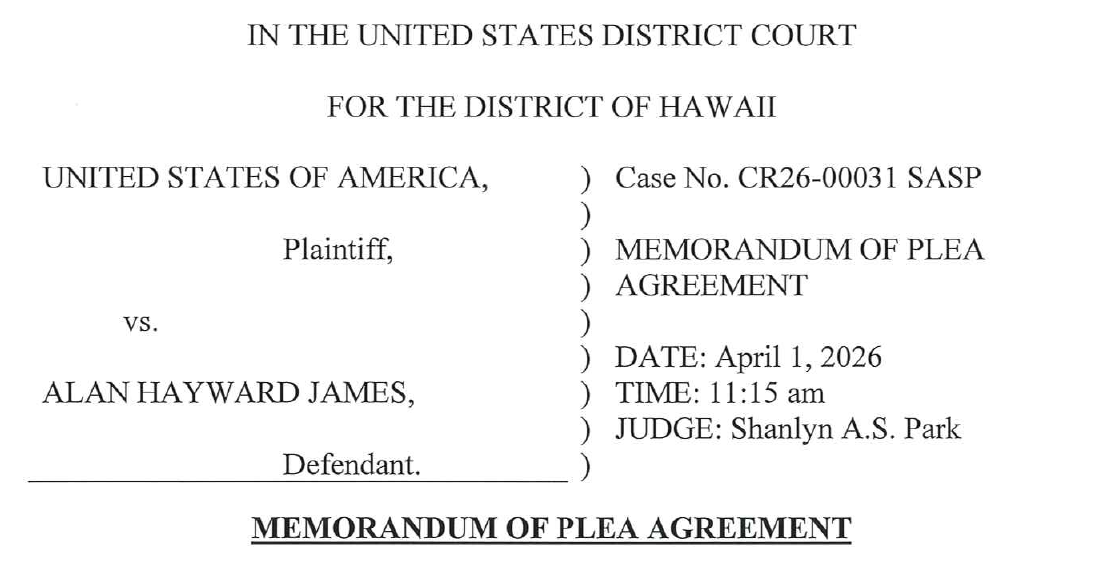
The lead image shows the case caption and title from page one of the filed plea agreement. It is not an original solicitation or a bid.
Where the overpayment figure comes from
The Justice Department’s account says the broader scheme ran from at least April 2016 until about April 2025. The bid coordination described there covered a narrower period.
The department said the government overpaid by at least $37 million. That figure describes inflated contract costs, not the total value of every contract or what James personally received.
James agreed to at least $1,451,656.80 in restitution under his plea agreement. An amount promised in a plea is not proof that the government has already collected it.
What an apparently competitive purchase can conceal
The federal account describes bids that were supposed to compete but were coordinated and excess funds that benefited people involved. The fraud was about prices and decision-making.
A losing bid is not suspicious on its own. Investigate whether the decision was genuinely independent and whether there is credible evidence of coordination rather than coincidence.
- Separate the estimated fair cost from the amount actually paid.
- Check whether the vendors were eligible, separate and competing independently.
- Keep a record of who approved any change to price or scope.
- Record who received the work, the payment and any side benefit.
Keep those checks distinct from the verdict. The plea establishes what James admitted, not the responsibility of every person or company on a purchase order.
How the Procurement Fraud Worked
Step 1: A real purchase gives the process a legitimate starting point
The Air Force had real technology purchases to make. Prosecutors did not describe the entire program as a fictitious project invented for the sole purpose of requesting money.
That is an important distinction for purchasing teams. A legitimate business need doesn’t establish that the price, competition or payment is legitimate.
Start by recording what was ordered and the requirements that vendors were asked to price. A comparison is weak if you cannot tell whether everyone priced the same work.
Check whether a later scope change was approved and communicated through the proper route. An old price can be misleading when the purchase has changed.
Step 2: Bids that look independent are coordinated
The Justice Department says that from at least May 2019 until about October 2022, James directed bidders who were supposed to be competing about what amounts to submit.
When prices have been coordinated, a comparison sheet can turn into evidence of a contest that didn’t really happen. A visibly lower quote doesn’t prove there was market competition.
A buyer can’t decide that bidders acted together just from one unusual proposal. Review what changed across solicitations and whether an independent reviewer can verify the basis for each concern.
If a bidder contacts you about another firm’s price, preserve the communication and don’t negotiate based on it. Ask your procurement or compliance lead to assess the next step.
Step 3: A favored result looks defensible because the other bids exist
The chosen proposal may seem to be the best option on the page. The problem arises when the alternatives weren’t developed independently and so cannot establish a fair price.
A clean summary of the evaluation won’t fix a tainted comparison. Where there is a credible concern, review the underlying submissions and the timelines, not just the winning document.
Consider a second price check using an independent estimate, comparable work or a fresh legitimate procurement process. The right choice depends on your organization’s rules and what it already committed.
If staff believe they must choose from the same quotes even after a concern arises, ask which policy requires that. Get independent advice before treating an exception as routine.
Step 4: Excess money is diverted away from the purchase
The federal account says the excess benefited James, members of his family and others involved. It describes payments and perks that did not serve the procurement need.
The public charging and plea documents concern a particular conspiracy. Don’t infer that an employee or relative did something wrong merely because a name appears in a filing.
Compare the procurement file with what the organization actually paid. A record that shows the award but not later changes cannot answer whether the final amount matched the decision.
Keep the records showing what was actually delivered. Good delivery does not excuse collusion, just as late delivery does not prove fraudulent pricing.
Step 5: The plea separates accountability from the recovery figure
James pleaded guilty after the conduct described in the court record. The Justice Department’s case page links to the information and the plea agreement.
Read those records alongside the date of any later judgment. A guilty plea, a maximum possible punishment and a sentence imposed by a judge are different events.
Likewise, the overpayment estimate and the agreed restitution amount answer different questions. Do not quote the smaller amount as the total fraud or the larger amount as already recovered.
If you suspect a different procurement problem, report your facts instead of trying to match every detail of this prosecution. Your own files are the evidence that matters.
How to Check a Purchase Without Accusing the Wrong Supplier
Compare the terms before comparing the amounts
Read the buying documents, including any written clarifications, and list the main terms used to judge bids. Separate price, delivery time, service coverage and exclusions.
Ask whether the evaluation file records the exact quotes as received. A spreadsheet copied from several proposals can hide terms that explain an otherwise odd price difference.
Confirm when bids arrived and who was allowed to see them. Save the answers in the case file rather than forwarding confidential bids to anyone outside the authorized review.
If the request changed, look for written evidence that eligible vendors received the same update. Check which version was used to make the award.
Distinguish legitimate collaboration from supposedly competing bids
Companies may participate in lawful subcontracting or shared arrangements. A disclosed team submitting one proposal is a different situation from separate quotes represented as independent competitors.
Do not treat a shared product supplier or a common software price as proof of collusion. Record what appears unusual and have someone independent review the surrounding evidence.
If the relationship between suppliers is unclear, check the disclosures the solicitation required. Don’t ask one vendor to explain another vendor’s confidential price in a side conversation.
Find out who can review conflicts through your procurement process. A review is stronger when the person checking the concern isn’t the one who recommended the original award.
Keep the record usable before taking action
Organize the file by event: invitation, submission, evaluation, award, amendment and payment. That makes it possible to distinguish what people knew before and after a decision.
Do not annotate the only original document. Keep a separate note of what you noticed, how you found it and which part you can’t verify.
If you worked on the deal, describe your own role up front. A record that identifies who had access and approval is more useful than a conclusion without dates.
A seller who believes it lost an award unfairly can preserve its own bid and correspondence. That does not give it permission to obtain another company’s restricted records.
Compare the award file with payments after the decision
Once a contract is signed, look at the payment schedule and any approved amendments. Ask what extra work was performed in exchange for an increase.
A change to the invoice can have a legitimate cause. Review who requested it, which written approval applied and whether somebody compared the new amount with the work.
Build a timeline from the first approved purchase through the last payment you can verify. That lets a reviewer see whether the issue arose before award or later.
If one person handled several of those decisions, document which independent checks the file shows. A weak control is worth fixing even when nobody has proved fraud.
Compare across related orders if your role permits it. A procurement reviewer can often learn more from several properly matched purchases than from one price quoted out of context.
Separate price concerns from conflicts of interest
An unusually high price can justify asking for an explanation. A personal connection or undisclosed benefit is a different concern and should be recorded separately.
Check the available conflict disclosures rather than asking colleagues to speculate about a bidder. If they are missing, tell the reviewer which record you expected to find.
Don’t contact the supplier to test whether a payment was improper. An independent reviewer can decide whether to request information or involve an oversight body.
If a manager says the concern was resolved, ask for the explanation or case reference. Keep what your policy allows instead of moving files to personal storage.
If your organization prohibits retaining a bid outside its own system, record where the relevant file lives. That helps reviewers find the original without creating another security problem.
Keep your own statement factual and proportionate. Procurement fraud can be serious without every supplier, subcontractor or employee associated with a purchase being responsible.
What to Do if You Have Fallen Victim to This Scam
Preserve the documents you are authorized to hold.
Save original proposals, notices, evaluation records, contract amendments and payment approvals where your organization’s rules permit. Record when and how you received them.
Keep messages and attachments together without changing timestamps or contents. For a government workplace, follow records rules and do not send protected files to personal storage.
Record the concern in concrete terms.
Write down which purchase, bid or payment you question and the record that prompted it. Separate things you saw from what another person told you.
Identify unanswered questions without listing everyone involved as a suspect. Similar wording, timing or price can justify review without proving an unlawful agreement.
Use a reporting channel outside the deal.
If your own workplace is involved, contact compliance, the relevant inspector general or another authorized channel outside the transaction. Ask how to submit documents safely.
For suspected collusion affecting government purchases, open the Justice Department’s Procurement Collusion Strike Force page independently and use its reporting route. Don’t include restricted records without authorization.
Ask about pending decisions and payments.
If you oversee the purchase, ask your legal or procurement lead how to handle an unsigned award, scheduled payment or new order. Follow its instructions rather than stopping work yourself.
If you are a bidder, preserve the award notice and verify any applicable protest or review deadlines through the official procurement channel.
Keep sensitive information away from outsiders.
Don’t send bid files to someone who claims they can investigate privately or guarantee compensation. Verify any investigator by using the agency’s established contact details.
If you emailed restricted records to an unverified recipient, report that disclosure through your workplace’s security or compliance route and preserve the message.
Check the case status without assuming an outcome.
Keep your report reference and certificate of submission if one is provided. Ask the receiving office how it handles follow-up and what information it can share.
Don’t treat a public restitution figure or whistleblower program as a promise of a personal payment. Verify the terms and get independent advice if needed.
Frequently Asked Questions
Does receiving several quotes prove there was competition?
Several quotes prove that proposals were submitted. They don’t show whether the bidders set their prices independently or made an agreement outside the visible process.
Can a company submit a bid with a disclosed partner?
Disclosed collaboration can be lawful and may be contemplated by the procurement rules. It isn’t the same as representing coordinated bids as independent competition.
Was $37 million the total value of the contracts?
The Justice Department described at least $37 million in overpayment. That is different from the gross value of all affected contracts or the amount later recovered.
Does the restitution amount prove payment already happened?
No, the plea agreement records a commitment. An official payment or recovery record is needed to establish what has actually been collected.
Does James’s plea establish that every contractor was guilty?
No, it establishes the defendant’s guilty plea. Other people or entities must be assessed by the evidence and legal outcomes relevant to them.
Can I report without knowing whether the bids were rigged?
Report concrete facts and let the appropriate office assess them. Explain which records support your concern, what remains unverified and how you obtained the records.
The Bottom Line
Don’t count different quotes as proof of independent competition. If you see a credible concern, preserve the original procurement record and refer it for an independent review.
If your organization already awarded the work or made a payment, contact the appropriate oversight channel promptly. Keep your case reference and follow authorized instructions on what to preserve.

Join the discussion
0 commentsShare your experience or ask a question about this article.
Community experiences
Did this happen to you?
Your experience could help someone recognize the same scam. Submit a private report for our team to review.
I experienced this tooReports are reviewed before publication. Sharing publicly is always your choice.
Discussion
Start the conversation
Have a question or something useful to share? Add the first comment.