


A bond can be real even when money raised through it ends up somewhere it shouldn’t. The hardest part may be checking the receiving company rather than the deal’s name.
In the 1MDB case, similar names and official titles helped give money transfers a plausible explanation. Looking at the legal entity behind each name changes what the records show.
Overview
What the Malaysian court decided
1Malaysia Development Berhad, or 1MDB, was a Malaysian state investment fund. The case involves funds diverted from a real institution, not a fake website pretending the fund existed.
The Guardian reported that former Prime Minister Najib Razak received a 15-year sentence in December 2025 in a case concerning transfers from 1MDB.
Bernama’s report on the completed verdict says the High Court convicted him on four abuse-of-power counts and 21 money-laundering counts. Those counts belong to that Malaysian case.
It is separate from the earlier SRC International case. A later report about house arrest or pardons on a separate sentence does not by itself change the 1MDB verdict.
Why the receiving company’s identity mattered
The investigation was not simply about a fund making a poor investment. Investigators examined whether the stated business purpose matched where the proceeds went and who controlled them.
One example in a United States civil forfeiture complaint involves a company known as Aabar-BVI, whose name closely resembled that of a genuine Abu Dhabi investment company.
The complaint describes the tracing allegations and supporting evidence presented by the authorities. It is not a criminal verdict against every named party in the document.
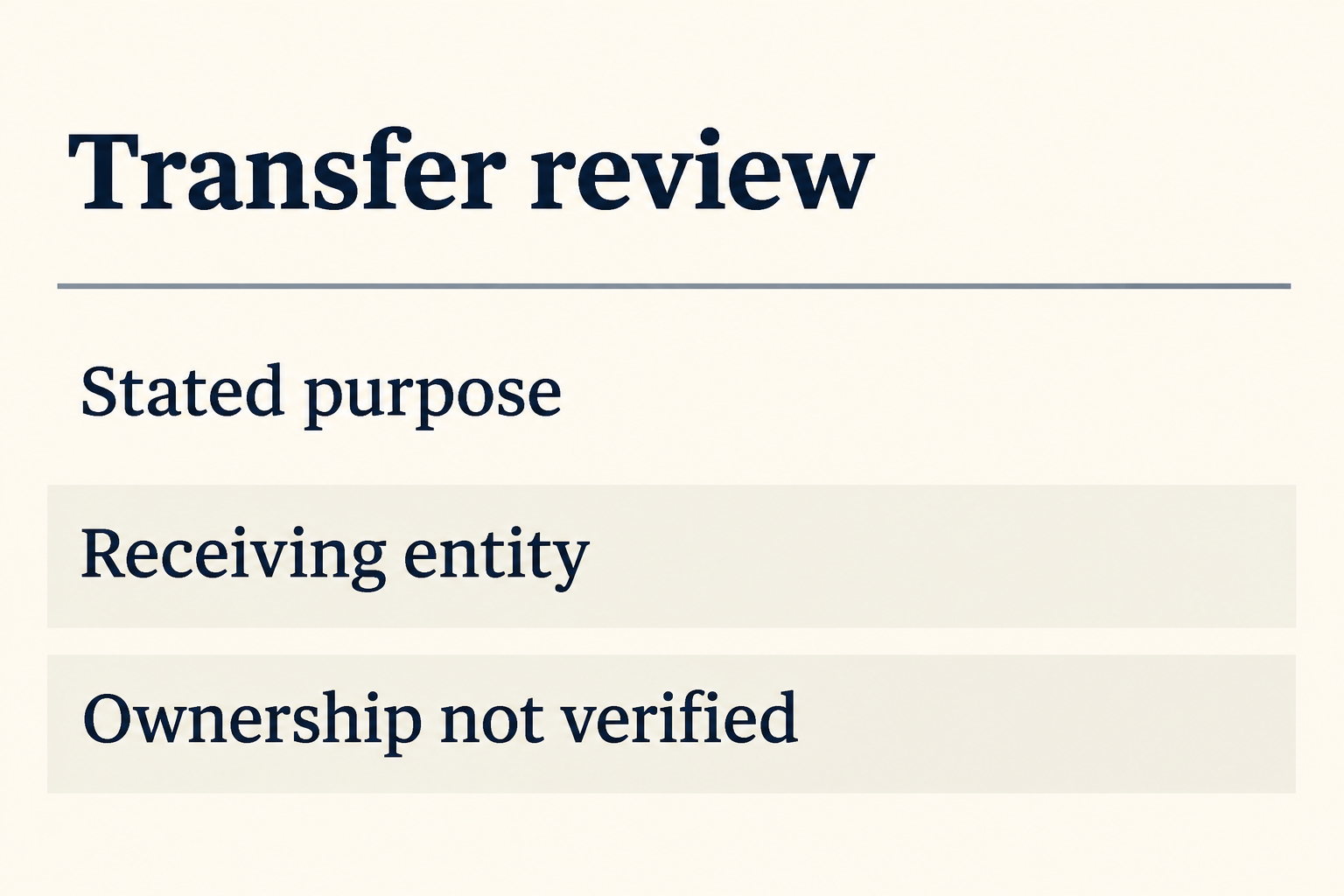
The lead image is a fictional transfer review. It contains no real payment instructions or account records from the investigation.
Four kinds of figures appear in the coverage
Treat the size of a bond issue, a loss estimate, money returned to Malaysia and a court penalty as different measurements. One figure cannot be substituted for another.
- Bond proceeds describe what was raised, not what every investor lost.
- The wider diversion figure covers multiple transactions, not one transfer.
- Returned assets describe completed recoveries to Malaysia, not individual payments.
- A court fine or sentence describes a penalty rather than an investor refund.
That distinction is useful if you receive a notice claiming to release 1MDB money. Quoting a correct public figure doesn’t authenticate the notice or make you eligible for payment.
How the 1MDB Diversion Worked
Step 1: A real fund raises money through recognizable institutions
A public institution can issue bonds to finance purchases or projects. Investors who buy the bonds are lending money under written terms, not approving each payment the issuer later makes.
The Justice Department’s Goldman Sachs resolution identifies three 1MDB bond deals totaling about $6.5 billion. The deals themselves existed, and the proceeds came from actual bond financing.
Checking the issuer’s name is only a start. A genuine issuer can still be misrepresented in a later payment request or lose control of the proceeds.
Start by separating the purchase from what happened after the money arrived. A prospectus describes the stated investment, while independent transaction records help establish where the proceeds actually went.
Step 2: Insider influence weakens independent checks
The United States resolution describes admissions relating to a conspiracy to bribe officials to obtain or retain business with 1MDB. Goldman Sachs Malaysia pleaded guilty in its case.
The parent company’s resolution and the subsidiary’s guilty plea are different legal outcomes. Neither means every employee, bondholder or firm associated with the transactions did anything unlawful.
Apparent approval may not come from an independent source. A contact who arranged the deal shouldn’t be your only source for confirming the beneficiary or purpose.
When someone presents status or influence as a substitute for documentation, ask who is entitled to approve the payment independently. A recognizable institution’s name doesn’t answer that question.
Step 3: A similar company name makes a recipient seem familiar
The forfeiture complaint distinguishes the real Aabar Investments PJS from a similarly named entity incorporated in the British Virgin Islands. The latter is called Aabar-BVI in the filing.
The issue is ownership, not how convincing the label sounds. Two organizations can look connected in a letter or account description without sharing the same legal identity or ownership.
The complaint alleges that transfers described as security deposits went to the lookalike entity. It is that difference between the stated purpose and actual recipient that matters here.
Before making any payment on behalf of a business, check the legal name, jurisdiction and documented relationship to the counterparty. Verify an unexplained difference through a contact you already trust.
Step 4: Separate transactions make the larger picture harder to see
Prosecutors and civil investigators described money moving into other accounts and assets. The Guardian reports that investigators linked fund proceeds to property, artwork and other luxury assets.
An asset mentioned in a filing belongs to a particular legal process. Its appearance in the case doesn’t tell you whether it was sold, forfeited or returned.
Read the outcome next to the event. A complaint seeking an asset is not a court order, a completed settlement or a transfer back to Malaysia.
Those distinctions also stop a common kind of confusion. Separate recoveries from different dates cannot simply be added if one announcement already includes the earlier amounts.
Step 5: Recovery announcements concern the recipient named in the record
A June 2024 Justice Department announcement said an additional $156 million brought the amount the department had returned to Malaysia to approximately $1.4 billion.
That is a dated total for that department’s transfers. It should not be treated as a current worldwide recovery total or proof of a payment program for individual recipients.
The Malaysian judgment serves another purpose. It determines liability and penalties in that prosecution; it does not identify every person entitled to a payment arising from the broader scandal.
If a message says the proceeds are being distributed directly to you, ask for an official program order and independently confirm that it applies to your records.
How to Verify an Alleged 1MDB Transfer or Recovery Notice
Look up the entity, not just the name
Write down the legal names that appear in the correspondence, including any suffix. Check the jurisdiction and registration details against documents you obtained before the new request.
Look for who is permitted to act for each organization. A signature block, corporate logo or copied government title does not establish whether the sender holds that authority.
If a transfer recipient changes, use the contact details on the original contract. Do not verify the change by replying to the message that announced it.
A company registration record can confirm that a company exists. It does not by itself confirm that the company is an approved payee or an affiliate of a better-known institution.
Check whether the notice describes an actual program
Find the agency named in the message using an independently opened government page. Look for the official announcement, its date and the recipient named in it.
Read what the announcement says happened. Words such as returned, recovered, frozen or sought describe different stages, even when a headline puts them under the same label.
If the agency hasn’t announced a payment process that applies to you, don’t send bank or identity details to the caller. Ask the real agency about the notice.
An unsolicited demand for a processing fee does not prove a claim exists. Do not make a small payment merely to find out whether the larger one will arrive.
Keep the court timeline separate from the payment timeline
The December 2025 judgment followed the earlier SRC International case. Bernama reported in October 2026 that the court refused to stay the later sentence and fine pending appeal.
A refusal to pause a sentence does not decide the appeal. Use dated records to distinguish the sentence, the stay request and any appellate decision.
If an old article mentions only four counts, check whether it was written before reporting of the completed verdict. The timing can explain what appears to be a disagreement.
Put the court and date beside each update. That makes it easier to spot someone who quotes a real judgment from a different case.
Confirm that a guarantee covers the payment in front of you
A guarantee identifies an obligation and who stands behind it. It doesn’t prove that an account with a familiar name belongs to that party.
Find the signed provision and identify the parties to it. If a document tells you to pay a different entity, ask your own bank or adviser to review that instruction.
Don’t assume the new details are legitimate because an earlier payment went through. A bank can confirm that it processed a transfer without attesting that its purpose was genuine.
List what you’ve actually verified before treating the proposed payment as approved. A registration, a contract, a bank confirmation and a court notice answer different questions.
If several people approve payments in your organization, send the discrepancy to the person who didn’t arrange the deal. Preserve the original beneficiary instructions for comparison.
These checks apply even if a commercial transaction has nothing to do with 1MDB. The case illustrates why resemblance is weaker evidence than verified rights and ownership.
If an unsolicited seller describes a return as guaranteed by a government, request the exact official document. Don’t accept a forwarded fund announcement as proof that it covers your payment.
What to Do if You Have Fallen Victim to This Scam
Stop contact before making another payment.
If someone asks for a fee connected with 1MDB proceeds, don’t pay or share a verification code. Save the message without following any link it contains.
Check the notice through the relevant agency’s official page. Follow instructions only after confirming the program and its intended recipients through a channel you opened yourself.
Call the sending bank or payment provider.
If you paid an apparent recovery agent or changed a supplier payment to a false recipient, contact the bank’s fraud team using its official number.
Give the transaction date, amount, currency and reference. Ask whether a recall or fraud report is possible and request a reference you can use later.
Preserve the documents that led to the transaction.
Keep the initial request, later changes, payment confirmation and any company information already supplied. Note who introduced the sender and who was supposed to receive the funds.
Keep your original records in secure storage. Send financial or identity records only when a verified bank, agency or adviser actually requires them.
Check whether you’ve exposed credentials or identity documents.
If you entered a password or banking code, tell the provider immediately. Change exposed passwords through the genuine service from a trusted device and review recent activity.
If you shared identification, ask the issuing authority or your bank about protections appropriate to what you disclosed. Receiving a message alone doesn’t mean your identity was stolen.
Report the new contact separately from the historical case.
Describe what the sender said and what you paid, rather than reporting the entire 1MDB loss as if it were yours. Your own evidence is the useful part.
For a Malaysian financial scam, start with your bank and check Bank Negara Malaysia’s scam guidance. Elsewhere, use the reporting route for your own location.
Get qualified advice about an actual holding or claim.
If you hold a bond or have a documented legal claim, ask your broker, custodian or independent lawyer which authority has jurisdiction and what process applies.
Do not assume a government-to-government return creates a personal entitlement. Verify the actual notice and responsible institution before accepting any recovery estimate.
Frequently Asked Questions
Was 1MDB itself a fictitious fund?
It was a real Malaysian state investment fund. The scandal concerned the diversion of money raised through genuine transactions, not the invention of the fund’s name.
Are the bond proceeds the same thing as the loss figure?
No, the figures measure different things. The three bond deals identified in the Goldman Sachs resolution raised approximately $6.5 billion; that is not an individual or overall loss calculation.
Was Aabar-BVI the genuine Abu Dhabi company?
The forfeiture complaint describes them as separate legal entities. The similarity of their names did not establish ownership or make transfers to one transfers to the other.
Did the December 2025 sentence replace the SRC case?
No, it was a separate Malaysian judgment. Check the date and court case whenever a report mentions an appeal, a pardon or a different confinement arrangement.
Does money returned to Malaysia mean I am owed a payout?
A return of assets to Malaysia does not establish an individual entitlement. Look for an official program that explicitly applies to your position before sharing information.
Should I pay a company to check whether I qualify?
Do not pay an unsolicited agent that promises access to recovered funds. Check the official announcement and ask your provider or an independent adviser what is actually available.
The Bottom Line
An official name and a real bond do not prove that proceeds reached the intended recipient. Verify the legal entity and purpose before acting on a transfer or recovery notice.
If you already paid a suspicious sender, contact your bank and save your records. For an actual claim, verify the governing case and the official process before submitting anything.

Join the discussion
0 commentsShare your experience or ask a question about this article.
Community experiences
Did this happen to you?
Your experience could help someone recognize the same scam. Submit a private report for our team to review.
I experienced this tooReports are reviewed before publication. Sharing publicly is always your choice.
Discussion
Start the conversation
Have a question or something useful to share? Add the first comment.