


An unfamiliar marketing charge appears in your business bank account, but nobody remembers buying the service. The transaction looks routine enough to disappear among ordinary expenses.
Before treating it as a forgotten subscription, find out who authorized it. The Jeremy Briley case shows how fake merchants used normal payment processing to reach real accounts.
Overview
Sham marketing businesses obtained unauthorized bank debits
Jeremy Todd Briley worked as a payment-processing broker, helping merchants establish relationships with companies that processed their charges. His two largest clients were sham businesses.
They claimed to provide online marketing services, but obtained money through unauthorized bank debits. Briley maintained processing relationships despite information showing that victims had not authorized the charges.
The DOJ’s sentencing announcement describes more than $14 million in unauthorized debits and attempted debits associated with the scheme.
That figure includes both completed and attempted transactions. It does not mean every debit succeeded or that $14 million was returned to victims.
A guilty plea and prison sentence confirmed the conduct
Briley pleaded guilty to wire fraud in April 2026. He received three years in prison in July, followed by three years of supervised release.
The court also ordered forfeiture of $460,000 in fraud proceeds. Forfeiture is different from a verified payment to each person or business that lost money.
This was deliberate theft through sham merchants and concealed unauthorized activity. It was not established merely by one customer’s disagreement with a legitimate marketing company.
A processed charge did not prove customer consent
The case illustrates a basic problem with statement entries: the bank can record a transaction even when the underlying merchant’s claim to authorization is false.
- Check the original transaction and recipient instead of relying on a familiar-sounding service description.
- Ask other authorized account users whether they actually approved the charge.
- Report an unexplained debit to the bank promptly rather than waiting for a merchant’s explanation.
- Keep requests for a refund separate from requests to prevent further unauthorized activity.
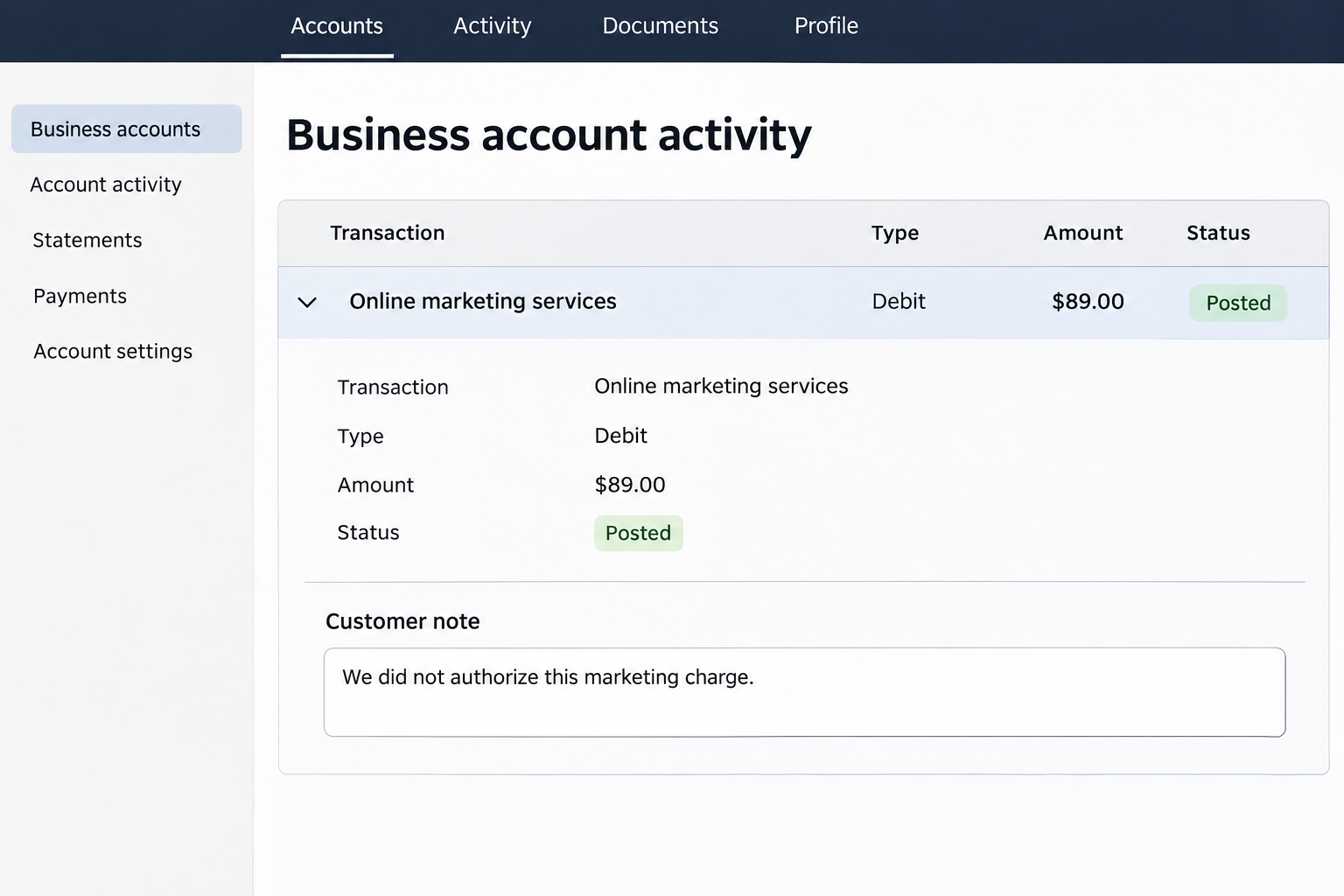
The reconstructed account image uses a fictional $89 entry to illustrate the issue. It is not a victim’s bank record or an amount established in Briley’s case.
Why an Ordinary-Looking Marketing Charge Can Be Missed
Business statements contain many recurring expenses, and the person reviewing them may not have placed every order. A broad description such as marketing can fit several plausible purchases.
A charge can be unfamiliar to you but authorized by someone else. It can also look familiar while having no genuine approval at all.
Start with the underlying transaction rather than guessing from the wording. Find the amount, date, description and bank reference, then compare them with actual purchasing records.
If nobody can identify an agreement or authorization, that is a reason to contact the bank. You do not need to wait for a stranger to confirm the problem.
The Briley case also shows why reaching a payment processor was part of the fraud’s machinery. Access to normal processing helped sham merchants submit the debits.
A merchant’s ability to collect money therefore did not independently establish a genuine customer relationship. The payment rail and the customer’s consent were different questions.
How the Fake Marketing Debit Scam Works
Step 1: Sham merchants claim to sell a legitimate service
Briley’s largest clients presented themselves as online marketing providers. That description supplied an apparently ordinary business reason for charges against customer accounts.
The criminal account says the merchants instead stole through unauthorized debits. Their claimed service did not establish a genuine purchase behind those transactions.
When checking a comparable entry, ask what was ordered, by whom and under which agreement. A broad service category cannot supply those missing details.
Step 2: A broker connects the merchants with processors
As a broker, Briley identified U.S. payment processors for his merchant clients. Those relationships enabled the companies to submit charges through established financial channels.
This role placed him between the merchant and the processing system. It also explains why the person enabling the debits might never appear in the customer’s original conversation.
You do not have to identify every intermediary before reporting the transaction. Start with the bank record and let the institution establish the route it actually used.
Step 3: Unauthorized debits reach real bank accounts
From February 2017 through December 2023, Briley obtained and maintained processing relationships for the sham companies while knowing they were fraudulently debiting accounts.
Victims were dealing with actual financial transactions, rather than merely a fabricated invoice demanding payment. Money could leave the account before the customer recognized the supposed merchant.
That is why checking the account itself matters. Ignoring a suspicious message does not resolve a debit that has already posted.
Step 4: Warning information is concealed
Prosecutors said Briley repeatedly received information that the debits lacked authorization. He concealed the fraudulent activity and arranged for a processor to manipulate return rates to deceive banks.
The important finding is his knowing participation in keeping the scheme operating. It is not necessary to reproduce methods for evading payment controls to understand the harm.
For a victim, keep the bank’s responses and any repeated entries. Those records may show a pattern beyond one unexplained transaction.
Step 5: Victims need both recovery and prevention
A request to return an earlier debit does not automatically establish that future debits are blocked. Ask the bank about both issues explicitly.
Likewise, closing a conversation with a merchant is not the same as securing the financial account. Check which protection the bank applied and how you can verify it.
The relevant action depends on the transaction type. A bank-account debit, check and card charge may require different handling even when all appear on a statement.
411 Listings, Altitude Processing and Clear Marketing Agency
The case page identifies merchant names
The DOJ’s Briley case page lists 411 Listings, Altitude Processing and Clear Marketing Agency among the sham-company names associated with his case.
Those names can help a person compare existing records with the prosecution. A similar descriptor alone does not prove that a different company or transaction belongs to this scheme.
The customer’s actual authorization still matters
Check whether anyone with authority over the account approved a service under another business name. Compare the charge with the agreement and the original payment instructions.
If a legitimate purchase exists, describe that fact accurately to the bank. Do not label an authorized payment unauthorized simply because a provider later disappointed you.
Briley’s brokerage role was separate from the supposed service
Briley helped the merchants obtain processing relationships. Their claim that they provided online marketing was the apparent commercial reason for debiting accounts.
That division helps explain why several names can appear in the financial trail. Ask your bank to identify the actual originator rather than guessing which name performed which role.
The shared page covers a separate defendant as well
The same DOJ page also discusses Eri Guzman Ortiz and a separate fraudulent-check case. Its amounts and proceedings should not be merged with Briley’s sentence.
For an inquiry about the Briley matter, identify case 1:25-CR-20350. The case number helps distinguish which set of transactions and court proceedings you mean.
Check the Debit Before Searching for a Cancellation Form
Begin with your genuine bank website, app or a statement you already trust. Open the account’s transaction history and locate the entry by date and amount.
Save the available transaction details, including the full description and reference. Avoid posting an account statement publicly to ask strangers what the charge means.
Ask authorized colleagues whether they approved it, and check purchasing records. If there is no matching authorization, contact the bank’s fraud or business-account support team immediately.
Ask whether the entry is an electronic debit, a check or a card transaction. That classification determines which dispute, stop-payment or account-protection options the bank can assess.
The Nacha payment FAQ explains that banks can help identify unrecognized ACH debits and that time for reporting unauthorized transactions is limited.
Nacha itself does not process individual payments or hold the records needed to trace your transaction. Your own financial institution is the practical starting point.
For a business account, ask which agreement and deadlines apply instead of assuming a consumer rule covers it. Request that information when first reporting the debit.
If the bank cannot identify the entry immediately, keep the inquiry reference and ask which team will investigate. Do not supply credentials to an outside caller offering to trace it.
What to Do if You Have Fallen Victim to This Scam
-
Collect the transaction details from your own account and compare them with actual approvals. Ask other authorized users before concluding that nobody consented.
Preserve the date, amount, description and available bank reference. Keep any related invoice or message separately so the original record remains clear.
-
Report the unauthorized debit to your bank through its genuine business-account or fraud contact. Explain that you cannot identify a purchase or authorization supporting the charge.
Ask how it classifies the transaction and which return or dispute procedure applies. Provide the evidence requested and obtain the applicable deadlines immediately.
Do not wait for a website or merchant to answer first. Your bank’s reporting window may continue while an outside party delays responding.
-
Ask specifically how to prevent further unauthorized debits from the identified originator. Have the bank explain any available block, filter or other account control.
Confirm which protection it actually applied and what you should monitor afterward. Do not assume that a refund request automatically stopped every future transaction.
-
Review nearby transactions and earlier statements for the same originator or unexplained description. Record each entry separately with its date and amount.
If new activity appears after the report, notify the bank using the existing case reference. Keep the original inquiry and later reports connected.
-
If your records may relate to Briley’s prosecution, use the official case page and identify case 1:25-CR-20350.
The page publishes the Victim Assistance Line at 888-549-3945. Ask whether your information relates to that case and which supporting documents should be provided.
A case inquiry is separate from asking your bank to investigate a debit. Neither process requires paying an unsolicited agent to unlock an alleged refund.
-
Report the internet-related fraud through FBI IC3. Start with File A Complaint, review and accept the terms, and complete the transaction and encounter details.
Include the merchant descriptions and bank references from your actual records. Retain your submission details and any confirmation provided rather than relying on memory.
-
If credentials or financial access were disclosed, tell the bank exactly what was shared. Let its authorized staff assess the relevant protection for that account.
The presence of an unauthorized debit does not itself establish how account details were obtained. Avoid assuming that every device or unrelated account has been compromised.
Keep a Refund Promise Separate From Your Bank Report
An outside party may promise that a refund is already underway. Ask for the transaction reference and verify the status through your own bank.
Do not treat an email saying money was returned as equivalent to a credit in the account. Preserve the promise, but check what actually posted.
If a genuine credit appears, ask whether it is final or provisional under the bank’s process. Keep the relevant notices and respond to any request for supporting information.
An unfamiliar caller offering a refund should not need your password or active verification code. End the conversation and contact the institution through details you already trust.
The Briley forfeiture order does not establish a public payout ready for anyone who recognizes a descriptor. Verified case communications must explain any actual victim process.
Frequently Asked Questions
Is this a confirmed scam or a billing complaint?
Briley pleaded guilty to wire fraud and received a prison sentence. The official account describes knowing facilitation of unauthorized debits through sham merchants.
That is different from an ordinary service dispute. For your own entry, establish whether it was actually authorized before telling the bank how it occurred.
Was $14 million definitely taken from accounts?
DOJ described unauthorized debits and attempted debits totaling more than $14 million. The figure includes transactions the companies attempted, rather than only completed theft.
It should also not be confused with forfeiture or money returned. Each amount answers a different question about the criminal case.
What names should I compare with my records?
The Briley case page lists 411 Listings, Altitude Processing and Clear Marketing Agency. Preserve the exact description and recipient information shown by your bank.
A partial or similar name is a lead for checking, not proof that an unrelated company committed fraud. Ask the bank to identify the transaction’s actual originator.
Will canceling a debit card stop the charges?
First ask the bank which payment route produced the entry. A bank-account debit and a card transaction can require different handling.
Have the bank explain the relevant protection rather than assuming one replacement card resolves everything. Ask separately about recovery and preventing another unauthorized debit.
Should I contact Nacha to retrieve the payment?
Nacha explains the rules of the ACH network but does not process individual payments or have access to their details. Contact your bank or credit union first.
Its staff can identify the transaction and explain the applicable process. Keep the reference and deadline provided when reporting the activity.
Does the forfeiture order mean refunds are available?
The $460,000 forfeiture order does not establish that a specific victim refund has been approved or distributed. Check any claimed payout through the official case contact.
Do not pay a processing fee to someone claiming to release your share. Use the official victim-assistance route if the records relate to this prosecution.
The Bottom Line
Do not dismiss an unexplained marketing debit as a forgotten subscription. Check actual authorization and contact your bank promptly if nobody approved the charge.
The Briley case confirms that sham merchants can use ordinary processing relationships to submit fraudulent debits. A posted transaction does not establish genuine consent.
If money has already left, preserve the entry, report it immediately and ask about both recovery and further-debit prevention. Follow verified case instructions without paying an unsolicited refund intermediary.

Join the discussion
0 commentsShare your experience or ask a question about this article.
Community experiences
Did this happen to you?
Your experience could help someone recognize the same scam. Submit a private report for our team to review.
I experienced this tooReports are reviewed before publication. Sharing publicly is always your choice.
Discussion
Start the conversation
Have a question or something useful to share? Add the first comment.