


An anti-choking device looks reassuring in a kitchen drawer. The appeal is having something within reach when nobody knows what to do next.
AirwayClear adds a claim about the FDA to that reassurance. Before relying on it, check what the agency actually authorized.
Overview
The FDA wording is about a specific device, not a family of lookalikes
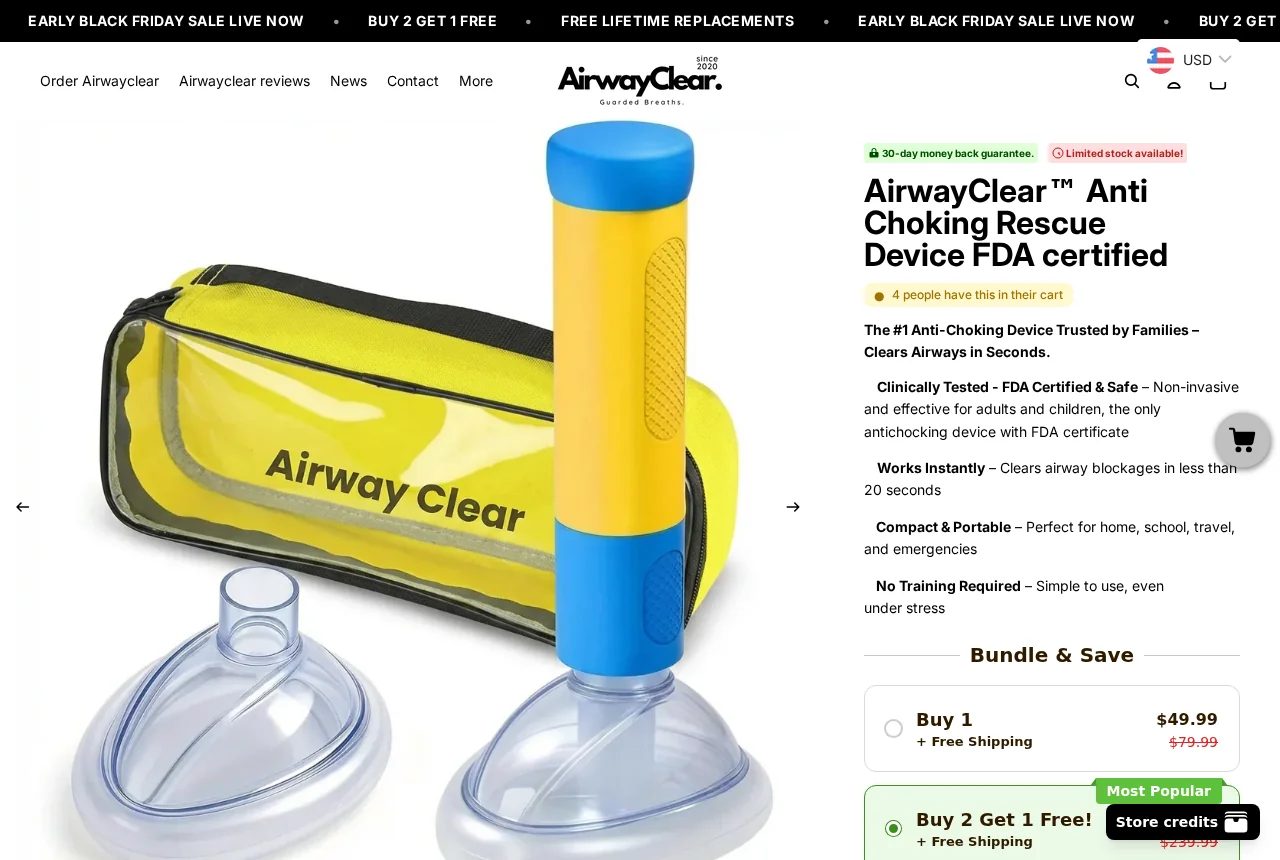
An AirwayClear sales page describes its rescue device as FDA certified. Its page title uses FDA approved. Those are material claims for emergency equipment.
The FDA’s public authorization record names LifeVac, made by LifeVac LLC. It doesn’t identify AirwayClear as the authorized product.
Both descriptions involve suction, but that’s a shared mechanism, not a shared authorization. A seller needs a record that identifies its own exact manufacturer and model.
The FDA’s safety communication directs people to established choking rescue protocols first. If someone is choking now, call emergency services and follow the dispatcher’s instructions.
An unboxing isn’t a test of rescue effectiveness
In ScamAdviser’s AirwayClear video, the reviewer showed a manual suction device with masks for different sizes and discussed the need for a seal.
The reviewer also gave an impression of suction after trying it on themself.
That is not a controlled test in a choking emergency and doesn’t measure successful removal of an obstruction.
The relevant footage showed a yellow component and a clear mask. Another listing under the AirwayClear name describes an automatic version. Don’t apply the manual unit’s findings to it.
These differences matter before you even ask about price. You should know whether the seller is offering the same mechanism and age indications as a device it compares itself with.
Three checks the marketing doesn’t do for you
- Check the name on the FDA record. Don’t stop at a screenshot of an agency logo or the number for a different company.
- Check the intended role. The named FDA authorization is for a second-line device, not a replacement for standard choking first aid.
- Check the actual package. A child-size mask doesn’t establish that the device is appropriate for an infant, or that a regulator has authorized it for that age.
- Check the written terms if you already ordered. A satisfaction banner and the actual refund exclusions aren’t necessarily saying the same thing.
How the AirwayClear Offer Builds Confidence
Step 1: The page turns a frightening scenario into a buying decision
The seller’s presentation starts with the fear of losing time during a choking emergency. A product photo offers something you can buy today to feel more prepared.
That is understandable. But the decision you need to make now isn’t how to buy the quickest gadget. It’s what plan your household should follow while you wait for help.
The FDA warns that getting a device out, assembling it or using it can delay known rescue measures. A simplified buying page doesn’t remove that risk.
Set a separate goal from purchasing anything. Learn age-appropriate first aid from a recognized organization and know how to reach emergency services. Equipment marketing is not a training program.
Step 2: Familiar technology is presented as proof of authorization
AirwayClear compares its suction approach with LifeVac and other devices. A sentence about similar technology is not the same thing as the FDA finding two finished products equivalent.
In the LifeVac classification order, the FDA describes a specific non-powered device for complete obstruction after the current choking protocol hasn’t worked.
The authorized indications specify use from age one and a second-line role. That language should not be copied into the instructions for another product.
AirwayClear’s sales copy doesn’t provide a matching AirwayClear authorization number next to the FDA claim. Do not rely on that claim unless the seller can supply the exact record.
Step 3: Revisions and bundles make the comparison more confusing
The same brand appears on a separate AirwayClear offer that describes automatic, one-button operation and distinguishes it from manual devices.
That version is not what the reviewer demonstrated. It also shouldn’t inherit the regulatory record for a non-powered LifeVac device just because both packages include masks.
On the automatic bundle page the seller lists one unit at $59.99, two plus one at $119.90, and three plus two at $179.99, before any address-dependent charges.
Those advertised totals describe package choices. They do not establish that an order upgrades automatically or renews. Compare the model, the final charge and the quantity on the actual order.
Step 4: The offer uses a guarantee to make uncertainty feel reversible
The main product page advertises a 30-day money-back promise. The separate automatic page shows 60 days near the offer and refers to 30 days in its FAQ.
That’s a genuine reason to save the page before ordering. A buyer shouldn’t have to choose a deadline by guessing which line applies to a particular model.
More importantly, a refund guarantee cannot test an emergency tool.
It can’t show that a child-size mask will fit, that a seal can be achieved, or that an obstruction will clear.
Get the model documentation before buying. If you can’t confirm the device and its regulatory status, a discount or longer return period doesn’t solve the problem.
Seller, Device Identity, and Return Checks
An official-looking domain isn’t the device manufacturer’s name
The seller site uses the AirwayClear brand and publishes a Dubai business address. That tells you what the storefront discloses. It doesn’t identify the manufacturer in an FDA authorization record.
A seller may use another distributor or fulfillment partner. Your receipt and the box label are better evidence of who took the order and which product was supplied.
Don’t combine orders across similarly named domains. The specific website, receipt and product markings matter if you want the seller to explain the safety claim.
The support address doesn’t establish the return destination
The storefront lists a support email. The policy directs buyers to contact it to start a return.
That is not permission to send an item to the address in the footer.
Ask for the return location, any authorization code and who pays postage. Get the instructions for the order you actually made instead of using a shipping-label address.
This matters on a purchase made for multiple households. One merchant may handle returns per order, and sending only one part of a bundle back can leave the claim unresolved.
The written policy is narrower than satisfaction copy
The AirwayClear refund policy describes a 30-day request window and calls for an unused item with the original packaging and proof of purchase.
It separately discusses damaged, defective or incorrect items. Its exclusions include some opened personal care items and discounted or final-sale items.
If you bought from a discounted offer, ask whether the store applies that exclusion to your order.
Don’t assume that every purchase is excluded or that a no-questions banner overrides it.
A model number is more useful than an impressive medical phrase
Look for manufacturer, model, lot information and intended age range on the packaging and instructions.
If you cannot match them to a regulatory record, don’t treat a generic certificate as enough.
The FDA distinguishes device establishment registration from product clearance or authorization. A facility record in a database doesn’t prove the particular product was evaluated for use in an emergency.
If the seller provides the LifeVac number, check the marketed model anyway. A number for LifeVac is not evidence that an AirwayClear-branded manual or powered unit is covered by it.
What the Label Should Tell You Before You Trust It
Start with the use case, not the list of people in the ad
The product page describes uses at home, school, during travel and in emergencies. That list describes settings. It doesn’t show that the device is suitable for everyone in them.
Ask for the age and size limits from the actual instructions, not the seller’s broad description.
A supplier can put two masks in a box without establishing the smallest safe fit.
For a school or childcare setting, talk to the person responsible for first aid. Staff should know their established response plan rather than assuming a purchase changes it.
If someone has recurring trouble swallowing, talk to their care team. A shopping page can’t assess why that is happening or tell you which plan is appropriate.
Check that the written record matches how the device is powered
A manual plunger and a powered unit have different things to verify. Learn which one the seller will ship before reading an instruction sheet or certificate.
On the captured filled-out offer, one unit was listed at $49.99 and the multiple-unit line was selected. The separate automatic page advertised its single unit at $59.99.
That pricing difference doesn’t establish that one is a better device. It tells you the offer changed enough that you can’t use the product name alone to compare two purchases.
Keep a screenshot of the package selection before you leave the page.
If the seller shows one device with a yellow body and another with a button, identify the ordered one.
Ask to see what backs the speed and risk claims
The seller says the device clears airways in less than 20 seconds. A number that precise calls for evidence about the actual model, not just a short video.
It matters whether a claim describes a timed operation on a demonstration model or successful outcomes in real people. Those cannot be substituted for one another.
The promotional comparison describes its own approach as having no injury risk. The FDA notes reports of problems with this broader device category, including bruising and inadequate suction.
Those category reports don’t tell us the number of incidents for this advertised model. They do explain why the sales page can’t guarantee a risk-free result.
For an emergency product, missing evidence isn’t just an inconvenience. It leaves you without a good reason to rely on this particular offer or change the sequence of care.
What to Do If You Ordered AirwayClear
-
Keep an established emergency plan in place. Don’t swap first aid readiness for an unverified device. Use training appropriate for the ages in your home and follow emergency dispatch instructions.
In an active emergency, call your local emergency number. Don’t spend that time trying to find an order receipt, assess a marketing claim or figure out an unfamiliar device.
-
Preserve the claim and confirm which version you received. Save the wording about the FDA, order date, quantity and product page. Photograph the packaging and exact model label.
If you ordered a manual model and received an automatic one, record the difference explicitly. The seller needs to explain your actual order, not just the version advertised today.
-
Ask for the exact authorization citing the named device. Request the number, manufacturer and model.
Compare them with the public record rather than accepting a copied agency mark or seller screenshot.
Ask what indications and age limits the record covers. Do not assume a child’s mask establishes suitability for every age.
-
Request cancellation or return before the shortest stated window closes. Contact the original storefront with the order reference and the problem. Ask whether it wants the device left unopened.
If you receive return instructions, verify the destination, tracking requirement and postage responsibility. Keep copies of the policy and confirmation instead of relying on a temporary sales page.
-
Use the proper channel if there was a harm or unresolved purchase. In the US, the FDA safety notice explains how to report a device problem through MedWatch.
A merchant dispute is separate. Ask your card issuer or marketplace what proof it needs if the seller does not resolve a problem. Keep the device and its packaging available.
Frequently Asked Questions
Does the FDA record for LifeVac cover AirwayClear?
No. The record names LifeVac and its manufacturer. Shared suction mechanisms, similar masks or a seller comparison do not carry that authorization over to AirwayClear.
What did the AirwayClear video actually establish?
The reviewer showed a manual device and gave an impression of its suction.
That demonstrates what one product looked like, not its success rate or ability to replace established first aid.
Is an FDA registration the same as authorization?
No. The agency explains that registering a facility or listing a device does not establish that the product was cleared, approved or authorized. Verify the named model and record.
Does the AirwayClear name always mean a manual device?
No. One offer describes an automatic AirwayClear model, while the test showed a manual version. Confirm which one appears on your order and packaging.
Should I use a suction device before standard choking first aid?
No. The FDA recommends established rescue protocols first. The LifeVac record specifically describes a second-line role. If someone is choking now, call emergency services and follow the dispatcher’s instructions.
Can I return an AirwayClear device after opening it?
Don’t assume you can. The published policy specifies unused condition and original packaging for ordinary returns. Ask the seller about the exact order and preserve the reply.
The Bottom Line
Don’t buy AirwayClear because the page says FDA approved. Verify the exact device and manufacturer independently, and don’t replace established choking first aid with a sales promise.
If you already ordered it, keep the packaging, save the approval claim and ask the seller to document it or arrange a return. Keep a first-aid plan in place.

Join the discussion
0 commentsShare your experience or ask a question about this article.
Community experiences
Did this happen to you?
Your experience could help someone recognize the same scam. Submit a private report for our team to review.
I experienced this tooReports are reviewed before publication. Sharing publicly is always your choice.
Discussion
Start the conversation
Have a question or something useful to share? Add the first comment.