


A stranger who signs as Amanda Murphy says she’s selecting people and businesses for an investment. The note mentions a British bank and a name everyone knows.
It doesn’t look much like an online giveaway. It reads like the beginning of a private conversation, and that’s what makes it worth a closer look.
Overview
A bank name, a famous donor and a raffle that doesn’t add up
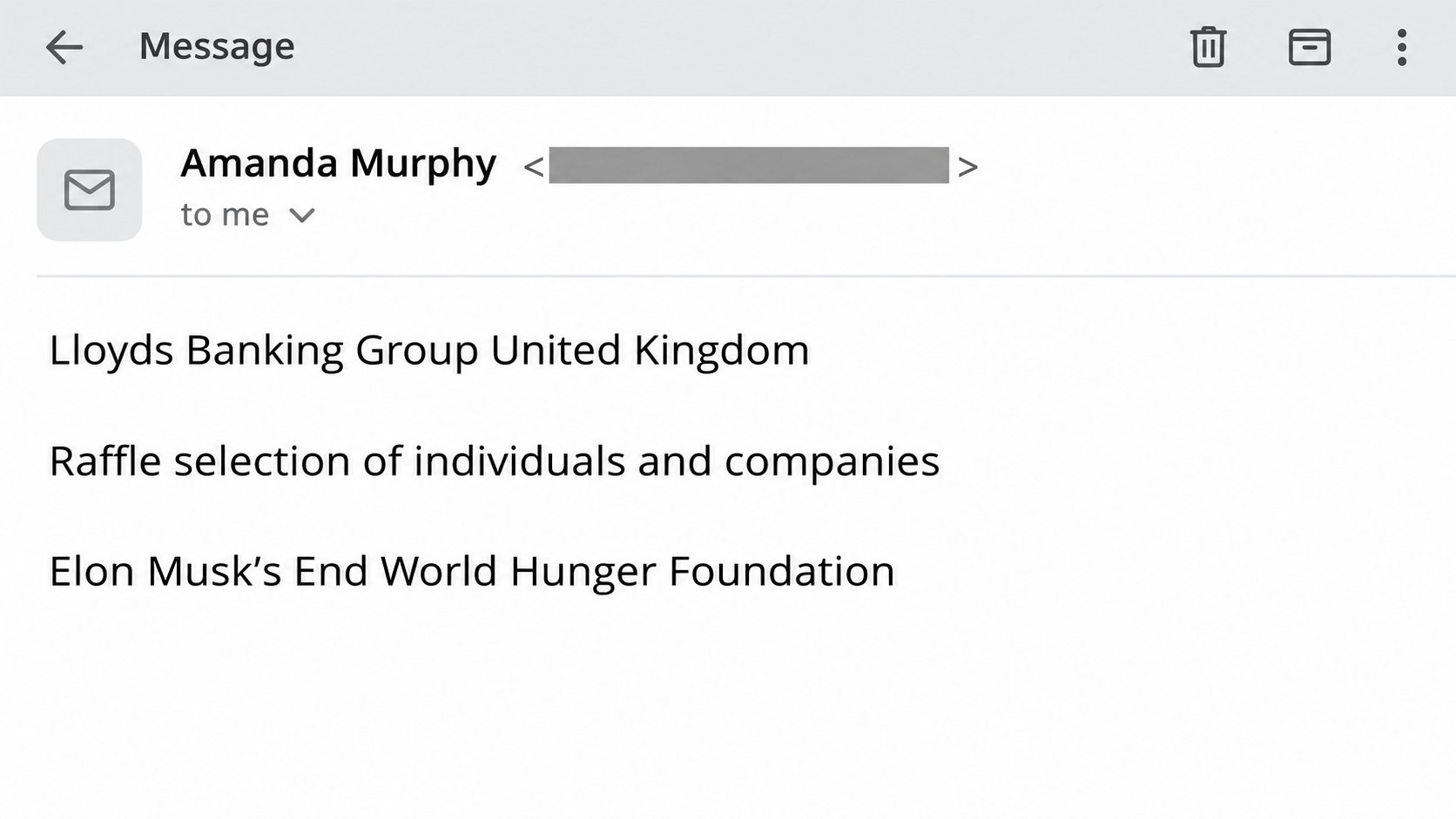
The Amanda Murphy email scam claims that someone at Lloyds Banking Group is selecting people and companies to receive an investment connected to Elon Musk and world hunger.
The text of the reported email spells the surname Murphy. You may see Murph in references to the same message. Neither spelling identifies the person behind it.
The supposed bank representative describes a raffle but doesn’t name a contest you entered. She says money will be invested but doesn’t tell you what the investment actually is.
That combination matters. The note wants you to react to a prize without giving you anything you could verify as a recipient, applicant or business owner.
The email is asking for a reply, not a payment yet
The reported message ends by inviting the recipient to ask for details. It doesn’t show a transfer, an application portal, an upfront charge or a claim amount.
The image above is a reconstruction of the message’s wording, not the original inbox. The available text doesn’t establish the delivery address, email headers or who would receive replies.
These are the clues you can check without replying:
- The sender claims to represent a bank but offers no independent way to confirm the role.
- The raffle is described without an entry, published rules or a selection record.
- The message borrows a public figure’s name but does not show authorization from that person.
- It asks you to continue privately before you know whether the offer is a prize, grant or investment.
A real conversation about famine is not proof of a private offer
A search about Musk and hunger can turn up real discussion. The World Food Programme published a plan for reaching 42 million people at risk of famine in 2021.
That plan is about getting food assistance to people in crisis. It is not a set of raffle rules or instructions for claiming an investment from a bank employee.
There’s no reason to dismiss the real humanitarian work. The useful distinction is that an authentic public document about hunger doesn’t validate a private email making a different promise.
What Would Make This an Actual Investment Offer?
Start with the terms you would need before accepting
An investment could involve a stake in your company, a loan or another agreement. Those arrangements have different consequences. You’d expect a written explanation of what each party gets.
A grant may instead have eligibility rules and instructions for how the money can be used. A sweepstakes needs a clear organizer and rules for entering and selecting winners.
Here, the sender uses language from all three without committing to any. You can’t check whether you qualify for an arrangement the message hasn’t defined.
If you’ve dealt with legitimate donors or investors before, don’t let that experience make you fill in the blanks. An impressive name doesn’t supply the missing terms.
Don’t use one claim to verify another
Finding a real employee with a similar name on a professional network would not show who sent the email. A stranger can look up the same profile you can.
Likewise, a document with the bank’s logo would not show that the bank issued it. Any verification needs to start outside the email, using contact details you found independently.
If you already bank with Lloyds, open the app or use a number from the bank’s own site. You don’t need to forward private documents to ask about impersonation.
The bank’s guidance on scam messages explains how to report suspicious email. For a business account, use the business support channel you normally use.
If you’re actually looking for funding, start with your own shortlist
Make a separate list of programs you approached, with dates and contact names from your records. An unexpected selection is easier to recognize when you can see your actual applications.
For a claimed foundation, look for a public program page describing who can apply and on what terms. Follow its published route rather than accepting a form from a stranger.
If a grant officer contacts you, check whether you can reach them through a published channel. Be wary if they insist that only the private thread can confirm your eligibility.
Check the kind of funding, too. A grant agreement shouldn’t suddenly become a personal account verification. Send questions to the organization before you send forms to anyone.
If you don’t have a connection to the purported program at all, you don’t need to disprove it or establish who sent it. You can leave it unanswered.
If you found the message in a shared business account, mark it unverified in your notes. That keeps a coworker from mistaking a forwarded copy for an invitation you endorsed.
How the Amanda Murphy Email Scam Works
Step 1: An unexpected message makes the offer feel personal
Instead of asking you to buy a lottery ticket or pay a bill, the email describes a selection already underway. It invites you to imagine what being selected might mean.
A small business might think about replacing worn equipment. An individual might see a lifeline for a project that hasn’t found financing.
The email names both audiences but doesn’t show why the sender approached either one. There’s no reference to an application, a proposal or even the nature of your work.
Look for the work you’ve already done to earn the opportunity. Was there a conversation with a known investor, a public entry form, or an application you can locate independently?
Step 2: Familiar names stand in for independently checkable details
Lloyds supplies a banking association. Musk’s name suggests the ability to fund a large project. The reference to hunger gives the note a reason to mention recipients in different countries.
You can recognize all three ideas and still have no reliable answer to the basic question: who is actually offering what? Familiar names alone don’t establish that.
This is why the same note can look more persuasive after a quick search. A result about Musk and food assistance feels relevant, even though it doesn’t authenticate the sender.
Step 3: The stranger asks you to continue the conversation
There is no payment button to tip you off in the reported message. The immediate request is simply to write back for more information.
That reply could show the inbox is monitored. Your email signature might also give away your job, direct phone number or the name of someone who approves payments.
At that point the exchange can start to look like business you initiated. Remember which side made first contact. A thread you answered is not an established relationship.
Step 4: The conversation may shift to documents or a fee
Later conditions were not captured for this message. The FTC’s charity and sweepstakes warning explains how similar offers can turn into demands for payment or sensitive information.
If a follow-up asks for an ID scan, details about your accounts or a fee to unlock funds, stop there. A request sounding administrative doesn’t make the recipient legitimate.
Don’t let a fee be judged by how small it seems. Ask why a stranger needs your money to give you theirs.
Step 5: A new explanation can keep the same promise alive
If you responded or paid, a second message may repeat details from the exchange. That can make the new sender sound like someone briefed by a legitimate office.
Don’t accept a fresh demand just because it refers to your earlier conversation. Someone who can repeat a name, document number or payment amount may simply have the same information.
Keep the earlier thread for evidence. Contact your provider directly if any money moved. Don’t ask the person who received it to arrange the next step for you.
If It Reached a Business Inbox
Hand it to one person without sending the whole office the lure
A note about investment may land with reception, an employee who handles invoices, or the owner directly. It only takes one well-intentioned person forwarding it to start an internal chain.
If you need to alert colleagues, share the relevant facts: the display name, the claimed bank, and the purported hunger raffle. Don’t circulate unnecessary copies of the message.
Use whatever your organization already uses for suspicious mail. A report button or a help desk can preserve the original for review while preventing mistaken replies from a shared address.
Keep the supposed funding out of real payment workflows
Do not create a new supplier, payee or settlement instruction because of the email. Do not send extracts from the company register just to find out what the opportunity is.
If other people can authorize transactions, let them know that the proposal is unverified. A warning before a rushed transfer is more useful than a dispute after it clears.
Check whether anyone replied from a shared mailbox or sent a file. Record what left the company. The response depends on the information disclosed, not the number of people copied.
What to Do if You Have Fallen Victim to This Scam
- Stop replying. Don’t accept a new contact channel, send another document, or ask for a final confirmation. Save the conversation before blocking the sender.
- If you sent money, contact the provider now. Use your bank’s official fraud channel. Give it the actual amount, time and destination, and ask what can still be stopped.
- Distinguish a payment you made from one you didn’t authorize. Describe what happened accurately so the provider can explain the right process. Neither kind of report guarantees reimbursement.
- List what you disclosed. An email signature exposes less than a passport image, a tax number or banking credentials. Tell each affected institution what the message recipient actually received.
- Secure any exposed sign-in separately. Use the real service to change the password and review recovery details and active sessions. Tell your work security team about a work account.
- Keep the evidence together. Save the original message, available headers, replies, attachment names and transaction receipts. Leave account numbers and ID pages out of public posts and group chats.
- Report the impersonation. Use the bank’s official reporting instructions. In the United States, use ReportFraud.ftc.gov. Outside the United States, use your local fraud-reporting service.
- Treat a promised recovery as a separate claim. Don’t pay a stranger to reverse a transfer. Ask the provider handling your report how it will contact you.
If you replied but gave away no credentials or sensitive files, that isn’t the same as a bank or mailbox takeover. Stop the exchange and watch for personalized follow-ups.
If you sent a national identifier or ID image, take that exposure seriously even if no payment went through. In the U.S., IdentityTheft.gov offers a recovery plan.
If you aren’t sure whether a payment is pending, don’t wait for it to appear in your account. Call the provider while a hold or recall may be possible.
For a wire transfer, keep the original confirmation and the beneficiary details your bank has on record. A forwarded screenshot from the stranger is not a reliable transaction record.
And if you’re helping someone else, start by asking what the email requested and what they actually sent. Blame can make people stop sharing details just when they need help.
Frequently Asked Questions
Is Amanda Murphy really contacting people from Lloyds?
The name is an unverified claim in the message. It is not evidence against a real person with that name or evidence that Lloyds sent the message.
Is the End World Hunger Foundation raffle the World Food Programme’s plan?
No. The published WFP plan concerns humanitarian assistance. It does not describe a Lloyds-administered raffle or an opportunity to claim an individual investment.
Does the reported email say how much I would receive?
No. The available text does not put a figure on the supposed investment. Amounts in other messages are not evidence about this one.
Is asking for more information harmless if I don’t click anything?
Replying can disclose your address or signature and invite a more personalized approach. You can verify any claimed offer independently without opening a conversation with the sender.
Do I need to change my password just because I read it?
Ordinary reading is not the same as sharing a password. Prioritize account recovery if you typed credentials into a page, sent them, or approved an unfamiliar sign-in.
Can I get my money back if I paid a clearance charge?
It depends on the payment method and transaction status. Report the payment promptly to its provider. Don’t send a second fee to the same person for a refund.
The Bottom Line
Don’t reply to the Amanda Murphy email scam or send money or identification. The note uses a real bank’s name and a public cause without a verifiable investment offer.
If you already responded, preserve the message and stop the exchange. If you paid or shared financial details, use your bank’s official fraud channel now.

Join the discussion
0 commentsShare your experience or ask a question about this article.
Discussion
Start the conversation
Have a question or something useful to share? Add the first comment.