


A card-account hold is the kind of message that can interrupt your day immediately. You start thinking about your next purchase before checking anything else.
The American Express notice discussed here offers a quick identity check. Before following its instructions, take a closer look at the promise behind that reassurance.
Overview
A supposed hold with a simple solution
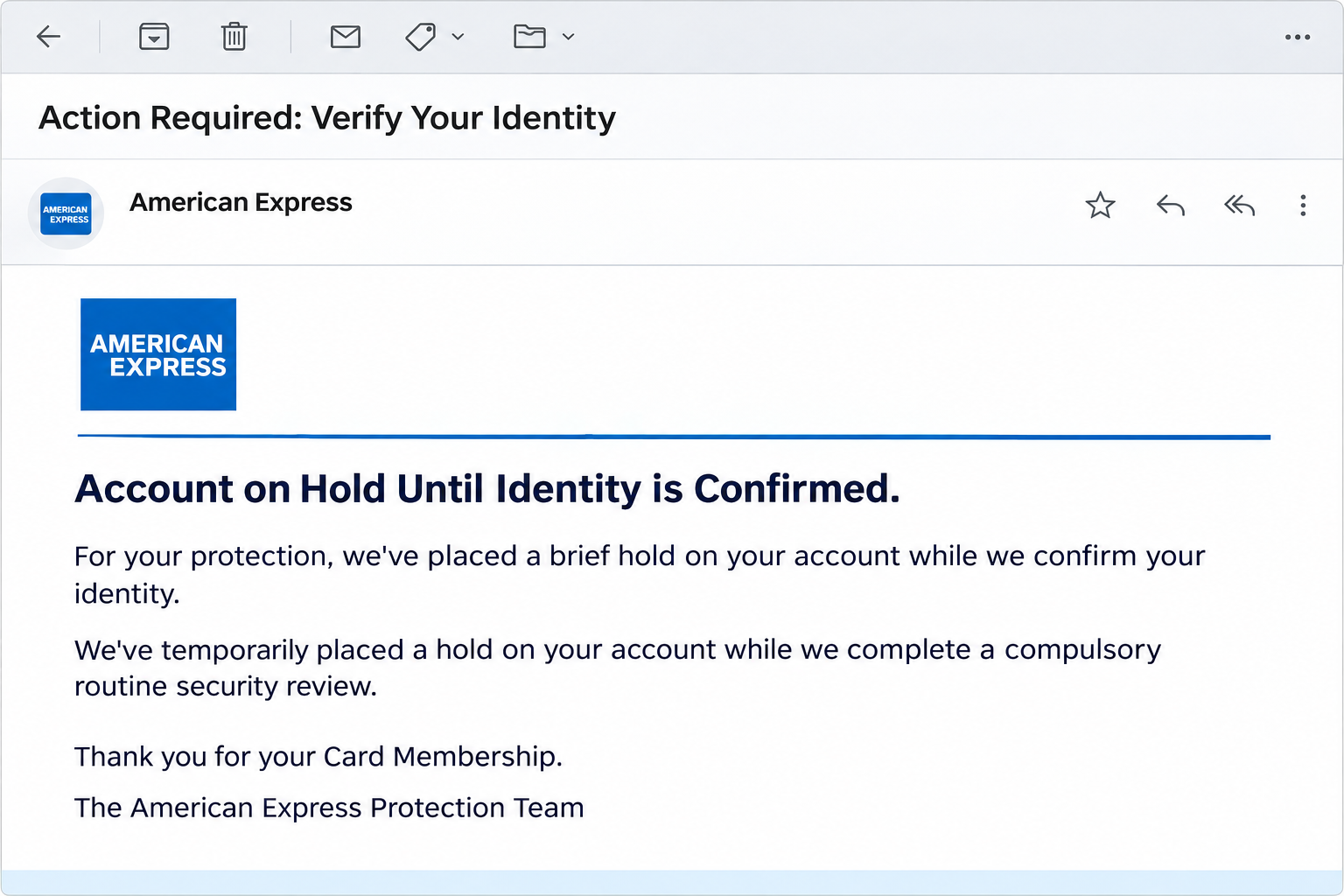
The American Express Account On Hold email says a compulsory security review has temporarily restricted the recipient’s account. Completing an identity check supposedly removes the hold immediately.
Its subject refers to identity verification, while the body addresses the reader as a cardmember. The message presents cooperation as the easiest way to restore normal access.
That is an effective financial pressure point. A person expecting to use a card may focus on removing the restriction rather than verifying who announced it.
The recorded message is an impersonation
This notice is not an authorized American Express communication. It borrows the company’s identity to direct recipients toward a purported account-verification process.
The linked destination was unavailable when the case was documented. Its final fields and behavior therefore cannot be described as an observed, completed transaction.
The safe conclusion is still clear: don’t use this email to restore card access. Verify the account through an independently opened Amex app or official support channel.
The claim needs checking without the message
American Express is a real card issuer, and real financial accounts can be restricted. The deception here is the unauthorized notice, not the existence of security reviews.
- A hold announced by an email should be checked against the actual account and the issuer’s records.
- A button displaying a familiar company address can conceal a different destination underneath its visible wording.
- An inaccessible link does not prove that an earlier password submission failed to reach its recipient.
- Any information already disclosed should be reported precisely, without assuming every possible type of fraud has occurred.
You don’t need to choose between ignoring account security and obeying a suspicious email. A separate conversation with the issuer addresses the real concern safely.
What the Message Is Trying to Make You Believe
The notice combines a restriction with reassurance. Your account is supposedly on hold, but the sender describes the review as brief, routine, and protective.
That combination can lower your guard more effectively than a dramatic warning. The interruption feels manageable, so a quick login seems like a sensible administrative step.
The promise of immediate restoration also supplies a reward. Entering information is framed as finishing a task, not as deciding whether an unknown website deserves your credentials.
Notice how little independent account information is needed for this approach. A generic security review can sound plausible without identifying a real purchase, dispute, or declined transaction.
A genuine account concern deserves a genuine channel
If a card really is restricted, the issuer can explain that through its established app, secure account messaging, or verified customer service.
You should not have to establish trust by following the very message you’re questioning. That would let the sender select both the alleged problem and the supposed authority.
Use the number printed on your physical card or already available through the official account. Don’t substitute a number supplied only in the concerning email.
The same applies to follow-up messages. Someone who claims to be fixing the hold still needs independent verification before receiving information or directing you to a page.
How the American Express Account On Hold Email Scam Works
Step 1: A financial restriction gets your attention
The email introduces an account hold as an existing fact. It doesn’t ask whether you’ve noticed a problem; it tells you that the company has already acted.
That wording moves the reader directly into problem-solving mode. A person planning travel, paying a bill, or managing expenses may feel an immediate need to respond.
The alleged restriction is only the sender’s claim until independently confirmed. Reading it does not establish that your actual Amex account is blocked or that your card details changed.
Keep that distinction in mind before trying a purchase or moving money. You can ask the issuer about account status without creating a transaction merely to test the email.
Step 2: A routine review makes the request feel reasonable
The notice describes identity confirmation as a compulsory security procedure. This gives the requested action an institutional explanation rather than leaving it as an unexplained login demand.
People are accustomed to financial verification, especially after changing devices or making unusual purchases. The message exploits that familiarity without proving that a genuine review applies.
Its protective tone also discourages resistance. A reader may worry that refusing to cooperate means refusing the issuer’s attempt to keep the account safe.
The better question is not whether identity checks can be legitimate. It is whether the request originated from the real issuer and leads into its authorized process.
Step 3: The advertised login becomes the point of trust
The message directs the recipient to log in and complete the check. Familiar wording beside that action can make the destination seem settled before it has been examined.
A displayed company address is just text within an email. It does not independently establish where a linked control will send your browser.
For this recorded example, the unavailable destination prevents a reliable account of the exact form. It would be wrong to invent card fields, document uploads, or additional verification screens.
Related phishing routes commonly imitate financial sign-in pages. The relevant precaution is to keep account credentials away from the unverified route, not to wait for a particular form design.
Step 4: Disclosed information can become a separate account problem
If you supplied a username and password, those credentials need protection even when the promised hold removal never appeared. A failed page does not retrieve a secret already submitted.
What happens next depends on account protections and the information disclosed. A stolen password creates risk, but it isn’t evidence that a particular purchase or transfer occurred.
If you also approved an unexpected authentication prompt, tell the issuer. That changes the incident from password exposure alone to a possible authorized session or action.
Don’t send further information to see whether the process eventually works. Additional submissions can widen the exposure while keeping you inside the sender’s invented verification task.
Step 5: Recovery must move outside the false review
The email’s promise is that completing its process will restore normal service. Following that promise further can delay the call or account check that actually matters.
Once you suspect impersonation, stop using the message as your source of support. Explain the incident to American Express through a separately established route.
The issuer can help distinguish an authentic account restriction from the fake claim. It can also assess disclosed credentials, card information, unusual activity, and any action already taken.
Keep these questions together, but don’t confuse them. A real restriction may need resolving even though the email was fraudulent, and a fraudulent email may arrive without any restriction.
Check the Hold Before Changing Anything
Open the account independently
Use the Amex app you already installed or navigate to the issuer through a trusted bookmark. Avoid taking a replacement login link from the suspicious message.
Look for account notices and review the status shown there. If something is unclear, use the app’s established support route rather than trying the email again.
For supplementary cards or business accounts, the relevant account holder or administrator may need to assist. Don’t disclose someone else’s credentials to overcome that limitation.
Keep your purpose narrow: confirm whether a hold exists and how the issuer wants it resolved. You don’t need to prove the sender’s intentions by interacting further.
Ask about the specific notice
Describe the subject and the claim that an identity check will immediately remove a compulsory review. Let the issuer determine whether it sent that notification.
Provide the email through the issuer’s reporting instructions when requested. Preserve the original rather than editing its content into a cleaner-looking version.
If you entered information, state the categories accurately: account password, card details, verification code, identity document, or another item. Don’t assume support can infer that from the email.
Read account activity without rushing to conclusions
Review posted and pending activity with the issuer’s help. A merchant description you don’t immediately recognize deserves investigation, but it is not automatically connected to this email.
Likewise, the absence of a strange charge doesn’t make exposed credentials safe. Protect the login before waiting to see whether financial harm appears.
Ask whether a password reset, session review, card replacement, or another measure fits your exposure. Card replacement and login recovery address different parts of the problem.
What to Do if You Have Fallen Victim to This Scam
-
Leave the message’s verification process and keep an incident record. Save the email and note approximately when you clicked, submitted information, or approved any prompt.
You can document those actions without reopening the destination. If the email was received at work, preserve it through your organization’s reporting process as well.
-
Contact American Express through a trusted route. Use your card’s printed number or support inside the established app, and explain that the hold notice may be fraudulent.
Ask whether the issuer actually restricted the account. This prevents a fake warning from distracting you from any genuine issue that separately needs attention.
-
Reset any account password disclosed on the unverified page. Use the real issuer’s reset process and choose a replacement that you have never used elsewhere.
If access has already changed, ask official support to guide recovery. Don’t purchase account-unlocking help from someone who approaches you after you discuss the incident.
-
Tell the issuer about codes, approvals, or personal information shared. A one-time code can authorize more than the task described by a scammer.
Identify what the real code message said, if available. That helps distinguish a sign-in attempt from another action requiring an issuer-specific response.
-
Review transactions and report unauthorized activity promptly. Follow the issuer’s dispute instructions and retain confirmation numbers, dates, and supporting records for any report.
Don’t send a new payment to supposedly reverse a fraudulent charge. Let the issuer explain the available process and any documents it needs.
-
Replace reused credentials on unrelated accounts. Start with the email account that receives your financial notifications if it shares the exposed password.
Inspect its recovery information and unfamiliar sessions too. Someone controlling financial-notification email could interfere with the very alerts you are relying on during recovery.
-
Report the impersonation without forwarding sensitive extras. American Express publishes phishing-reporting guidance through its official Security Center.
Follow those instructions while keeping passwords, full card details, and verification codes out of an ordinary reporting email. The original suspicious message is the relevant evidence.
-
Continue monitoring through the real account, not the warning email. Save your issuer’s advice and check for account changes or transactions you don’t recognize.
This case does not document a specific malware download. If you separately installed software or granted remote access, explain that additional exposure and obtain appropriate technical assistance.
If You Need Identity Verification for a Real Hold
A legitimate restriction can still be inconvenient, especially when a payment is due. Tell the issuer about that practical concern and ask which options remain available.
Let the verified support channel describe any required documents and the authorized method for providing them. Don’t reuse an upload page introduced only by the suspicious notice.
Check what a verification code is authorizing before proceeding. A request framed as removing a hold should not quietly become approval for an unfamiliar transaction or device.
If another person manages the account, contact them directly. Keeping them informed is more useful than trying several sets of credentials in an unverified form.
The important habit is consistent: resolve real financial administration with the issuer, while treating the email as evidence to assess rather than instructions to obey.
Frequently Asked Questions
Is the American Express Account On Hold email genuine?
The documented notice is an impersonation, not an authorized Amex security review. Verify your own account’s status through the established app or the number printed on your card.
Does receiving it mean my card has been frozen?
The email cannot establish the card’s actual status. American Express can confirm whether a restriction exists and whether any genuine action is required.
Why is the message promising an immediate release?
That promise makes the requested login feel like a quick solution. It does not demonstrate that the sender controls your real account or can remove a restriction.
What if the link was broken when I opened it?
Stop using that route and check the account independently. If you submitted information before the error appeared, report the disclosure and protect the relevant credentials.
Must I replace my card after entering a password?
Ask the issuer to assess the information exposed. A disclosed login, card number, identity document, and approved code can require different protective measures.
Should I ignore every email about an Amex security review?
Don’t ignore the underlying possibility of an account issue. Verify the concern independently instead of trusting the link, number, or instructions inside an unexpected notice.
The Bottom Line
Do not use the American Express Account On Hold email to verify your identity. Its claim of an immediately removable restriction does not authenticate the sender or its login route.
Ask the real issuer about your account through an established channel. If you disclosed information, report exactly what happened and protect the affected login or card without waiting for losses.

Join the discussion
0 commentsShare your experience or ask a question about this article.
Community experiences
Did this happen to you?
Your experience could help someone recognize the same scam. Submit a private report for our team to review.
I experienced this tooReports are reviewed before publication. Sharing publicly is always your choice.
Discussion
Start the conversation
Have a question or something useful to share? Add the first comment.