


The page asks for only one cent to verify your details, release an offer, or finish downloading something you wanted. The amount feels too small to matter.
Before reaching for your card, look beyond that first payment. The important question is what the page is asking permission to charge afterward.
Overview
The small payment is the opening
The €0.01 verification subscription scam uses an apparently trivial charge to draw people into a recurring arrangement they did not knowingly choose.
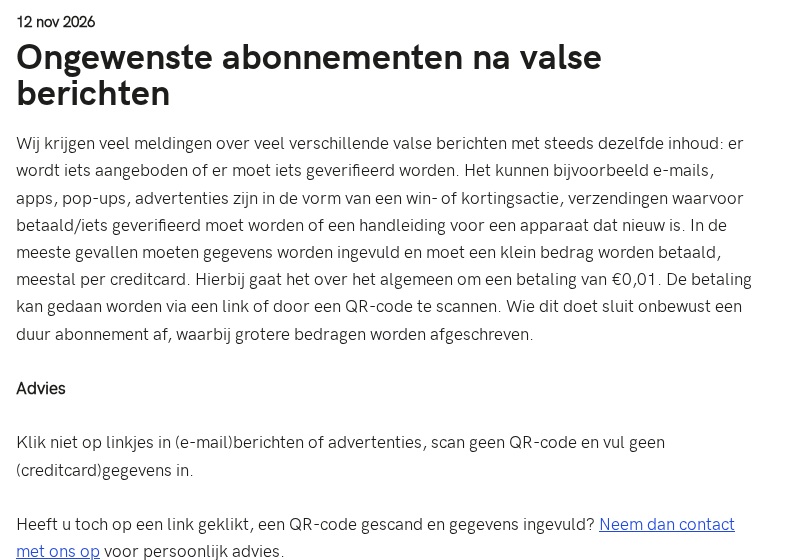
Fraudehelpdesk’s November 12 warning describes offers and supposed verification requests reaching people through messages, advertisements, pop-ups, links, and QR codes.
The bait can change without changing the billing risk
The service lists prize promotions, delivery-related requests, and device manuals among the examples. People provide details and a tiny card payment, then face larger subscription charges.
This warning concerns that deceptive enrollment pattern. It does not identify a single merchant or mean every legitimate card verification is fraudulent.
Check the arrangement, not just the amount
- Reject verification pages that conceal the actual service and ongoing price.
- Check whether the charge is a payment, authorization, trial, or subscription.
- Contact your card issuer if unexpected recurring charges appear.
- Keep cancellation evidence separate from requests to refund earlier payments.
Why One Cent Can Distract You From the Real Purchase
A one-cent request encourages a quick calculation: losing that amount would not hurt much. But that calculation addresses the first transaction, not the arrangement attached to it.
The page may be asking you to provide reusable payment information and accept terms for another service. The immediate price does not explain those commitments.
A person looking for a manual is thinking about operating an appliance. Someone waiting for a parcel is thinking about delivery, not joining a separate membership.
That mismatch matters more than the size of the initial charge. Ask whether the thing being sold is actually the thing you came to obtain.
If a page cannot clearly identify the service, business, ongoing price, and cancellation method, stop before entering card details. You do not need to risk payment to investigate.
Likewise, a page saying it merely needs to confirm your identity does not explain why an ongoing service would be necessary. Treat that unexplained change as material.
How the One-Cent Verification Subscription Scam Works
Step 1: An Ordinary Task Leads to a Payment Page
The first hook concerns something recognizable: collecting an offer, completing a delivery step, or accessing information. It makes a payment page seem incidental to your original task.
Before proceeding, identify where the task began. A manufacturer’s genuine support page differs from a search advertisement offering a manual through an unrelated service.
The same applies to a parcel message. Check the delivery in the carrier’s independently opened app or tracking page rather than letting an unsolicited message choose your payment destination.
Step 2: A Tiny Charge Makes the Decision Feel Harmless
The amount becomes the focus while the recipient enters more valuable information. Your card details and any payment permission deserve attention regardless of the first charge.
Read the business name and transaction description in your bank’s own prompt. If they do not match what you expected, decline rather than accepting the page’s reassurance.
A secure connection cannot resolve that mismatch. Encryption can protect data in transit without making the business, advertised task, or consent request trustworthy.
Step 3: The Actual Arrangement Is Different From the Expected Task
The central problem is unwanted enrollment. A reader expecting verification may discover that the payment was connected to a membership or service they never intended to purchase.
Do not assume the absence of a separate subscription checkbox settles the issue. Examine the visible summary and terms, without treating hidden code as proof of enrollment.
If important terms appear only after you provide payment information, do not continue to learn what they are. A legitimate decision requires that information before payment.
Step 4: Larger Charges Reveal the Consequence
A later bank entry may be the first moment the recipient realizes something broader happened. The name on that entry may differ from the original offer’s headline.
Build the connection using dates, amounts, receipts, and the service named in correspondence. An unfamiliar descriptor needs checking, not an immediate guess about who charged it.
Once the relationship is identified, address future billing and past payments separately. Stopping the next charge does not automatically resolve money already taken.
Legitimate Card Verification Versus an Unwanted Subscription
Check Why the Verification Exists
A known service may use a small authorization while adding a payment card. That context differs from an unexpected message telling you to pay to receive an unrelated benefit.
Confirm the request inside the service you intentionally opened. Look for an explanation of whether funds are actually collected or temporarily authorized, and why the check is needed.
If you never asked to add a card or start the service, do not assume a familiar logo explains the request. Verify the underlying account activity independently.
Read the Ongoing Price in Its Own Right
Look for the amount after any trial, the billing interval, what the service provides, and how cancellation works. A first-payment figure cannot substitute for these details.
Annual, monthly, and weekly charges are materially different commitments. Work out the cost over the period you expect to use the service, not just today’s amount.
If the summary changes when you choose a package or country, read it again. Preserve the final visible terms rather than relying on the page you first saw.
Do Not Confuse a Membership With a Download
A device manual should be checked through the manufacturer’s own support resources first. Find the exact model number so you do not pay for unrelated instructions.
A third-party information service may be selling access to its library rather than the single document you expected. That distinction must be understandable before any enrollment.
The existence of a downloadable file would not settle whether the billing was clearly explained. Content delivery and informed agreement to recurring charges are separate questions.
What to Do if You Made the One-Cent Payment
- Save the receipt, original message, page address, and any terms you already captured, without returning to an unfamiliar payment form.
- Review your card account for the initial entry and later charges, including pending transactions and unfamiliar merchant descriptors.
- Contact the card issuer through your banking app or established number, explaining that a verification payment may have created unwanted recurring billing.
- If you can identify a genuine merchant contact, dispute unwanted enrollment and request written cancellation and a separate decision about refunding earlier charges.
- Record dates, case numbers, and replies, then monitor subsequent statements to confirm that the requested billing stop actually took effect.
Describe what you agreed to as accurately as possible. Explain whether you saw a subscription price, received a receipt, or believed the payment served only a verification purpose.
Do not exaggerate your account to make it sound more urgent. The issuer needs the actual transaction and consent history to assess the available response.
If you paid through another provider, contact that provider too. A wallet, bank transfer, and recurring card payment may follow different procedures and offer different options.
Stopping Future Charges Is Not the Same as Canceling Everything
Ask About the Recurring Payment Permission
Ask the issuer whether the entry is part of recurring card billing and what instruction will stop further payments. Keep the answer and the time you gave that instruction.
The UK’s FCA guidance on recurring card payments explains that customers can ask their card issuer to cancel a continuous payment authority.
That guidance applies to the UK framework. Readers elsewhere should ask their own issuer about local protections, deadlines, and how to challenge billing they did not authorize.
Do Not Rely Only on Replacing the Card
A replacement card is not always sufficient to stop recurring payments. Ask your issuer specifically about the merchant and payment permission rather than assuming a new number resolves everything.
If card details may also be compromised, tell the issuer that separately. Protection against unrelated misuse and cancellation of an identified recurring arrangement address different risks.
Continue checking statements after the issuer acts. Save any further charge and compare its date with your cancellation instruction before asking the bank to investigate.
Keep the Service Dispute in Writing
Stopping a payment permission does not necessarily end a contract. If a merchant claims an agreement exists, request its evidence and obtain jurisdiction-appropriate consumer advice where needed.
Ask what service was supposedly purchased, when consent was recorded, and what terms were presented. Keep the merchant’s response rather than accepting a verbal assurance alone.
Do not pay an additional cancellation or verification charge simply because support demands it. Take that request to your issuer or consumer adviser before authorizing another transaction.
Organize the Evidence Around What You Expected to Buy
A useful record starts with your original purpose. State whether you were trying to receive a parcel, collect a promotion, or obtain instructions for a particular appliance.
Record the payment page’s description, the bank prompt, and the later statement entry. Keep those three descriptions separate in your notes.
Include the dates of receipts and cancellation requests. If a trial was mentioned, preserve the stated end date rather than reconstructing it from memory after a charge.
Do not publish complete statements or card details while asking other people for help. A redacted explanation is safer, while originals can go directly to the appropriate provider.
If a family member helped complete the form, ask what they saw too. They may remember a visible service name or package choice that you missed.
Ask the Issuer What the First Bank Entry Actually Represents
Record whether the tiny entry is pending or posted when you contact the bank. Ask it to identify the transaction rather than guessing from its temporary appearance.
If the initial amount disappears, do not take that alone as confirmation that no recurring arrangement exists. Ask the issuer specifically about any continuing payment permission.
Likewise, a refund of the first charge does not answer whether the service was canceled. Obtain an answer about future billing as well as the earlier transaction.
Keep your own notes of what each representative confirms. A statement about one payment should not quietly become an assurance about every later charge.
This makes follow-up clearer if another entry appears. You can show the issuer precisely what was requested, what it confirmed, and which payment now needs attention.
A QR Code Does Not Verify the Organization Behind It
A QR code is another way to supply a destination. Scanning it does not authenticate the sender or establish that the resulting payment is part of a genuine service.
When the original request is unexpected, open the real organization independently. Confirm the underlying task before following the code to an unfamiliar form.
If you only scanned and closed the page, that alone does not establish recurring billing. Check whether you entered details, approved payment, downloaded software, or granted another permission.
Do not buy a cleanup product merely because a QR code opened a website. Match your response to the information or authority actually disclosed.
This Is Different From Receiving a Tiny PayPal Payment
The direction of the payment matters. Here, the recipient is persuaded to provide card details and pay, with unwanted recurring billing emerging afterward.
Our separate PayPal $0.01 investigation concerns a different small-payment bait. Do not use the amount alone to decide which incident happened to you.
Follow the actual transaction record and subsequent instruction. A refund phone number, a subscription receipt, and a bank authorization require different checks even when their opening amounts look similar.
Frequently Asked Questions
Is Every One-Cent Card Verification a Scam?
No, a known service can make legitimate verification checks. The warning concerns misleading offers that collect payment details and create recurring billing the recipient did not knowingly choose.
Does a QR Code Make the Payment Safer?
No, it only supplies a destination. Verify the organization and purpose independently before entering details or approving any payment on the page it opens.
Should I Wait for a Larger Charge?
No, ask your issuer about the suspected arrangement promptly. Preserve the first transaction and any receipt so it can assess what permission may have been created.
Will Replacing My Card Stop the Subscription?
Not necessarily, so ask the issuer about the recurring payment specifically. A replacement card and a stop instruction are not automatically equivalent actions.
Can I Challenge Charges Without a Merchant Reply?
Contact your issuer and explain the attempted cancellation and unwanted enrollment. Procedures depend on your location and transaction; do not wait indefinitely for an unresponsive support address.
Does Opening the Page Mean My Device Is Infected?
Opening alone does not establish infection or enrollment. Respond to what happened next, especially card entry, payment approval, account disclosure, or an unexpected software installation.
The Bottom Line
Do not provide your card for a one-cent verification that conceals a different service or ongoing price. The small first charge is not the limit of your exposure.
If you already paid, check the arrangement with your issuer now. Address future billing, unwanted enrollment, and earlier charges separately, keeping evidence of every cancellation request.

Join the discussion
0 commentsShare your experience or ask a question about this article.
Community experiences
Did this happen to you?
Your experience could help someone recognize the same scam. Submit a private report for our team to review.
I experienced this tooReports are reviewed before publication. Sharing publicly is always your choice.
Discussion
Start the conversation
Have a question or something useful to share? Add the first comment.