

News of big-box retailers struggling is everywhere, and home décor chain At Home has been no exception. The Texas-based company, known as “The Home Décor Superstore,” filed for Chapter 11 bankruptcy in June and announced 31 store closures. By late October, most of these shutterings will be completed, adding to the wave of closures hitting retailers nationwide.
Unfortunately, scammers are exploiting this legitimate news. They’re using the real headlines about At Home’s bankruptcy and store closures as cover to push fake “store closing sales” online. With promises of 90% off deals on furniture and décor, they trick shoppers into entering payment details on fraudulent websites. In return, customers either receive nothing at all or get random junk like sunglasses or costume jewelry.
This article digs deep into the At Home Store Closing Sale Scam—how it works, why it’s convincing, and how to protect yourself. Whether you’ve seen these ads on Facebook Marketplace, TikTok, or Instagram, or you’re worried about accidentally buying from a fake site, this guide will give you all the information you need to stay safe.
Scam Overview
The The At Home scam is especially dangerous because it blends fact with fiction. Yes, At Home has filed for Chapter 11 bankruptcy and is closing certain locations. But no, the company is not liquidating its entire inventory online with 90% discounts.
This mix of truth and lies makes the scam harder to spot. Let’s break down the mechanics of how scammers operate:
1. Borrowing Legitimacy from Real Headlines
News outlets like USA TODAY have reported on At Home closing more than 20 stores across the U.S., with more closures scheduled through late October. Scammers take this real-world development and spin it into a nationwide “Going Out of Business Sale” narrative.
For a casual shopper, seeing an ad that says “At Home Closing Forever – 90% Off” doesn’t sound far-fetched, because they’ve already seen legitimate headlines about closures.
2. Professional Branding and Copycat Websites
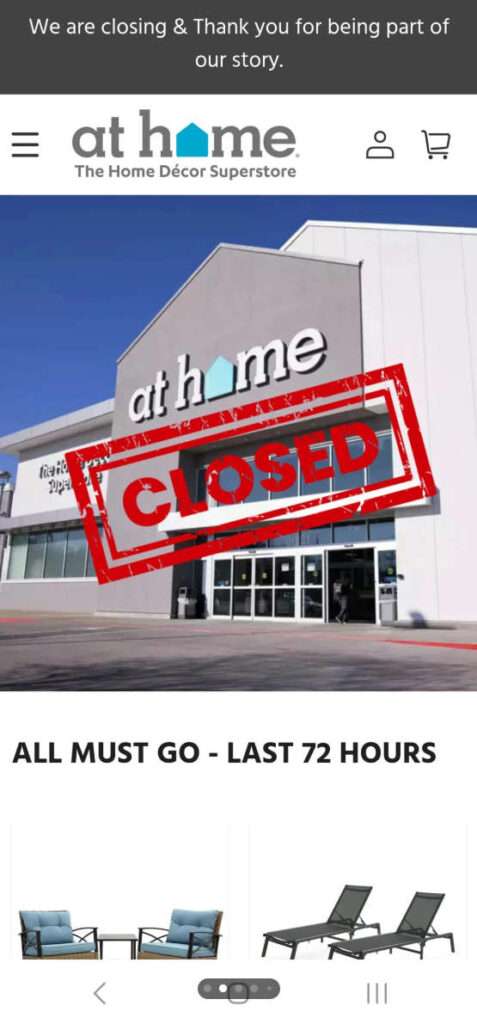
Fake At Home websites look professional, often indistinguishable from the real thing at first glance. These sites:
- Use the real At Home logo and tagline.
- Display high-resolution product photos stolen from the official At Home site.
- Include standard e-commerce features like shopping carts, search bars, and checkout options.
- Use banners that mimic liquidation campaigns: “All Must Go,” “Last 72 Hours,” or “Warehouse Clearance.”
But dig deeper, and the cracks show. Domains like athome-us.com or athome-outlet.shop are not affiliated with At Home. A quick WHOIS lookup reveals they were registered only weeks or days ago.
3. Unrealistic Discounts as the Hook
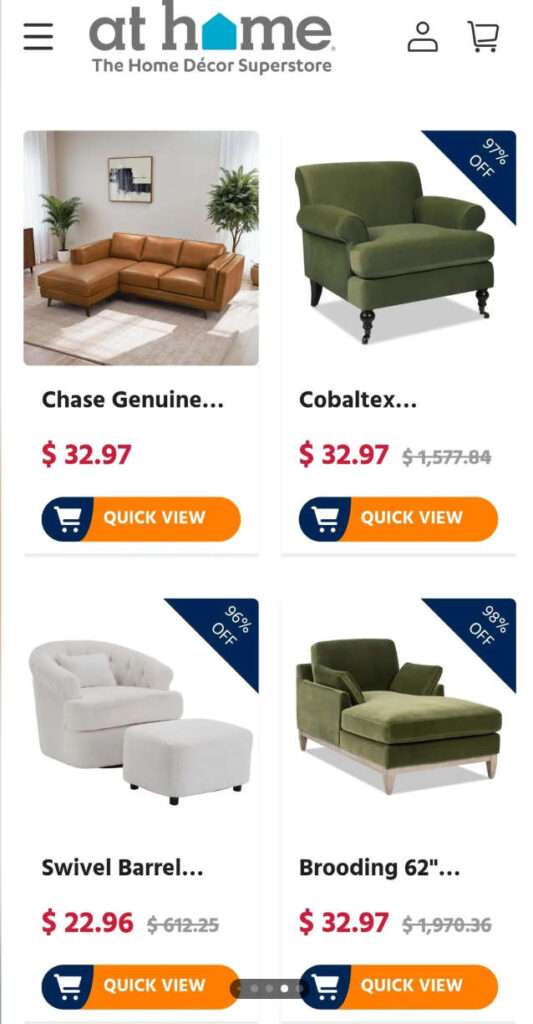
The scam’s main weapon is its too-good-to-be-true pricing. Here are some examples spotted on these fraudulent sites:
- A $1,977 leather sectional sofa for $32.97.
- A $612 armchair for under $25.
- Outdoor patio sets priced at $29.
These “discounts” are designed to short-circuit rational thinking. Shoppers feel like they’ve stumbled onto a once-in-a-lifetime deal, especially when paired with countdown timers or low-stock warnings.
4. Aggressive Social Media Advertising
The scam is spread primarily through Facebook Marketplace, Instagram, and TikTok ads. Victims report seeing ads featuring photos of real At Home stores, sometimes digitally altered with bright yellow “STORE CLOSING” signs.
Because these are paid “sponsored posts,” they appear alongside legitimate ads, giving them a veneer of credibility.
5. Outcomes for Victims
Once payment is made, one of three outcomes usually occurs:
- Nothing ever arrives.
- A random item—like sunglasses or a cheap bracelet—is shipped instead of the purchased furniture.
- A poor-quality knockoff arrives, nowhere near the advertised product.
In every case, contacting “customer service” leads nowhere. Email addresses either go unanswered or generate automatic replies. Phone numbers, if listed, are fake or inactive.
6. The Damage Done
Beyond financial loss, victims often face additional risks:
- Identity theft if sensitive payment details are stolen.
- Repeated charges if card information is saved by the scammer.
- Emotional stress and wasted time trying to get refunds.
This scam has cost consumers hundreds, even thousands of dollars, all while At Home itself deals with the fallout of real store closures.
How The Scam Works
The At Home Store Closing Sale scam is sophisticated, but when broken down step by step, the tactics become clearer.
Step 1: Creating Fake Websites
Scammers register new domain names that resemble the official At Home site. Common tricks include:
- Adding “-us,” “-store,” or “-sale” to the domain (e.g., athome-us.com).
- Using cheap hosting services with recently created registration dates.
- Copy-pasting layouts, product images, and even policy wording from At Home’s real website.
Since these domains are fresh, scam-checking tools might not immediately flag them as fraudulent.
Step 2: Running Aggressive Ads
The scammers pay for sponsored posts on Facebook, Instagram, and TikTok, ensuring their fake sales reach thousands of people. They target demographics likely to shop for home furniture: families, homeowners, and interior décor enthusiasts.
The ads highlight:
- “Warehouse Closing Sale”
- “Everything 90% Off”
- “Store Closing Forever – Last Chance to Save”
Photos of real At Home stores are edited with huge “CLOSING” signs to add credibility.
Step 3: Psychological Triggers
Once you click through, the website uses powerful psychological tricks:
- Scarcity: “Only 3 left in stock” or “Sale ends in 00:05:32.”
- Social Proof: Fake popups showing “Someone in Texas just bought this item.”
- Urgency: “Last 72 hours only.”
These triggers push customers to checkout without taking time to think critically.
Step 4: Collecting Payment
The fake sites usually accept credit cards and sometimes PayPal. Once payment is processed:
- The scammers withdraw the money instantly.
- Victims may get an order confirmation email to make it look official.
- Tracking numbers, if provided, are fake or untraceable.
Step 5: The Aftermath
Victims realize they’ve been scammed only after:
- No order arrives after weeks.
- The “customer service” email is unresponsive.
- They receive a package containing unrelated cheap items.
At this point, the scammers have often already shut down the fake website and launched a new one under a different domain.
What To Do If You Have Fallen Victim
If you suspect you’ve been scammed by the At Home Store Closing Sale scheme, here are the steps you should take immediately:
- Contact Your Bank or Credit Card Company
- Report the fraudulent transaction.
- Request a chargeback or dispute the charge.
- Ask if your card needs to be canceled to prevent further unauthorized charges.
- Check PayPal (If Used)
- If you paid via PayPal, open a dispute under “Item Not Received.”
- Escalate the claim if the seller does not respond.
- Report the Fake Website
- Report the domain to the FTC (Federal Trade Commission).
- Use Google Safe Browsing to flag the site.
- Notify Facebook/Instagram/TikTok that their ad platform is hosting scam ads.
- File a Report with the Better Business Bureau (BBB)
- This helps warn other consumers about the fake site.
- Monitor Your Financial Accounts
- Check for suspicious activity or additional unauthorized charges.
- Enable fraud alerts on your credit accounts.
- Spread Awareness
- Post warnings on social media or community forums.
- Share scam details with friends and family to prevent them from falling victim.
Frequently Asked Questions About the At Home Store Closing Frequently Asked Questions About the At Home Store Closing Sale Scam
1. Is At Home really going out of business?
No, the At Home chain is not going out of business entirely, but the company did file for Chapter 11 bankruptcy in June 2024 and announced the closure of 31 store locations across the U.S. Some of those stores have already closed, while others are scheduled to shutter by late October.
Scammers are taking advantage of this real news to make their fake “At Home Store Closing Sales” look more believable. While some stores are closing, At Home is not running online liquidation sales with 80–90% discounts. The official website remains www.athome.com.
2. What is the At Home Store Closing Sale Scam?
The scam involves fake websites and ads on Facebook, Instagram, and TikTok pretending to be At Home’s official “store closing clearance.” These fraudulent sites:
- Use the At Home logo, branding, and product photos stolen from the real website.
- Offer massive discounts of up to 90% off furniture and home décor.
- Provide only an email address for customer service, with no valid phone number or physical location.
Victims who order from these sites either receive nothing at all or a cheap random item like sunglasses or a bracelet instead of the furniture they paid for.
3. Why are scammers targeting At Home?
Scammers exploit At Home because:
- The brand is well-known and trusted, with physical stores across the U.S.
- Recent news of bankruptcy and store closures makes fake liquidation sales sound more believable.
- Furniture is high-value, so scammers can extract larger payments.
- Social media platforms make it easy to spread sponsored ads that look legitimate.
4. How can I spot a fake At Home website?
Look for these red flags that indicate a scam:
- Recently created domain names (check with WHOIS tools).
- URLs that are not athome.com (examples: athome-us.com, athome-sale.store).
- Unrealistic discounts, such as $1,977 sofas for $32.
- No customer service phone number or fake numbers that don’t work.
- Only a generic email address for support.
- Countdown timers or “Only 1 left” warnings.
- Template design with stolen product photos.
If you see a site with multiple red flags, avoid entering your payment details.
5. How do scammers make the sites look real?
Fraudsters:
- Copy At Home’s product catalog, images, and text.
- Use professional-looking website templates.
- Run sponsored Facebook, Instagram, and TikTok ads with real storefront photos.
- Add fake urgency like “Final Days” or “Warehouse Clearance.”
By mixing real news of store closures with slick design, they trick shoppers into thinking they’ve found a genuine sale.
6. What happens if I order from a fake site?
Most victims report one of three outcomes:
- Nothing arrives at all.
- A random cheap item arrives instead of what was purchased.
- A low-quality knockoff shows up that looks nothing like the product advertised.
Refunds are virtually impossible. Customer service email addresses are fake or unresponsive, and phone numbers, if listed, are disconnected.
7. What should I do if I got scammed by the At Home sale?
Take action immediately:
- Contact your bank or credit card company – Request a chargeback.
- Dispute the charge with PayPal if that’s how you paid.
- Report the site to the FTC (reportfraud.ftc.gov) and BBB Scam Tracker (bbb.org/scamtracker).
- Flag the scam ad on Facebook, Instagram, or TikTok.
- Monitor your accounts for unauthorized charges.
- Consider freezing your credit if you shared sensitive financial details.
8. Can I get my money back?
- Credit cards: Often, yes. File a chargeback as soon as possible.
- PayPal: Disputes can be successful under “Item Not Received.”
- Debit cards, gift cards, or wire transfers: Recovery is much harder, and in many cases, the money is lost.
This is why credit cards are safer for online purchases.
9. Does At Home ever run big sales?
Yes, but not at 90% off. The real At Home does run seasonal clearance events with discounts typically ranging between 20% and 50%. These sales are only available on the official website (athome.com) or in physical stores.
If you see prices that look impossibly low, it’s a scam.
10. How do I verify if a sale is real?
To confirm a legitimate sale:
- Only shop at www.athome.com.
- Call your local At Home store to ask about promotions.
- Check At Home’s official social media pages for sale announcements.
- Avoid clicking links in random ads or unsolicited emails.
11. Where do I report an At Home scam site?
You can report scam websites to:
- FTC: reportfraud.ftc.gov
- BBB Scam Tracker: bbb.org/scamtracker
- Google Safe Browsing: safebrowsing.google.com
- IC3 (FBI’s Internet Crime Complaint Center): ic3.gov
The more reports submitted, the faster scam domains can be flagged and taken down.
12. Why do these scam websites keep popping up?
Scammers constantly create new domains. Once one site is reported or blocked, they register another with a slightly different name. Since domains are cheap and fast to set up, they can stay ahead of takedowns. This is why you’ll see dozens of different “At Home Closing Sale” sites circulating at the same time.
13. What keywords in ads should I watch for?
Scam ads almost always include phrases like:
- “Warehouse Clearance”
- “Everything Must Go”
- “Final Days – 90% Off”
- “Going Out of Business”
- “Outlet Store”
- “Closing Forever”
If you see these combined with luxury furniture priced under $40, it’s a scam.
14. Can scammers steal more than just money?
Yes. By entering your details into a fraudulent site, you may risk:
- Identity theft if personal data is stolen.
- Card information being sold on the dark web.
- Phishing attempts through your email.
Always assume that any information you gave to a scam website may be compromised.
The Bottom Line
The At Home Store Closing Sale scam is one of the most convincing online retail scams because it plays on real-world events. While the company has filed for bankruptcy and closed dozens of stores, it is not running online liquidation sales at 90% off.
If you want to shop At Home safely, stick to athome.com or physical stores. Any other site offering $30 luxury couches is a scam designed to steal your money.
Stay skeptical, double-check URLs, and always remember: if a deal looks too good to be true, it probably is.

Join the discussion
0 commentsShare your experience or ask a question about this article.
Discussion
Start the conversation
Have a question or something useful to share? Add the first comment.