

The voicemail sounds like an easy win: your AT&T or DIRECTV account has supposedly qualified for 50% off, but the discount will disappear unless you call back today.
The savings are bait. What follows is a carefully paced impersonation scheme designed to turn a familiar monthly bill into a payment, account takeover, or identity-theft opportunity.
Overview
The call promises a dramatic bill reduction
Reported messages claim to come from AT&T, AT&T DIRECTV, or an account promotion department. The recipient is told that an existing television, internet, or wireless bill can be cut by 50% for several months or even a full year.
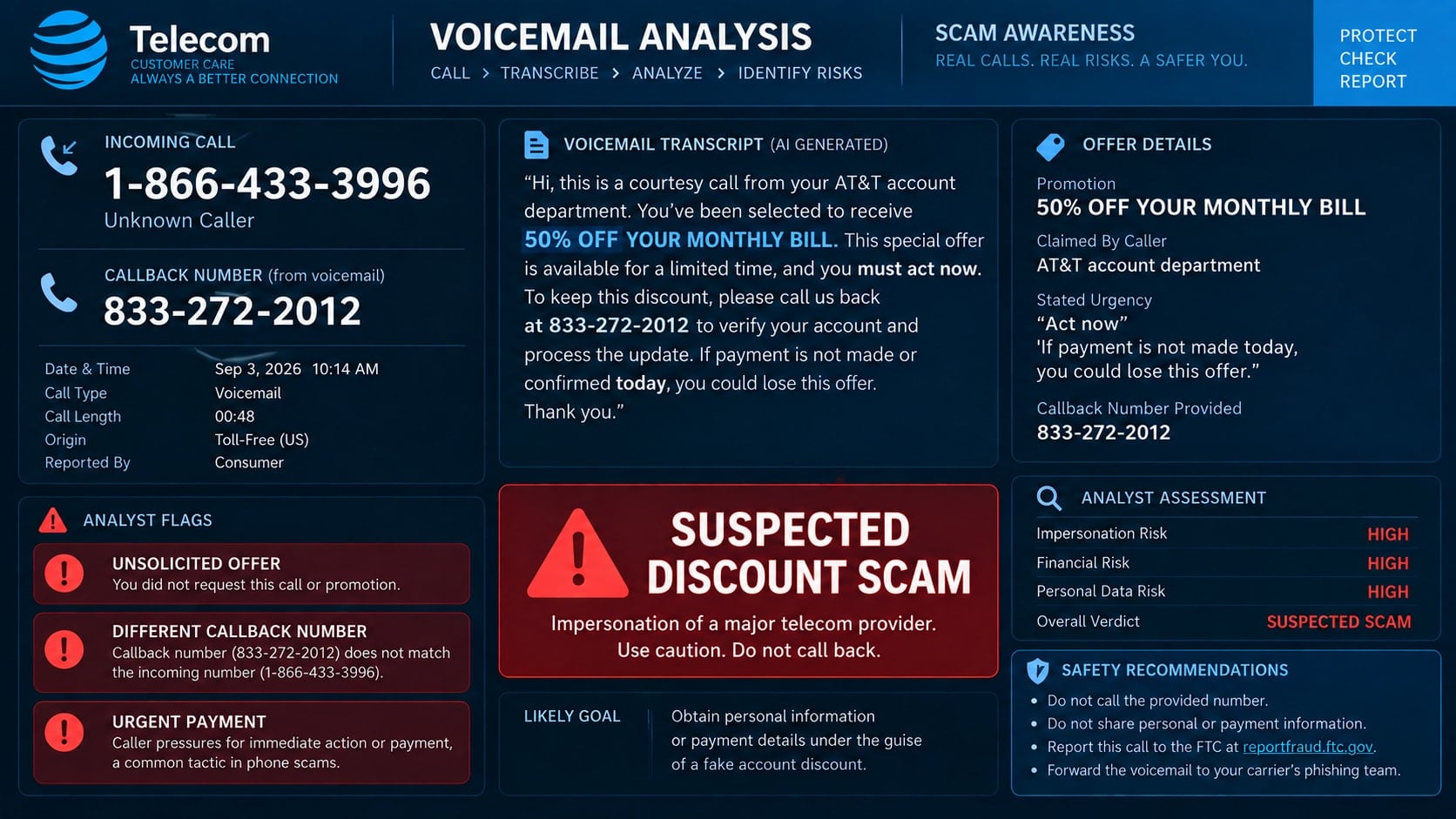
One version arrives from 1-866-433-3996 and instructs the recipient to call 833-272-2012. The numbers are part of the pitch, not proof that the caller represents AT&T.
The fake discount requires verification or advance payment
After the callback, the supposed representative may ask for an AT&T account number, passcode, Social Security number, billing address, or one-time security code. Another variation says the reduced rate must be prepaid before it can be activated.
Gift cards and prepaid cards are common demands because the funds can be redeemed quickly and are difficult to reverse. Scammers may also request a card payment, bank transfer, cryptocurrency, or payment through an unfamiliar portal.
The goal is money, account access, or both
The criminal may simply steal the upfront payment and disappear. With enough account information, however, the same operation can access a real carrier account, order devices, change contact details, redirect a telephone number, or collect information for another fraud.
AT&T warns that imposters may offer discounts or threaten disconnection while requesting gift cards, prepaid cards, cryptocurrency, or money transfers. An unexpected discount call should always be verified through the official app, website, or number on the bill.
- The offer arrives through an unsolicited call, voicemail, or text.
- A 50% discount is available only if you respond immediately.
- The callback number differs from the number that contacted you.
- The agent asks for an account PIN, password, or one-time security code.
- You must prepay months of service to unlock the lower rate.
- Gift cards, cryptocurrency, wire transfers, or payment apps are requested.
Why the AT&T 50% Off Story Is So Effective
Telecommunications bills are familiar, recurring, and often complicated. Many customers already receive legitimate promotional offers, bundle discounts, loyalty credits, and rate changes, so a call about a lower price does not sound impossible.
The 50% figure is large enough to create excitement but not as unbelievable as a completely free plan. A person paying $180 each month may immediately picture saving more than $1,000 in a year.
Scammers also know that households may have several connected services. If the recipient says the call concerns wireless rather than television, the agent can change scripts without admitting a mistake.
A toll-free telephone number adds another layer of credibility. Numbers beginning with 800, 833, 844, 855, 866, 877, or 888 can be obtained by many businesses and individuals. The prefix does not verify the company operating the line.
In some cases, criminals already possess a name, telephone number, provider, or billing address from leaked or commercially available data. Repeating that information creates the illusion that the caller opened your account, even when nothing was authenticated.
How the AT&T 50% Off Scam Works
Step 1: A robocall or voicemail announces the discount
The message congratulates the recipient for qualifying for an account promotion. It may name AT&T, DIRECTV, a loyalty department, or a generic account-services team and claim the monthly bill can be reduced by 50%.
The recording uses a deadline such as “today only” or “before the billing cycle closes.” That urgency is intended to stop the recipient from opening the official app and comparing the offer with real account notices.
Step 2: The recipient is directed to a callback number
The call may display 1-866-433-3996 but tell the recipient to dial 833-272-2012. A different callback route lets the operation separate mass outbound calls from the people trained to handle interested victims.
Calling the number also confirms that the recipient responds to promotions. Even if no payment occurs, the telephone number may receive more impersonation attempts later.
Step 3: A fake representative performs account verification
The agent asks for the name on the account, service address, email, account number, and passcode. The questions resemble legitimate verification but actually supply the information needed to access or socially engineer the real account.
A one-time code is especially sensitive. A criminal may trigger a genuine AT&T password reset while speaking with the victim, then ask for the code under the claim that it activates the discount.
Step 4: The discount suddenly requires an upfront payment
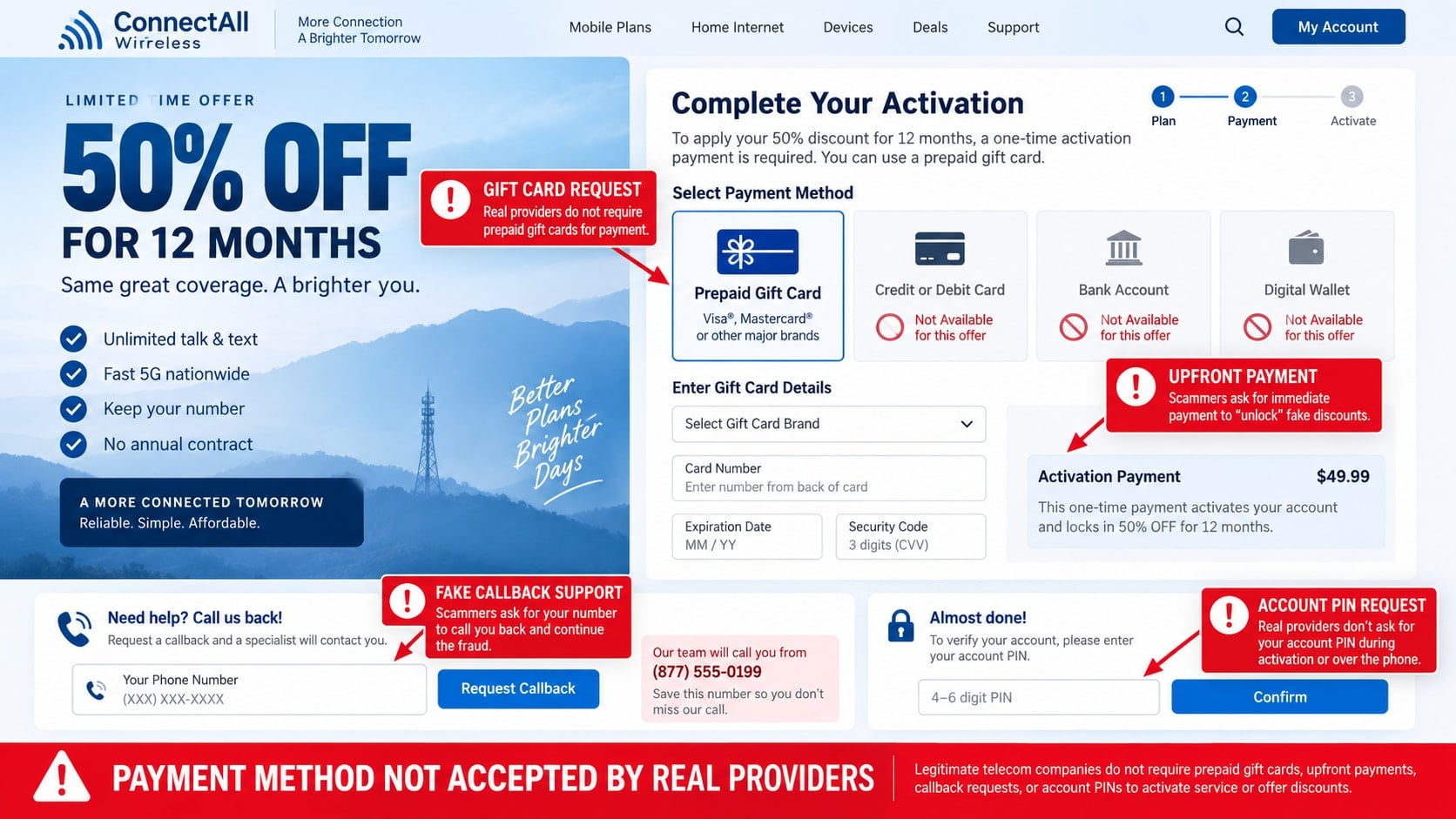
The representative explains that a partner promotion requires prepayment for several months. The victim may be told that paying $300 today will create a much larger credit across future bills.
Some scripts claim a retailer sponsors the deal and therefore payment must be made with a particular gift card. Real telecom providers do not require retail gift cards to activate a service discount.
Step 5: The victim shares redeemable codes or payment details
The scammer stays on the telephone while the victim buys cards, then asks for the number and PIN from the back. Once those codes are disclosed, the criminal can redeem or resell the value without possessing the physical card.
Other victims are sent to a lookalike billing page that records card data, bank credentials, or AT&T login information. A confirmation screen may appear even though the payment went to the fraudster.
Step 6: The operation exploits the account and returns for more
If the scammers captured credentials, they may change the account email, add authorized users, order expensive devices, or attempt a SIM swap. A compromised mobile number can then be used to intercept password-reset messages from other services.
The victim may receive another call claiming that activation failed or a tax remains due. The promised bill credit never appears, but the criminal uses the first payment to justify a second request.
Identity, Contact, and Payment Checks
Check the promotion inside your authenticated account
Open the myAT&T app or type att.com into the browser yourself. Review account notifications, current plan details, billing credits, and available offers without using a link or telephone number from the voicemail.
A genuine promotion should be confirmable through the provider’s official channels. If the offer exists only during an unsolicited call, do not provide information or payment.
Use contact information from the bill or official website
Do not assume 1-866-433-3996 or 833-272-2012 belongs to AT&T because the recording says so. Caller ID can be spoofed, and toll-free numbers are not reserved for well-known companies.
End the call and use the support number printed on your bill, shown inside the official app, or published on att.com. Ask whether the account has a documented outbound offer.
Keep passcodes and one-time codes private
A representative who contacts you unexpectedly should not need your password or a one-time code to give you a discount. Treat any request for a code or PIN as an account-takeover attempt.
If a genuine security code arrives while you are speaking with the caller, read the entire message. It commonly states that the code must not be shared, including with someone claiming to be support.
Reject unusual payment instructions
Do not purchase gift cards, transfer cryptocurrency, wire money, or pay through an unknown site to activate a rate reduction. AT&T specifically warns about imposters who combine discounts with prepaid payment requests.
Even an ordinary card payment should be made only inside the authenticated account or through a telephone number independently verified as official. The scammer should never choose the payment route.
What to Do if You Receive One of These Calls
Let an unknown call go to voicemail when practical. A recording preserves the numbers and wording without giving the operator an opportunity to apply live pressure.
Do not call 833-272-2012 or another number supplied in a discount message. Open the official account separately and check whether any promotion, balance, or service warning appears.
Block the number after preserving evidence, but remember that criminals can rotate or spoof caller IDs. Carrier-level spam filtering and built-in call screening can reduce future interruptions, though neither catches every campaign.
Forward suspicious text messages to 7726 when supported by your U.S. carrier. AT&T also provides official channels for reporting fraud and suspicious messages through its support site.
If the caller knew accurate account details, change the account password and PIN even if you did not pay. The information may have come from a previous breach or unauthorized account access.
What to Do if You Have Fallen Victim to This Scam
- End contact and stop additional payments. Do not buy another gift card or pay a supposed activation, cancellation, refund, or tax fee. A second payment will not recover the first.
- Contact AT&T through an official route. Use the myAT&T app, att.com, or the number on your bill. Report the impersonation and ask the fraud team to review login history, orders, profile changes, authorized users, and SIM activity.
- Change your password and account PIN. Use a trusted device, choose credentials not used elsewhere, sign out unfamiliar sessions, and enable every available multi-factor security feature.
- Call the gift-card company immediately. Use the number printed on the card or official issuer website. Report the scam, provide the receipt and codes, and ask whether unused funds can be frozen.
- Notify your bank or card issuer. Report any card, bank, or payment-app transaction connected to the fake discount. Ask about stopping pending payments, replacing exposed cards, and opening a fraud claim.
- Secure your email and mobile number. Email often controls password resets, while the telephone number receives verification codes. Change the email password, review forwarding rules, and ask the carrier about port-out or SIM-swap protection.
- Scan devices used with scam links. Run a full Malwarebytes scan if you downloaded a file, installed a support tool, or entered information on an unknown page. Remove unfamiliar remote-access software and browser extensions.
- Add web protection. AdGuard can block many reported phishing domains and intrusive redirects, although it cannot determine whether a telephone representative is genuine. Keep software updated and continue verifying offers independently.
- Report the incident. File at ReportFraud.ftc.gov and include 1-866-433-3996, 833-272-2012, the promised 50% discount, requested payment method, and actual loss.
- Watch for related fraud. Monitor carrier, email, bank, and credit accounts. If sensitive identity data was exposed, use IdentityTheft.gov and consider fraud alerts or credit freezes.
Could a Real AT&T Discount Ever Be Offered by Phone?
Companies can contact customers about legitimate promotions, so the word “discount” alone does not prove fraud. The important question is whether the offer can survive independent verification.
A real promotion should appear in the authenticated account or be confirmable through an official support channel. You should not have to trust the caller’s number, reveal a password, or read back a security code.
Normal billing methods remain normal. A genuine provider does not require gift cards, cryptocurrency, or a secret transfer to lower a monthly rate.
Be cautious when an agent insists that the offer disappears if you disconnect. A legitimate company can document the promotion, while a scammer needs to keep control of the conversation.
If the price sounds attractive, write down the claimed plan details and end the call. Contact AT&T independently and ask whether the same offer is available for your account.
Frequently Asked Questions
Are AT&T 50% off calls from 1-866-433-3996 legitimate?
Do not trust the call based on that number. Reported messages use it to advertise a 50% discount and direct recipients to another number. Verify any offer inside your official account.
Is 833-272-2012 an official AT&T callback number?
Do not use it as a verified support number merely because a voicemail provides it. Reach AT&T through the number on your bill, the myAT&T app, or att.com.
Why do scammers ask for gift cards to activate a discount?
Gift-card codes transfer value quickly and are difficult to reverse. Real telecom providers do not require retail gift cards as payment for account promotions.
What if the caller already knows my AT&T account information?
Known details may come from public data, a breach, or prior account access. End the call, change the account password and PIN, and ask AT&T to review recent activity.
Can I safely call the number just to investigate?
No. Calling confirms that your line reaches a responsive person and gives the operator an opportunity to manipulate you. Report the message and use official channels instead.
Will AT&T ever ask for my one-time verification code?
Treat an unexpected caller’s request for a one-time code as a scam. Security codes can allow criminals to reset credentials or enter an account, and they should remain private.
The Bottom Line
AT&T 50% off scam calls turn the promise of a smaller monthly bill into pressure to call an unverified number, disclose account credentials, or make an irreversible advance payment.
Do not call 833-272-2012 because a recording tells you to. Open your real account, contact AT&T through an independently verified channel, and reject any discount that requires gift cards, codes, or secrecy.

Join the discussion
0 commentsShare your experience or ask a question about this article.
Discussion
Start the conversation
Have a question or something useful to share? Add the first comment.