


You open your bank app and a withdrawal looks wrong. You still have your card, and you have not been to a branch lately.
Figuring out how the bank processed that withdrawal is more useful than guessing who knows your password.
Overview
The Maine case involved people posing as actual account holders
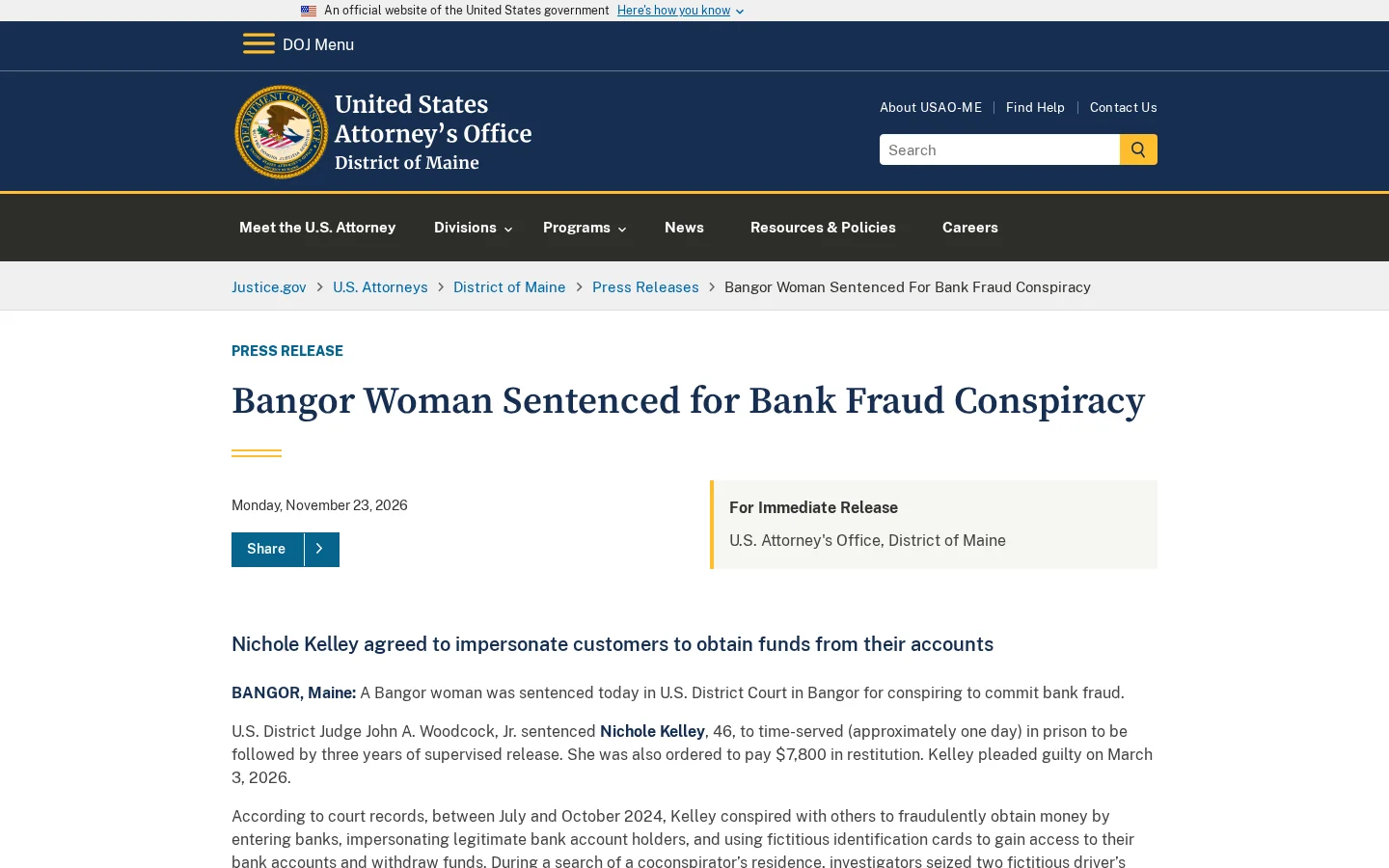
Federal prosecutors say Nichole Kelley and others conspired to enter banks, impersonate customers and take money from their accounts. The case concerns in-person withdrawals, not a stolen bank app login.
The District of Maine sentencing announcement describes fictitious driver’s licenses. Investigators found two with other people’s names and Kelley’s photographs at a co-conspirator’s residence.
Those findings do not explain how every account holder’s details were first obtained. Changing your password can be appropriate, but it does not resolve an already disputed branch withdrawal.
The sentence was for participating in a bank fraud conspiracy
Kelley pleaded guilty on March 3, 2026. The court sentenced her on November 23 to time served, approximately one day, and three years of supervised release.
She was also ordered to pay $7,800 in restitution. Seven defendants were charged in the investigation; that does not make the outcome the same for all of them.
Another defendant, Darren Deorsey, was sentenced to 13 months in June. The announcement reported that two other defendants were still awaiting sentencing at the time.
Start with the transaction the bank can actually identify
- Check whether the debit is a branch withdrawal, cash machine transaction, transfer or card payment.
- Ask the bank to document the channel and location it has on record.
- Dispute the withdrawal even if you still have the card or the original identification.
- Address wider identity misuse if you see indications beyond the disputed debit.
A short description on your statement may be too vague to answer where the money went. Ask the institution for its own record before building a theory about the incident.
How the Bank Branch Impersonation Scam Worked
Step 1: The intended victim already had an account
In this case, other people’s identities were used to pose as bank customers. Prosecutors said the conspiracy operated from July through October 2024.
Tell the bank whether you found a new account you never opened or money missing from an existing one. They need different responses even when both involve impersonation.
Read the debit in relation to your ordinary activity that day. Check your own movements and any authorized appointments before you call, but do not delay reporting while collecting proof.
For a joint account, ask whether the bank records the transaction under a person authorized on it. That information is more useful than assuming all unexpected spending is impersonation.
Step 2: An impersonator presented identification at a branch
According to court records cited by prosecutors, members of the conspiracy used fictitious identity cards to obtain money at banks. They were not merely passing around a copied email.
A forged identity document is a reason to ask the bank which verification it can review. Do not try to obtain private branch surveillance yourself or confront a suspected customer.
The branch record might include a transaction identifier or the time recorded for a withdrawal. Preserve your own statement so that customer support can locate the same debit.
If you still have your identification, say so. Let the investigator know about any prior loss, replacement or alerts without presenting one possible cause as a fact.
Step 3: An unfamiliar withdrawal appeared as bank activity
A branch withdrawal may not carry the name of a business. If the statement label is unclear, ask the bank what kind of transaction it recorded.
The case announcement also says Kelley agreed to travel to impersonate customers outside Maine. You should not assume every branch entry is local to the account’s original opening location.
Give the bank the date it posted and the date it says the withdrawal occurred if those differ. Ask which one it wants on the dispute form.
A bank may have records you cannot view in the app. Ask its fraud team to preserve those records while it reviews your claim.
Step 4: Your next actions depend on what else was affected
A disputed withdrawal does not establish that someone opened a credit account. Look for other unfamiliar activity while you continue pursuing the money that is missing.
Ask the bank whether it also recorded a change to contact details, named users or access settings. A change made separately from the withdrawal could require its own correction.
Take stock of cards, passwords and the documents you actually shared. Fix the exposures that apply instead of assuming a replacement card covers every form of impersonation.
Keep the bank’s response in writing. If its answer identifies a different transaction type, ask which dispute procedure applies and what information it considers missing.
How to Read an Unfamiliar Withdrawal Before You Dispute It
Locate the posting and compare it with the bank’s description
Sign in to your own account through the official app or a saved bookmark. Open the account activity and select the line containing the amount you do not recognize.
Record the amount, available location information and all displayed dates. Download the statement when it is available, because a transaction description can look different after posting.
Call the bank through the number on its site or an existing statement. Ask whether the transaction was performed at a branch, electronically, at an ATM or through another channel.
If you see only a pending debit, ask when the bank can open a claim. Tell it about the suspected misuse before the amount settles.
Ask whether the transaction ID, branch name or terminal identifier is available. You need only enough detail to confirm that you and the fraud team are discussing the same debit.
If the branch location surprises you, preserve that answer in your notes. Do not travel there to interview staff independently before the bank has reviewed the record.
Save the balance before and after the withdrawal if available. If the missing funds caused fees or missed payments, record those separately for the bank.
Separate an identity problem from a missing debit card
A card lock may help when the card is at risk. It does not tell you whether the same person can still present themselves to the bank as you.
Explain that your concern is someone using your identity at the institution. Ask whether it offers additional in-branch verification or a fraud note and what that measure actually does.
If the bank offers a new account or other restriction, ask how existing deposits and scheduled bills will be handled. Get the transition steps before moving money or closing anything.
Identify the bills that will come due first. Ask what happens to an expected paycheck or automatic payment if the bank changes the account number while investigating.
Keep notes about who is allowed to authorize future transactions. If you already use a joint account or an agent, ask what the proposed restriction changes for each authorized person.
If the bank requests a visit, confirm which identification to bring and whom to ask for. Do not send document photos to an unsolicited contact.
Check for other signs that someone used your identity
Look for messages about a changed phone number or address, new financial products or emails about accounts you did not open. Save those messages without following unfamiliar links.
For identity misuse in the United States, open IdentityTheft.gov directly and start the reporting process. Identify what was misused and follow the recovery plan for those facts.
A credit freeze can make some new credit harder to open. It does not reverse a withdrawal from an account you already have, so continue the bank claim separately.
Make a separate entry for any new account opened with your information. Record the financial institution that identifies it, the dates and the report reference you receive.
Keep watching the existing account while the dispute proceeds. Ask whether the bank offers alerts for large transactions or changes to your contact information.
When a notice reaches you unexpectedly, sign in from your known app or site to confirm whether anything changed. Do not call the number appearing only inside the notice.
For mail about an unfamiliar account, preserve the letter and envelope while checking the institution independently. The sender’s branding should not decide where you send a copy of identification.
When the Bank’s First Answer Does Not Match Your Evidence
Look at the issue described in the bank’s reply. It may say the card was present while your actual complaint concerns money removed at a teller window.
Ask the fraud team to correct the recorded claim type if it is wrong. Give the earlier reference and clarify which facts are yours and which the bank supplied.
If you cannot resolve a U.S. bank account complaint with the institution, open the CFPB’s complaint site and choose the checking or savings account category.
Identify the bank, describe the transaction and any missing funds, and attach copies of the original decision and statement. Save the receipt from the complaint portal.
If the bank sends a new decision, compare it with the question you asked in writing. A regulatory complaint does not guarantee an outcome or replace the original dispute.
What to Do If You Find a Withdrawal You Did Not Make
-
Call your bank promptly and identify the exact withdrawal. Use a verified number and explain you did not make or authorize the transaction.
Ask the bank to record an unauthorized activity report and confirm what evidence it needs. Ask for the case number, next steps and any deadline that applies.
If it lists the activity as a cash withdrawal, ask what channel it used. A disputed teller transaction and a lost-card case should not be confused.
-
Write down what supports your account of the transaction. Keep the statement, dates, reference number and any messages about changes to security or contact details.
If you were elsewhere and can document that, preserve the relevant record. Do not use a pile of unrelated personal documents to substitute for a clear timeline.
Put the report in writing if the bank asks for it. Keep a copy of the completed form, attachments and the date you submitted them.
-
Protect other access without moving funds to a stranger. Update account credentials and look for unfamiliar devices if you have reason to suspect digital access too.
Ask the bank whether it recommends changing account identifiers or restricting transactions. If someone calls telling you to move money to safety, hang up and verify independently.
Check that the bank has your current contact information. Ask how it will contact you during the investigation and go back to its main number if a call seems wrong.
-
Report wider identity misuse through the official recovery service. If you find evidence someone is using your details, create a report at IdentityTheft.gov and retain it.
Follow the plan for each affected business separately. For an existing account, use the bank claim rather than assuming an identity report will automatically repay the money.
If you file a police report, save its reference with the bank claim. Share only the paperwork required through the official process and keep your originals.
-
Ask for the bank’s reasons if it denies the claim. Request a written explanation and ask what it relied on to determine the withdrawal was legitimate.
Point out exact errors instead of opening several identical claims. If you need to escalate, ask for the institution’s formal complaints process and keep the original case number.
State precisely how the withdrawal differs from anything you authorized. Refuse any paid recovery offer from a caller promising to undo the debit.
Frequently Asked Questions
Can someone take money even if I still have my original driver’s license?
Possessing your original document does not rule out impersonation. Investigators in the Maine case found fictitious identification carrying other people’s names.
Does this case prove a password was stolen?
The sentencing announcement describes impersonation at banks with fictitious identification. It does not establish how every victim’s information was first obtained or that a password was used.
What should I say if the bank asks whether I lost my card?
Answer honestly and ask it to identify the transaction channel. A card you still hold can coexist with a branch withdrawal you never authorized.
Will a credit freeze stop someone from withdrawing from my current account?
Do not use a freeze in place of contacting the bank. It addresses access to your credit report, not the status of an existing withdrawal.
Did everyone charged in the Maine case receive the same sentence?
The announcement states different outcomes for Kelley and Deorsey and notes that other defendants were awaiting sentencing. It does not assign the same result to everyone charged.
Can a report to the bank guarantee I get my money back?
Reporting starts the investigation; it does not decide the outcome. Keep the reference and ask for the procedure that applies to your actual transaction.
The Bottom Line
Dispute an unexplained branch withdrawal even if your card and identification never left your possession. Ask the bank to identify the transaction rather than guessing how the money was taken.
If you see other misuse, start a separate identity-theft recovery record. Keep the bank’s claim active and refuse unsolicited offers to move or recover your money.

Join the discussion
0 commentsShare your experience or ask a question about this article.
Community experiences
Did this happen to you?
Your experience could help someone recognize the same scam. Submit a private report for our team to review.
I experienced this tooReports are reviewed before publication. Sharing publicly is always your choice.
Discussion
Start the conversation
Have a question or something useful to share? Add the first comment.