


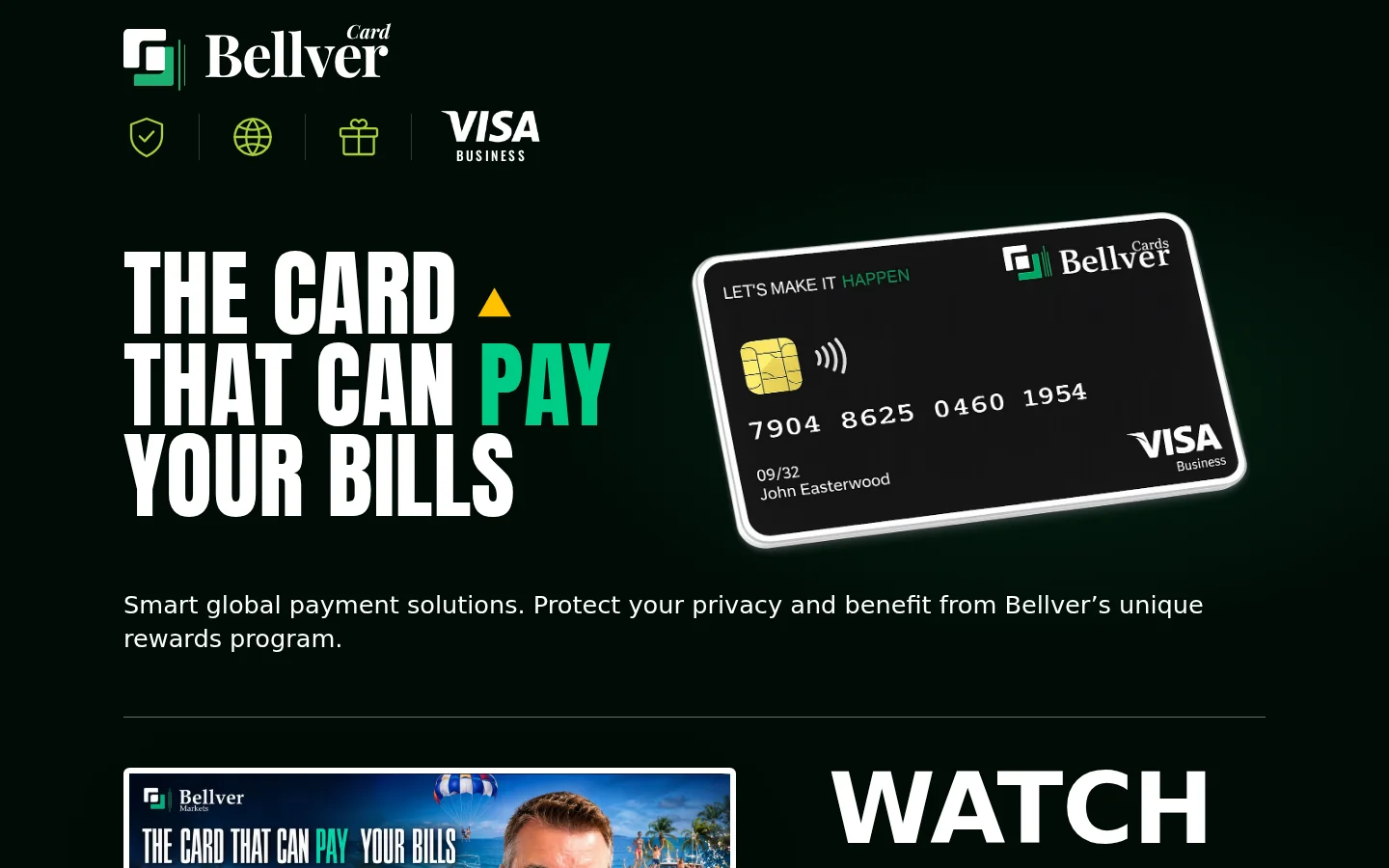
The BellverCard promotion starts with a promise about paying your bills. It shows a familiar payment logo alongside a card that looks ready to use.
That picture tells you what the card is supposed to look like. It leaves a more important question unanswered when you are about to pay for one.
Overview
There is a card offer and a referral offer
BellverCard’s own landing page shows physical or virtual cards and four versions, Basic through Gold. It highlights maximum spending limits and links the pitch to rewards.
A separately labeled independent promotion lists prices from $99 to $990. It presents direct commissions for referring a purchaser and further rewards tied to cardholder activity.
Those are two different reasons to pay. Someone who needs a payment card needs reliable access to their balance, even if they never invite another person.
The logo does not tell you who owes you the balance
The main promotion displays Visa Business branding. The independent page advertises Visa or Mastercard, but does not name the financial institution issuing the card in each market.
That is not a finding that no card exists. It means the images and promoter’s offer do not establish who would be responsible for the card you receive.
Keep the names straight before you authorize payment. The contract may describe more than one business, each responsible for a different part of the transaction.
- The promoter may receive a commission and can explain the offer. Their promise is not the same as a commitment by a bank.
- The merchant takes your purchase payment or sells the card package. Find its legal name and refund terms before authorizing the charge.
- The issuer is the party that can explain the actual card agreement, who holds loaded funds and how a disputed transaction is handled.
The company pages do not supply one clear identity
The current card page names Bellver Markets Ltd and gives an address in St Julian’s, Malta. The Bellver Markets finance site names Bellver Markets LLC in Tbilisi, Georgia.
The Georgia site displays a company number and describes itself as licensed. It does not explain on that page how the Malta entity relates to a particular card balance.
Either name could mean something different in a real program. The problem is relying on them as interchangeable without a cardholder agreement that tells you who does what.
How the BellverCard Offer Is Presented
Step 1: The headline sells the most generous limit
The card page advertises up to $250,000 per day and $20,000 per transaction. The independent promotion assigns both of those maximums to the $990 Gold tier.
The same offer gives Basic a $1,000 daily limit and a $500 transaction limit. The $99 fee does not buy the limits shown in the headline.
A spending limit is a ceiling, not a balance, a credit line or a promise that your transaction will go through. The applicable agreement determines the real restrictions.
If you are comparing cards, ask for the limit of the specific version in your country. Do not compare one program’s cheapest price with its most expensive tier’s allowance.
Step 2: More expensive tiers can pay the recruiter more
The independent promotion lists $10 for a qualifying Basic referral and $400 for a Gold referral. It also lists $100 for Premium and $200 for Business.
That matters when someone says to skip the entry version. Selling you a higher tier can earn them more, whether or not its extra capacity helps you.
The same page describes separate group rewards tied to cardholder spending. It says those earnings depend on others joining and spending, and are not guaranteed.
Do not treat those rewards as ordinary cash back on your own spending. Ask what activity earns the payment and what happens if your referrals never use their cards.
Step 3: The privacy upgrade adds another purchase decision
The card site advertises a Special Edition with extra privacy. The independent promotion describes it as a $370 add-on rather than one of the four ordinary card tiers.
On those advertised figures, Gold with that option would be $1,360 before a balance load or any other applicable charges. Those numbers were not verified through a paid checkout.
Privacy is not a precise term by itself. Ask what data the add-on changes, whose records are kept and whether it affects the way you recover an account.
Do not hand over identity documents on the strength of a privacy slogan. Find out who is collecting the documents and get their actual privacy policy first.
Step 4: Buying the package is not the same as loading the card
The independent page describes several funding methods, including stablecoins. Whatever method you choose, distinguish the initial package price from the amount you are trying to make available for purchases.
A refund on the package and redemption of unused balance are separate issues. The business that sold the package may not be the entity that holds your loaded funds.
Check currency conversion, idle-balance fees and withdrawal rules before sending money. A spend-anywhere claim does not explain what happens if the service declines a payment or closes an account.

Which Company Would Handle Your Card and Your Money?
Start with the issuer named in the cardholder agreement
Visa’s consumer support guidance directs account questions and disputed charges to the issuer or bank. A logo helps identify a network but cannot answer that question for BellverCard.
Ask for the issuer’s full legal name, the program and the country it covers. Confirm directly with the issuer that the named program is available to you.
There may be an intermediary that sells the package and a separate company that issues it. The written agreement should make clear which one can block the card.
The Malta and Georgia listings do not answer the same question
If a promoter says the Malta name issues the card, check it through the Malta financial services register. An address by itself is not a matching authorization.
If the offer points you to a Georgia entity, start with the National Bank of Georgia’s payment provider information and follow its provider list.
In either register, a similarly named business is not enough. Compare the full legal name, registration details and the exact scope. Ask the regulator if you cannot reconcile them.
A referral contact is not the place to send account secrets
The independent promotion invites readers to message its promoter. A chat can explain an advertised tier, but it is not proof of authority to reset a card account.
If you ordered, use the original purchase confirmation and look for a verified complaints channel. Do not forward a card number, security code or identification document through a referral chat.
If someone asks for more money so support can look at your case, keep the message. Confirm the fee and who is charging it before taking any action.
Ask how a balance is held and how it can be returned
Before funding a payment product, ask in writing which company holds the balance and whether it is held in your own name or in another arrangement.
Ask how to close the account, how unused funds would be returned and whether the currency changes. Those details are usually more useful than the largest spending limit.
No card was bought, funded or tested for this article. The available public material shows the sales claims, not an issued card, a tested payment or a successful refund.
Which Record Do You Need If Something Goes Wrong?
Start with the exact payment that caused the problem. A statement showing the package fee may not show a later transfer or stablecoin deposit.
If the issue is that the card never arrived, save the order confirmation, delivery promise and any cancellation. Identify that charge instead of disputing every related transfer as one payment.
If the card arrived but the balance is unavailable, record the amount you loaded, the last known balance and the exact error. Explain whether spending or withdrawal stopped working.
If you sent stablecoins from an exchange, save the transaction hash and the destination listed in the exchange. The site’s balance display cannot replace those records.
A card-provider dispute and a request to trace a stablecoin transfer are not the same procedure. Tell your original payment provider exactly what you paid for and how.
Have a separate record of any reward you were promised. Do not include promised referral commissions in the amount you say went missing from the card balance.
What to Do If You Ordered or Loaded a BellverCard
- Pause all top-ups until you know who holds the balance. Keep the opening offer and any invoice without passing the referral link to anyone else.
- Separate the package from any balance load. Record the merchant, payment method and transaction reference for each charge. List fees and extras on separate lines.
- Ask the identified merchant for the cardholder agreement. Get the actual issuer, available account balance, complaint route and the process for closing or redeeming it.
- Contact the bank or payment provider you actually used. Explain whether you have a non-delivery dispute, an unauthorized charge or a transfer to be traced.
- Keep a copy of your dispute and its reference. Ask what records are needed and which deadline applies. Request any decision or denial in writing.
- Decline recovery offers that want another payment first. Keep a private copy of the request. Use the original payment provider or an independently verified authority instead.
What to Ask for Before Sending Money or Identification
Get the final price for the tier you are actually considering. A promise to upgrade later does not explain what a new package would cost or replace.
Ask whether the purchase amount is an issuance charge, an initial balance or a mixture of both. The independent page describes price and loading as distinct steps.
If a promoter says a transfer covers two purposes, request the split in writing. Ask which part would be returned if the card could not be issued.
Ask which payment instruments the identified issuer actually supports in your country. A promoter listing several funding methods does not establish that each one applies to every account.
The independent promotional page also advertises up to $1,200 at ATMs where supported. That is a different limit from purchases, and local machine rules can further restrict it.
Ask whether the withdrawal is in your balance currency or converted at the machine. A high advertised purchase limit will not tell you the final cost of accessing cash.
If the card is sold as virtual, ask who provides access to it after your account is set up. A referral dashboard is not necessarily the issuer’s account portal.
If the program offers a physical card, ask when the card is dispatched, how delivery is tracked and what happens if your country is ineligible after payment.
You should also know where a lost-card report goes. If the support contact cannot identify the issuing institution, it is hard to know who can block transactions.
For a privacy upgrade, ask for the policy that applies to the applicant, not just a slogan about discretion. Identify which company would keep your documents.
Do not test whether a card works by moving enough money to cover a major bill. Make the purchase decision from the agreement and independently confirmed issuer, not a demonstration.
If you already shared identity records through a chat, preserve the recipient and date. Report the exposure through appropriate official channels if the recipient cannot be verified.
A promoter may be able to answer product questions quickly. An answer about fees or account protection still needs to match the terms of the party that provides the service.
Frequently Asked Questions
Does Visa issue the BellverCard shown in the promotion?
A Visa logo on a graphic does not identify the issuer. Ask for the cardholder agreement and verify the bank or institution named for your country.
Does the $99 Basic card have a $250,000 spending limit?
The independent promotion assigns that daily maximum to Gold, not Basic. The actual limits would have to be confirmed in the terms that apply to your card.
Do referral rewards pay my bills automatically?
The promoter describes commissions and activity-based rewards, not automatic bill payments or guaranteed earnings. Do not buy a higher tier to cover household expenses.
Does the $370 option mean no identity check is required?
The price refers to a privacy add-on on the independent page. It does not establish what identity checks a card issuer would require.
Is the Georgia company number the card program’s authorization?
The finance site’s company number is not the cardholder agreement. Check the issuer and scope of authorization rather than relying on a number displayed beside the brand.
Can I get the package fee and my loaded funds back together?
Do not assume a single request covers both. Use the purchase receipt for the package and separate loading records for anything held as a balance.
The Bottom Line
Do not buy or load a BellverCard based on the payment logo, high limits or referral earnings. The offer needs to identify who issues the card and holds your money.
If you already paid, separate the initial fee from what you loaded. Use those receipts to contact the actual payment provider and ask what can be disputed or recovered.

Join the discussion
0 commentsShare your experience or ask a question about this article.
Community experiences
Did this happen to you?
Your experience could help someone recognize the same scam. Submit a private report for our team to review.
I experienced this tooReports are reviewed before publication. Sharing publicly is always your choice.
Discussion
Start the conversation
Have a question or something useful to share? Add the first comment.